

Kawasaki KX327 two-strokes
Full deep dive on Team Green’s ring-ding return
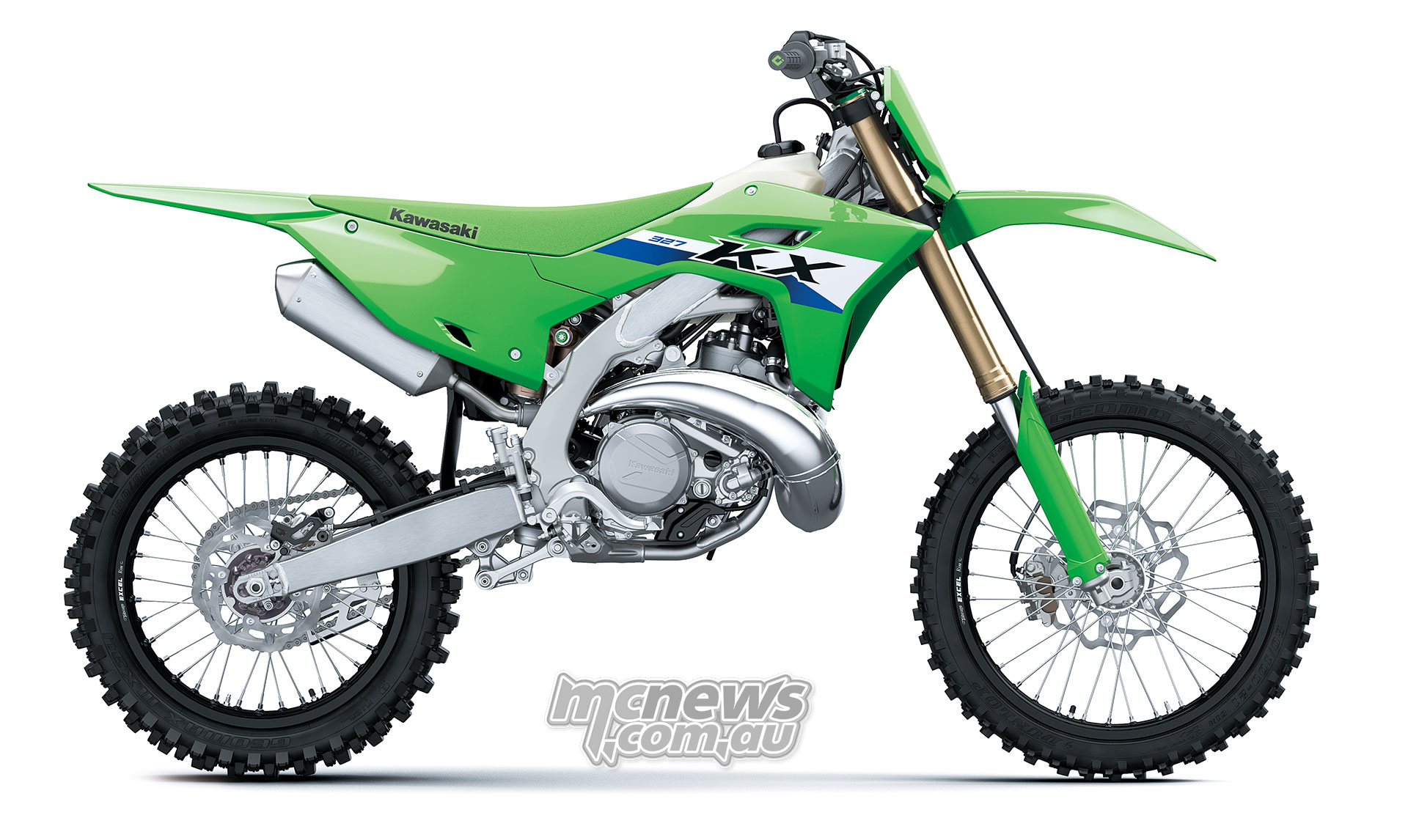
Kawasaki is back in the big-bore two-stroke game, with Team Green confirming a new KX327 motocrosser and KX327X cross-country variant built around a fresh 327 cc fuel-injected two-stroke single.
When the CGI mock-ups and rumours started swirling through the murky depths of the internerd in recent weeks, we were left wondering whether this was simply another take on the almost monthly clickbait tripe declaring Honda was about to bring back the CR500, or whether those mad boys, and girls, that brought supercharged litre-class sportsbikes into the mainstream were genuinely about to take us back to the future with two-strokes.

The answer was made clear overnight when the official drop landed. Yes indeed, Kawasaki is going to ring-ding in the new year with a motocross-focused KX327 and a more cross-country/enduro flavoured variant dubbed the KX327X.
And, even allowing for the fact that the first images Kawasaki has supplied appear to be CGI renders rather than actual shots of bikes in the metal, there is no getting away from how good these things look. Slim, sharp, angry, green and properly purposeful, they have that clean modern KX aggression with just enough expansion-chamber theatre to make two-stroke tragics weak at the knees.

Kawasaki has told MCNews.com.au that Australian arrivals are expected in the first quarter of 2027. Pricing is still to be confirmed.
A new Japanese big-bore two-stroke
Both models are powered by a completely new 327 cc liquid-cooled, fuel-injected, single-cylinder two-stroke engine. Kawasaki says it is the first new two-stroke machine over 250 cc that it has designed in more than 20 years, which makes this a properly significant moment for those of us who thought the Japanese factories had largely left this part of the market to the Europeans.
Of the Japanese Big Four, only Yamaha had kept those sweet-smelling wisps of two-stroke smoke drifting through the bush in recent years, continuing with the YZ125 and YZ250 nameplates while the others left the ring-ding faithful to stare wistfully at old classifieds. Kawasaki, however, has returned with a very different approach, going straight to fuel injection rather than carburettors.

The new engine uses crankcase reed-valve induction and a 39 mm fuel-injection system. Kawasaki says that brings stable fuel delivery regardless of changes in outside air temperature or atmospheric pressure, removing the old jetting dance that used to be part of two-stroke ownership.
Pre-mix lubrication remains, at a listed 32:1 ratio, so there is still some old-school ritual involved before a ride. For many two-stroke tragics, that will be part of the appeal.
Exhaust valve promises smoother drive
A newly developed exhaust valve system is fitted to the main and sub exhaust ports. Kawasaki says the system continuously adjusts exhaust port timing, working with the fuel and ignition mapping to smooth out the peaky character traditionally associated with old-school two-strokes.
The aim is a flatter, more controllable spread of drive from ultra-low rpm through to the top end. That should equate to traction, and as anyone who has spent time on the latest Austrian two-strokes will tell you, when the mapping, exhaust valve and chassis package are right, a modern smoker can crawl up things that make the latest and greatest four-strokes feel like hard work.
Have Kawasaki equalled the Austrians on that score? For those answers, we have to wait until we get a KX327X out in the wild and smoking. However, we are very glad Kawasaki has come forth to ask the question.
KX450 bones, two-stroke heart
The chassis is based on Kawasaki’s race-proven KX aluminium perimeter frame, derived from the KX450 motocrosser. Kawasaki says the frame balances light, agile handling with straight-line composure and a planted front-end feel.
The company also says the lower pipe layout and rigidity balance were optimised with cross-country riding in mind, which suggests the KX327X has not simply had an extra gear and a side stand thrown at it as an afterthought.
Suspension is handled by a factory-style 48 mm inverted AOS coil-spring fork with adjustable compression and rebound damping, matched to New Uni-Trak rear suspension with adjustable dual-range high/low-speed compression damping, rebound damping and preload.
Braking hardware comprises Nissin calipers and master cylinders, with a 270 mm petal disc up front and a 240 mm petal disc at the rear.
Kawasaki also claims that the simple two-stroke engine design helps achieve a weight comparable to that of a 250 cc-class four-stroke, although official weight figures are still to be confirmed.
KX327X takes aim at the bush
The KX327X is the cross-country focussed version of the pair. It runs a six-speed transmission with an ultra-low first gear designed for tight technical sections, rough terrain and obstacle work. Kawasaki says first gear has also been optimised to help front-wheel lift when picking through ugly terrain.

A hydraulic clutch is standard on the KX327X, with Kawasaki claiming lighter lever action and a more consistent feel during heavy use in tight technical sections. That could prove important for anyone who intends to spend weekends feathering the clutch through rocks, roots, gullies and other forms of self-inflicted fun.
The X model also scores a 21-inch front and 18-inch rear wheel combination, hand guards, skid plate, linkage guard, rear brake disc guard, side stand and a semi-transparent 8.6-litre fuel tank. Two power modes are selectable via a switch on the left handlebar.
We will have to wait until we get out in the wild and smokin’ on the new KX327X to see whether it can match the mountain-goat, crawl-up-anything skill set of the Austrian 300s. However, a KX450-derived aluminium frame, KYB suspension, fuel injection, electric start and a new 327 cc two-stroke engine sounds like a fairly serious opening statement.
KX327 heads for the motocross track
The KX327 is the motocross-focused variant. It uses the same basic engine and chassis concept, but runs a close-ratio five-speed transmission designed to keep the engine in the meat of the powerband on track.
Compared with the KX327X, the motocross model runs a 19-inch rear wheel and drops the cross-country extras such as the hand guards, skid plate, linkage guard, rear disc guard and side stand.
That gives Kawasaki two distinct bites at the two-stroke cherry: one for motocross riders who want a modern big-bore smoker in a proper KX chassis, and another for cross-country riders who want a broader spread of ratios and more trail-ready protection.
Known Kawasaki KX327 and KX327X details
| Feature | KX327X | KX327 |
|---|---|---|
| Focus | Cross-country | Motocross |
| Engine | 327 cc liquid-cooled two-stroke single | 327 cc liquid-cooled two-stroke single |
| Fuel system | 39 mm fuel injection | 39 mm fuel injection |
| Induction | Crankcase reed valve | Crankcase reed valve |
| Lubrication | Pre-mix, 32:1 | Pre-mix, 32:1 |
| Starting | Electric start | Electric start |
| Transmission | Six-speed, return | Five-speed, return |
| Front wheel/tyre | 21-inch, 80/100-21 | 21-inch, 80/100-21 |
| Rear wheel/tyre | 18-inch, 120/80-18 | 19-inch, 120/80-19 |
| Frame | Aluminium perimeter | Aluminium perimeter |
| Front suspension | 48 mm inverted AOS coil-spring fork | 48 mm inverted AOS coil-spring fork |
| Rear suspension | New Uni-Trak, adjustable shock | New Uni-Trak, adjustable shock |
| Fuel tank | 8.6 litres | 8.6 litres |
| Front brake | 270 mm semi-floating petal disc, dual-piston caliper | 270 mm semi-floating petal disc, dual-piston caliper |
| Rear brake | 240 mm petal disc, single-piston caliper | 240 mm petal disc, single-piston caliper |
| Colour | Lime Green | Lime Green |
Smartphone connectivity is also part of the package, with Kawasaki’s RIDEOLOGY THE APP KX2 allowing riders to record riding logs in conjunction with the bike’s GPS, along with real-time engine monitoring and maintenance reminders.
Adjustable ergonomics are also listed, with four handlebar positions and two footpeg positions allowing riders to tailor the cockpit to suit their size and preference.
A shot at the orange brigade
Of course, Kawasaki is not returning to an empty two-stroke paddock. Sherco, Rieju and Beta have kept serving riders who still prefer the lightness, simplicity and charisma of two-strokes, while KTM has done the heavy lifting in the fuel-injected two-stroke space.

The orange brigade, along with its Husqvarna and GASGAS siblings, remains the obvious hard-enduro benchmark Kawasaki will be shooting for. That is a tough target, particularly in the enduro and hard-enduro space, where the Austrians have become very good at making two-strokes that lug, crawl and refuse to stall.
Still, that is exactly why this is good news. More choice is good. More competition is even better.
For riders who have been waiting for one of the Japanese factories to take the modern two-stroke fight seriously again, Kawasaki has finally put a green expansion chamber back on the table. Whether the KX327X can tractor with the best of the European smokers remains to be tested, but the fact Team Green is even back in this conversation is a win for us all.

For those who bleed green, the only real question now is how quickly they can get to their local Kawasaki dealer and put down a deposit.
Final specifications and Australian pricing are still to be confirmed, with Kawasaki Australia telling MCNews.com.au that motorcycles are expected to arrive in the first quarter of 2027.
Will the waterways get smoky again?
Dirt bike tragics will not be the only ones sniffing the breeze after this announcement. Jet Ski and PWC enthusiasts will also be wondering whether Kawasaki’s renewed appetite for a clean-sheet, fuel-injected two-stroke might one day send the sweet smell of premix wafting back across the waterways. There is no indication of that at this stage, and a competition dirt bike is a very different regulatory proposition to a recreational personal watercraft, but Team Green has at least shown that the two-stroke story is not finished yet. For a few old-school watercraft fans, that will be enough to start some misty-eyed dreaming…