

Orphans Part Three
Phil Hall looks at the Yamaha TX750 and TX500
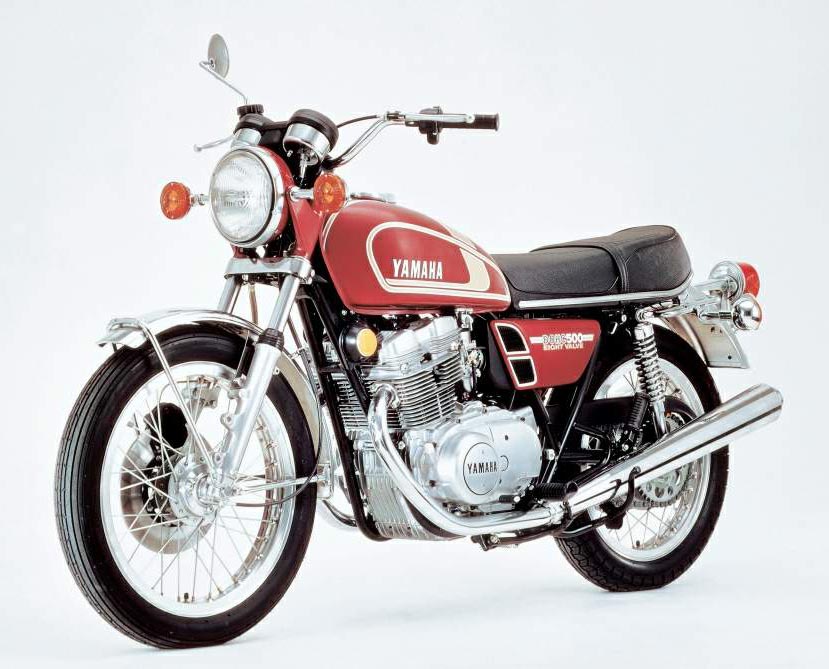
Continuing in our series of bikes that manufacturers forgot, we stay with the tuning fork brand and look at a pair of orphans, the TX750 and the TX500. Earlier we looked at the Honda MVX250F and Yamaha’s XZ550.
Incidentally, have you ever wondered why the tuning fork emblem? It’s pretty simple really. Yamaha is the biggest manufacturer of musical instruments in the world. It began as a musical instrument manufacturer and has acquired many other companies along the way in its rise to dominance and has also branched out into electronics and audio as well as many other smaller projects. In fact, their motorcycle division is a very small division in their corporate structure.
In its constant sales war with its main rival, Honda, Yamaha has had more than its fair share of successes both on and off the track, the company mastering two stroke technology and virtually making Grand Prix racing its exclusive preserve for nearly two decades. But it was their desire to appeal to the widest possible market (and, after all, every manufacturer wants to do this) that led to the birth of the two orphans that are the subject of our scrutiny this week.
First, as always, a little background. While Honda had stolen a march on its rivals with the 750/4, Yamaha still believed that there was a place in the market for a “traditional” bike. Rememering that this was the mid-60’s the British bike industry was still relatively healthy and their bikes were still seen as desirable.
However, most of the British bikes suffered from two serious faults and, surprisingly, neither of them were their uncertain electrics. The first was that, almost exclusively, they were of vertical twin configuration that featured vertically split crankcases. As a consequence, when the motor was still relatively new, it began to leak oil. This was partly as a result of the design and partly as a result of how that design was executed. It must be remembered that it took over 20 years for British industries to recover from the ravages of WWII and that, as a result, technology lagged behind that of the nations less badly hit by 6 years of conflict.
From 1945 till the death of the British bike industry in the 70’s, manufacturing of components generally took place using machine tools that were pre-war in design and manufacture. As such, they were basically worn out and had been for years. Most had been pressed into service producing war-related components and they had been thrashed to death. You cannot produce oil-tight components using machine tools whose tolerances were massively more than what they were supposed to be. While the machine tool could produce a crankcase that should have had tiny tolerances when it was new, it is going to be unable to duplicate those tolerances 20 years later when all of its own components were worn out.
So the crankcases, for example, could NEVER match correctly and be oil-tight because the machine that made them couldn’t make them do it. Couple this with the vertically split crankcase design and the bike was always going to leak oil no matter how carefully assembled it was and no matter how many gaskets you threw at it.
Yamaha’s answer was the venerable and much-loved XS range. It was, in every sense, what a modern British bike should have been. Produced in a new factory with new mills and presses (courtesy of massive reconstruction subsidies from the USA) the bike was traditional in design but modern in execution and it flew off the dealers’ floors. Owners loved it because it duplicate the look and feel of their much-loved British bikes but had none of their shortcomings. Featuring a horizontally-split crankcase (putting a stop to the dreaded oil leaks) it was a powerful and reliable engine. New electrics and running gear dragged the vertical twin bike back into contention and for riders who were tired of the unreliability of their BSA’s and so forth, it was a breath of fresh air.
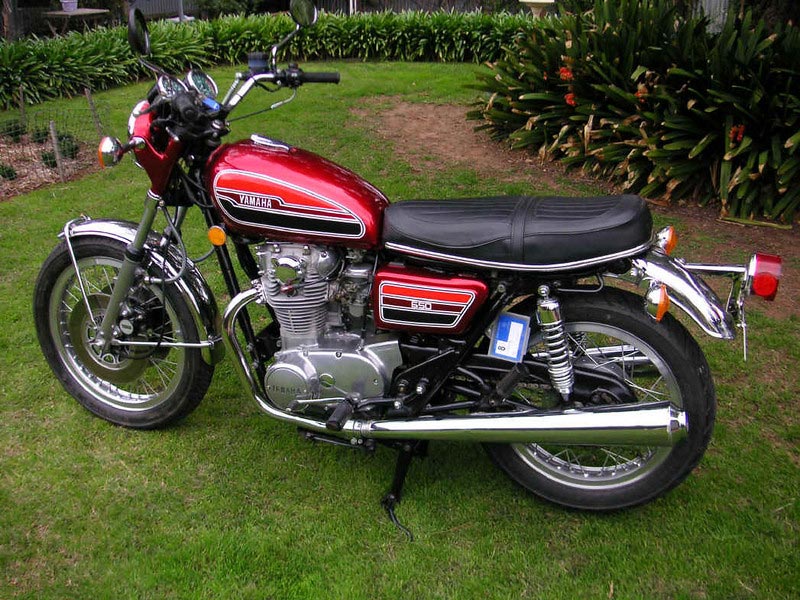
The first two models still featured kick start only but a compression release lever made it easy. In 1972 electric start was introduced as well. The bike’s success was assured. The model ran from 1968 to 1979, a spectacular record.
BUT, it was early in this model run that Honda and Kawaskai introduced their 4 cylinder superbikes with Suzuki arriving a little later to join the party. Loyalty to the “traditional” design of the XS kept it alive but riders looking for perfomance and bling were already looking elsewhere.
Added to this was the growing perception that the XS was an “old mans bike”, not hip enough for the era and Yamaha had to do something to retain the market share. While the XS did everything competently (even brilliantly) it had a fatal flaw that was aging it before its time – vibration.
All vertical twins vibrate, it’s built into the design and, for 30 years or more, vibration had been accepted as an integral part of riding a motorcycle. But the Z1 didn’t vibrate, it was as smooth as a baby’s bottom and so were the other 4 cylinder bikes. Seeing riders of vertical twins stopped by the side of the road re-attaching components that had vibrated loose was common and was treated with derision by the new wave of sophisticated riders.
Convinced (as it turns out, incorrectly) that there was still a place for the vertical twin, Yamaha went back to the drawing board and produced a “modern” twin, the Yamaha TX750. The choice of capacity was not coincidental and even the “X” part of the name was intended to evoke “experimental” which to Yamaha’s way of thinking, equated with technical innovation and avant-garde thinking.
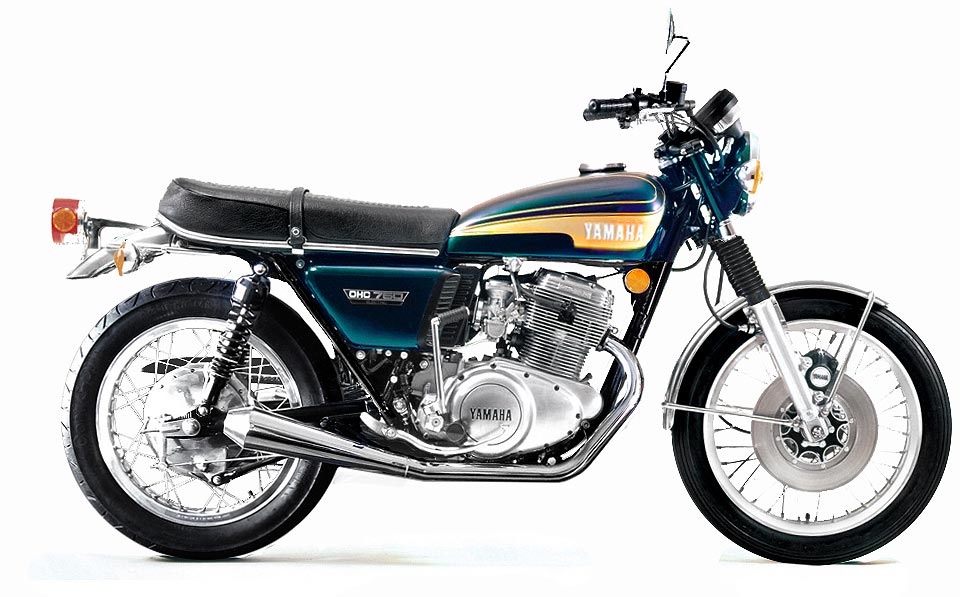
In order to cancel vibration Yamaha designed the “Omni Phase Balancer” a pair of contra-rotating balance weights which worked in two ways to smooth out the engine. The first worked to cancel the inherent vibration of the vertical twin design where both pistons rose and fell in unison, and the second dampened out the vibration caused by the first weight. The result was a vertical twin that felt for all the world like a “four.” The running gear was modern, a disk brake was fitted as standard (with lugs on the other fork leg to allow for the fitment of a second disk) and the electrics continued the bullet-proof tradition of Japanese bikes. It should have been a winner and should have prolonged the popularity of the vertical twin design.
Sadly, however, it didn’t. Almost as soon as the bike was released, serious reliability issues with the motor started to emerge. At higher revs (how come Yamaha hadn’t discovered this at the prototype and development stage?) the balance weights, thrashing around in the crankcase, began to aerate the oil, making it overly hot and frothy. If the motor was not allowed to cool, the crankshaft bearings, starved of oil, would begin to fail and fail they did.
In addition, the chain which ran the balance weights would stretch under load (probably through running in overheated oil) eventually putting the weights “out of phase” making the engine vibrate terribly, the very thing it was not supposed to do.
Much to Yamaha’s embarrassment, a TX750 entered in the very prestigious Castrol Six Hour Race, failed spectacularly in the glare of a crowd of spectators, forever tainting the model in Australian motorcyclists’ eyes. Mention the model today and someone will begin recounting the smell of burnt oil and the disastrous failure of that dreadful weekend.
The 750 lasted one year. Yamaha addressed the problems and the 1974 model was much better, but the damage was well and truly done and, at the end of the year, the model was quietly dropped.
Amazingly, alongside the 750, Yamaha also ran another vertical twin, but this time a much more sophisticated design. Aimed at the performance side of the market, the TX500 was smaller in capacity and featured a much more modern specification. The motor was a DOHC design with four valves per cylinder. The Omni Phase Balancer, perpexingly, worked much better in the smaller engine (maybe it didn’t have to work as hard as the 500 motor was a 180 degree design so it had less innate vibration to start with?) and the running gear was right up to scratch.
Initial impressions were good although it became apparent that the motor was very “cold blooded” and had to be thoroughly warm before it would deliver its best. Low down torque was disappointing, and the clutch was felt to be very “snatchy.” Of more concern was that, as the miles clocked up, starting issues began to appear and these drove owners batty.
Despite attempts to fix the issue it was left to an end-user to find the solution. Fitting a set of coils from a Mercury outboard motor made the spark fat and easily able to provide enough power to start the bike reliably.
But serious issues with the top end of the engine and failing head gaskets pointed to something far more serious and, by the time Yamaha had devised a fix, the march of time had passed the TX (later called XS) by. By 1978 the market share of vertical twins had shrunk to minimal proportions and, to put it in perspective, in that same year, Jim Budd and Roger Heyes won the Six Hour on Yamaha’s mighty “Excessive Elephant” the XS1100 four.
So two orhpans, one almost stillborn and one that perished in childhood. I’m happy to say that the Yamaha TX500 was the first bike I ever rode, in 1973, and it began my passion for motorcycling that has lasted to this day. So, despite its faults, I have a special place in my heart for it.