

Dainese on the future of rider protection
Modern motorcycles have never been smarter. IMUs, cornering ABS, traction control, radar, semi-active suspension, aero and increasingly sophisticated electronic strategies now help keep riders out of trouble in ways that would have seemed fanciful not all that long ago.
But when things do go properly pear-shaped, the rider remains the most exposed part of the equation.
That was the starting point for a discussion with Simone Nieddu, Dainese Head of Marketing, during a visit to Dainese in Italy, following my attendance at World Ducati Week and a subsequent visit to Sidi HQ.
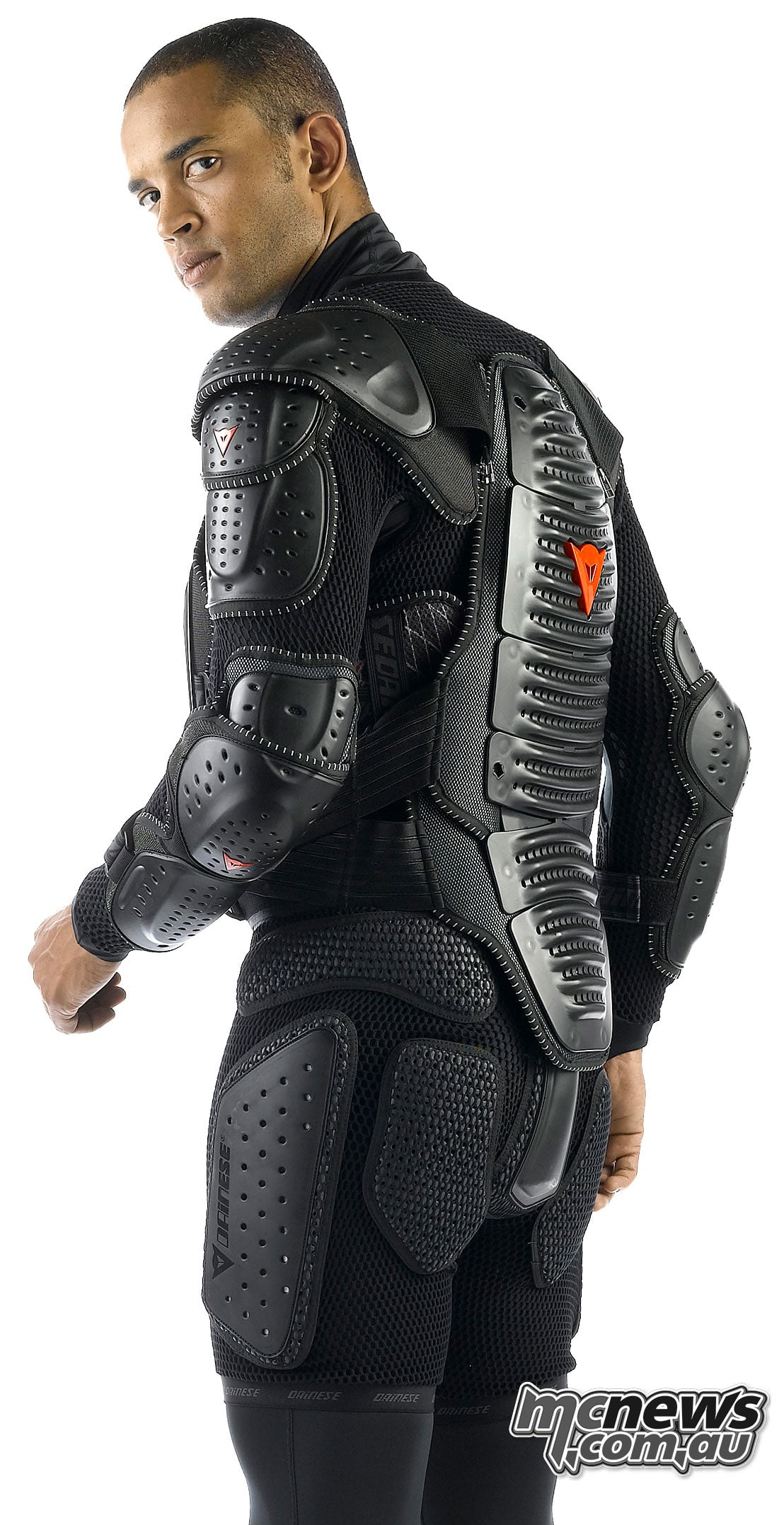
The conversation quickly moved beyond the usual brand-history story and into a much more interesting area: how rider protection is being reshaped by data, algorithms, crash analysis and the interaction between garments, electronics and, potentially, the motorcycle itself.
Protection is becoming a complete system
Leather, abrasion-resistant textiles and conventional armour remain fundamental, but at the top end modern motorcycle protection is no longer purely a sewing-and-materials exercise.
An electronic airbag is part garment, part impact protector, part sensor platform, part software product and part crash-analysis tool. Each element has to work with the others, which is why Dainese favours an integrated approach in its racing equipment.
Simone Nieddu – Dainese Head of Marketing
“We think that working on a full protective environment works way better than putting together different modules and different items that maybe stand alone are very good, but they are not meant for working perfectly together.”
Dainese is not suggesting the airbag has reached its limit. Nieddu sees room to improve comfort, weight, coverage and usability, even though the technology has already been under development for decades.
Simone Nieddu – Dainese Head of Marketing
“Airbag for sure is the technology that, if you think about it, is here since 20 years ago and still seems something that is new from yesterday. So it is a very refined and advanced technology, but it still has room for improvement.”
Dainese has continued extending the protection area of its racing systems, with its latest MotoGP development reaching farther towards the hips. Nieddu also said the company had developed a system intended to limit excessive rearward extension of the neck as the bag inflates, following two years of work with riders.
Should your bike talk to your airbag?
The big question is whether the next step in rider protection will come from the motorcycle, the rider’s gear, or an exchange of information between the two.
Modern motorcycles already know a great deal about what is happening beneath the rider. They can track lean angle, pitch, yaw, wheel-speed variation, braking force, ABS intervention and traction-control activity. Some can also monitor what is happening ahead through radar.
An electronic airbag, meanwhile, makes its own decisions from sensors carried by the rider. The obvious future possibility is for those two pools of information to intersect.
Simone Nieddu – Dainese Head of Marketing
“I would say, both for MotoGP but also for standard riders on the road and on the racetrack, for sure the interaction between the rider’s gear and the motorcycle would be super helpful to step up the level of safety.”
Asked whether Dainese was working with motorcycle manufacturers or electronics specialists such as Bosch or Continental on a system through which D-air could communicate with the motorcycle, Nieddu would not be drawn into specifics.
Simone Nieddu – Dainese Head of Marketing
“It is something we are investigating, that is for sure.”
That is an exploratory direction, not confirmation of a partnership or a production-bound system.
The potential advantages are easy to see. A motorcycle could provide more context to the airbag and perhaps help it identify a dangerous event sooner or more accurately. The complications are just as obvious: compatibility, common standards, liability, connection security and what happens once the rider and motorcycle have separated.
For now, Dainese’s current D-air systems remain self-contained and require no connection to the motorcycle. Even so, the question illustrates how motorcycle safety is increasingly becoming a software and data problem as well as a materials problem.
The crash library behind D-air
D-air is not simply a gas generator, an airbag and a collection of sensors. Much of its value lies in knowing when to deploy and, just as importantly, when not to.
That is where data becomes critical.
Dainese began collecting official crash data from World Championship riders and ordinary road users in 2007. Nieddu said the company now has millions of data points feeding its systems, with the database continuing to grow.
Simone Nieddu – Dainese Head of Marketing
“We started to collect official data from World Championship riders and standard road users since 2007. So we have millions of data that nurture our system and our database, and every year it gets bigger and bigger.”
Road data matters because a road crash can be very different to a race crash. A MotoGP rider will often slide across a relatively controlled run-off area. A road rider might hit a kerb, car, tree, guard rail or street furniture – or, in Australia, perhaps even a kangaroo – before reaching the ground.
Nieddu said Dainese collects information from road airbag systems as well as Grand Prix racing. In markets where the company is directly represented, that data has sometimes also assisted authorities trying to reconstruct an accident.
Simone Nieddu – Dainese Head of Marketing
“There are situations in which the police, when they have doubts about the dynamic of an accident, and they see the person involved in the accident has an airbag from Dainese, they contact us and ask for us to help them understand the dynamic of the accident.”
The distinction is important. Sensors supply the raw measurements, but the hard-won value lies in the algorithm’s ability to recognise patterns in those measurements and distinguish a crash from the many abrupt movements that are simply part of riding a motorcycle.
Why Dainese is not chasing a helmet airbag
Given Dainese’s ownership of AGV and its work in upper-body airbag protection, it was natural to ask whether a helmet-integrated airbag might be another frontier.
Nieddu said Dainese tested the idea during the development of its earliest airbag systems but does not see it as the right path.
Simone Nieddu – Dainese Head of Marketing
“We tested the solution of having an airbag connected to the helmet when we were developing the first airbag that we presented in the early 2000s. I think that is not the path that could help us to improve protection in the upper body, because adding more weight and taking away space for the protection of the helmet is not working.”
That does not mean Dainese and AGV consider helmet development static. Nieddu sees meaningful scope to improve how helmets manage rotational acceleration and the types of impact energy most dangerous to the brain.
Simone Nieddu – Dainese Head of Marketing
“I will not say the helmet will improve with airbags, but there are parts of the impact, especially those that are more dangerous to the brain, like rotational accelerations, where there is a lot of room for innovation.”
Why riders remain slow to adopt airbags
Despite the technology being well established in racing, use among road riders remains low. Nieddu identified three main barriers: cost, ease of use, and perceived weight or bulk.
He argued that the price of an airbag does not look excessive beside what many riders spend on exhausts, suspension, accessories or cosmetic upgrades. However, when the device is not mandatory and its best possible ownership experience is never needing to deploy it, many riders still treat it as optional.
Simone Nieddu – Dainese Head of Marketing
“When it comes to something that can save your life, it is not that much. But still, when it is not mandatory, it is perceived as something that many times you do not need, or that happens to others.”
Airbags also introduce another routine: one more item to put on, charge and remember. That makes reduced weight, less bulk and easier management more than matters of comfort. They directly affect the likelihood that the protection will actually be worn.
Whatever the precise adoption rate, the broader point is difficult to dispute: airbags remain unusual away from racing and the more safety-conscious end of road riding.
A sizeable research effort
Airbag development is no longer a small side project within Dainese. Nieddu estimated that around 30 per cent of the company’s R&D department is involved with airbag systems in some way.
That does not mean one large group of people all doing the same job. The work spans software, algorithms, data analysis, electronics, airbag construction, textiles, materials, testing and integration into finished riding gear.
Simone Nieddu – Dainese Head of Marketing
“There are many areas to cover. There is the software side, the airbag itself, the algorithm and data side, all the material and textiles, and then the overall testing and general R&D. I would say that 30 per cent of our R&D department is in a way involved in the development of the airbag systems.”
Where the work is done
Dainese’s manufacturing footprint is spread across several countries and is more nuanced than the shorthand that its leathers are made in Italy.
Dainese clarified after our visit that Italy is principally responsible for its top-of-the-range rider suits and custom leather work. GP suits and other flagship leathers are produced in the Vicenza area, while AGV’s Pista GP helmet is also made in Italy. This should not be read as meaning every Dainese leather garment is Italian-made.
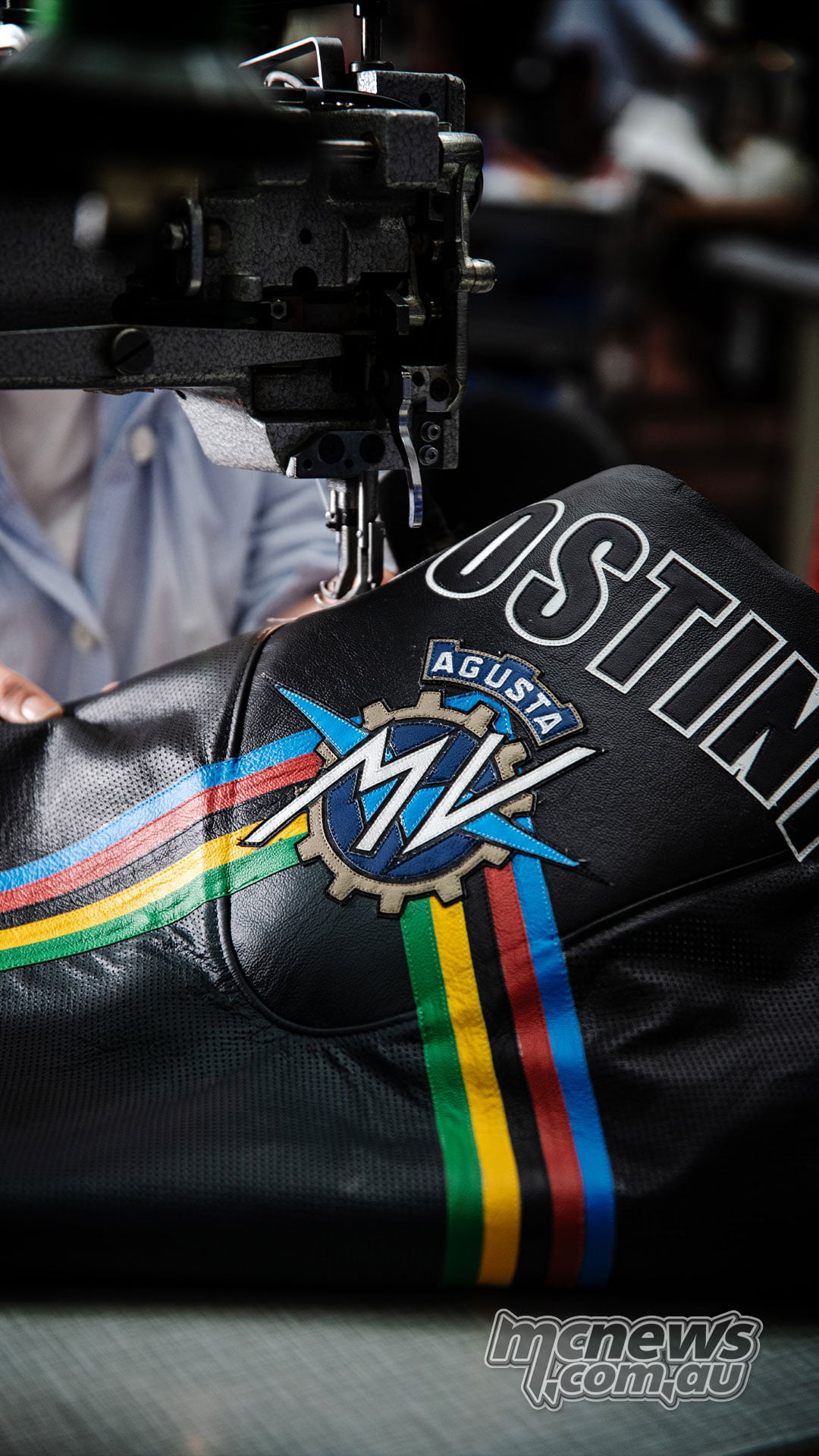
In that context, Nieddu’s reference to leather suits being fully made in Italy concerned the high-end and custom work being discussed and shown at Colceresa.
Simone Nieddu – Dainese Head of Marketing
“The leather suits are fully made in Italy, here in Colceresa. The Smart Air, the road system, is mostly made in our own facility in Tunisia.”
Dainese says its Tunisian factory produces most of its textile garments and airbag systems. Nieddu stressed that the operation, established around two decades ago and increasingly specialised in airbags, is a Dainese-controlled facility rather than an arm’s-length subcontractor.
Simone Nieddu – Dainese Head of Marketing
“The facility is very modern and it is something that we have worked with over the last 20 years. It is not about having something coming from outside with no control. It is totally under the Dainese hat.”
Production is also distributed across European facilities in Romania, Hungary and elsewhere in Eastern Europe. Dainese says smaller product lines are made in other parts of the world, including Asia.
Motocross remains outside the current D-air range
Smart Air’s Offroad mode is intended for adventure riding and non-competitive enduro use. It is not a motocross or off-road racing system, and Dainese confirmed that it currently has no MX airbag product.
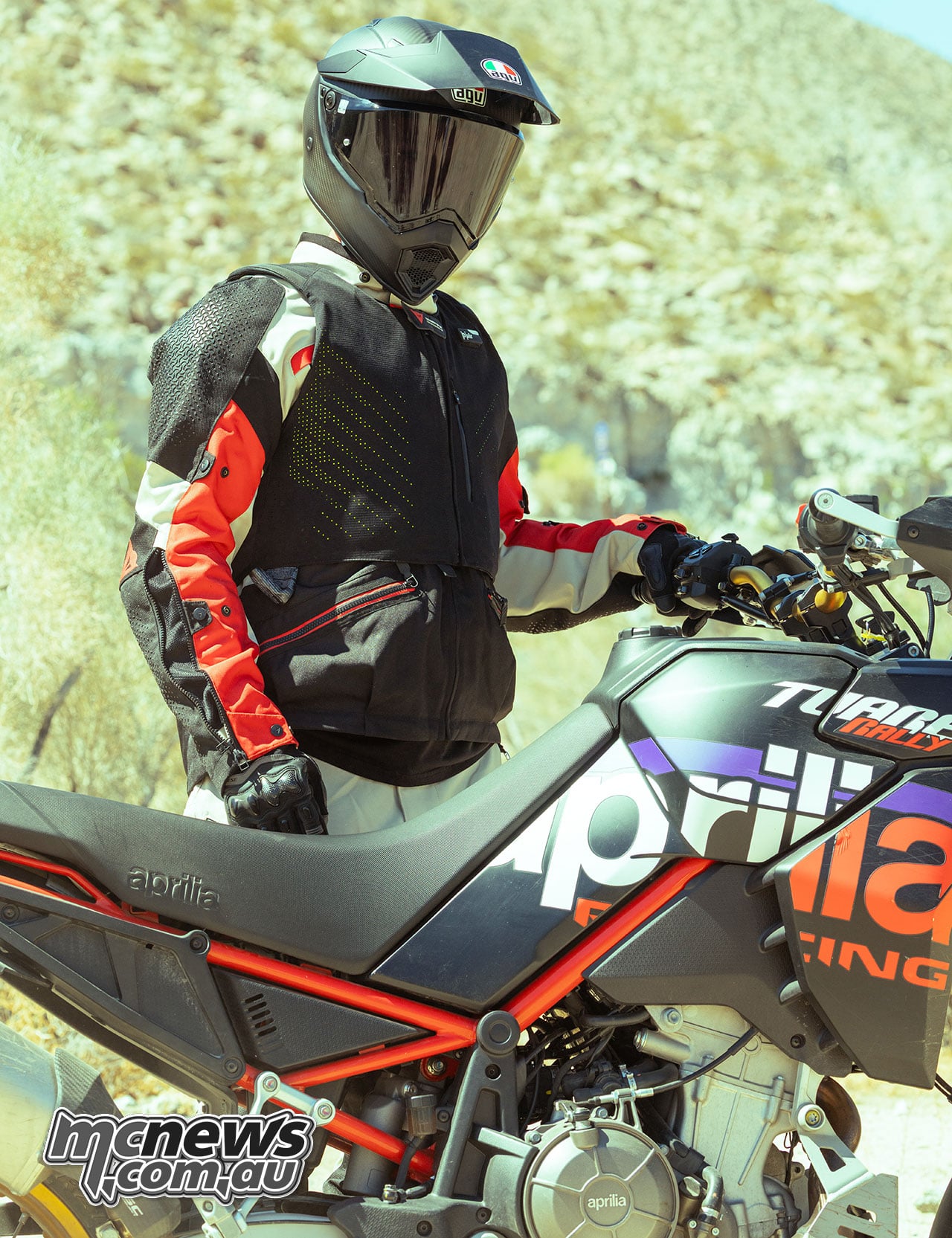
That does not mean the company has dismissed the category. Dainese said its approach would be to establish a new safety benchmark rather than simply adapt an existing system, although it ruled out the arrival of a new Dainese off-road product during 2026.
Dainese statement to MCNews
“We are always working to bring the airbag protection to the widest audience possible. And it is important for us to set a new safety benchmark in all the categories we work on, not just providing a version of a current technology. Although, you won’t see any new offroad Dainese product on the market in 2026.”
The real challenge is normalising the airbag
The technology is no longer a science experiment. The harder task now is normalisation.
Airbags are normal in MotoGP and increasingly accepted by track-day riders and serious sports riders. They remain far from normal for commuters, tourers and adventure riders, despite those riders spending their time around cars, animals, poor road surfaces, roadside furniture, unpredictable weather and long days in the saddle.
Simone Nieddu – Dainese Head of Marketing
“Our goal number one is to expand the audience, to let more and more people wear the airbag, so having more and more people on the road be safer.”
There is an obvious commercial opportunity in that, and Nieddu acknowledged as much, but the safety argument is stronger.
Motorcyclists often spend heavily on power, noise, suspension, tyres, luggage, navigation, carbon bits and billet jewellery. Many of us still hesitate when the money is for something that may never be used, and which we hope never will be.
That is probably the mindset that has to change.
Dainese’s future will no doubt involve lighter products, greater coverage, better algorithms, broader styles, easier servicing and perhaps, eventually, communication between the motorcycle and the gear. The most important step might be simpler: getting more riders to think of an airbag not as exotic technology, but as normal motorcycle kit.
The motorcycles we ride are already thinking. The next step is making sure the gear we wear is thinking just as quickly.