

Brembo Hyction
A lighter brake disc can change how a motorcycle handles before the rider even touches the lever. That is one attraction of Brembo’s Hyction carbon-ceramic technology, but the company’s ambitions extend well beyond removing weight from the front wheel.
When WorldSBK switches from steel front discs to Hyction in 2027, Brembo intends one disc specification and one pad specification to cover the entire calendar. From the relatively light braking demands of Phillip Island to the heavier work at Misano and Aragon, the aim is to give riders a consistent response while simplifying the choices facing their teams.
During our visit to Brembo, Performance Motorcycle Market Manager Andrea Pellegrini and Chief Officer of Brembo Performance Mario Almondo explained the material, manufacturing and rider-feedback considerations behind that change. Their account also reveals why Hyction has potential on the road, and why making it more affordable will require considerably more than increasing production.
A road-bike debut followed by a WorldSBK commitment
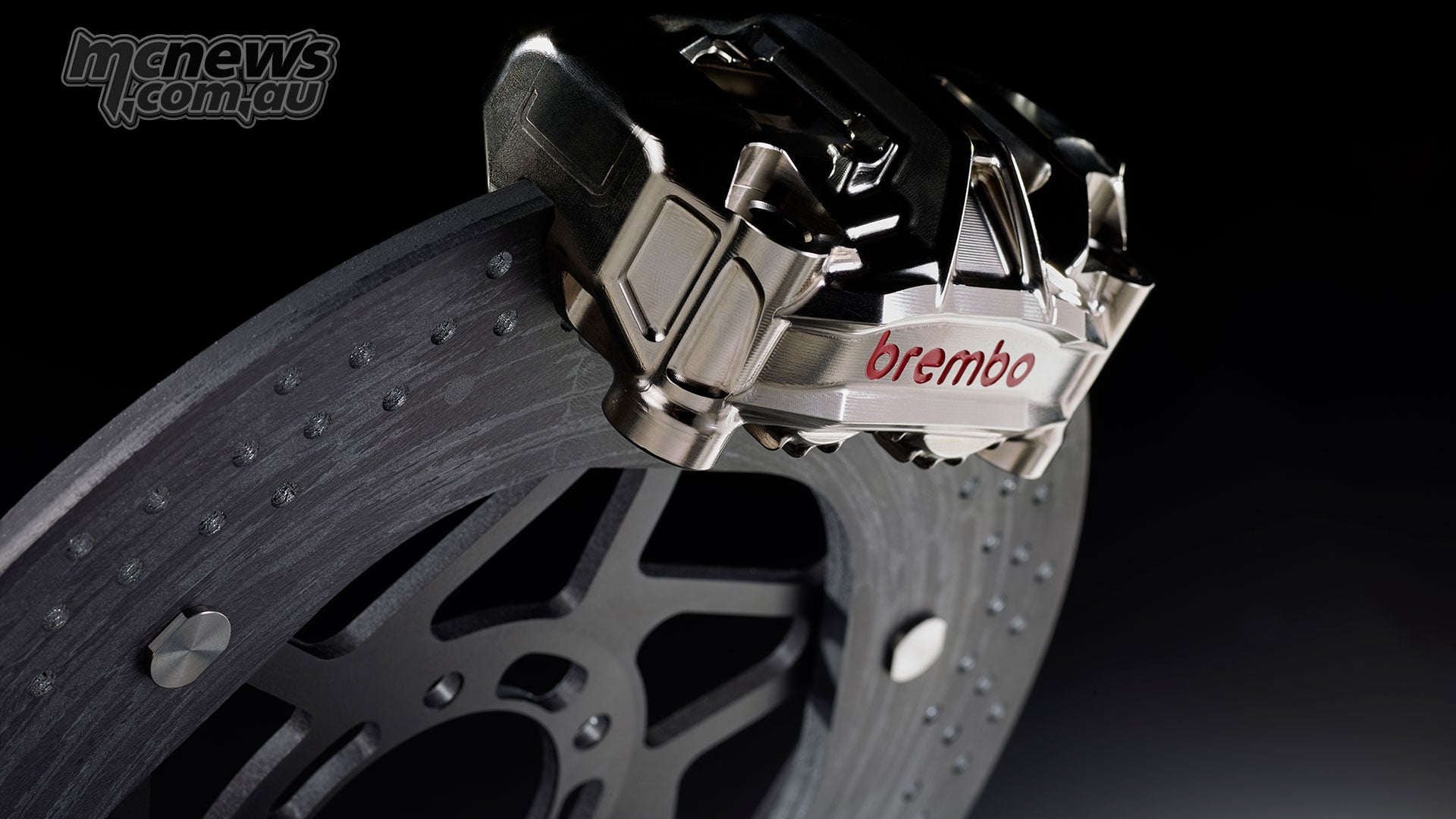
Hyction first appeared on the Ducati Superleggera V4 Centenario. Its arrival in WorldSBK follows that road debut, taking technology developed for a production motorcycle into competition.
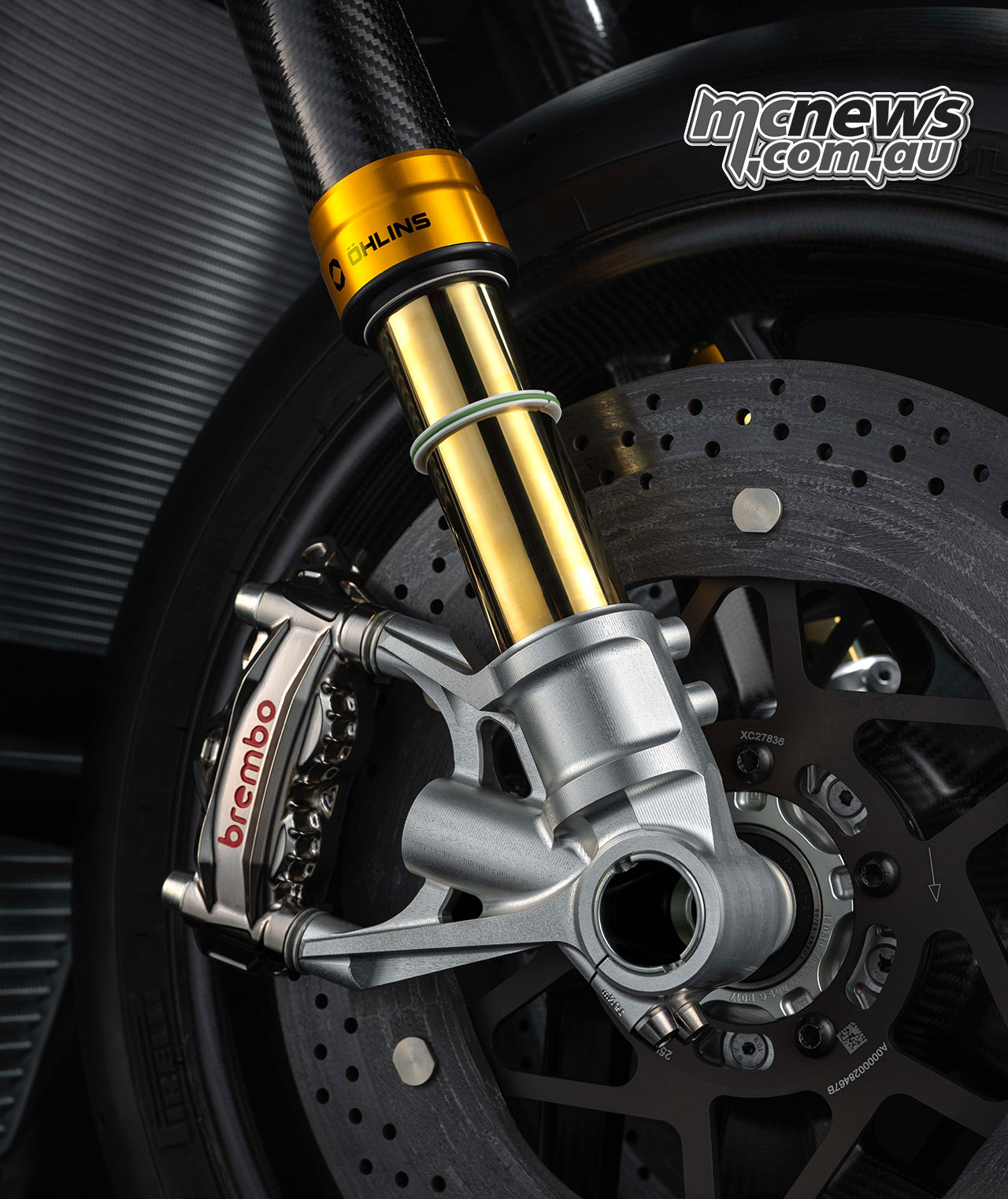
Under the announced agreement, Brembo becomes the exclusive braking-system supplier to the WorldSBK class from 2027. The move establishes Hyction across the premier category, giving the technology a much broader competitive examination than testing with individual riders and manufacturers can provide.
The attraction is a combination of reduced rotating mass, low disc wear and predictable braking across a wide operating range. Each matters to a racing team, and each has a potential benefit for road and track-day riders.
Carbon-ceramic and MotoGP carbon-carbon do different jobs
Hyction’s dark appearance invites comparison with a MotoGP disc, but the materials are different. Brembo describes Hyction as a carbon-ceramic composite incorporating carbon fibres, silicon and silicon carbide. MotoGP uses carbon-carbon discs.
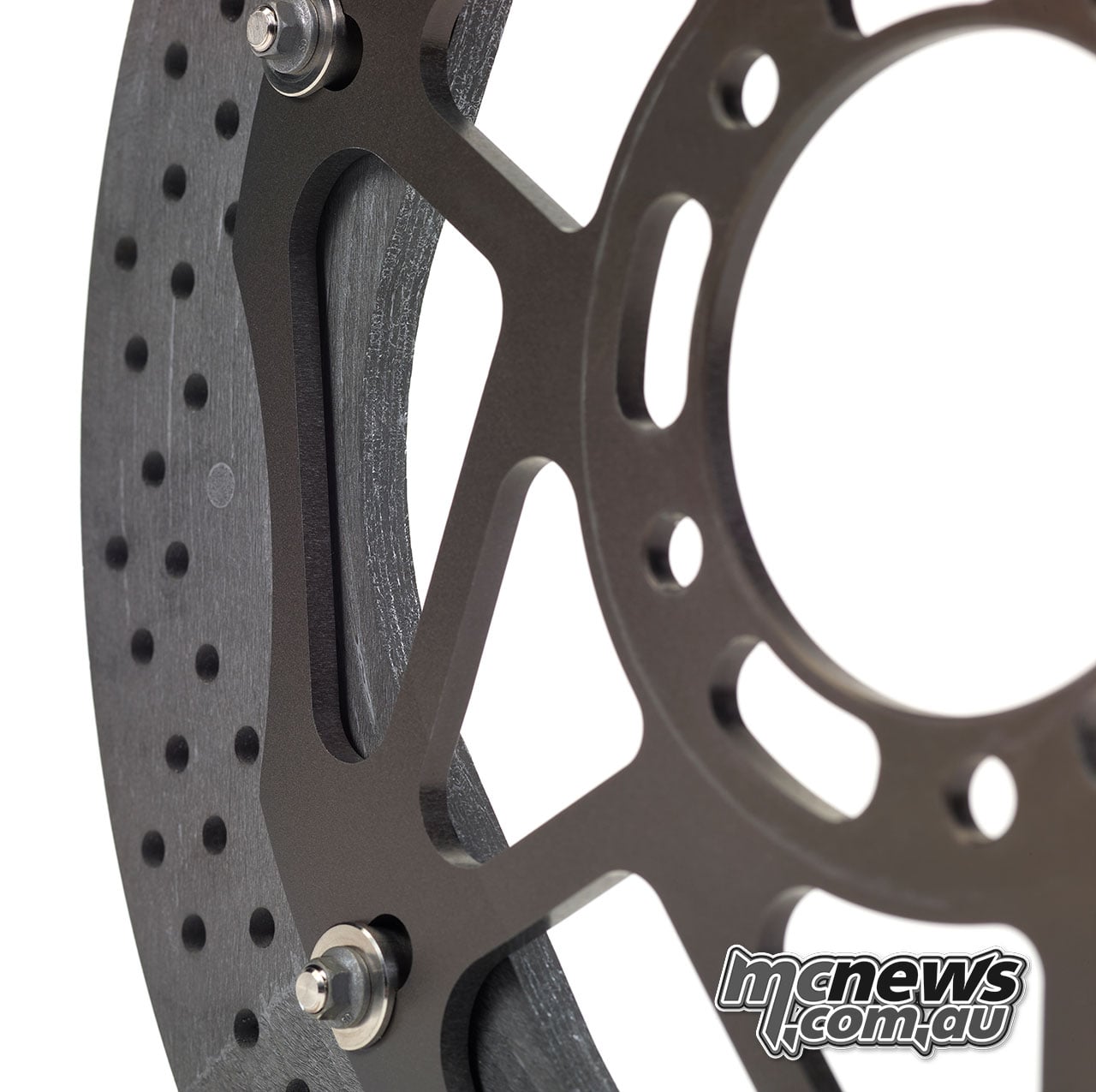
The distinction becomes particularly important at low temperatures. A MotoGP carbon-carbon system needs heat to deliver its intended braking characteristics. Hyction is designed to work from ambient temperature, allowing a rider to leave home or the garage and use the brake without a racing warm-up procedure.
Asked about its cold response compared with a steel road disc, Pellegrini said the initial bite could be slightly lower, while emphasising the controllability and consistency of the response. A less abrupt first application can still be followed by powerful braking as the rider increases pressure.
Almondo was clear about the different priorities behind the two materials.
“The gap between this product and the carbon-carbon used in MotoGP is quite big,” he said. “MotoGP bikes are prototypes.”
He does not expect Hyction to overtake MotoGP carbon-carbon on outright performance in the near term. Its development has instead centred on combining performance, controllability, durability and simplicity in a system suitable for production motorcycles.
That broader working range is central to its relevance. A road rider needs dependable braking on the first application, in changing weather and after periods of light use, as well as when the system becomes hot during sustained hard riding.
Why the location of the weight saving matters
Brembo’s published road-package specification lists a 340 mm disc, 8 mm thick, with a 35 mm braking track and 132 ventilation holes. Each disc weighs 1.375 kg, around 450 grams less than the steel road-superbike disc used in Brembo’s comparison.
Across the front pair, that amounts to 900 grams. Brembo also quotes a 40 per cent reduction in the discs’ rotational inertia.
Those figures describe the road application and its stated steel-disc comparison. They are not a confirmed like-for-like saving against every WorldSBK team’s current equipment, and the inertia figure refers to the discs rather than the complete front wheel.
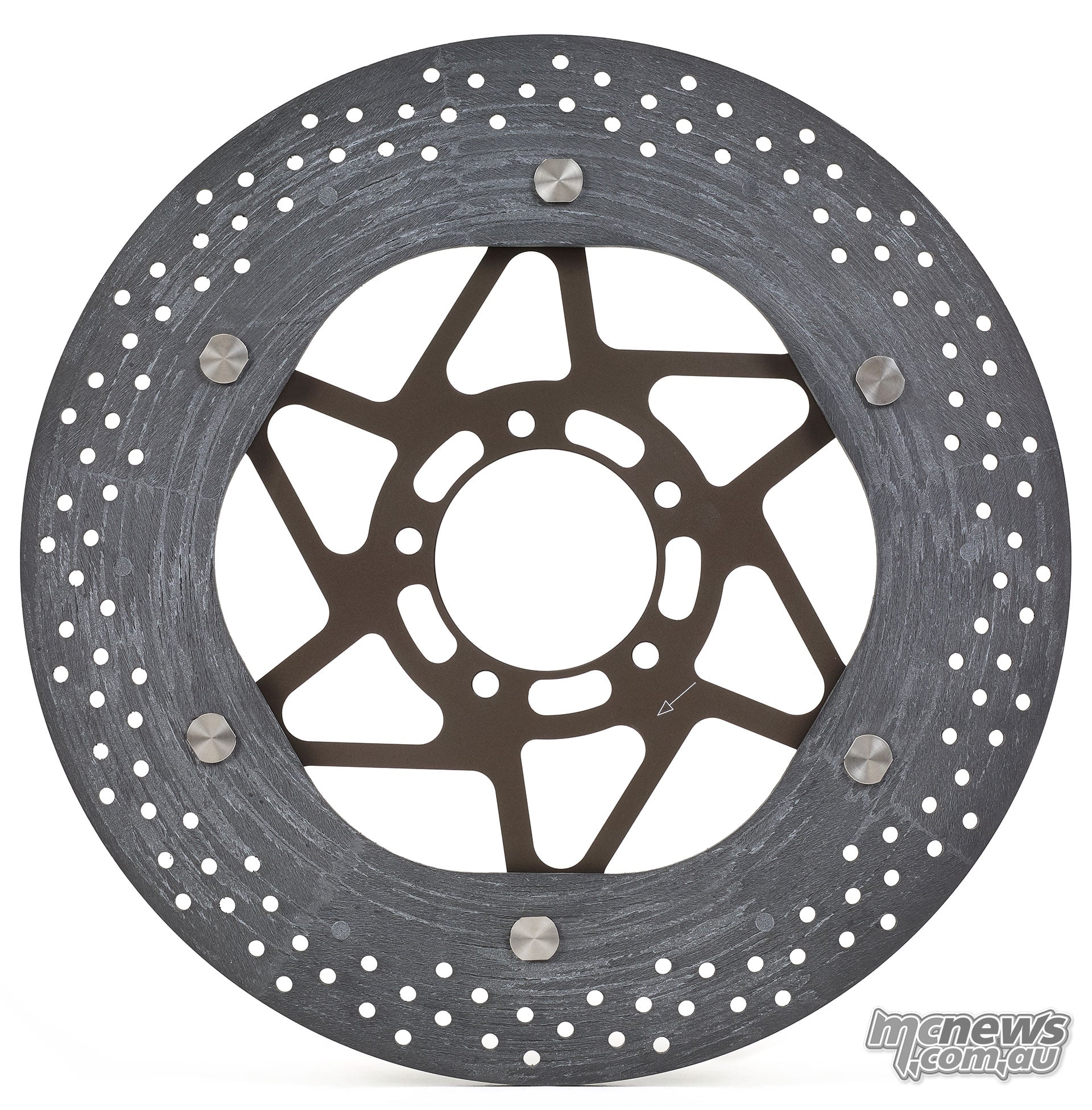
A brake disc is both unsprung mass and rotating mass. Reducing its weight leaves the suspension with less mass to move as the wheel follows the track. Reducing rotational inertia also lowers the energy needed to change its rotational speed and reduces its contribution to the gyroscopic effects involved in changing the motorcycle’s direction.
Where the material sits is just as almost just as important as well as how much it weighs. Mass farther from the axle contributes more strongly to rotational inertia, which is why the percentage reduction in inertia need not match the percentage reduction in weight.
For the rider, Brembo expects the combined result to be easier direction changes and less effort in repeated transitions. The scale of that benefit will depend on the whole motorcycle, including its wheels, tyres, geometry and suspension.
One specification, with consistency as the target
With steel discs, WorldSBK teams choose between different constructions to suit the circuit’s braking demands. Pellegrini contrasted the relatively light workload at Phillip Island with venues requiring a more substantial thermal package. Disc mass and pad specification are part of that preparation.
Hyction is intended to reduce those choices.
“With Hyction you can use the same disc for all the races,” Pellegrini said.
He was describing one disc specification across the calendar, paired with one pad specification. Pads still need replacing as they wear, and the statement does not imply that one physical set of discs must last a complete season.
Fewer specifications could simplify stockholding and give teams a more familiar starting point each weekend. Set-up work will continue, but engineers should have fewer disc and pad combinations to evaluate as they adapt the motorcycle to a circuit.
Both Pellegrini and Almondo emphasised the early feedback on consistency at the lever. A rider who experiences a similar response throughout a run has a more dependable reference when deciding how much pressure to apply and how progressively to release it.
Almondo said the initial reaction was exceptional in his 35 years of top-level motorsport. He was referring to the first two test riders, whose feedback had consistently aligned with the development team’s objectives.
“The control, the confidence, the consistency is absolutely unbelievable,” he said.
Those were encouraging early reports. Almondo also acknowledged that further running would expose problems to solve. The 2027 field will put the system through a wider range of riding styles, motorcycle configurations and race conditions.
Wet-weather operation and the role of disc covers
Hyction’s ability to work in the rain is important to its road application. In its technical questions and answers, Brembo states that the system operates in wet and low-temperature conditions without covers or preheating.
Pellegrini nevertheless recommends covers for wet WorldSBK use. He explained that reducing the volume of water reaching the braking surfaces helps provide a more stable response, particularly at the beginning of a race.
The cover does not have to enclose the disc completely or keep it perfectly dry. It limits direct water flow at racing speeds. That recommendation addresses consistency under race conditions; it does not establish a requirement to fit covers to a Hyction-equipped road motorcycle whenever it rains.
The disc, pad and caliper work as a system
The road package pairs Hyction with the GP4-HY caliper, which uses 30 and 34 mm pistons, mechanical boosting and an anti-drag system. The pads use friction material developed specifically for the carbon-ceramic disc.
The booster uses inclined pad movement to generate additional clamping force from the interaction between the pads and rotating disc. The anti-drag mechanism helps retract the pads when the rider releases the lever, reducing residual contact.

Disc material alone therefore does not define the braking response. The pad’s friction characteristics, the caliper’s operation and the hydraulic relationship at the lever all contribute to what the rider feels.
Pellegrini said WorldSBK testing had used Hyction with the established racing caliper because the disc thicknesses were sufficiently close. Road-bike compatibility requires separate consideration: disc thickness, pad shape, operating clearances and mounting dimensions all have to suit the application.
A racing caliper accepting Hyction during development does not make the disc a universal replacement for an existing road-bike rotor.
Low wear changes the cost equation
Pellegrini said Hyction discs cost more than steel discs, but their much lower wear rate should allow substantially greater mileage. Using fewer specifications could also reduce the range of spares a team needs to carry.
Those are two potential routes to savings: replace discs less frequently and hold fewer alternatives. Whether they outweigh the higher purchase price depends on actual service life, supply costs and replacement requirements.
There is also a useful difference in how wear is assessed. Brembo states that disc weight, as well as thickness, is a reference parameter for Hyction. A minimum permitted weight is marked on the carrier, providing a replacement limit as the disc loses mass through use.
Low wear therefore still comes with defined service limits, while the pads remain consumable components. The interviews established the potential for improved running costs, but did not provide figures proving that the complete WorldSBK package will be cheaper to operate than steel.

Why building more will not automatically make Hyction cheap
The production challenge became clearer as Almondo discussed what happens inside Brembo’s furnaces. Manufacturing these advanced braking materials requires energy-intensive processes, and increasing volume does not remove the cost of the heat and tightly controlled conditions involved.
“The process is less sensitive to scale efficiency,” Almondo explained.
He expects opportunities to improve efficiency through better processes and furnace cycles. Simply expanding production offers more limited savings than buyers might expect from their experience of other technologies.
Process development is also unusually demanding. A successful experiment in a small furnace does not guarantee the same quality and consistency in a much larger one, because the thermal behaviour changes with scale.
Almondo described the performance factory as both a manufacturing operation and an applied research facility. Some developments must be tested on production-scale equipment, making the experiments expensive and tying research closely to the factory itself.
Brembo’s university collaborations, including its relationship with Politecnico di Milano, are helping develop more accurate simulations of furnace processes. Better modelling could reduce the number of costly full-scale trials and help engineers improve consistency and energy use.
That work matters to Hyction’s prospects beyond expensive flagship motorcycles. Bringing the technology to a wider market depends partly on making a complex material more economical and repeatable to manufacture.
What comes next for road and track-day riders?
Pellegrini identified an aftermarket and track-day application as a development target. Almondo also confirmed plans for upgrade kits for motorcycles already in the market. Neither supplied a launch date or price during our discussions.

The appeal is clear: less rotating mass, slower disc wear and a braking response intended to remain predictable through changing temperatures and repeated hard use. Those qualities have value well beyond a WorldSBK grid.
The championship’s 2027 switch will provide a demanding measure of how those ambitions translate into race-distance consistency, replacement requirements and rider confidence. For wider road adoption, application-specific compatibility and cost will be just as important as performance.
Hyction’s significance lies in the combination. Brembo is pursuing a disc that can improve handling before the lever is pulled, deliver controlled braking from cold and maintain its characteristics through sustained use. WorldSBK will put that proposition to work across an entire championship.