

BSA returns to Australia
We ride the new 2026 BSA range
BSA is back.
For one generation of motorcyclists, those three letters carry an enormous amount of history. For another, they might barely register at all.
There is also a neat symmetry between BSA and the manufacturer whose modern-classic pie it would dearly like to carve a few slices from.
BSA literally stands for Birmingham Small Arms. The company was founded in 1861 to manufacture firearms before motorcycles entered the equation. Royal Enfield’s lineage also intersects with the British arms trade, with the Enfield name following a contract to supply precision rifle components to the Royal Small Arms Factory – hence Royal Enfield’s enduring “Made Like A Gun” connection.

Of course, those less charitable towards BSA motorcycles back in the day had their own interpretation of the initials: Better Shoved Along.
More than half a century after BSA disappeared from Australian showrooms, we now have the opportunity to see whether anybody is likely to be doing much shoving this time around.
The name itself has been part of Australian motorcycling for more than a century and, at its peak, BSA was the world’s largest motorcycle manufacturer.
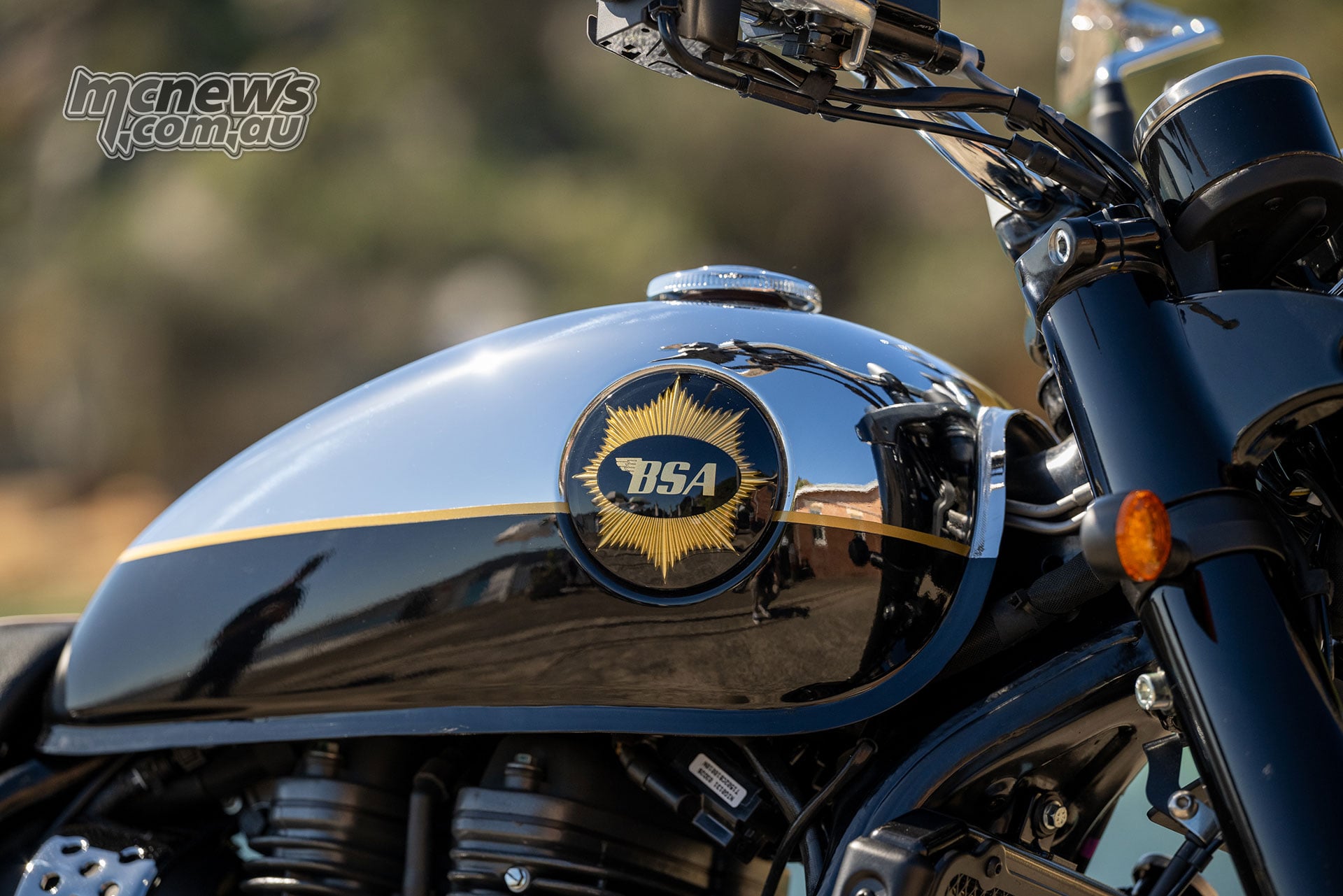
The new BSA has heritage in abundance, but heritage only gets you so far. The motorcycles underneath those famous badges still have to work in 2026, while the newly established Australian operation behind them has to build the dealer network, parts supply, technical support and customer base required to keep them on the road.
So, with the first customer bikes already putting rubber on Australian roads, we spent two days on the Bantam 350, Gold Star 650 and Scrambler 650 to find out what the reborn BSA actually brings to the party.
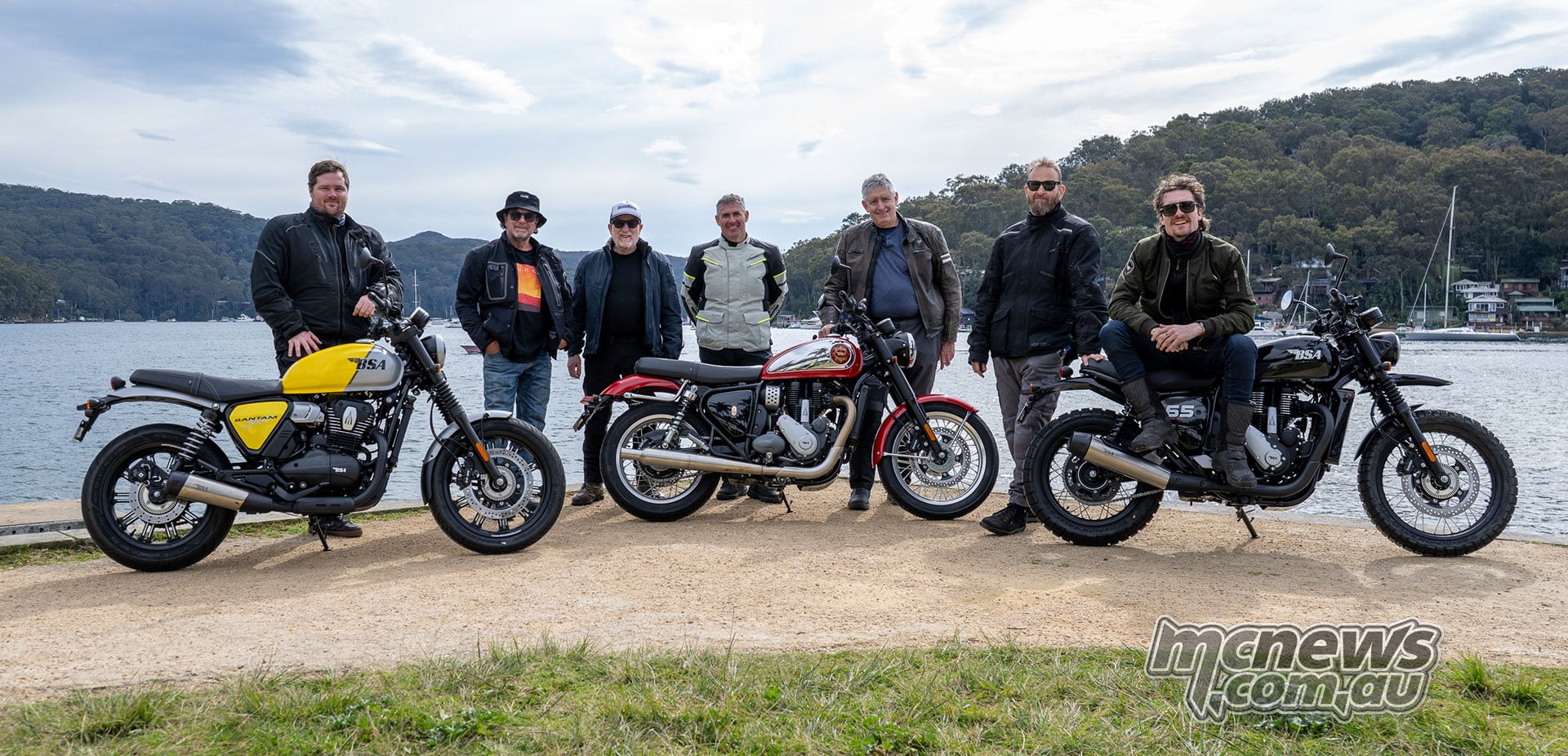
And somewhat unexpectedly, the motorcycles we finished the launch on felt appreciably different to the ones we started on.
Putting BSA back on Australian roads
The man responsible for BSA’s Australian return is Jeff Leisk, operating through the newly established Leisk Moto Imports alongside wife Liana and family.
Jeff originally became involved after being asked to investigate what it would take to bring BSA into Australia and perhaps identify someone suitable to take the distributorship on.

The deeper he looked into the company, its history and who was behind the modern revival, the more interested he became.
Leisk says the BSA stories he’d heard from his father also helped strike a chord, and learning more about the structure and backing of the revived company convinced him it was a serious enough operation to take the plunge himself.
So instead of simply advising somebody else on how to bring BSA here, Leisk and family established their own import company and did it themselves.
And this time, as Jeff put it rather succinctly during our conversation, it is “our own company, our own money“.

That brings a different sort of pressure.
Leisk certainly knows something about growing motorcycle businesses. He remembers KTM’s local operation being around the 500-bike mark in those early years, before growing to more than 15,000 by the time he left at the end of 2020. Now he’s effectively back at the beginning again, except this time with a clean sheet of paper and his own capital on the table.
The modern BSA sits under Mahindra-controlled Classic Legends, alongside the revived Jawa and Yezdi brands, with manufacturing in India while BSA retains important sales, marketing and technical functions in Britain.
Classic Legends was established specifically to revive historic motorcycle marques, with Jawa relaunched in 2018, Yezdi in 2022 and BSA returning at Motorcycle Live in Birmingham in 2021. Behind it sits considerable industrial muscle: Mahindra operates in more than 100 countries across automotive, aerospace, agribusiness, IT, finance, real estate and hospitality.
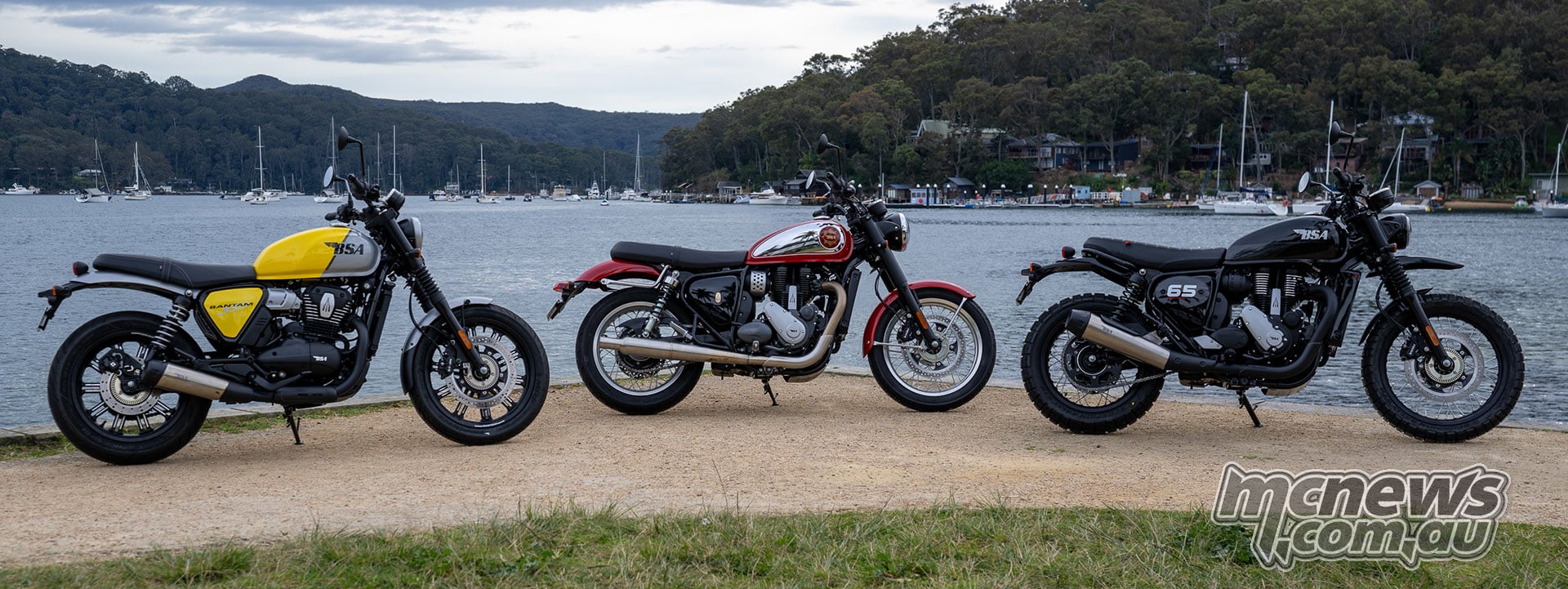
The Gold Star spearheaded the modern BSA revival, initially unveiled in 2021 before the brand’s return to production gathered momentum through other markets. Australia is comparatively late to the party.
Customer deliveries here began in late May. One early wrinkle was problems with the battery model they originally used. Leisk says LMI has now switched to genuine, made-in-Japan Yuasa YTZ14S batteries, a much more expensive solution than the original supply. Availability is the current hurdle; once supply is confirmed, LMI plans to roll replacement batteries out through its dealers to early adopters. In the meantime, LMI is replacing any problematic original batteries with available alternatives while it waits for sufficient YTZ14S supply to begin the broader replacement program.
The range
The opening Australian line-up encompasses three motorcycles.
At $7590 ride-away, the Bantam 350 is the entry point, powered by a 334 cc liquid-cooled DOHC single producing 29 horsepower at 7550 rpm and 29.62 Nm at 6000 rpm through a six-speed gearbox.
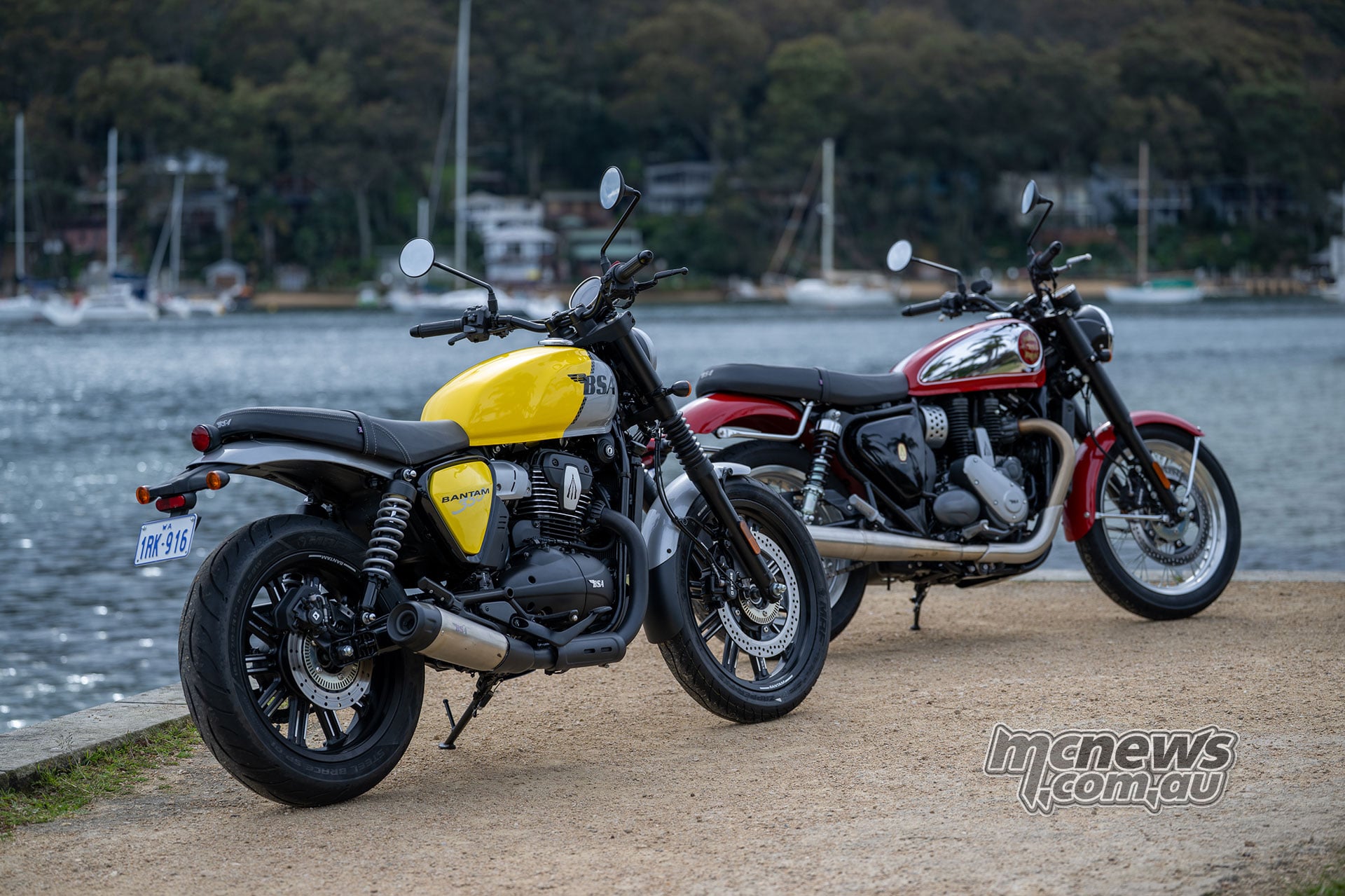
Then come two different takes on BSA’s 652 cc liquid-cooled DOHC single.
The Gold Star 650 and Scrambler 650 both use the 652 cc single in 45 hp at 6500 rpm / 55 Nm at 4000 rpm tune, driving through five-speed gearboxes. The Gold Star range starts at $11,699 ride-away and rises to $12,799 depending on finish, while all three Scrambler colours are $11,799 ride-away.

All three are LAMS approved and Euro 5+ compliant.
| Model | Engine | Gears | Seat Height | Weight | Wheels | Ride-away |
| Bantam 350 | 334 cc single 29 hp / 29.62 Nm | 6 | 800 mm | 185 kg | 18/17 cast | $7,590 |
| Gold Star 650 | 652 cc single 45 hp / 55 Nm | 5 | 780 mm | 213 kg | 18/17 wire | $11,699-$12,799 |
| Scrambler 650 | 652 cc single 45 hp / 55 Nm | 5 | 820 mm | 218 kg | 19/17 wire | $11,799 |
Both 650s carry 12 litres of fuel, while the little Bantam somewhat amusingly gets the biggest tank of the trio at 13 litres. We didn’t have the bikes for long enough under repeatable conditions to establish meaningful real-world ranges, so we’ll leave that particular question for a longer test.
A fourth model is coming.
The Thunderbolt 350 takes BSA into the increasingly competitive lightweight adventure segment, and Jeff expects it in Australia during 2027, although precise timing has not yet been established. BSA has already shown the bike with rally-style bodywork, traction control and three ABS modes, making it a more overtly adventure-focussed proposition than the current trio.
Singles amongst a sea of twins
Perhaps the most interesting mechanical decision BSA has made is what it hasn’t done.
The middleweight market is drowning in parallel twins.
BSA has instead made the single-cylinder engine central to its new identity.
Large singles aren’t completely extinct in Australia. Kawasaki’s KLR650 continues at the utilitarian dual-sport end of the market, while Ducati’s Hypermotard 698 Mono and the KTM/Husqvarna 690/701 family occupy the far more aggressive performance end.
But if you’re looking for a conventional road-going modern classic around this capacity, BSA is essentially out there on its own.

There is also an interesting engineering family tree behind that 652.
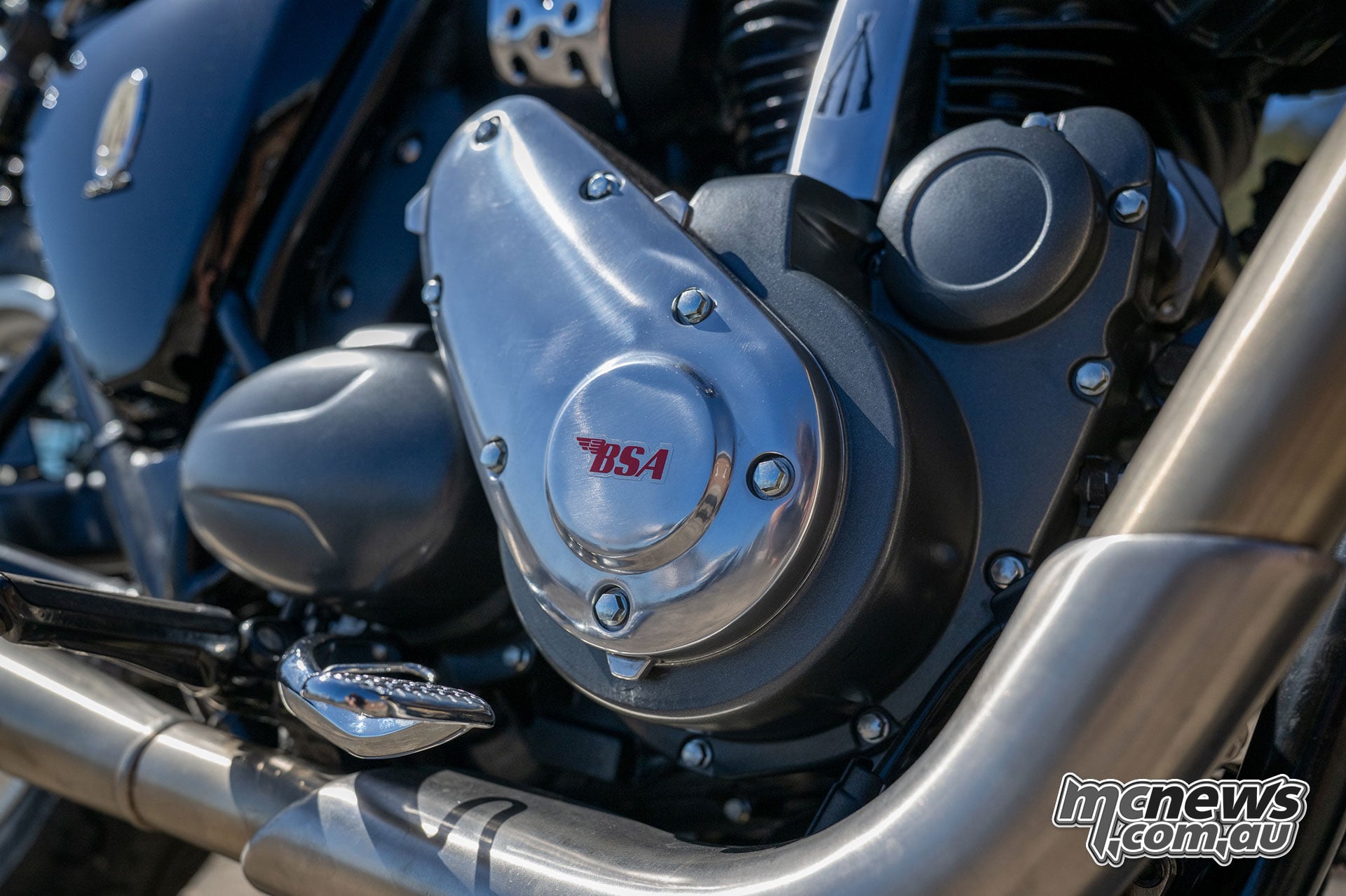
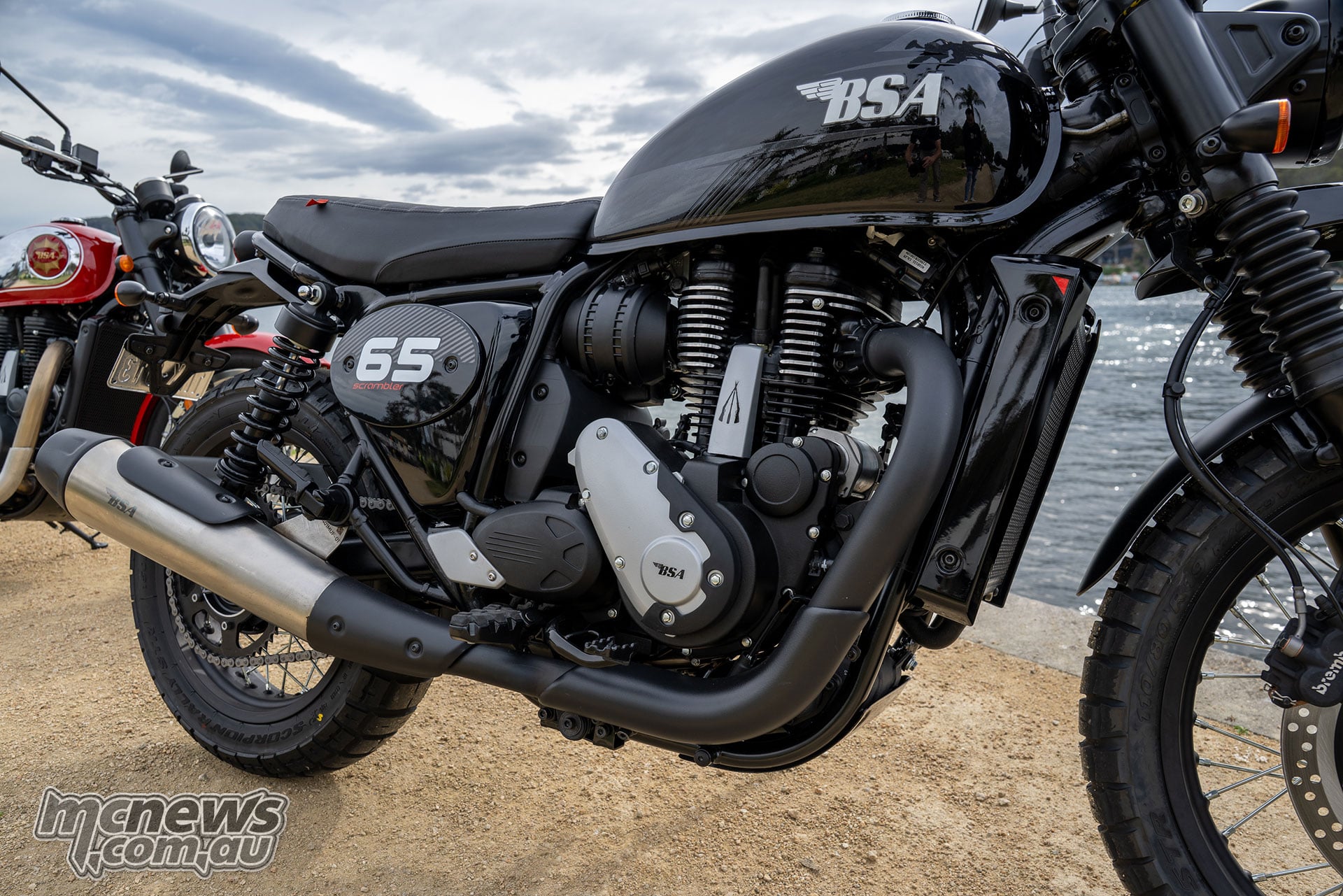
The engine architecture traces back to the Rotax single most famously used in BMW’s old F650 range, with that basic Rotax design subsequently heavily reworked for the new BSA application. In BSA form it is a twin-spark, four-valve DOHC design with liquid cooling, dry-sump lubrication and an assist-and-slipper clutch. Rotax have a fantastic reputation for durability.
Curiously, the BSA and current KLR650 share exactly the same 100 x 83 mm bore and stroke. The BSA works it considerably harder, however, running an 11.5:1 compression ratio compared with 9.8:1 for the Kawasaki.
That almost four-inch diameter piston might have you expecting some sort of slow plodding and somewhat agricultural exhaust note.
That’s not really what you get.

They look right – and sound different
The visual side of these motorcycles is something photographs can only convey so far.
Rob’s images here will give you a far better idea than another thousand words from me, but these are motorcycles that reward being walked around and stared at for a while.
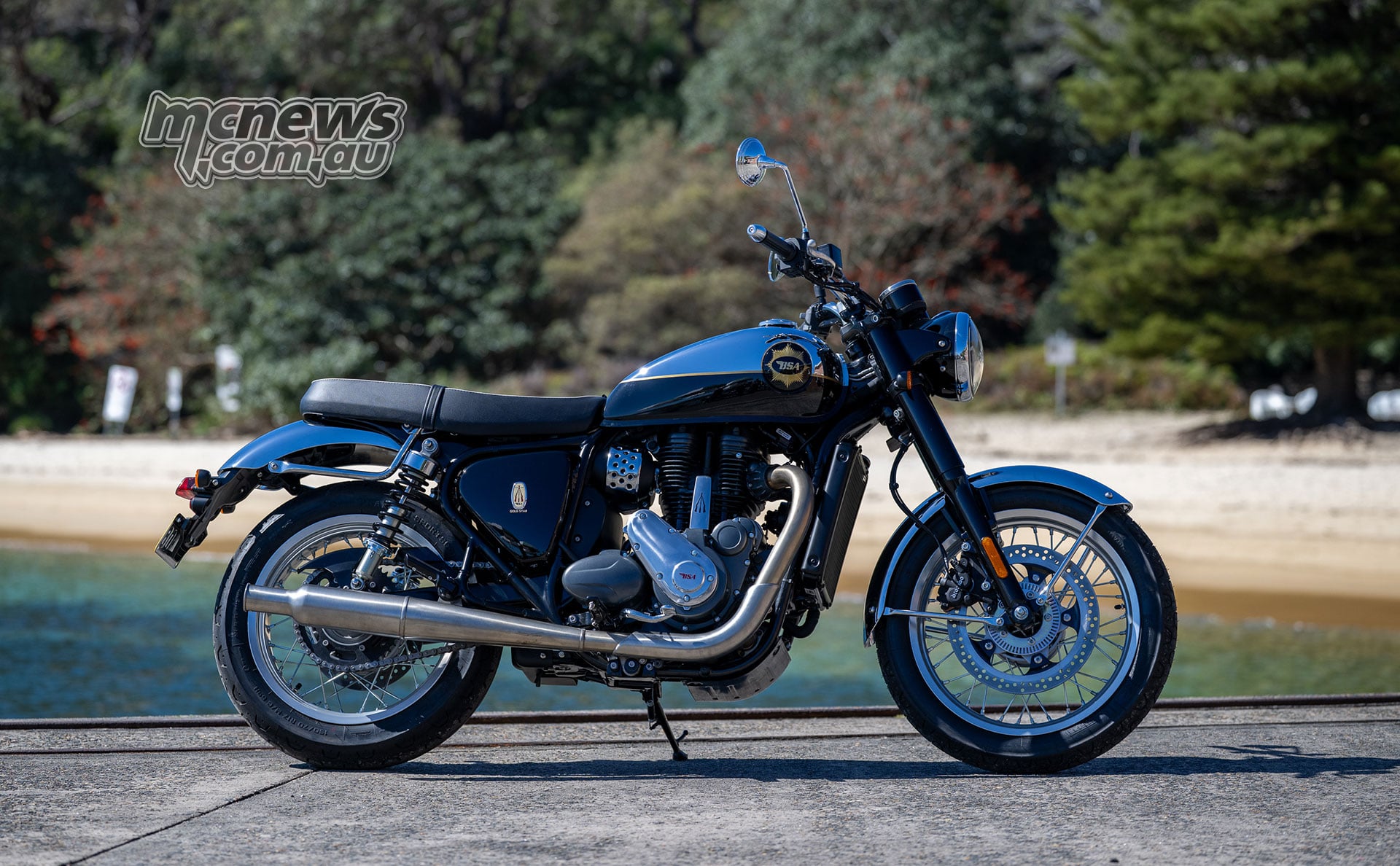
You need the old Mark One eyeballs to really drink in how the various shapes, finishes, textures and little period details come together.
The colours make a larger difference to the character of the motorcycles than a simple change of hue normally manages as well.
Insignia Red grabbed my attention on the Gold Star initially, but the longer I looked at the new Birmingham Blue, the more its understated treatment started talking to me. The blue really grew on me.
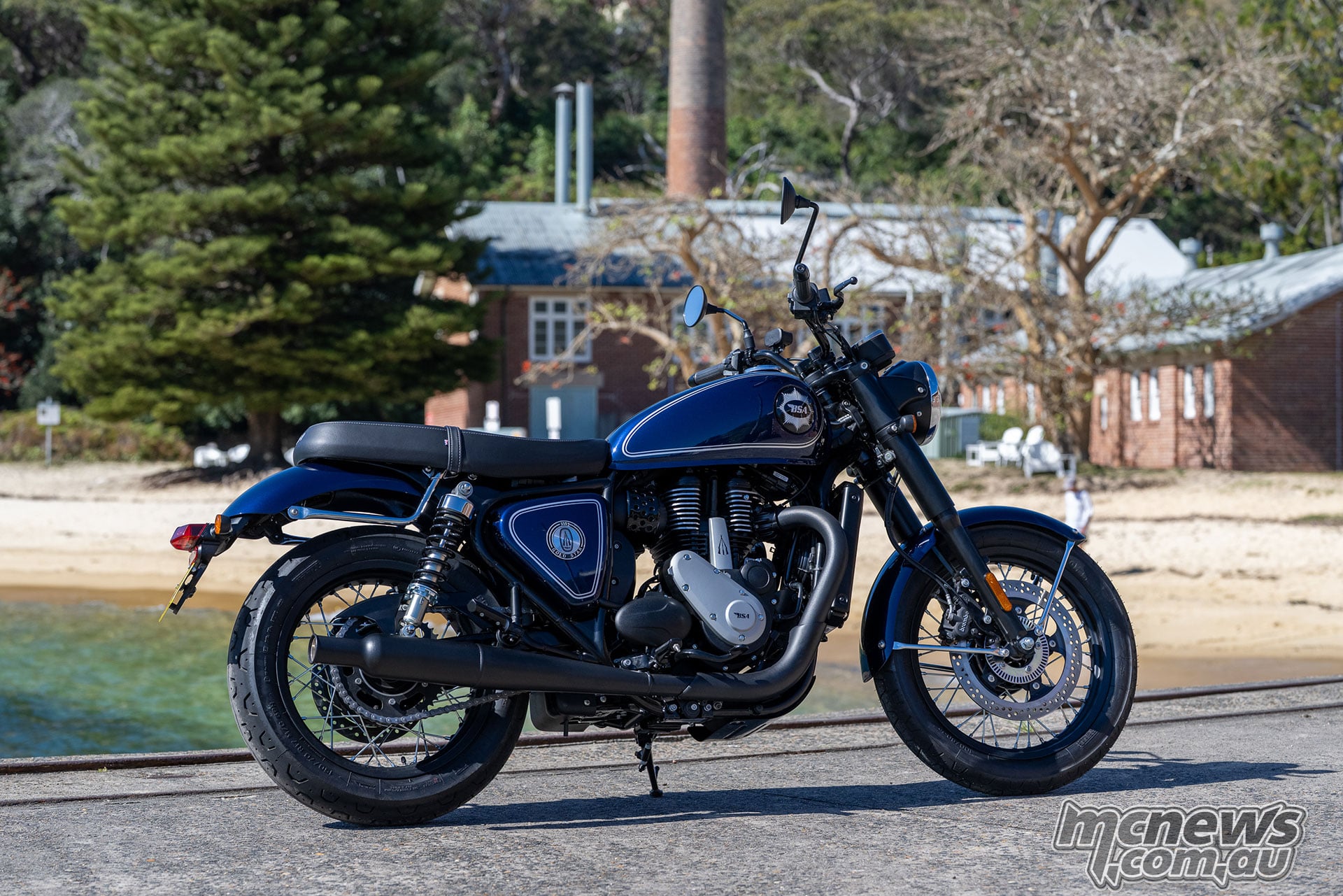
The Scrambler produced a similar reaction.
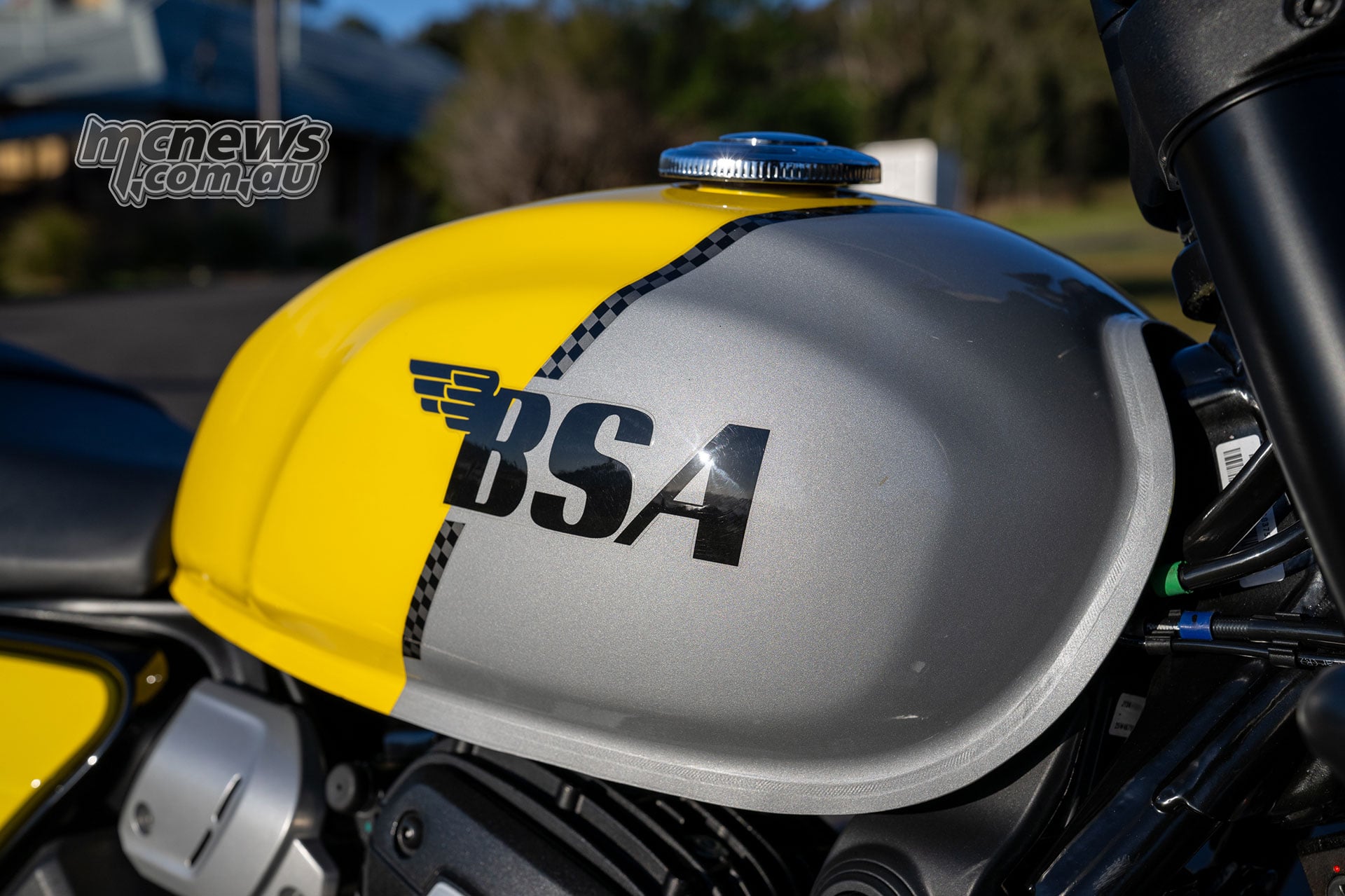
The extroverted Victor Yellow shouts at you first, but I increasingly warmed to the much more understated Thunder Grey – which visually reads closer to white.

Those who subscribe to the seemingly ever-popular “everything must be black” school of motorcycle design aren’t going to look past Raven Black.
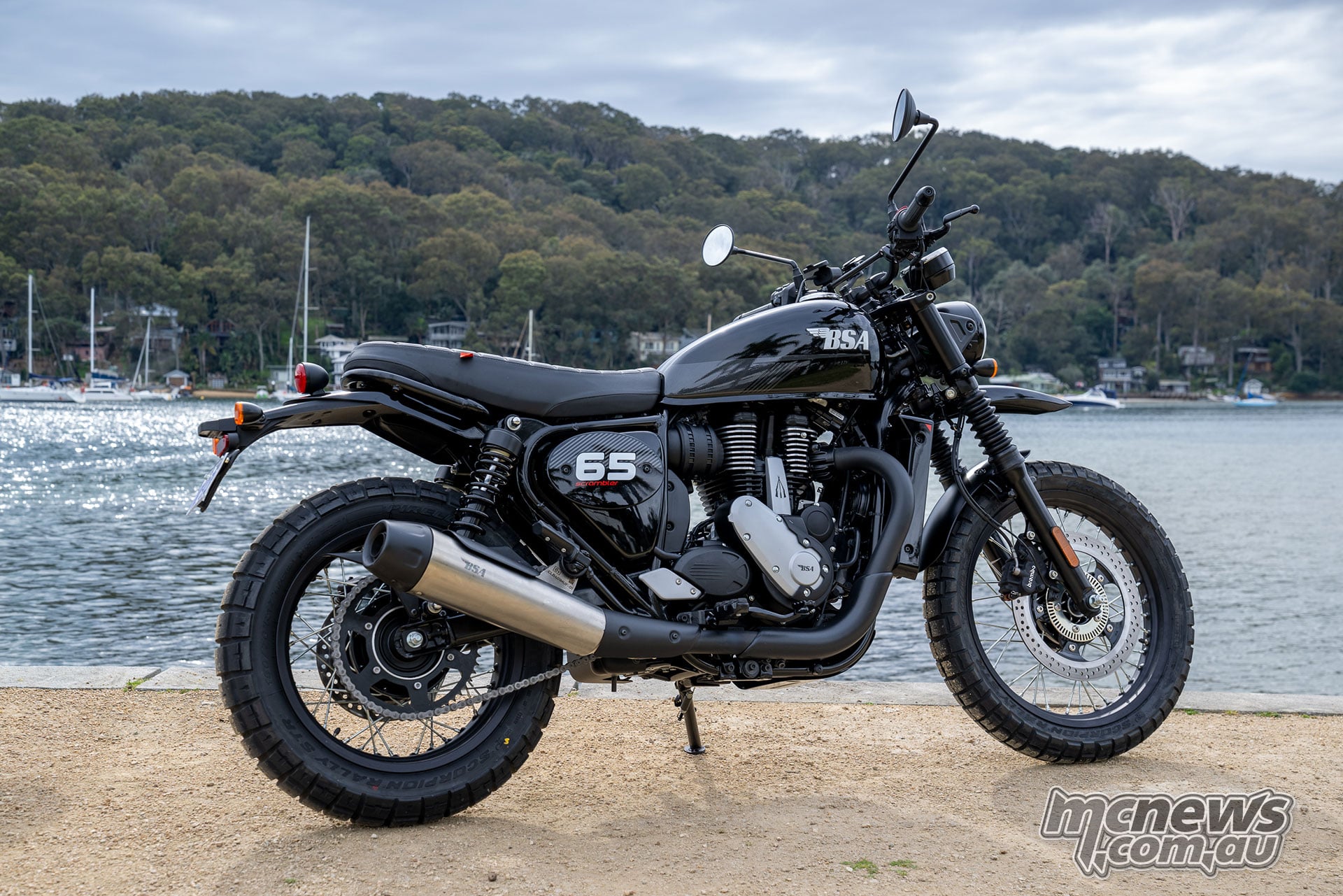
And with the Bantam, Oxford Blue eventually won me over.
The colour catalogue gives prospective owners plenty of scope to change each motorcycle’s personality before they’ve fitted a single accessory.
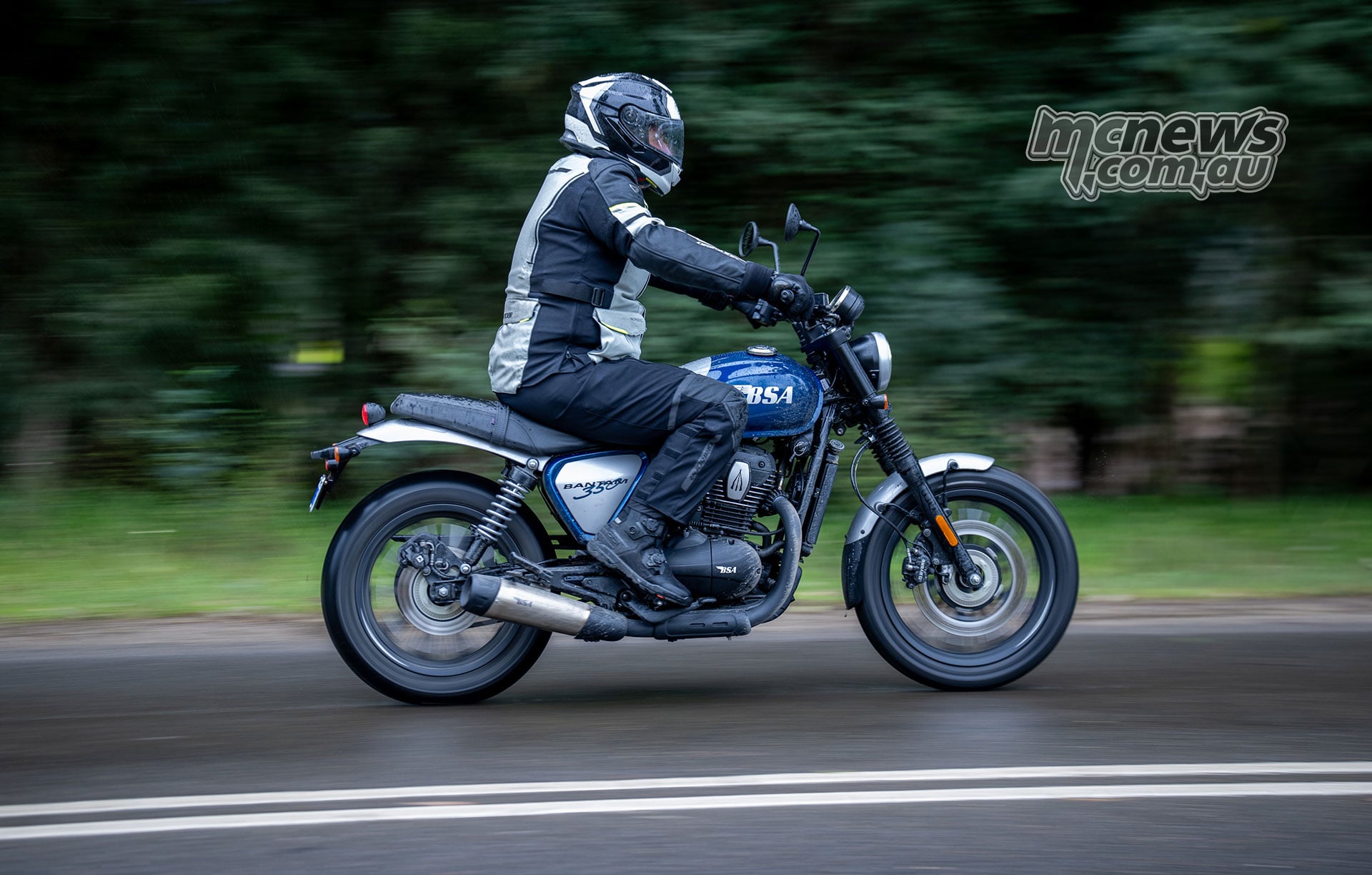
A couple of those new hues also have genuine history behind them. Brooklands Black references the circuit where the original Gold Star built its racing legend, while the new Mist Green Bantam nods to the first BSA Bantam released in 1948.
| Model | Colour and ride-away pricing |
| Gold Star 650 | Shadow Black / Birmingham Blue – $11,699 Highland Green – $11,999 Dawn Silver / Insignia Red / Midnight Black – $12,249 Silver Sheen Legacy / Brooklands Black – $12,799 |
| Scrambler 650 | Raven Black / Thunder Grey / Victor Yellow – $11,799 |
| Bantam 350 | Barrel Black / Victor Yellow / Avalon Grey / Fire-Cracker Red / Oxford Blue / Mist Green – $7,590 |
They sound pretty good too.
Importantly, the soundtrack is distinctly different from the parallel twins surrounding them in the market. The 650 singles don’t produce the slow, heavy chuff you might expect. There is a harder and more energetic edge to the note than that.

I’m not going to wax lyrical about exhaust acoustics for six paragraphs, though. Sound is too subjective. You really need to hear one yourself and decide whether it floats your boat.
Instant response
What isn’t subjective is the immediate response you get when cracking the throttle.
Big singles have a particular way of turning a relatively modest peak horsepower figure into something that feels muscular at everyday speeds.
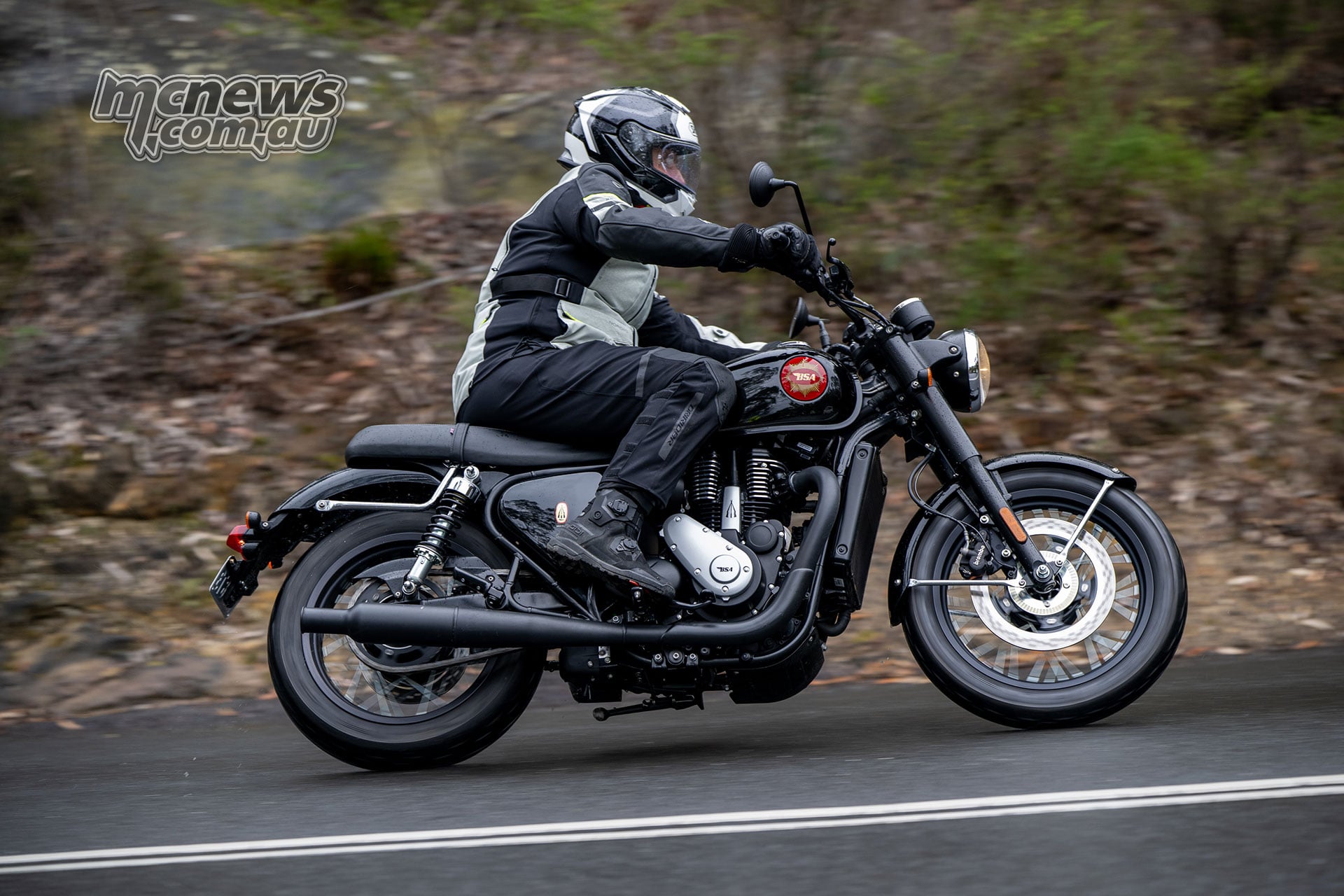
The BSA does exactly that. Open the throttle and there’s an instant shove that makes the 45 hp headline almost irrelevant much of the time.
Fuelling during our riding was also very close to spot-on. I could deliberately catch the system out occasionally by snapping the throttle from idle while stationary and provoke the odd cough, but I couldn’t ascertain anything untoward while actually riding. Throttle connection was clean and predictable, and the engine pulled very willingly from idle.
That was one of the strongest early impressions from the Gold Star, and our day-one observations also found the little Bantam surprisingly willing from 4000 rpm in top gear.
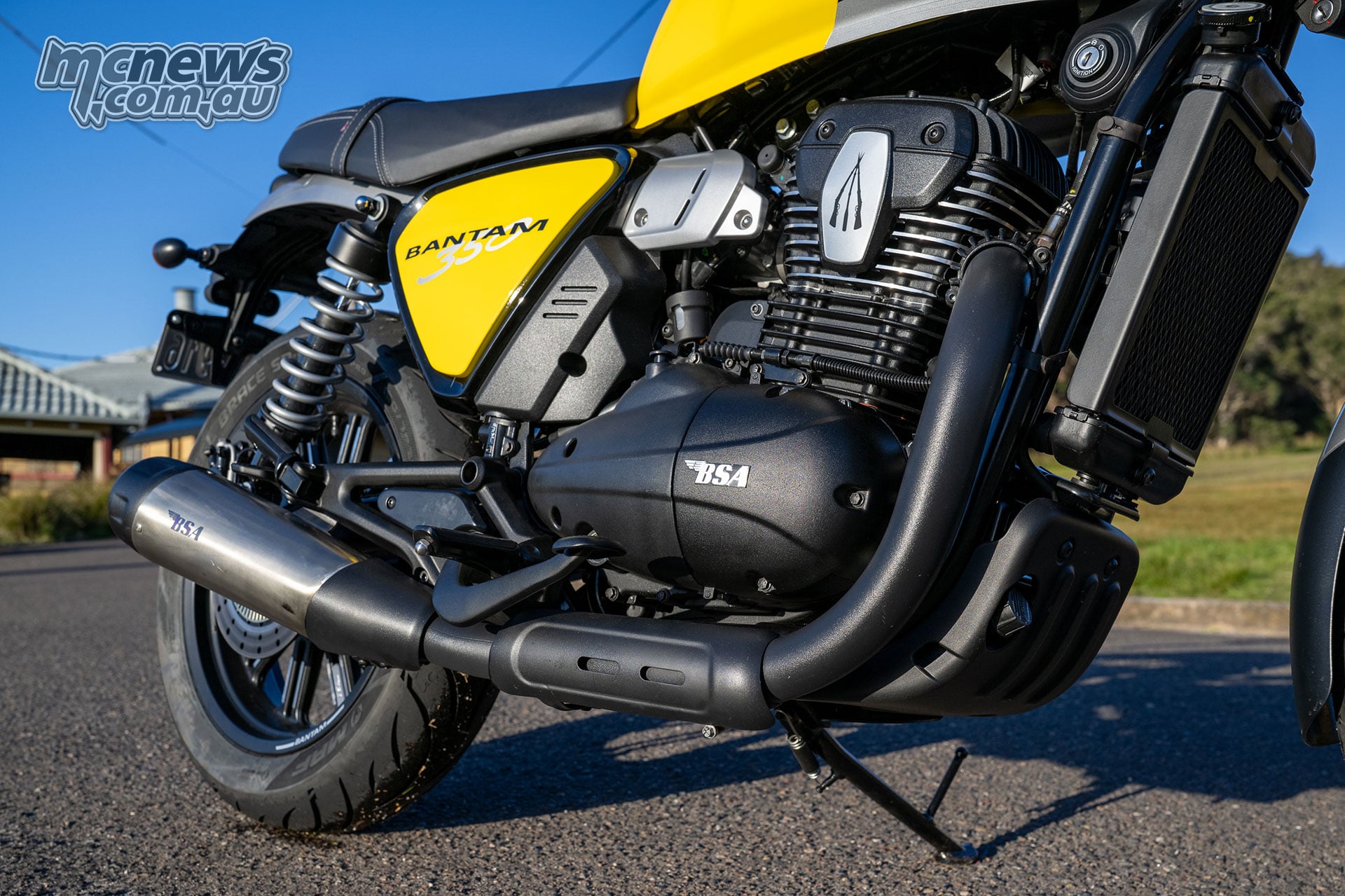
Gold Star 650 – heritage front and centre
If you’re looking for the motorcycle that most completely sells the BSA heritage story, the Gold Star is it.
And Australian buyers appear to agree.
Leisk says the early sales mix has run at roughly 70 per cent Gold Star, with Bantam and Scrambler splitting the remainder at around 15 per cent apiece. He isn’t particularly surprised, describing the Gold Star as the obvious heritage model for riders already familiar with old BSAs.
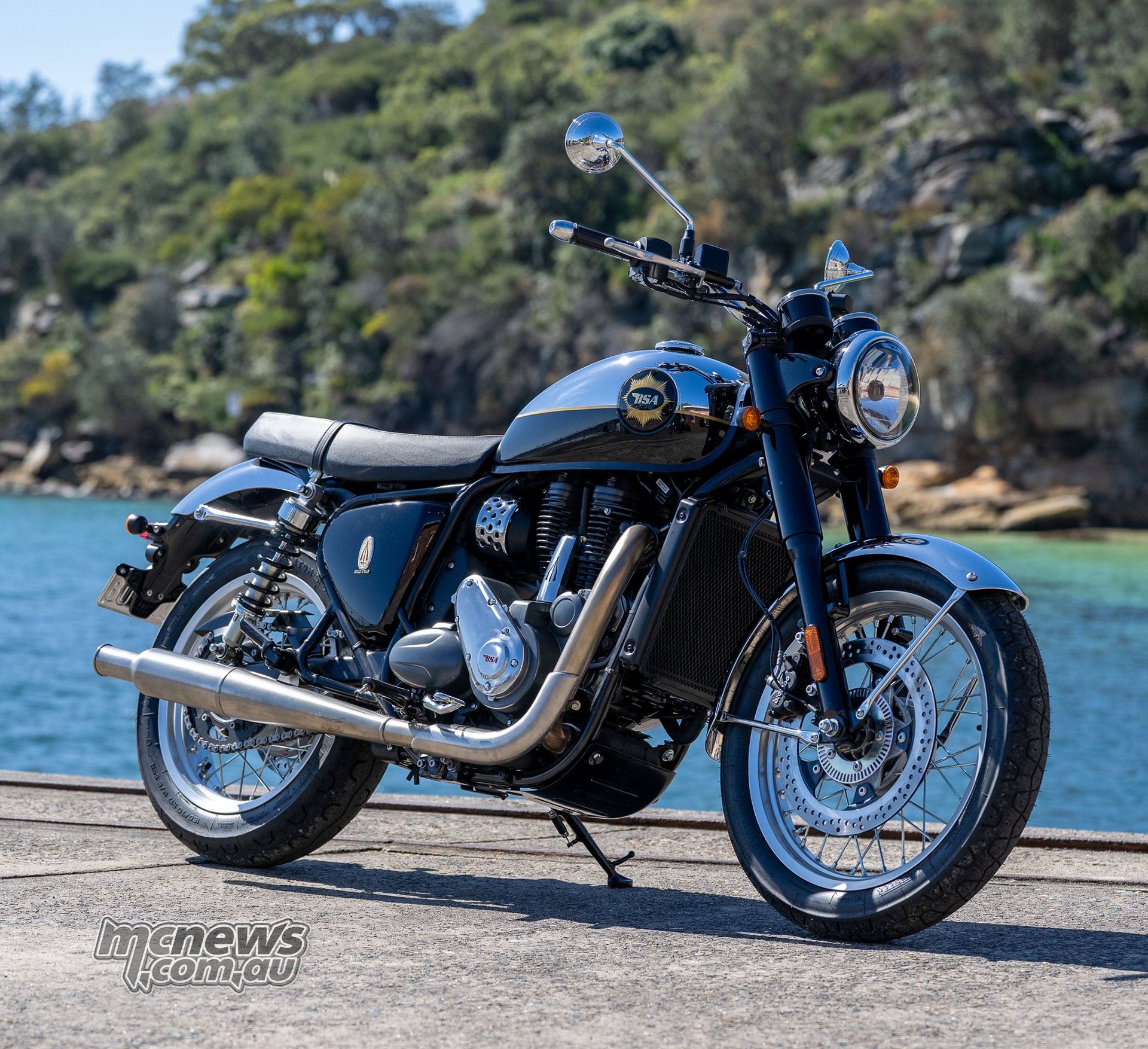
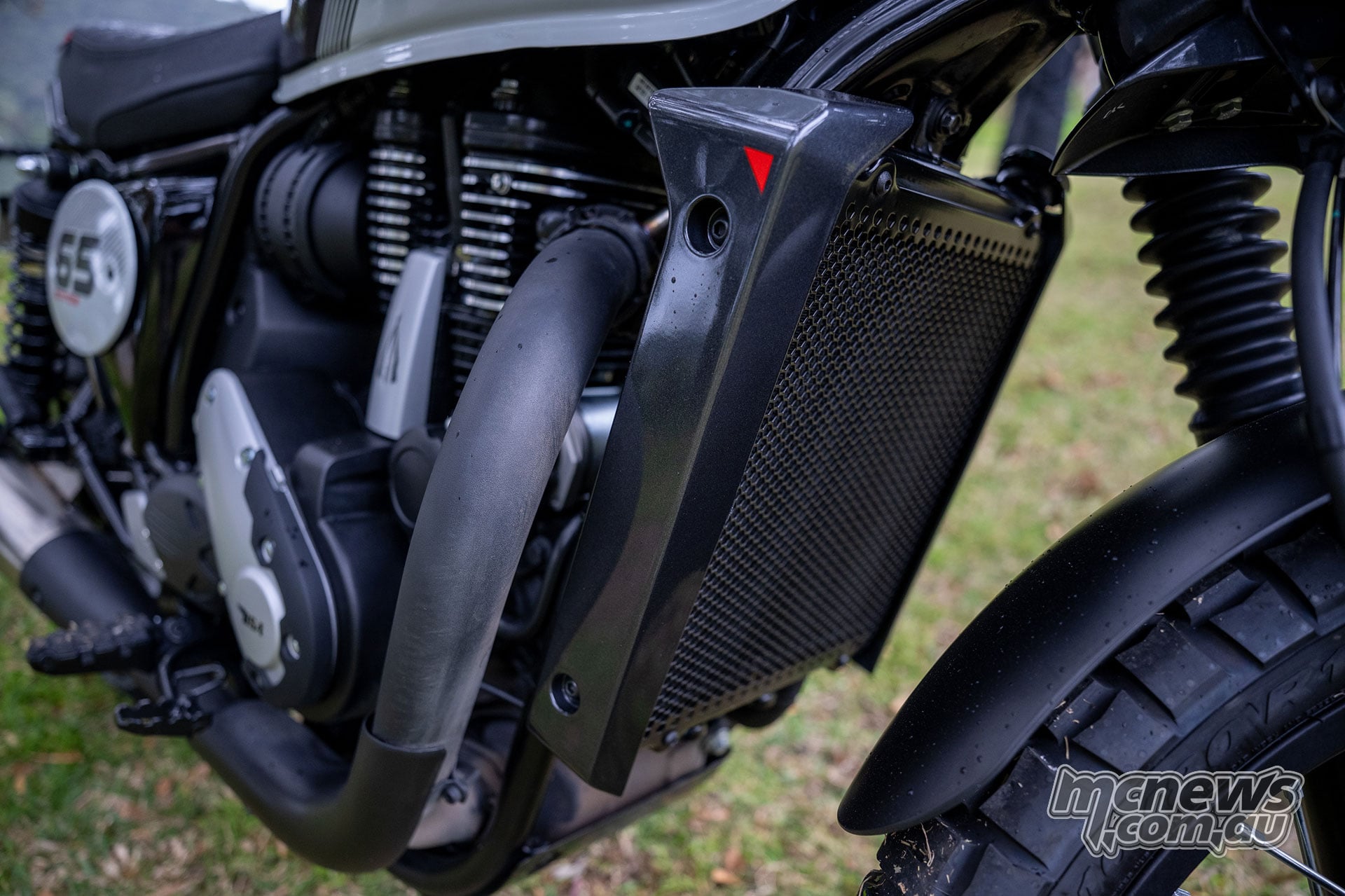
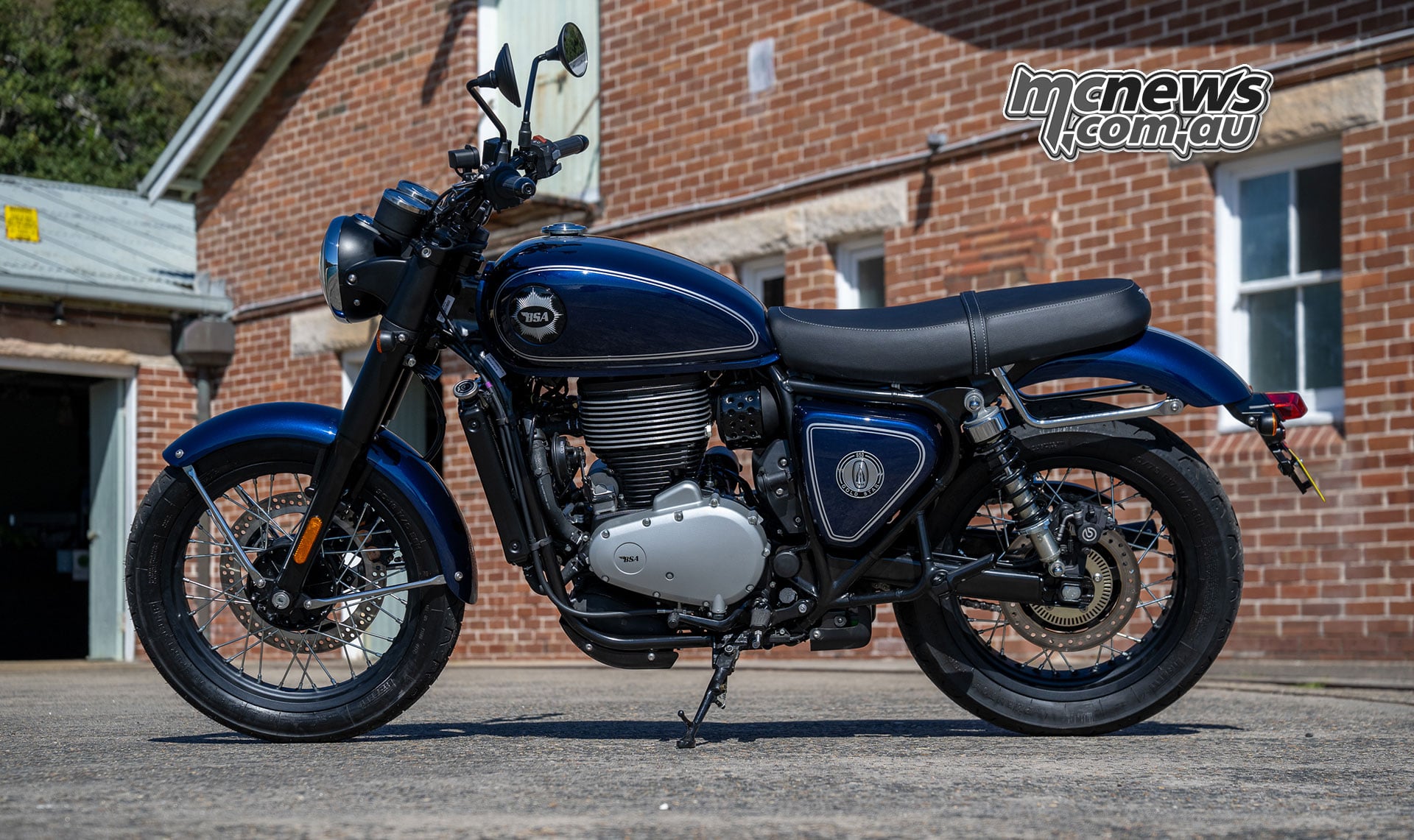
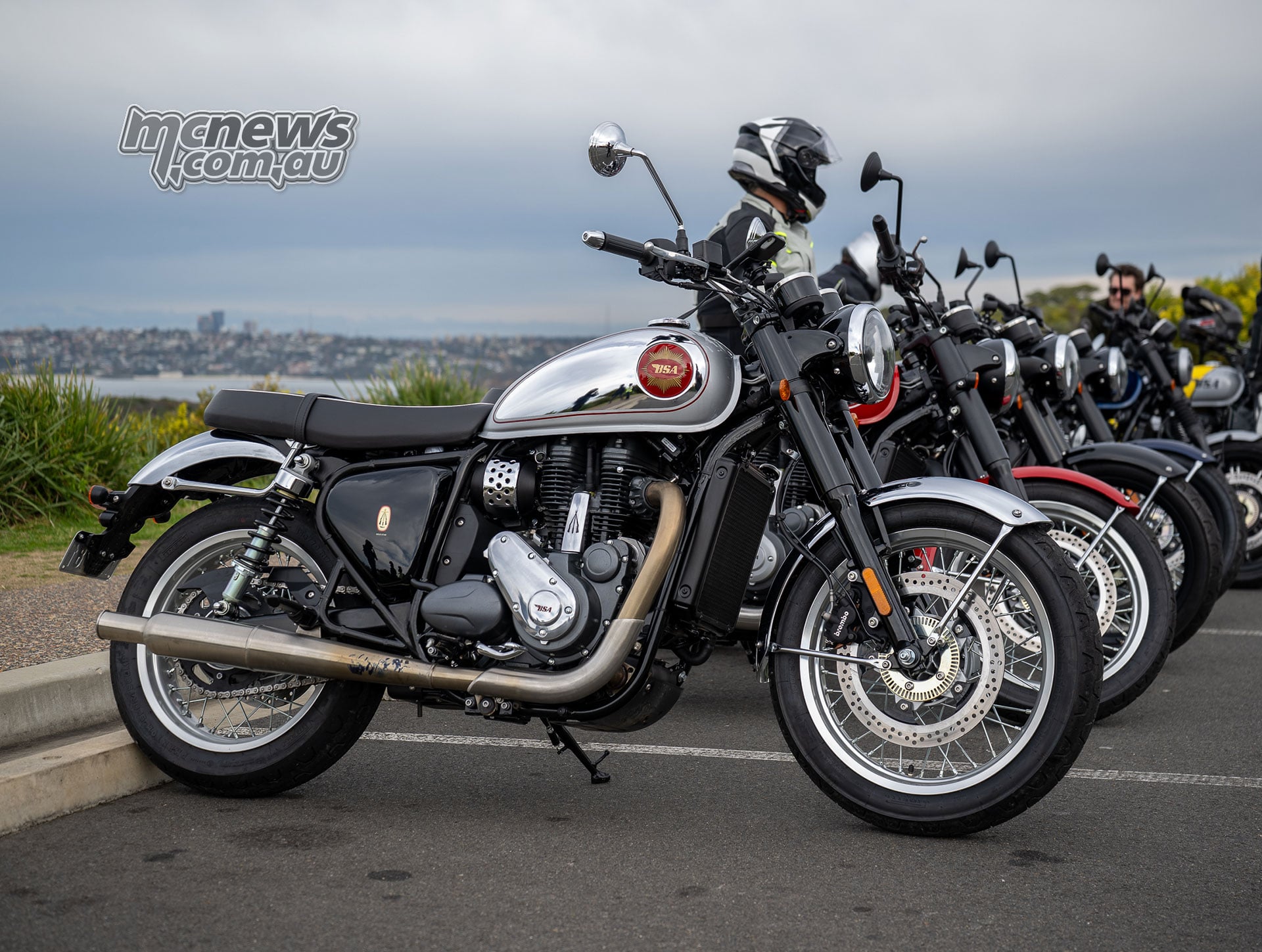
The Gold Star’s silhouette, chrome, wire wheels, twin rear shocks, traditionally shaped tank and low 780 mm saddle all conspire to sell the period theme.
Importantly, it does so without looking like somebody raided an old motorcycle catalogue and simply enlarged everything.
The liquid-cooled engine is styled to fit the picture, and much of the modern hardware is kept relatively discreet.
Don’t chase the redline
Peak torque arrives at only 4000 rpm.
That tells you plenty about how to ride it.
At 60 km/h in fifth, the Gold Star is turning only a little over 2000 rpm. It will accept 50 km/h in top without immediately throwing its toys out of the cot, but ask it to accelerate hard from there, and you can feel the big single telling you it would rather you selected fourth.
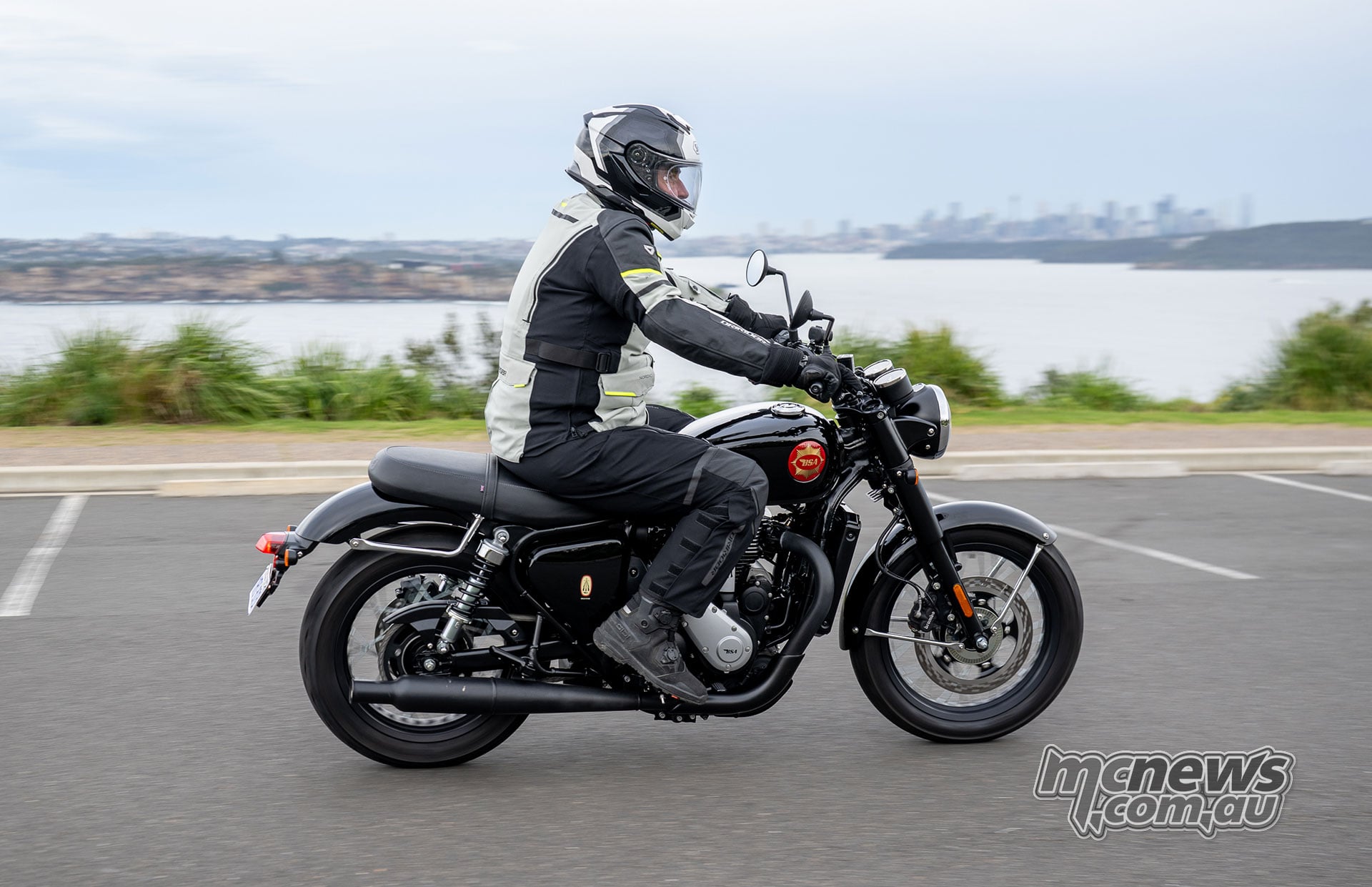
At 80 km/h you’re around 3000 rpm and at 100 km/h only just over 4000. The engine feels good operating there.
Short-shift it, ride the torque and let the big single punch its way along.
Early on, once the needle climbed beyond about 5500 rpm, vibration became progressively more intrusive, and there seemed little reward in continuing much further.
It would rev beyond 6000, but why bother?
That was my opinion on day one, anyway.
It didn’t remain quite that simple.
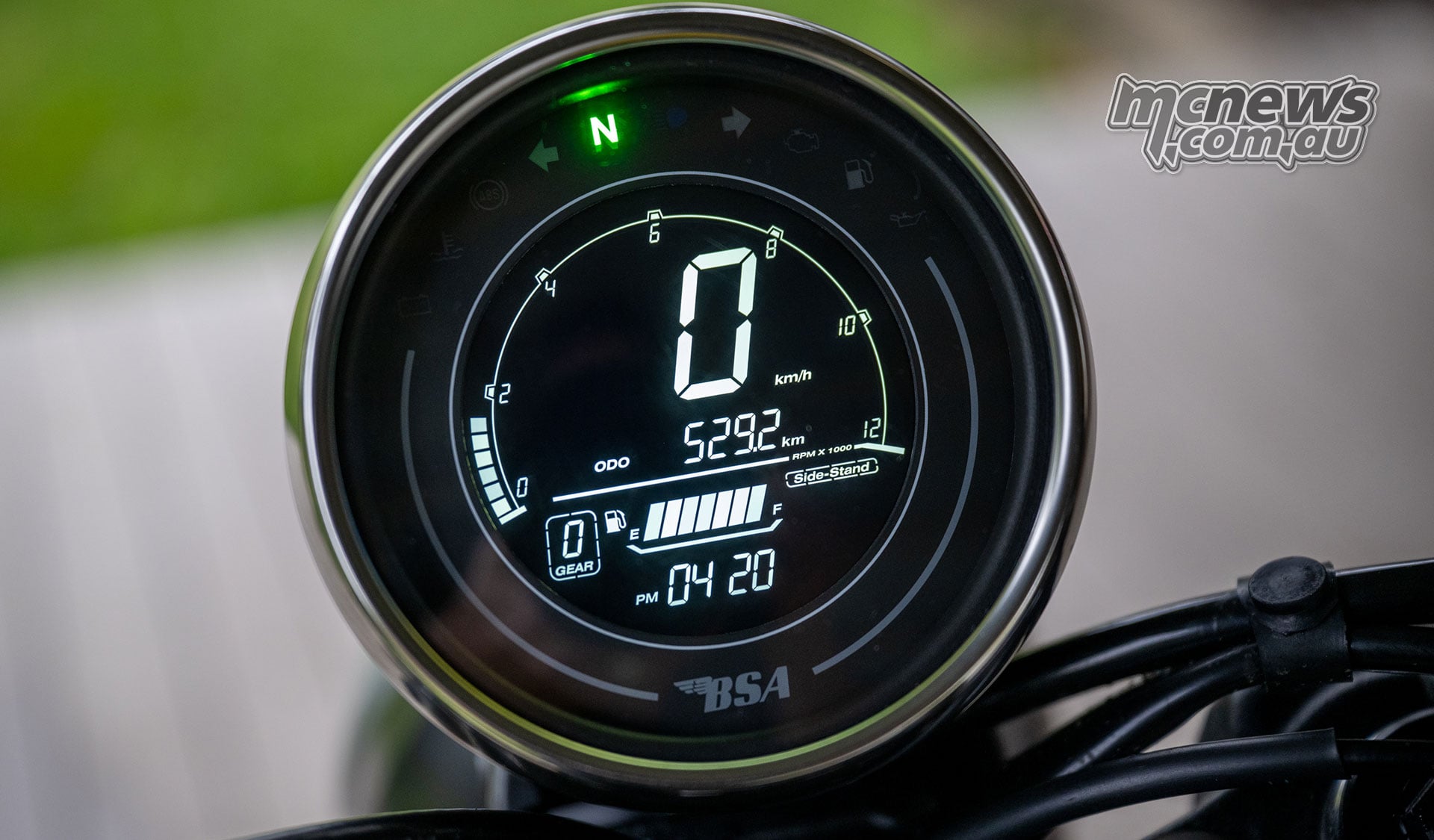
The Gold Star’s wonderfully odd clocks
The cockpit is unapologetically retro, but on first glance I thought I might be having a stroke.

You get separate analogue speedometer and tachometer pods, but their needles sweep in the opposite direction to normal, which had me squinting for a moment.
Once underway, it became entirely natural. However, the kilometre being spelt in American across the top continued to damage this editor’s brain.
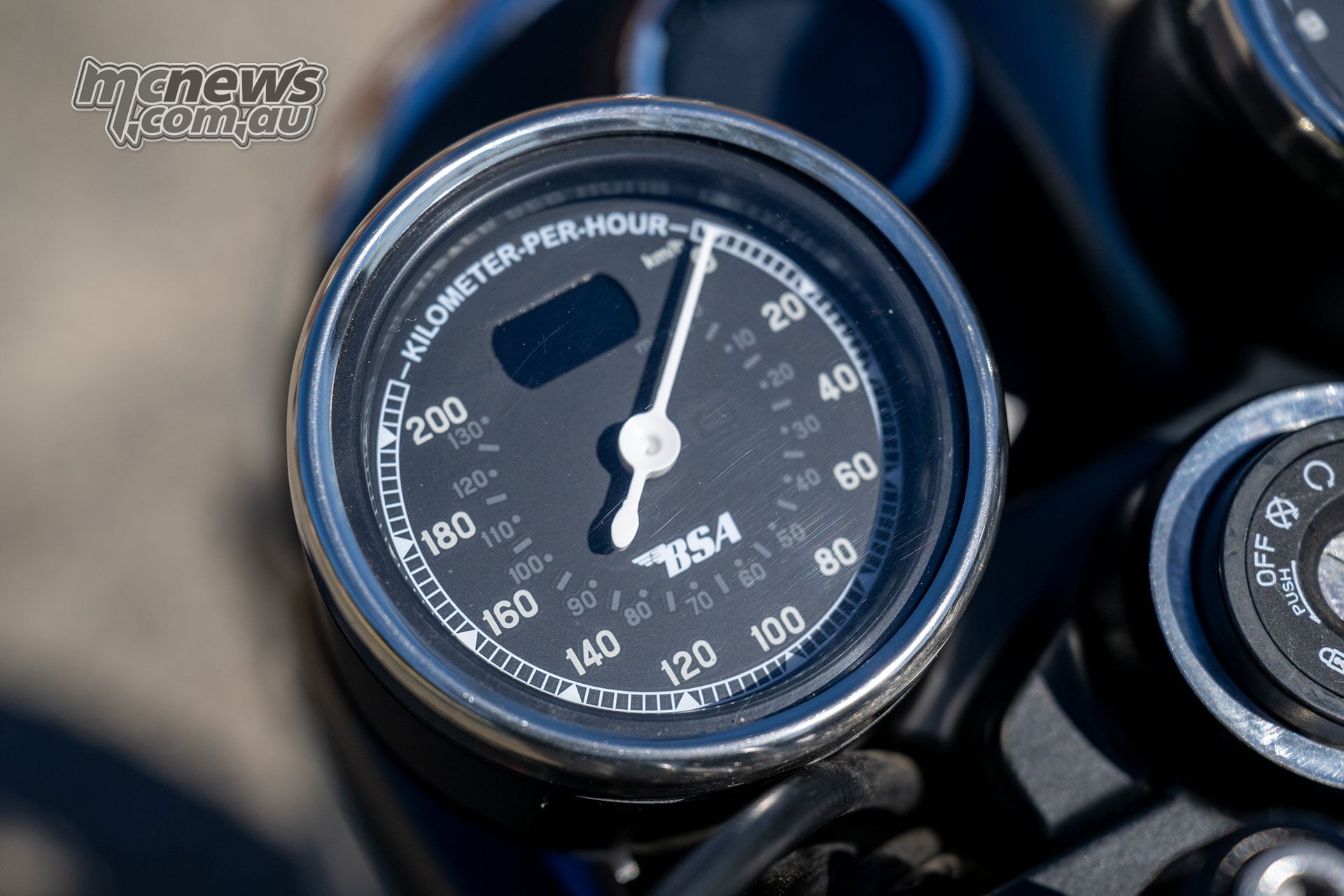
Both clocks incorporate tiny LCD sections that are almost invisible until you take a second look. That’s clever aesthetically because it preserves the analogue appearance from a distance. The price is readability, as some of the digital information is sufficiently small that it isn’t particularly easy to digest on the move.
The tacho is graduated all the way to 10,000 rpm, but I think the engine internals would become externals before you hit those heights…
The speedometer is similarly optimistic and more realistic scales would make both substantially easier to read at a glance.

The primary warning-light arrangement is cleverly separated into the subtle dark circular panel perched in the nose above the headlight, again keeping the clocks visually clean. It’s a discrete solution.
A few modern bits intrude
Not everything in the rider’s eye-line sells the period illusion quite as convincingly.
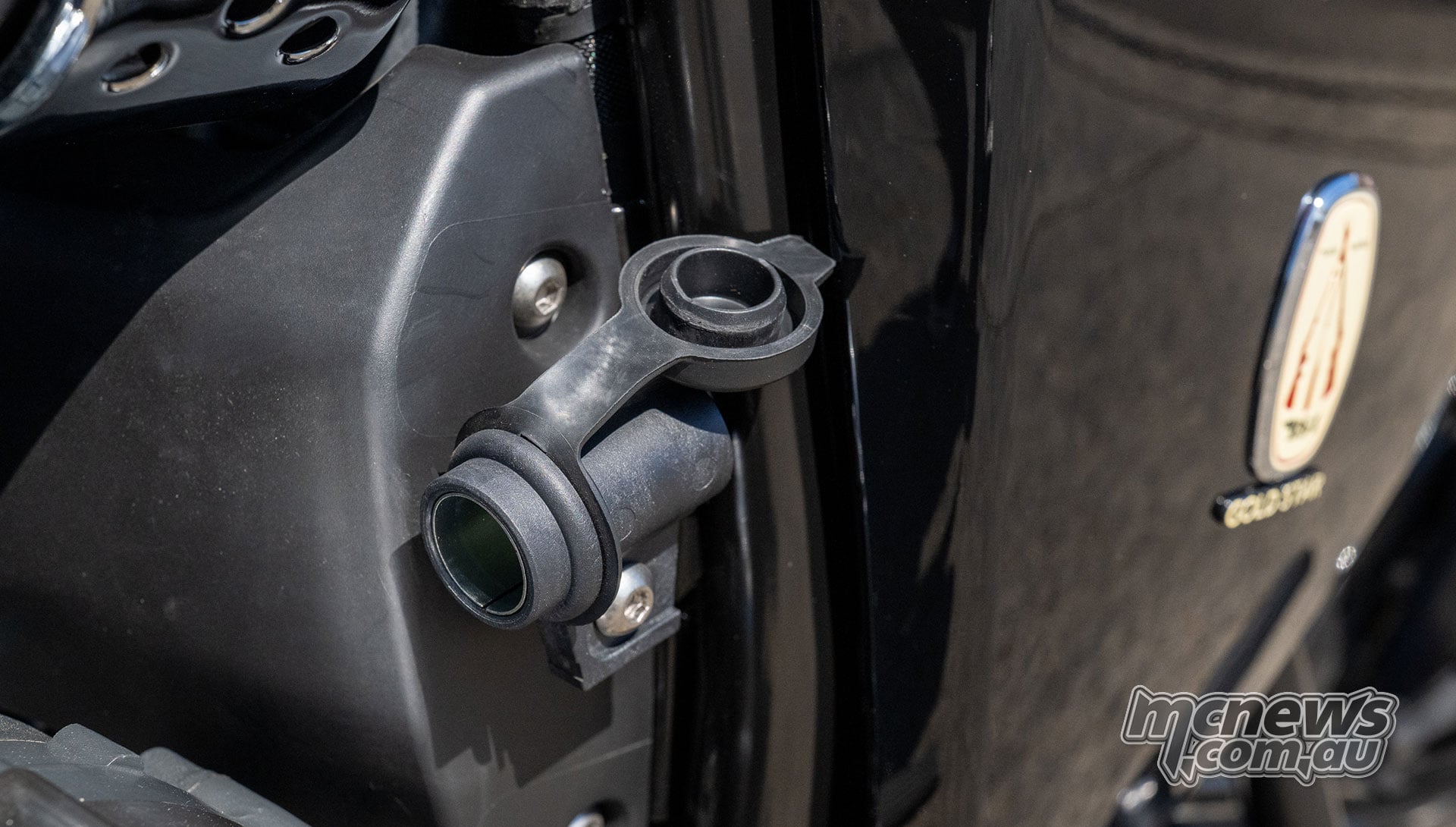
The switchgear looks considerably more modern than the rest of the Gold Star, while the combined USB-A and USB-C power outlet looks somewhat stuck onto the cockpit rather than integrated into the styling from day one.
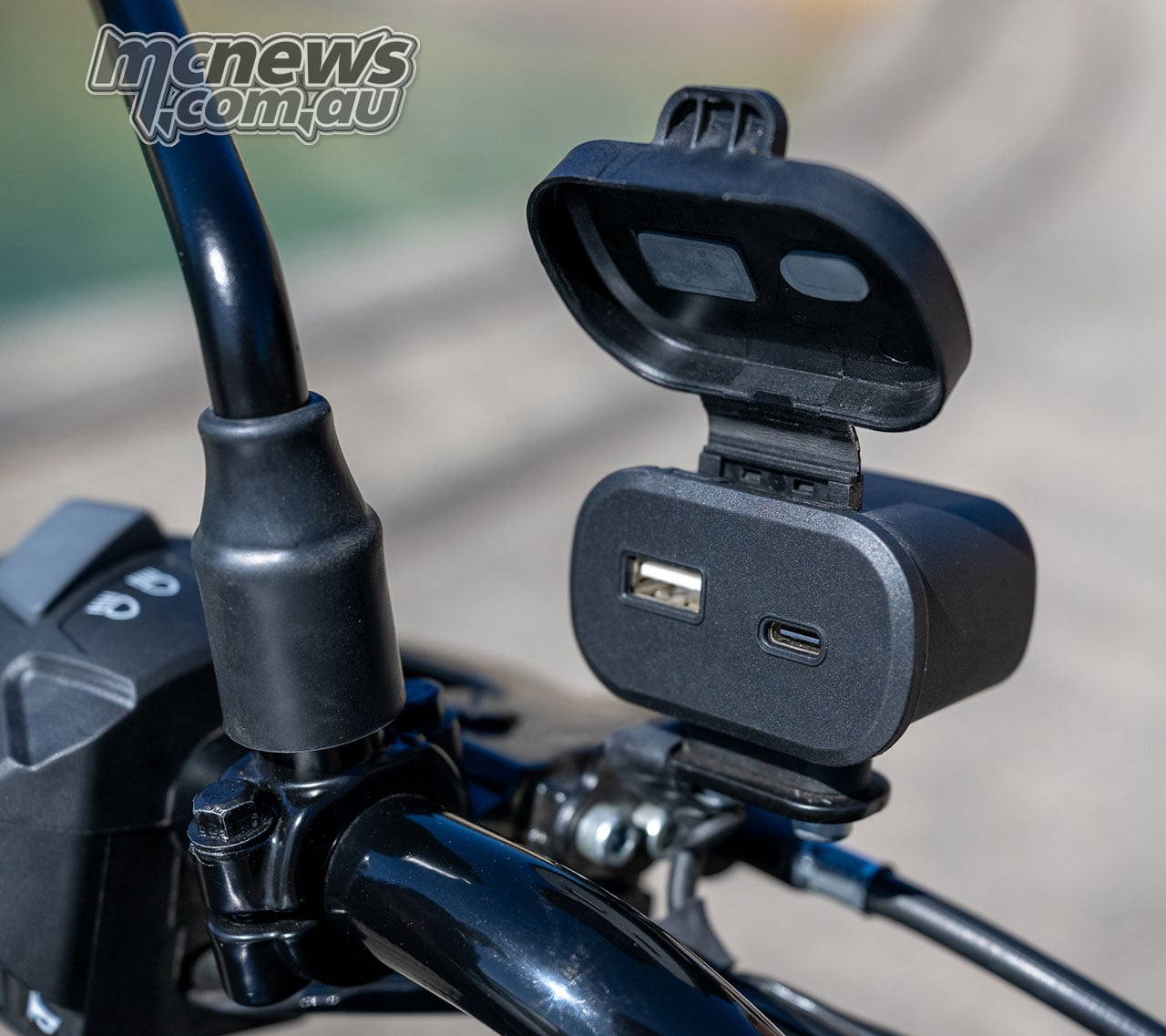
It’s a minor complaint. I’d rather have useful power outlets than not. But if you’ve sweated every visual detail trying to transport a rider back several decades, those little modern intrusions stand out more than they would on almost anything else. You could always take the outlet off easily enough and then just put it back on if heading away on tour.
Heated grips aren’t currently offered; however, a 12-volt cigarette-style power outlet is provided as standard, which could power your heated riding gear and is a nice touch at no extra cost.
Low, stable and initially a little reluctant
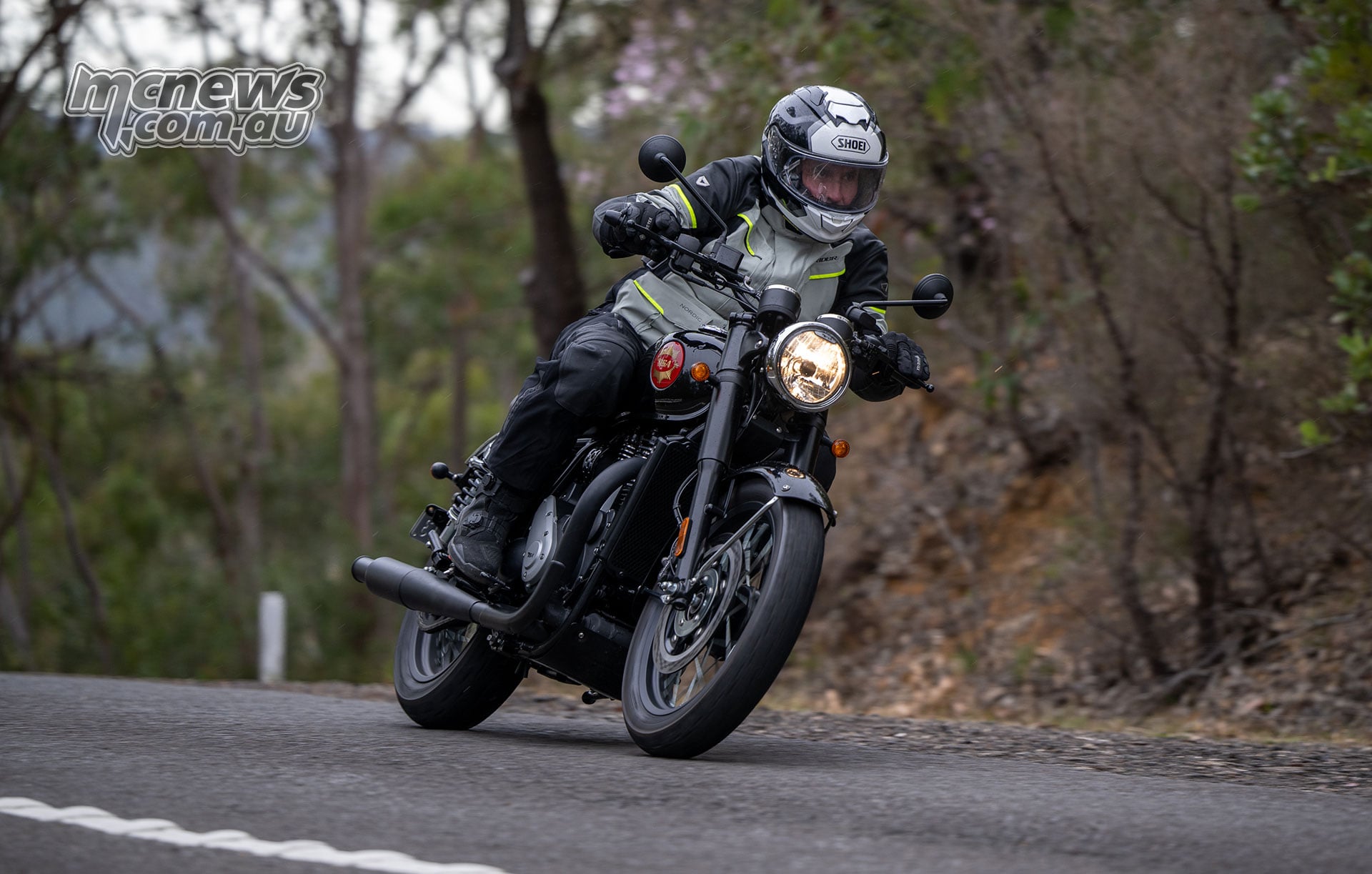
At 780 mm, the Gold Star saddle is low, which, combined with the flat seat, makes throwing a leg over the bike a doddle.
Its 213 kg wet weight is hardly featherweight, but with the mass carried down low it is easy enough to balance at a stop.

My first impression of the steering was less positive.
There was a distinct bit of effort required to move the bike away from straight ahead before it then tipped into the turn reasonably willingly.
The chassis felt stable, but over bigger ripples and mid-corner bumps it became less composed than I’d like.
Our day-one notes described the forks as doing a somewhat better job than the rear and suggested the chassis could become unsettled over mid-corner bumps.
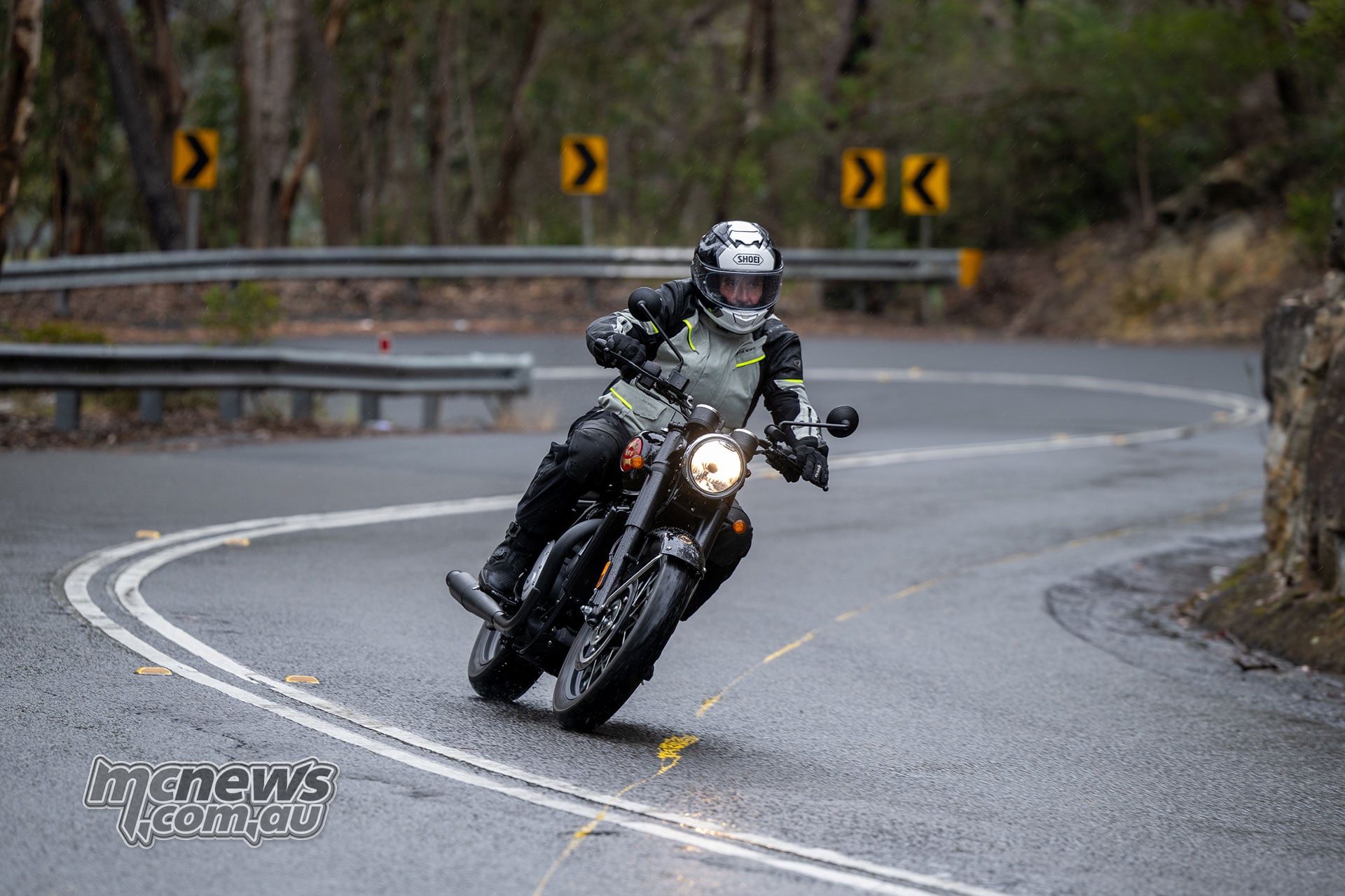
At that stage I was comfortable saying Royal Enfield’s 650 chassis package felt appreciably better sorted.
By the end of day two, I wasn’t nearly as certain.
Tyre pressures muddy the water
Another point makes me reluctant to issue too definitive a chassis verdict.
The local BSA team had deliberately set front and rear tyre pressures a few psi below the manufacturer’s recommendations. While putting initial kilometres on the bikes, they felt the lower settings helped the ride, so they carried that philosophy into the launch fleet.
I’m not convinced it was the right direction.

Lower front pressure could certainly be contributing to that initial reluctance to steer away from centre, while extra carcass movement may also be playing a part in what we felt when the road surface became particularly ugly.
But importantly, we didn’t have the opportunity to conduct a controlled back-to-back test at the recommended pressures.
So I don’t want to pretend we’ve solved it, as this is something we need to revisit on a longer test. Set the tyres to BSA’s recommended figures, find some decent roads and see what happens. Preferably roads decidedly less shit than much of northern Sydney managed to serve up during this launch.
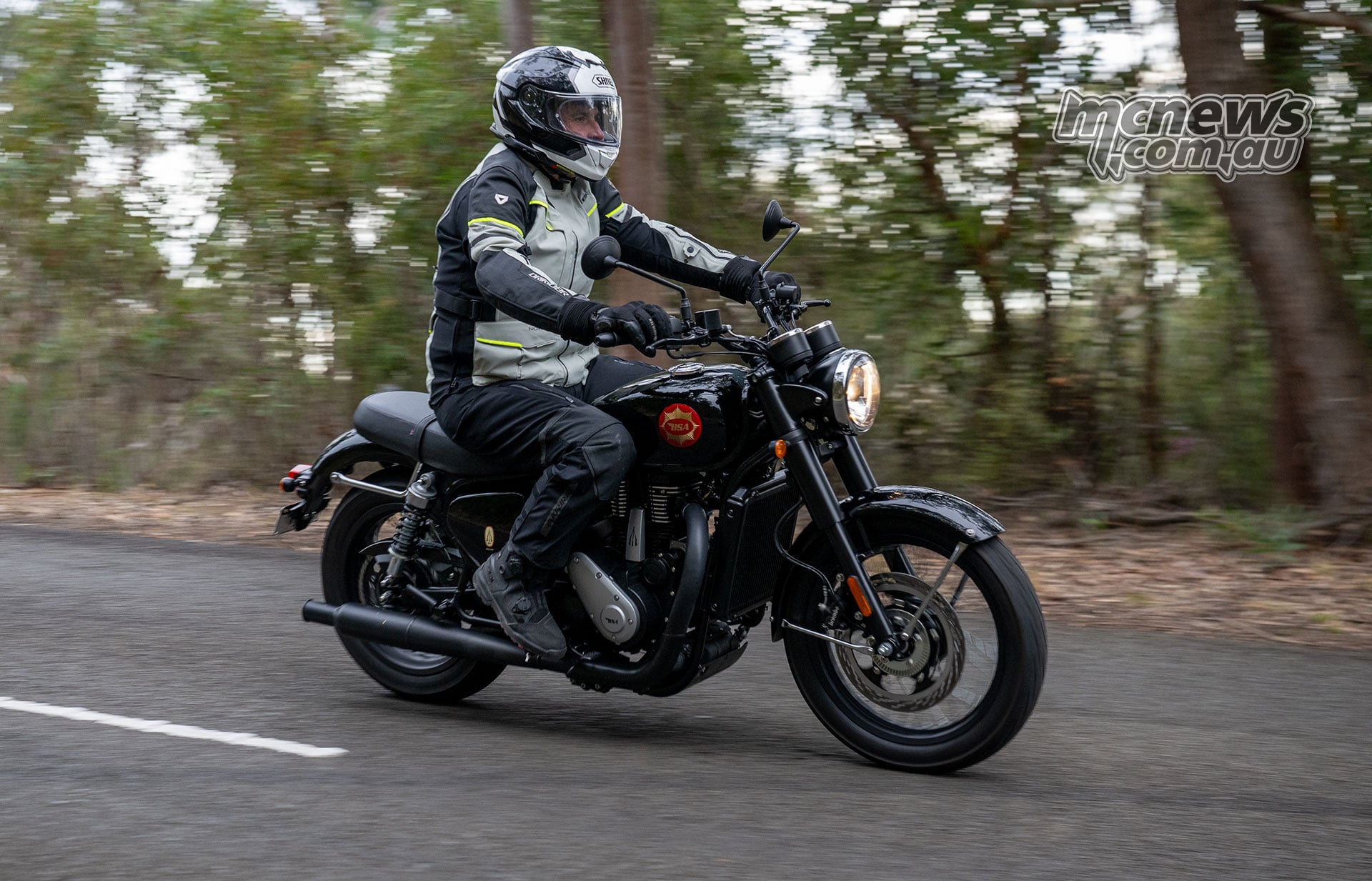
These bikes were also running themselves in
The other factor became impossible to ignore as the launch progressed.
BSA had warned us before riding that the motorcycles arrived extremely tight.
The small local team had been trying to put a few hundred kilometres on every bike before the media arrived, but with something like 15 motorcycles or more in the launch fleet, that represented a considerable amount of running around.
By the afternoon of day two, some motorcycles had accumulated noticeably more distance.
And they felt different.
Getting back aboard a Gold Star late on day two produced perhaps the starkest example.
The engine was appreciably smoother through the upper rev range and also seemed stronger.
Where earlier examples became coarse enough beyond about 5500 rpm to discourage chasing more revs, the later Gold Star was significantly happier being extended.
It still isn’t an engine that begs to have its neck wrung. That’s not the point. But the usable rev range had broadened noticeably.
The whole motorcycle seemed to feel better underneath me as well.
I’m much more cautious about attributing that entirely to kilometres because there are too many variables.
Different roads, different individual bikes, tyre condition, pressures, temperatures and suspension movement all muddy the comparison.
What I can say confidently is this:
My opinion of the Gold Star was significantly better late on day two than it had been early on day one.
The gap I’d initially perceived between the BSA and Royal Enfield chassis packages had closed markedly.
And the roads around the Hawkesbury and Wisemans Ferry on day two were hardly smooth enough to explain that improvement away.

The seat also needs another look
Initially, the Gold Star saddle feels sufficiently firm and supportive.
After a couple of hours, however, that padding seems to lose some resilience and it starts to feel as though the frame rails were making themselves known through the padding.
The Scrambler would subsequently produce much the same impression.
Neither is immediately uncomfortable; I would just like both seats to retain more support after a few hours.

Scrambler 650 – same engine, different personality
BSA says the Scrambler uses the same basic engine as the Gold Star.
From the saddle, you’d swear they were different.
At 100 km/h, the Scrambler was turning roughly 500 rpm more than the Gold Star, and the difference is obvious enough through the tighter stuff. The shorter gearing made the Scrambler appreciably more enjoyable through the switchbacks and twisties.
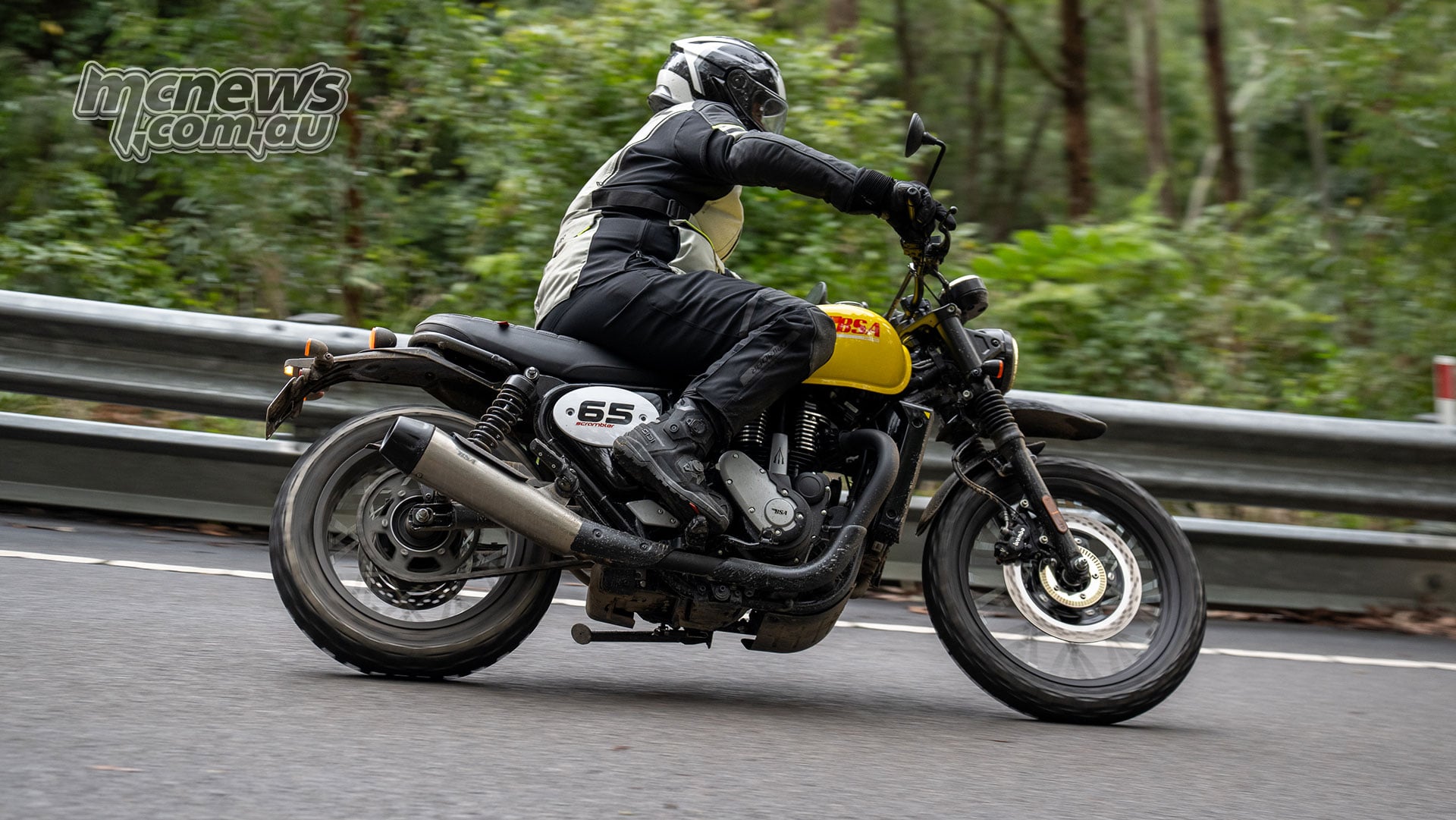
That extra engine speed keeps the single more immediately on the boil and contributes to a more eager feel when you punch the throttle.
Where the Gold Star encourages you to loaf, the Scrambler wants to play a little more.
The possible downside is open-road cruising.
You don’t really find yourself searching for sixth on the Gold Star, while on the shorter-geared Scrambler I suspect there will be moments on long 100-110 km/h highway stints when your left boot goes looking for a gear that isn’t there.
We didn’t get a proper highway run on the Scrambler, however, so that remains an assertion to test rather than a criticism to carve into stone.
I have long been a fan of Royal Enfield’s laid-back 650 twin. It also delivers a lovely surge from low rpm, but does so in a loping, almost lazy fashion. That’s no criticism; it is simply the way the engine goes about its business, and that easy-going character has appealed to me right from the start.
The BSA’s big single goes about things quite differently. There is considerably more immediacy and urgency when you crack the throttle, with its torque arriving harder and earlier. Both peak torque and peak power occur lower in the rev range than on the Royal Enfield twin, so that makes sense. It feels as though the BSA picks up revs more quickly too, although inevitably the single also runs out of breath sooner, while the RE twin keeps spinning further up the dial.
Without putting the two alongside each other back-to-back, it is difficult to be certain, but my seat-of-the-pants impression is that the BSA would get the jump and lead through the 60-foot mark, before the Royal Enfield maybe reeled it back in by the end of the quarter-mile as they start to approach their top speeds. Thus, around town, I think the immediate squirt of the single will win the day.
More suspension travel helps
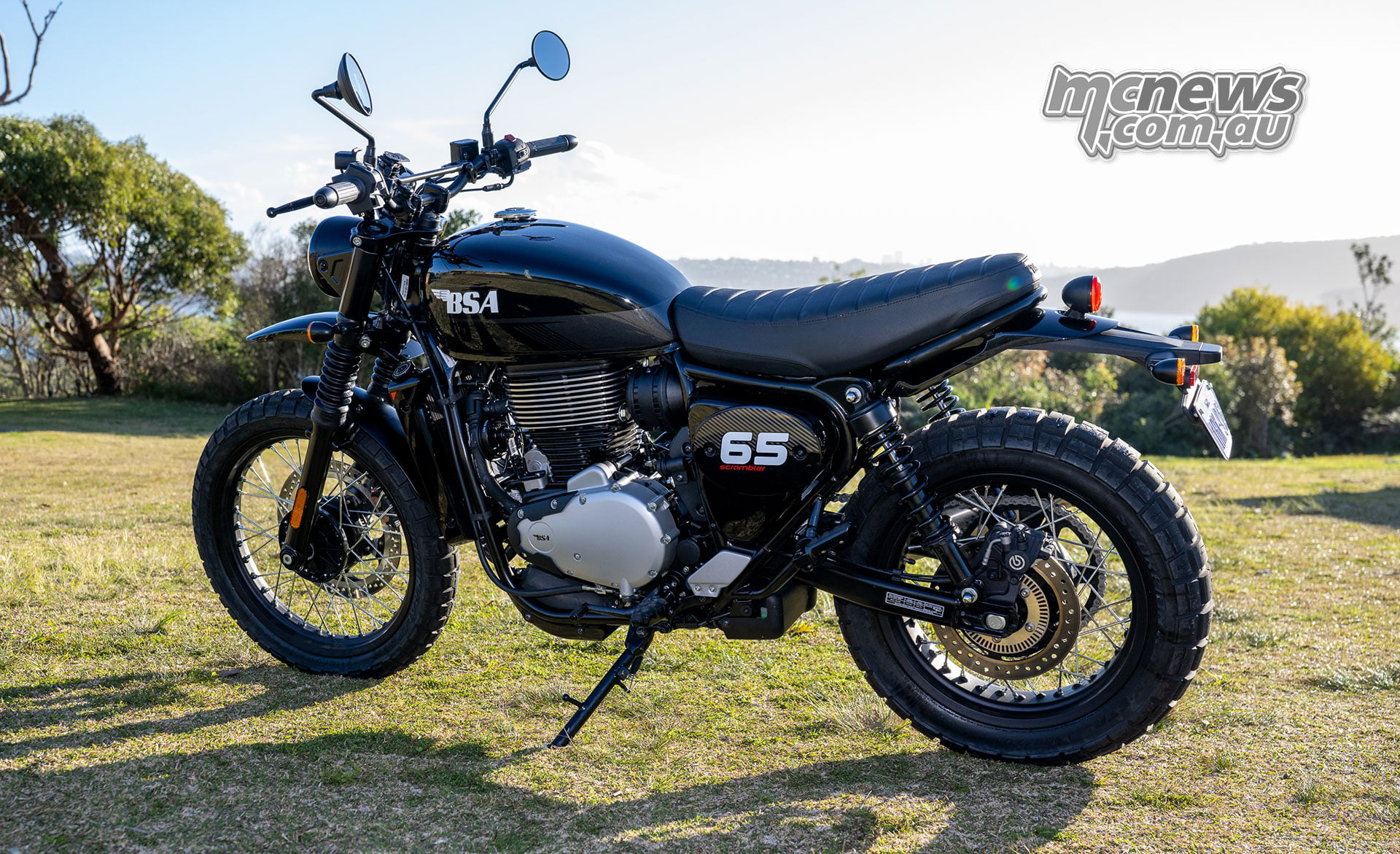
The Scrambler is five kilograms heavier than the Gold Star at a claimed 218 kg. We’re told much of that comes from its larger wheel and tyre combination along with the different exhaust. Yet despite that extra weight, it copes with poor road surfaces considerably better.
The additional suspension travel doesn’t look dramatic if you simply count millimetres. At the rear, however, 127 mm versus the Gold Star’s 108 mm represents almost 20 per cent more movement.

This means the Scrambler irons out the smaller wrinkles and warts in the road far better than the Gold Star.
With a 110/80-19 front compared with the Gold Star’s 100/90-18, the nominal tyre dimensions place the Scrambler’s front axle about 10.7 mm higher. That difference gives useful extra clearance before we’ve even started talking suspension.
BSA’s commitment to the traditional look extends to conventional wire-spoke wheels on both 650s with inner tubes inside the tyres. That’s authentic, certainly, but not necessarily progress. Neither bike comes with a centre stand either, so puncture repairs and some routine maintenance potentially become more involved than they need to be.

The Pirelli Scorpion Rally STR tyres probably contribute to the ride quality too. They offer more give than the Phantom SportsComp rubber fitted to the Gold Star and proved extremely confidence-inspiring when we headed onto damp dirt roads on the second morning.
The overnight moisture had left the surfaces tacky rather than treacherous, and the STRs found plenty of grip. None of the trails were remotely difficult – you could have ridden most of them on virtually anything – but the tyres allowed you to relax and have a bit of fun.

There are still limits
Decent-sized bumps can still make their way through the Scrambler though and set up the sort of wriggle that’s retro in entirely the wrong way.
Then I found one pothole big enough to answer the question more brutally. The fork went through everything it had and arrived at the stops with enough venom to leave my hands and wrists aching for quite some time afterwards.
In BSA’s defence, this was a very substantial impact. Plenty of motorcycles would have struggled.

The simple reality was that the Scrambler didn’t have enough suspension travel available to deal with that sort of hit. There is probably only one mainstream motorcycle carrying the Scrambler moniker that I’d expect to genuinely laugh that off: Triumph’s Scrambler 1200 XE. That thing has sufficiently serious off-road suspension and geometry to be something considerably more than a scrambler in name and styling alone. It also costs twice as much as the BSA.
Like almost everything else in the category, the BSA is still fundamentally a road motorcycle.
Think broken bitumen, gravel roads and relatively gentle tracks, rather than launching off erosion mounds.
Sit down, slow down and go with the flow
The ergonomics reinforce that message.
Compared with the Gold Star, the Scrambler gets straighter handlebars and a higher 820 mm seat, but the overall relationship isn’t transformed as radically as the styling might suggest.

And if you’re one of those adventure riders who likes attacking every unsealed section from the standing position, prepare to change the program. The peg-to-bar relationship isn’t particularly conducive to a serious standing attack stance.
So don’t attack.
Sit down.
Slow down.
Go with the flow, man.

It is much more enjoyable once you stop asking it to be an enduro bike.
A more modern cockpit
The Scrambler abandons the Gold Star’s wonderful twin analogue clocks in favour of a more contemporary single instrument unit.
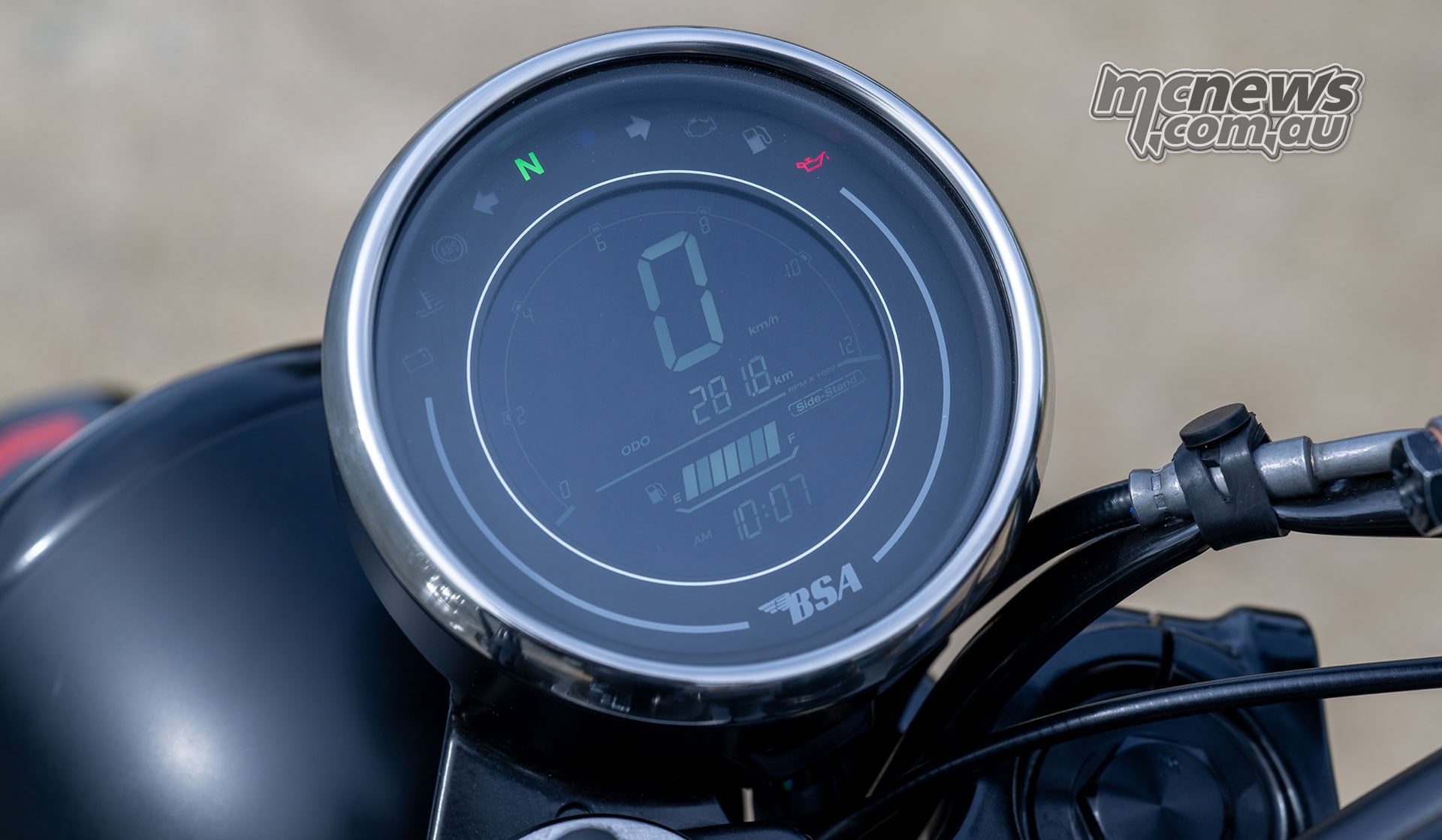
Where the Gold Star is committed to recreating the classic roadster look, the Scrambler is already taking more liberties with the old-school theme. The ergonomics, instrument treatment, tyres and exhaust all help push the personality in a more modern direction.
If the Gold Star is Connery-era James Bond, the Scrambler is Rambo.
Or perhaps more accurately, the Gold Star has slipped into a dinner jacket while the Scrambler has sprayed on the Brut 33 and left an extra shirt button undone.

It also throws more muck at you
The Gold Star’s big traditional mudguards have one very practical advantage.
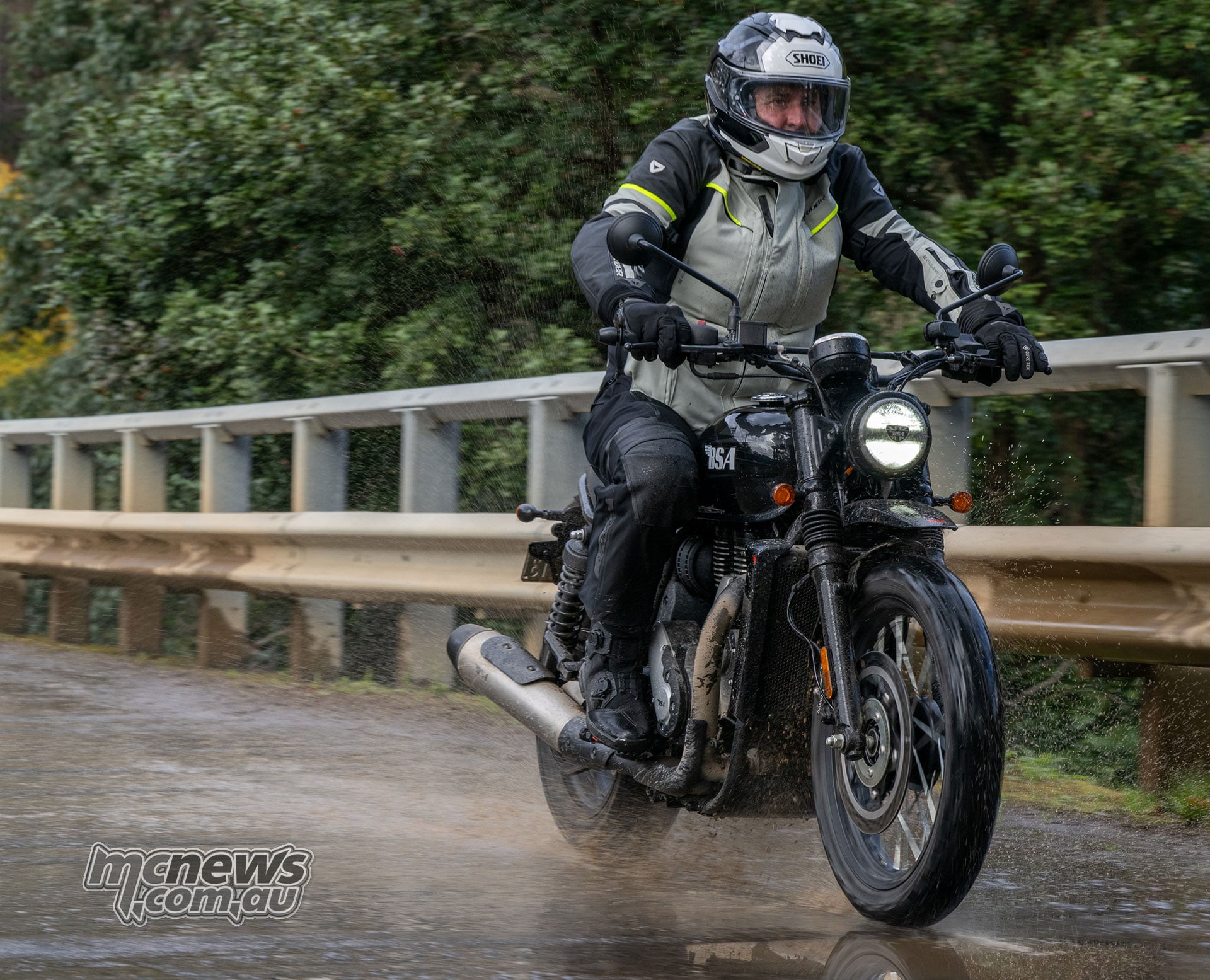
They actually work. Wet and dirty launch roads demonstrated that pretty clearly.
The shorter, more fashionable guards on the Scrambler left the front and back of me liberally splattered with road spray, while the Gold Star riders remained considerably better protected.
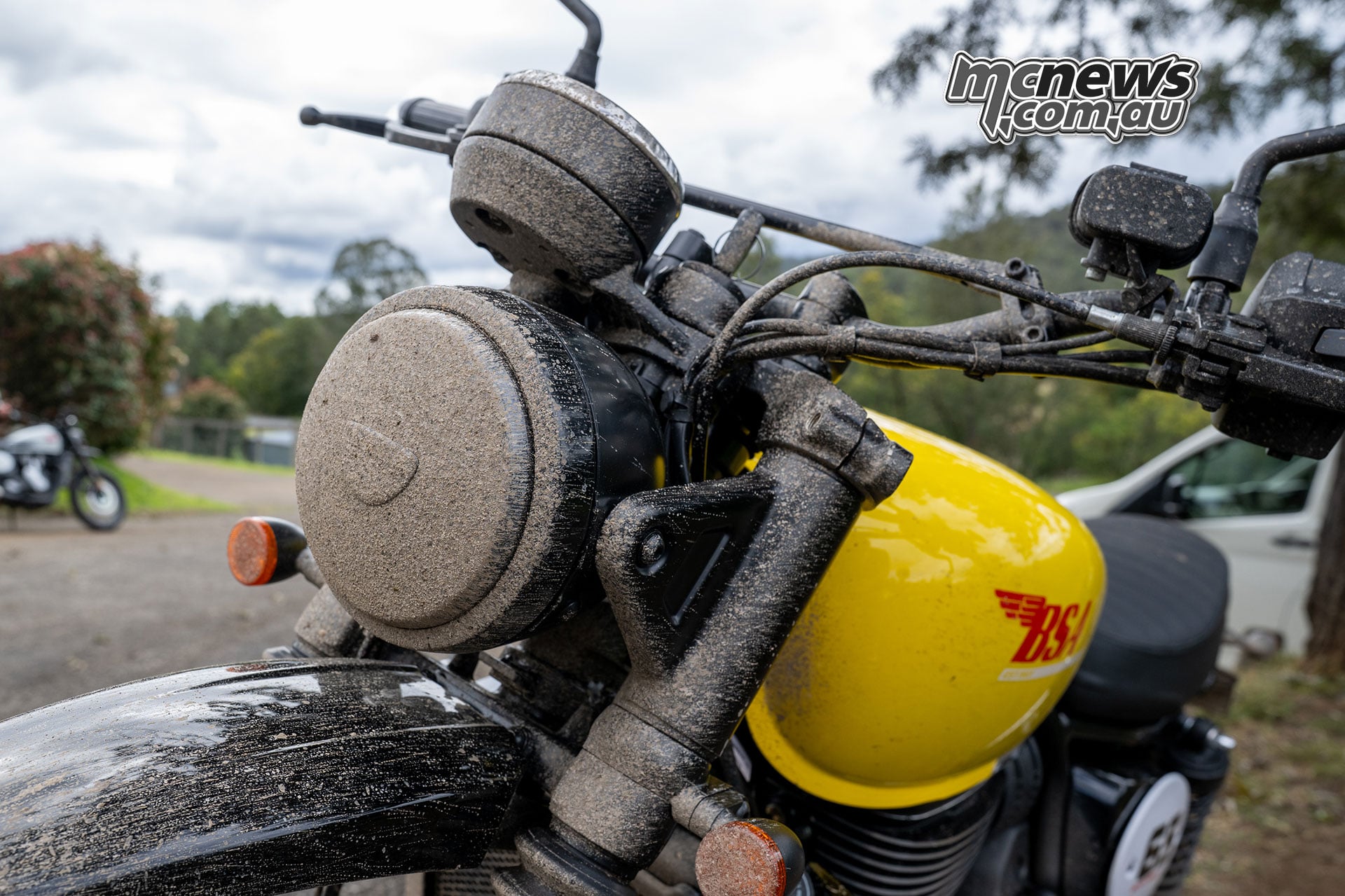
The Bantam wasn’t particularly shy about decorating its rider either, with our first-day run through wet roads leaving plenty of muck thrown up from behind.
Old motorcycles wore enormous mudguards for a reason.
Brakes – progressive rather than ferocious
The braking package follows the same general philosophy as the rest of the motorcycles. The Gold Star and Scrambler use a single 320 mm floating front disc with a Brembo twin-piston floating caliper and a 255 mm rear disc with Brembo single-piston caliper, while the Bantam runs a 320 mm front and 240 mm rear disc.

The lever response is progressive, with enough stopping power without a particularly aggressive initial bite.
For newer riders, that’s probably exactly right.
The ABS backup is reassuring, and its sealed-road calibration isn’t excessively intrusive.
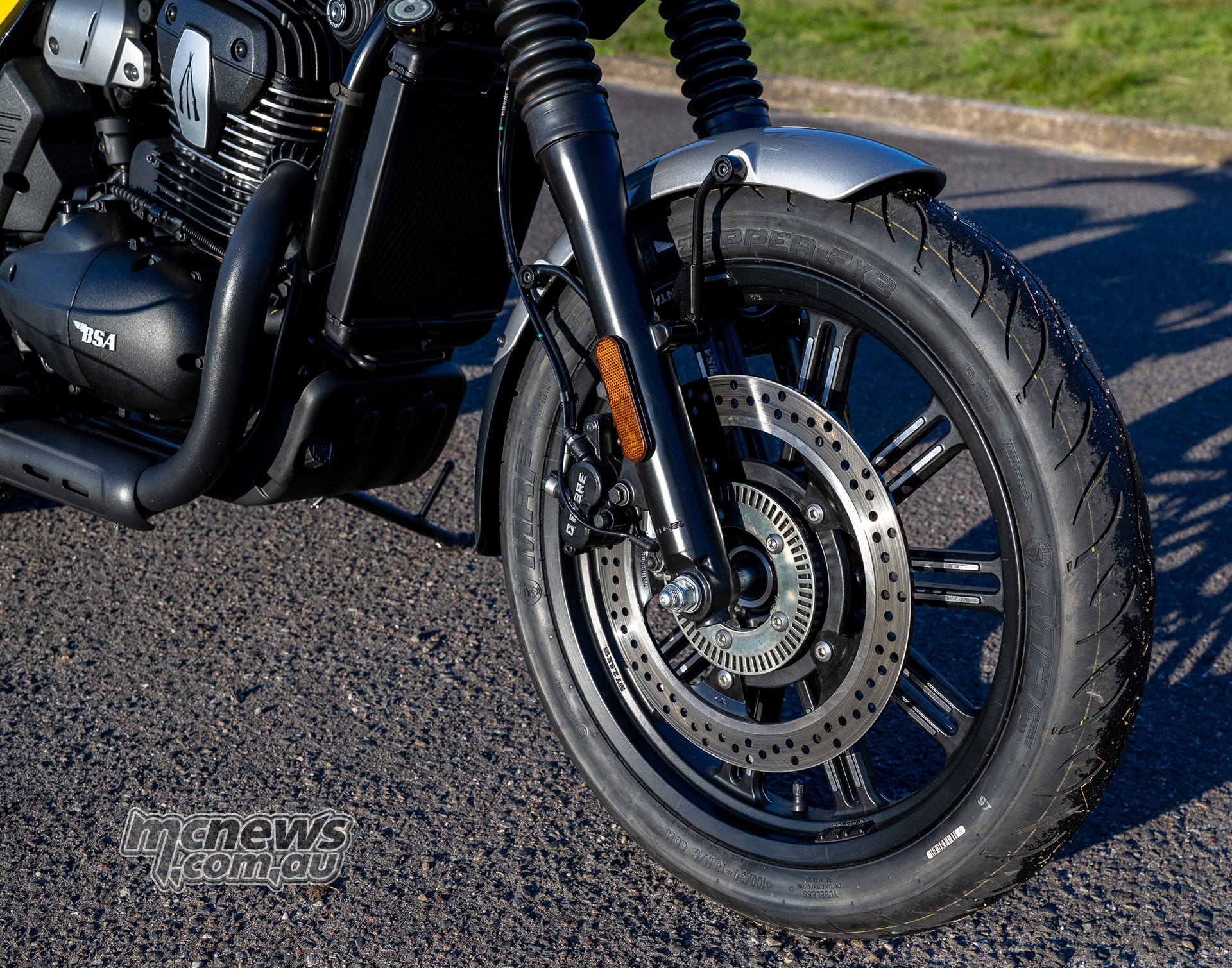
If you’re pressing on hard and habitually braking very late, there will be times when you wish for more.
The ABS cannot be disabled at either end on any of the bikes, which is another pretty clear indication of how BSA envisages the Scrambler being used away from the bitumen.
Then again, perhaps some recalibration is required at the other end of the handlebars.
These are retro-styled motorcycles.
Charging into a hairpin as though you’re trying to qualify on the front row of a Supersport race isn’t really part of the brief.
Use the torque, keep the bike flowing and adjust your attitude accordingly.

And then there is the Bantam
For all the Gold Star’s genuine heritage appeal and all the Scrambler’s hairy-chested attitude, I kept finding myself coming back to the cheapest motorcycle in the range.
The Bantam 350.
At $7590 ride-away, it was the surprise package.

On paper there isn’t much to scare anybody.
A 334 cc liquid-cooled single. 29 horsepower. 185 kg.
Nothing there screams excitement.
Then you ride it.
The engine is far more willing than those modest numbers suggest.
At roughly 4000 rpm you’re doing 60 km/h, 5000 gives you around 80, and by 6000 you’re at 100.
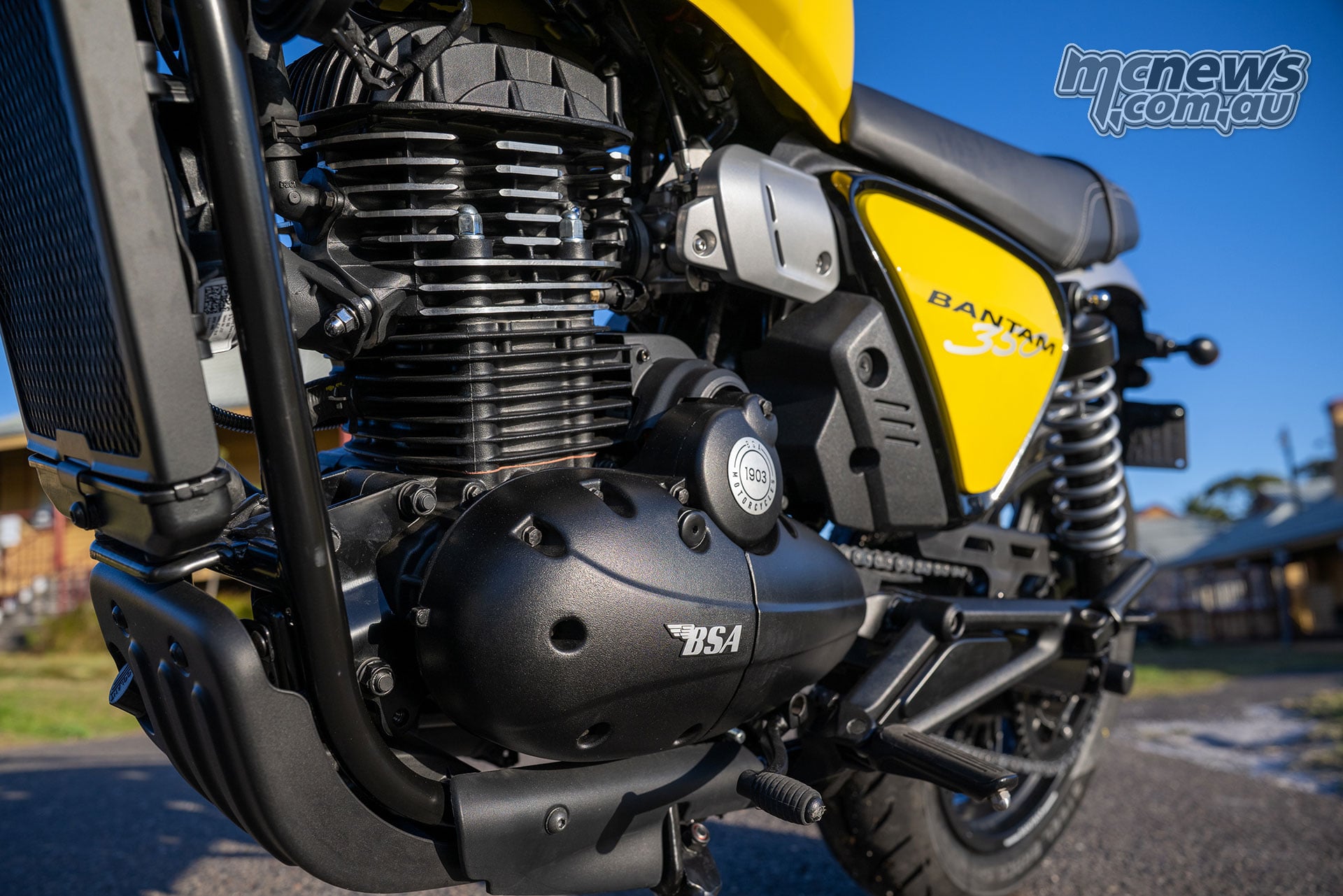
More surprisingly, the Bantam will still pull quite happily from about 4000 rpm in sixth.
That’s considerably stronger than I expected from a small-capacity single and was one of the first things that struck me when I climbed off it on day one. Performance-wise, it is in another league compared to the Royal Enfield 350, or even Honda’s charming GB350. Amongst the modern-classic singles in the market around this capacity, only the Triumph options leave the little Beezer in the shade, but they also enjoy a 20 per cent capacity advantage over the Bantam.
The gearbox also works nicely, and because the engine is willing to be worked, using those six ratios becomes part of the fun rather than a chore.
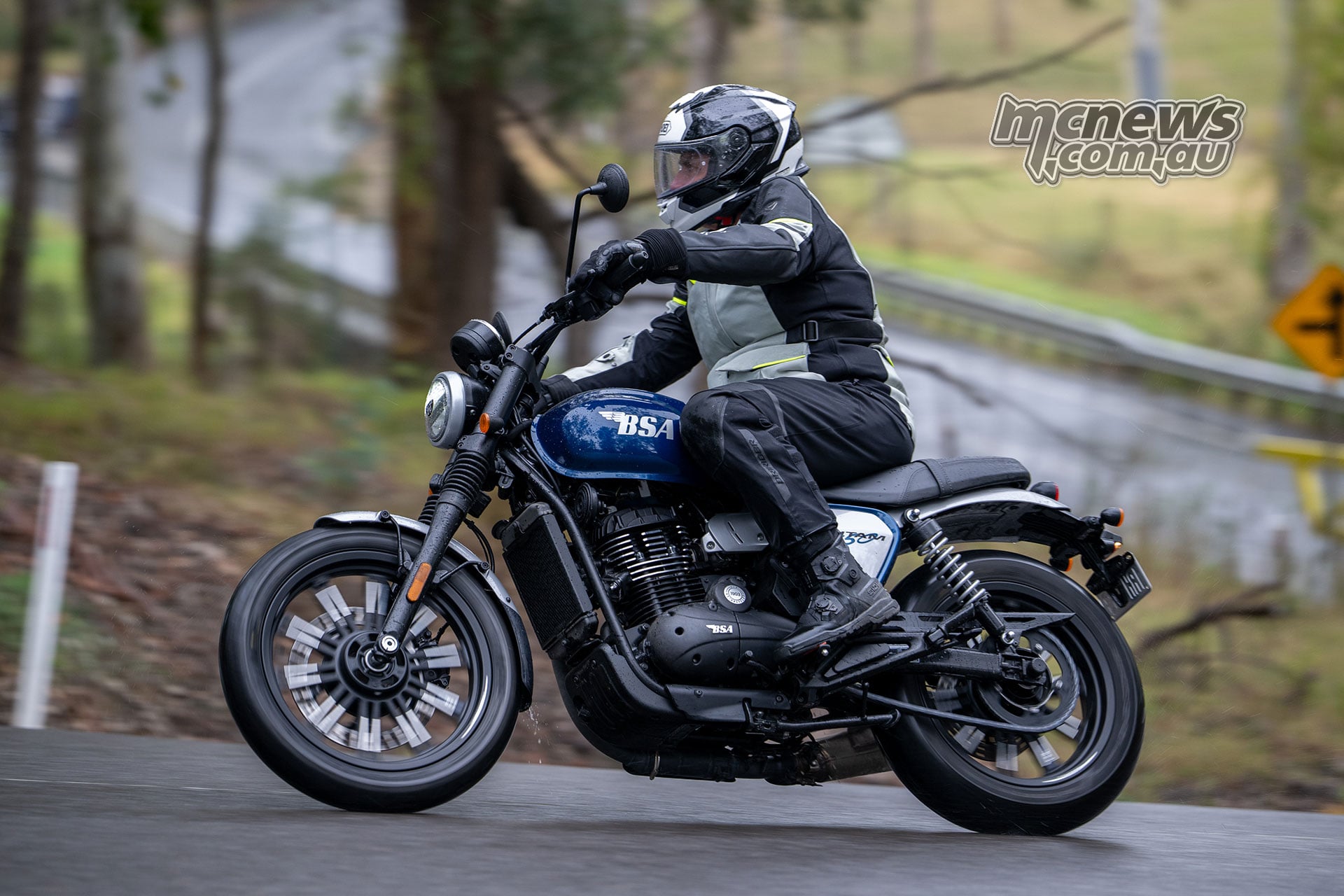
The Bantam chassis surprised too
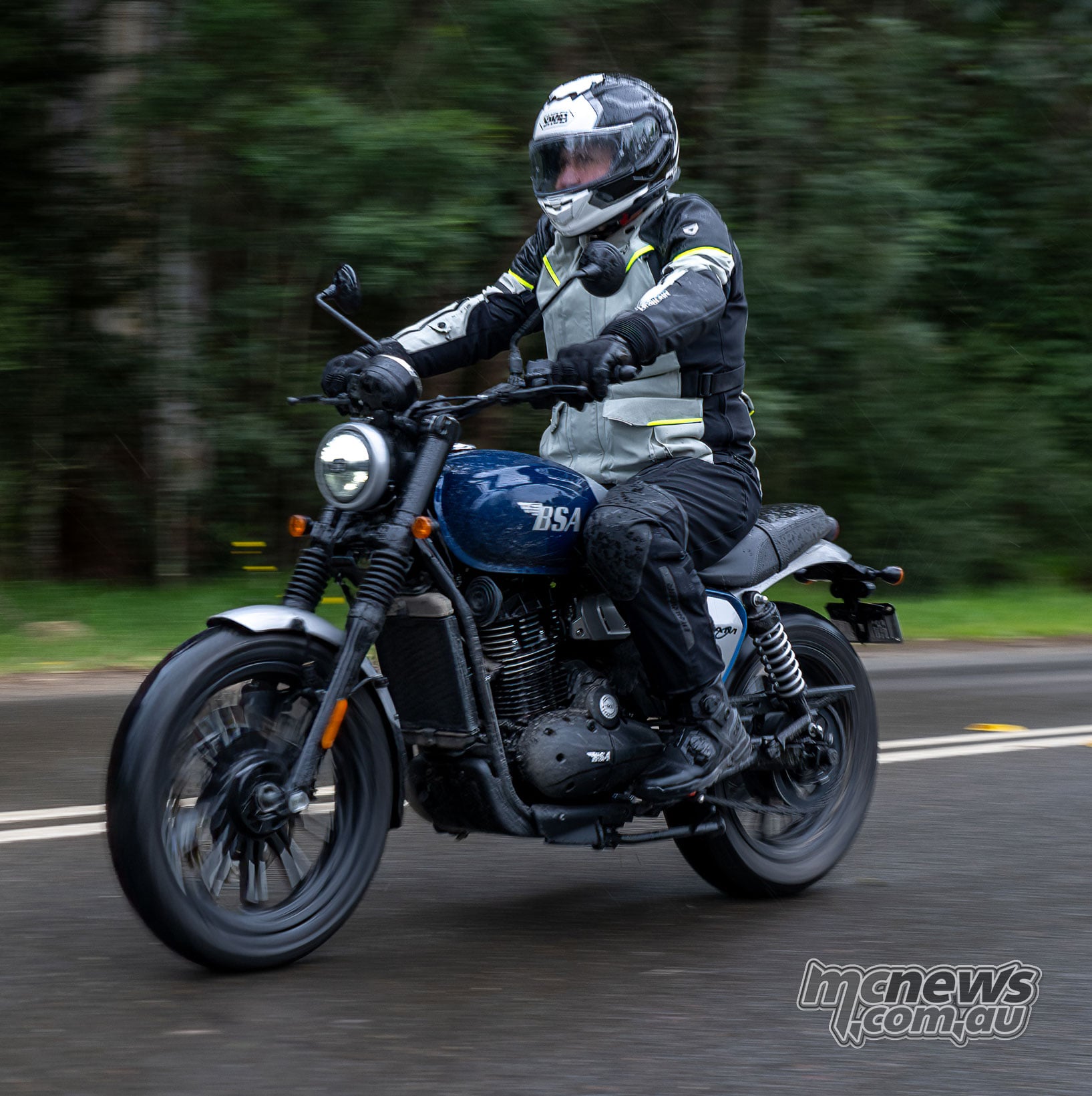
The Bantam is actually quite tautly sprung, but not harshly so, and coped surprisingly well with my roughly 100 kg riding weight. There is 135 mm of fork stroke and 100 mm of rear wheel travel, with five-step preload adjustment on the twin rear shocks.
It felt sufficiently well supported that I wouldn’t immediately assume adding a pillion would overwhelm the standard springs – unusual enough in an affordable small-capacity motorcycle to deserve mention.
The 650s also felt quite firmly sprung. Some of that is undoubtedly because the traditional twin-shock layout has comparatively limited rear travel to work with. It would be interesting to play around with longer-travel aftermarket options on the 650 models, but the lighter Bantam dealt with the pockmarked and rippled Northern Sydney roads quite well by comparison.
Modern classic, rather than time machine
The Bantam’s cast wheels look fairly substantial but have some nice machined detailing around the spokes, while other small touches such as the fork caps help stop it looking purely built to a price.

However, the Bantam doesn’t hold a candle to the Gold Star when it comes to genuinely convincing period detail.
Nor does it exude the same Brut 33 ruggedness as the Scrambler.
It isn’t trying as hard to transport you back in time. And that may be one of its strengths.
The Bantam carries the modern side of the modern-classic description better.
The cast wheels, detailing and overall silhouette feel contemporary enough to appeal to someone who has absolutely no recollection of an original BSA.
At seven-and-a-half grand, it’s a cool and extremely easy motorcycle to enjoy.
That might ultimately make it more important to the future of the brand than its position at the bottom of the price list suggests.
The launch route wasn’t doing them any favours
One thing BSA certainly didn’t do was engineer a billiard-table launch route specifically to flatter the bikes.
Across the two days we found enough rough, rippled, patched and broken roads to expose the limitations of conventional forks and twin shocks in reasonably short order.
Northern Sydney and the Wiseman’s Ferry run either side of the Hawkesbury really did put the range through the wringer. That’s actually valuable. Perfect bitumen tells you remarkably little about suspension quality. These roads ensured any deficiencies had nowhere to hide.
At times the BSAs did become unsettled, particularly when larger bumps and ripples arrived while cornering.
But the motorcycles also left us with a considerably better impression at the end of the two days than they had after the opening sessions.
Between the rapidly accumulating kilometres, the deliberately reduced tyre pressures and the severity of the surfaces, there are enough variables here that a longer road test is warranted before issuing the final word on chassis quality.
That’s exactly what we’ll try to organise.
The business behind the motorcycles
The motorcycles themselves are only half of this story.
BSA effectively needs to build an Australian motorcycle company while rebuilding awareness of the brand.
Jeff makes no secret of how much work lies ahead.
As he sees it, riders north of 60 are generally familiar with BSA, while plenty below that age simply aren’t. Reintroducing the brand therefore means digital marketing, events such as this launch, putting motorcycles in front of people and, most importantly, giving prospective customers opportunities to actually ride them.

Then comes the dealer network.
At the time of our interview, LMI had 13 dealers, with several more in the pipeline and a target of more than 20 by the end of 2026.
Early dealer uptake has apparently been strong.
Jeff says each dealer initially took more than 10 motorcycles despite the range currently consisting of only three models, and that there are already hundreds of BSAs in the Australian market after only a few months.
That shouldn’t be confused with hundreds of confirmed customer registrations, but it does demonstrate that dealers have been prepared to put meaningful inventory on showroom floors.
Parts before problems
Leisk also appears to have thought seriously about one of the big concerns customers inevitably have when buying into a newly established import operation.
Parts.
LMI’s Western Australian warehouse isn’t limited to oil filters and brake pads.
Jeff says it holds multiple complete engines, wheels, forks, shocks and the normal service parts required to support the fleet. Stock is positioned on both sides of the country to get motorcycles and components to dealers quickly.
His reasoning is refreshingly simple.
Motorcycles are discretionary purchases. People buy them because they want to go riding on weekends, not because they have to.
If their bike is broken, they aren’t having fun.
So parts backup was built into the business plan from the beginning.
Every BSA dealer has also received the appropriate diagnostic equipment, and LMI says the technical-support connection back to BSA in the UK has so far proved particularly responsive.
That’s precisely the unglamorous infrastructure a revived brand needs if it wants early buyers to become advocates rather than guinea pigs.
Warranty, accessories and old-school paperwork
The Australian BSAs carry a three-year warranty.
The ride-away pricing includes 12 months registration, something Leisk points out isn’t universal among brands advertising nationally at a ride-away figure, as some only include three months rego.
The first scheduled service is the initial 1000 km break-in service and associated checks, after which all three models move to 6000 km service intervals.
Valve-clearance inspections are considerably further apart on the 650s, at 24,000 km, while the harder-revving Bantam 350 calls for its clearances to be checked every 12,000 km.

And in perhaps the most wonderfully appropriate touch on the entire motorcycle, owners still receive proper printed documentation.
A printed owner’s manual and a physical warranty/service booklet. And somewhere in that book there remains a space for the dealer to stamp it. In 2026. Magnificent.
The first shipment of genuine accessories had also arrived immediately before the launch, with panniers already attracting enough interest to generate dealer backorders.
Clothing and merchandise are also beginning to flow into the network, including the BSA/Merlin relationship, while LMI has been looking at also producing some BSA apparel right here in Australia. They are also down the road towards becoming the Australian distributor of Hagon suspension products.
The old BSA faithful appear to be on board
One obvious starting point for rebuilding the marque is the existing BSA community.
So far, that relationship seems encouraging.
Leisk says the Victorian BSA Owners Club has around 400 active members and invited the new operation to its recent All British Rally, where roughly 700 motorcycles were present.
Naturally, a few purists have strong ideas about precisely what a modern BSA should look like, but Jeff says the clubs have generally been very supportive of the revival.
They also have some genuine Australian history to draw on. BSA points to the Bantam Bushman as part of the marque’s local motorcycle heritage, while Harry Hinton won the New South Wales Speed Championships on a Gold Star back in the day.
That existing enthusiasm is also translating into dealerships.
Fitzroy Motorcycles has been amongst the strongest-performing outlets so far, something Leisk partly attributes to the particularly active BSA community in Victoria.
The bigger question is what happens once you’ve sold motorcycles to the people who already wanted BSA to return.
The people who don’t know what BSA means
That’s where the Bantam and eventually Thunderbolt could become critically important.
The Gold Star can trade heavily on memory.
Bantam cannot rely on that to anything like the same degree with younger riders.
And Thunderbolt, with its small-capacity adventure positioning, potentially takes BSA into an audience with little interest in whether somebody’s grandfather rode a Gold Star in 1962.
Jeff understands that.
His aim is to get the motorcycles in front of people, get them ridden and gradually create a dealer and owner community around the new brand rather than relying solely on history.
There is significant industrial muscle behind that attempt as well.
Mahindra is a huge concern spanning automotive, agricultural, technology and other sectors, giving Classic Legends resources that a genuinely small independent start-up could never hope to match.
Jeff sees that scale as important not only for development and technical response, but also for hitting the value equation now demanded of motorcycles in this part of the market.
How big can BSA become?
Leisk is understandably cautious about making grand sales predictions with only three models on sale.
Push him for a number, though, and he reckons something around 500 motorcycles in the first 12 months would be a reasonable aspiration if the dealer network reaches its target and stock turns over as hoped.
That’s a modest number compared with the scale KTM eventually reached under his watch, but this is a very different product portfolio starting in a very different market.
And perhaps deliberately so.
BSA doesn’t need to beat Royal Enfield next year.
It needs to establish that the badge has a viable future once the initial wave of nostalgia subsides.
So which BSA?
Before the launch, I expected the Gold Star to dominate my thinking. In many respects it still does.
It is the motorcycle that most convincingly connects the revived company with the BSA people remember.
It looks the business, it has a distinctive soundtrack and the 652 single provides genuine character in a marketplace increasingly homogenised around parallel twins.
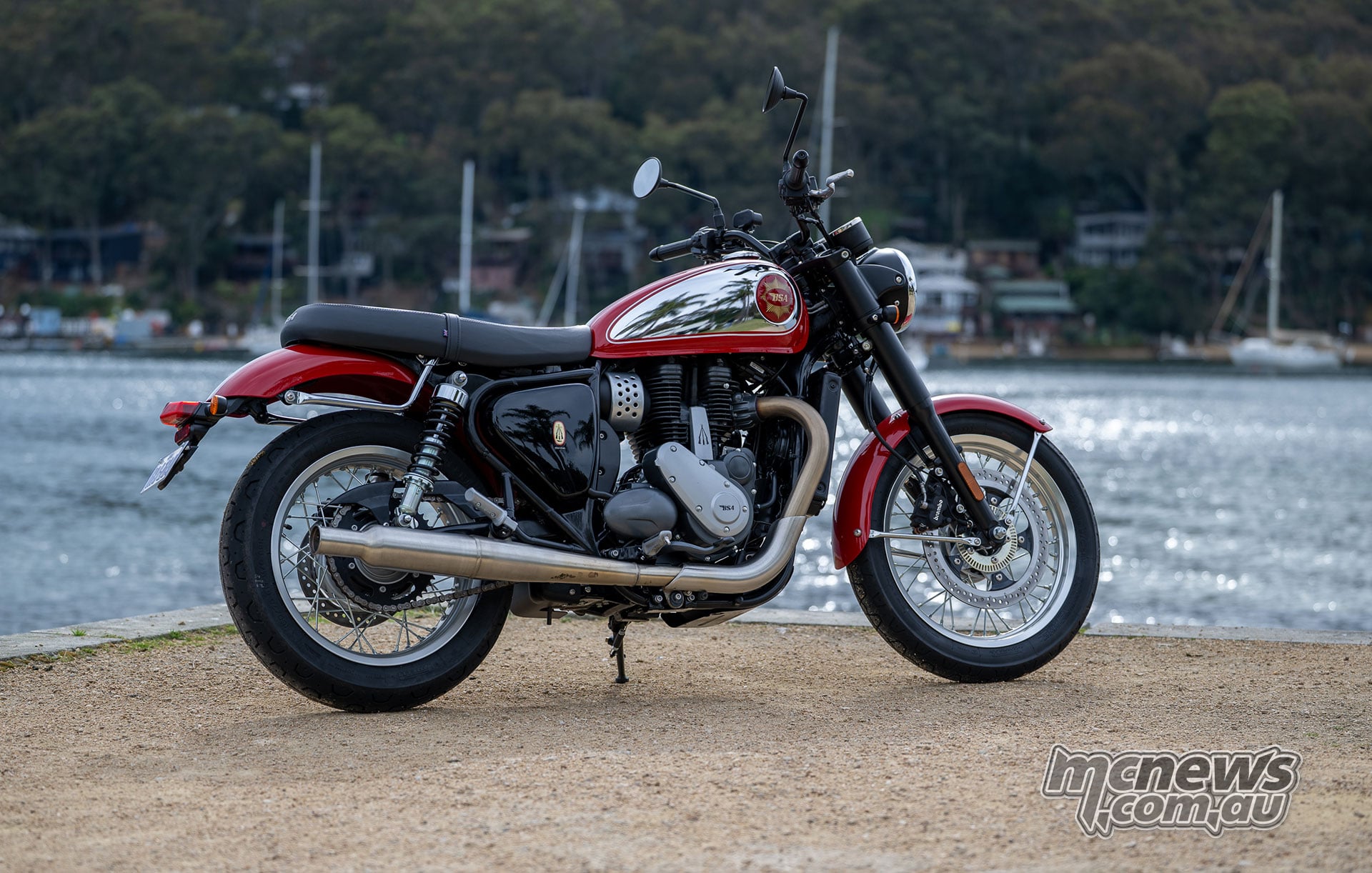
Once some kilometres had loosened the engine, it also became appreciably smoother and stronger than our earliest rides suggested.
The Scrambler takes that same core and makes it feel more eager through shorter gearing, gives the suspension more capacity to deal with rough roads and adds considerably more visual attitude.
It isn’t a serious off-road motorcycle. It doesn’t need to be. Accept it as a road-biased scrambler that can happily play on gravel and it makes much more sense.
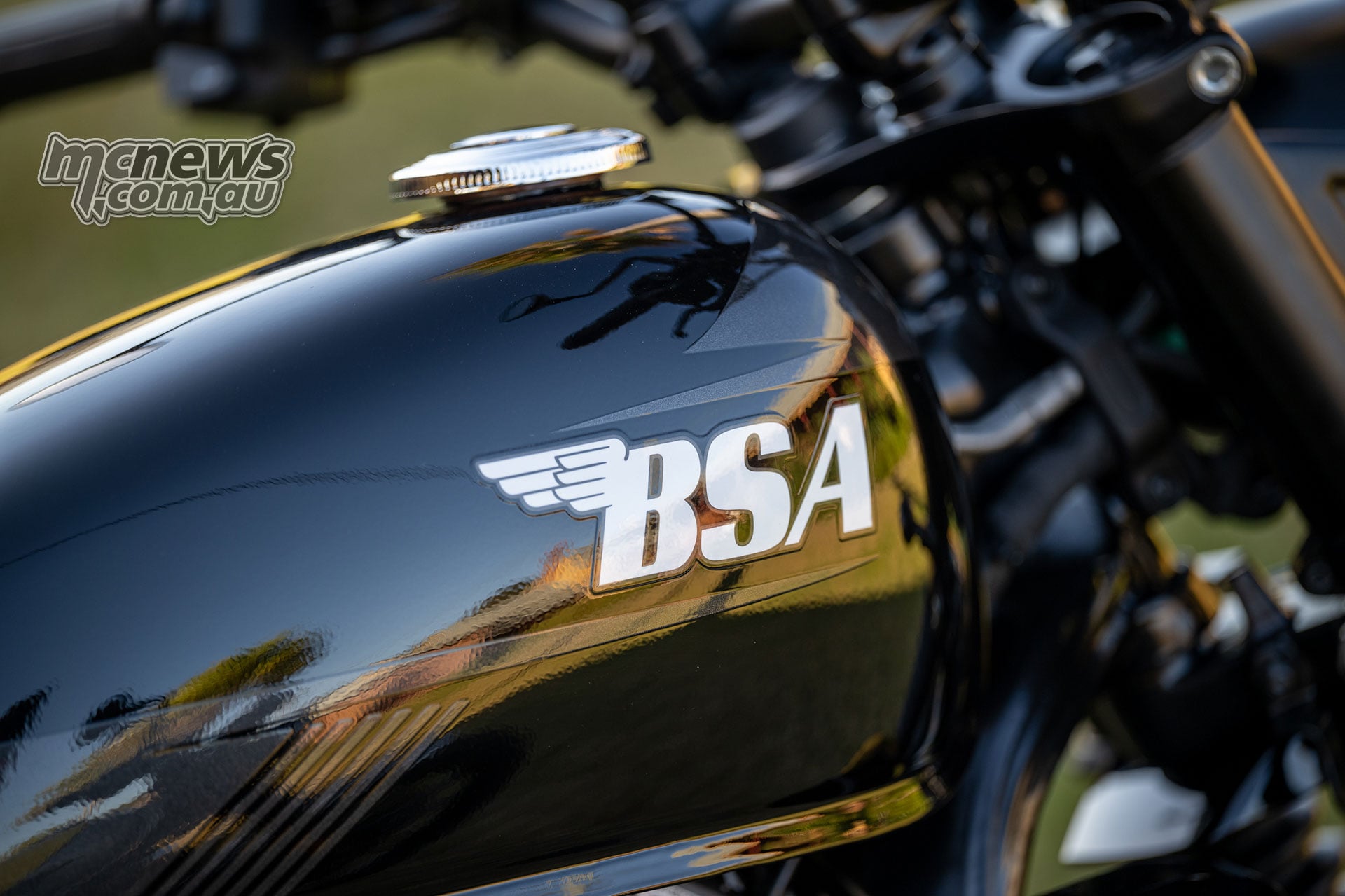
The highway question remains unanswered when it comes to the Scrambler and its shorter gearing. I will answer that on a subsequent reacquaintance with the model.
Then there’s the Bantam.
The $7590 entry-level bike shouldn’t necessarily be the one that sticks in your mind after spending two days with the bigger and more glamorous machines.
Yet it did.
It’s friendly without feeling completely neutered, the engine is considerably stronger than its 29 hp figure suggests, the gearbox is pleasant, and the chassis coped with my 100-kilogram frame better than expected.
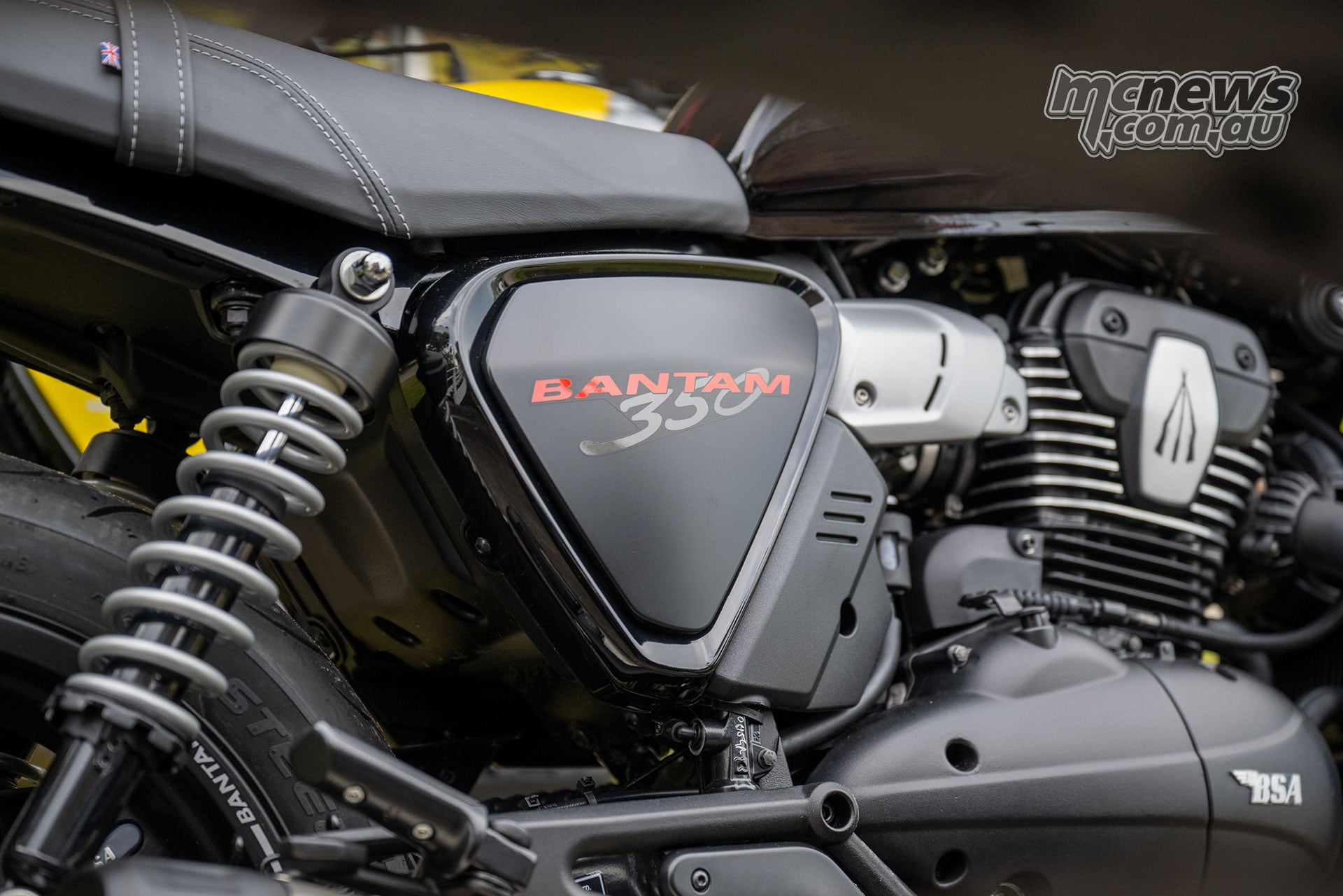
The Bantam doesn’t look as genuinely retro as the Gold Star. It doesn’t have the Scrambler’s machismo. It simply makes you want to keep riding it. And that may be exactly what BSA needs.
The Gold Star sells the history.
The Scrambler sells the attitude.
The Bantam might help sell the future.
BSA is back
There are still things we want to revisit.
I want the 650s back on recommended tyre pressures and on roads considerably smoother than the launch route. I want a proper highway run on the shorter-geared Scrambler. I want more kilometres to see just how far the engine refinement continues to improve once everything is properly freed up.
But after two fairly punishing days, there is already enough here to say the reborn BSA range is more than some famous badges applied to generic motorcycles.
The singles give them a genuine point of difference.
The Gold Star has real character.
The Scrambler is the more playful 650.
And the Bantam is much better than its modest specification sheet initially suggests.
For the first time in more than half a century, an Australian can again walk into a dealership, hand over their money and ride home on a brand-new BSA.
That doesn’t guarantee this revival will work.
But this first tranche of motorcycles gives Jeff Leisk and his small team something worth building on.
I wish them well, and look forward to the next ride…
2026 BSA Bantam 350 Images


2026 BSA Gold Star 650 Images


2026 BSA Scrambler 650 Images


Images by RbMotoLens