

Tungate’s GP breakthrough headlines major Australian speedway weekend
Rohan Tungate secured a full-time place in the 2027 FIM Speedway Grand Prix World Championship before helping Australia defeat Poland 49-41 in Rybnik, completing a major weekend for Aussie speedway.

The 36-year-old Hunter Valley racer finished second to Great Britain’s Robert Lambert in Saturday night’s FIM SGP Challenge at Terenzano, earning one of the four permanent places available in next year’s world championship.
Less than 24 hours later, Tungate was back in Australian colours as Mark Lemon’s impressively balanced line-up defeated reigning Speedway World Cup champion Poland on Polish soil — despite Jack Holder being unavailable through injury.
Tungate punches his ticket to Speedway GP
Tungate entered the 2026 FIM SGP Challenge alongside fellow Australians Jaimon Lidsey and Keynan Rew, with the top four finishers at Terenzano guaranteed permanent positions in the 2027 Speedway GP field.
The Australian made an ideal start, winning his opening two heats before finishing second to Maciej Janowski in his third appearance. Another victory in his fourth ride elevated Tungate to 11 points and secured his qualification with one programmed heat remaining.
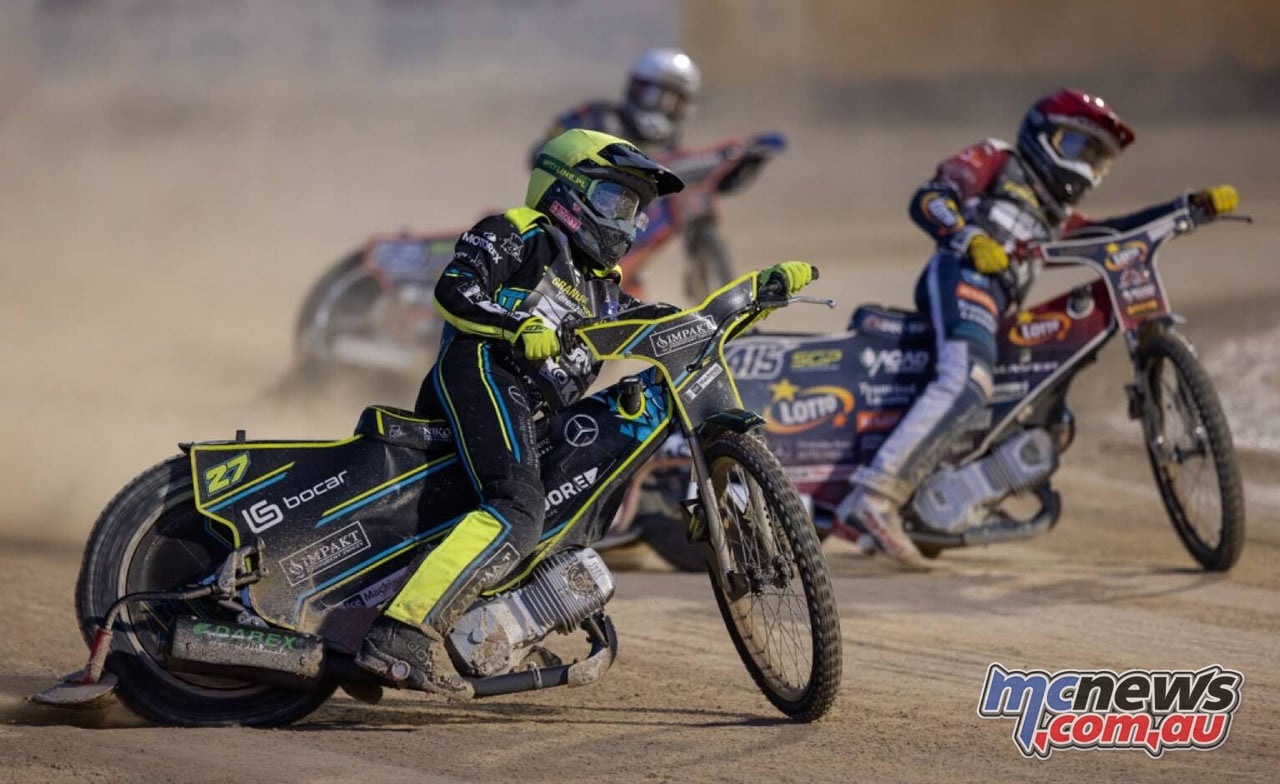
That removed the pressure before Tungate finished fourth in his final heat, with Lambert winning ahead of Michael Jepsen Jensen and Kacper Woryna.
Lambert topped the qualification scores with 14 points from five rides, having dropped his only point of the programme when Frederik Jakobsen defeated him in the opening block.
Tungate’s 11 points placed him second, while Woryna and Swedish champion Kim Nilsson both qualified on 10. The four then contested the final, with the finishing order remaining unchanged as Lambert defeated Tungate, Woryna and Nilsson.

For Tungate, the result secured his first full-time Speedway GP campaign after years spent competing at the highest levels of British, Polish and Swedish league speedway.
He does, however, enter the championship with a remarkable record already attached to his name.
Tungate made his only previous Speedway GP appearance as a track reserve at the 2017 Australian round in Melbourne. Called into two races at Marvel Stadium, he won them both and will therefore begin 2027 with a perfect two-from-two Speedway GP record.
“I believe I can still get three points in each race. I know what I am capable of doing.”
Tungate said the key at Terenzano was approaching the meeting one race at a time, remaining relaxed and avoiding becoming consumed by the potential significance of the result.
Getting some of the more difficult starting positions out of the way early — and winning from them — proved particularly important. By the time his final programmed ride arrived, the Australian had already removed any doubt over his 2027 place.
Attention now turns to preparing the team and organisation required to contest an entire world championship. Tungate will continue working with respected Polish engine tuner Ryszard Kowalski and plans to approach the season “race by race, GP by GP”.
At 36, Tungate will not arrive as a conventional young Speedway GP rookie, but he brings extensive international league experience and a level of maturity that could serve him well across the demanding 10-round championship.
Lambert leads four into 2027
Lambert’s victory officially secured his position in the 2027 series, although the Brit was already strongly placed to qualify through the current world championship standings.

With four rounds remaining, Lambert sits third in the 2026 title chase and holds a 27-point advantage over eighth position. The top seven in the final championship standings automatically retain their places for 2027.
Woryna is also provisionally inside that top seven. The Pole sits fifth on 55 points, although the battle remains extremely tight, with Max Fricke only one point behind him in eighth.
Woryna’s third place at Terenzano guarantees him a second Speedway GP season regardless of where he finishes in the current championship.
Nilsson claimed the final direct qualification position with a dramatic last-heat victory. The recently crowned Swedish champion charged around local wild card Paco Castagna to reach 10 points before placing fourth in the final.

Nilsson returns to Speedway GP for the first time since 2023 and believes he is now better prepared, both as a rider and in the organisation surrounding him, than he was during his previous campaign.

2026 FIM SGP Challenge Result
1. Robert Lambert – Great Britain – 14 points
2. Rohan Tungate – Australia – 11 points
3. Kacper Woryna – Poland – 10 points
4. Kim Nilsson – Sweden – 10 points
5. Andzejs Lebedevs – Latvia – 9 points
6. Michael Jepsen Jensen – Denmark – 9 points
7. Frederik Jakobsen – Denmark – 8 points
8. Chris Harris – Great Britain – 7 points
9. Maciej Janowski – Poland – 7 points
10. Paco Castagna – Italy – 7 points
11. Kai Huckenbeck – Germany – 6 points
12. Dominik Kubera – Poland – 6 points
13. Jaimon Lidsey – Australia – 5 points
14. Anders Rowe – Great Britain – 4 points
15. Luke Becker – USA – 3 points
16. Keynan Rew – Australia – 3 points
17. Nicolas Vicentin – Italy – 1 point
18. Brando Lunardi – Italy – DNR
More riders could advance through the qualification order
The top four positions were the only direct qualification places available at Terenzano, but the final composition of the 2027 field could allow several more Challenge riders to advance.
If either Lambert or Woryna finishes inside the 2026 Speedway GP top seven, fifth-placed Andzejs Lebedevs will receive a permanent place for next season.
If both Lambert and Woryna qualify through the championship standings, sixth-placed Michael Jepsen Jensen would also advance.
Should three of Lambert, Woryna, Lebedevs and Jepsen Jensen complete the current season inside the top seven, Frederik Jakobsen would make his Speedway GP debut after placing seventh at Terenzano.
An even more remarkable permutation remains mathematically possible. If all four riders finish inside the championship’s top seven, eighth-placed Chris Harris would return to Speedway GP at the age of 43, a decade after his last full season in the series.
Lidsey finished 13th at Terenzano with five points, while Rew scored three to place 16th. Janowski had entered the meeting as a replacement for the injured Jack Holder.
Australia defeats Poland in Rybnik
Australia carried its momentum into Sunday’s international test against Poland in Rybnik, where Lemon selected Brady Kurtz, Tungate, Jason Doyle, Ryan Douglas, Max Fricke and Ben Cook.
Poland countered with Bartosz Zmarzlik, Dominik Kubera, Patryk Dudek, Kacper Woryna and brothers Piotr and Przemysław Pawlicki.
With the exception of the injured Holder, the Polish report characterised the line-ups as close to the strongest combinations available to both nations.
Kurtz opened proceedings by defeating Kubera and Woryna, with Tungate fourth, before Doyle and Douglas combined for the first maximum of the night in Heat Two.
World champion Zmarzlik won Heat Three ahead of Fricke and Cook, but Tungate responded in the fourth by defeating Dudek, with Kurtz third. That result moved Australia six points clear at 15-9.
Zmarzlik reduced the margin by winning Heat Five, while Kubera took Heat Six, but Kurtz delivered one of the most significant individual results of the meeting when he defeated Zmarzlik in Heat Seven.
Tungate finished third in that race, extending Australia’s lead to 24-18.
The visiting riders repeatedly displayed strong speed beyond the opening turn, with the Polish account noting that most of the meaningful passing moves came from the Australians.
Doyle and Douglas demonstrated that strength in Heat Eight. Doyle won from Kubera, while Douglas worked his way past Woryna for third, extending Australia’s advantage to eight points.
Fricke then defeated Dudek and Cook in Heat Nine, moving the score to 32-22 and placing Poland under considerable pressure.
Poland fights back through tactical changes
Polish team manager Stanisław Chomski turned to tactical substitutions in an effort to recover the deficit, placing his most productive riders into additional heats.
Kubera won Heat Ten ahead of Kurtz and Zmarzlik, then backed that up by taking Heat 11 from Cook and Dudek.
Zmarzlik defeated Tungate in Heat 12, with Dudek third ahead of Fricke, reducing Australia’s advantage to four points at 38-34 with three races remaining.
Poland had found a route back into the contest, but its dependence on Zmarzlik, Kubera and Dudek left little margin for error elsewhere in the team.
Australia delivered the decisive response in Heat 13.
Doyle and Douglas combined for a commanding 5-1 over the Pawlicki brothers, restoring Australia’s eight-point lead and moving the score to 43-35.
Dudek and Woryna kept Poland alive with a 5-1 of their own in Heat 14, defeating Fricke and Tungate. The result reduced Australia’s lead to 44-40 and left the outcome to be settled in the final race.
Cook and Kurtz then produced an emphatic conclusion.
The Australian pairing capitalised on mistakes from Zmarzlik and Kubera to claim a final-heat 5-1 and complete a 49-41 victory in front of approximately 8500 spectators.
Cook also recorded the fastest time of the meeting, completing the deciding heat in 64.27 seconds.
Poland 41 – Australia 49
Australia
Brady Kurtz – 11+1
Rohan Tungate – 6
Jason Doyle – 9
Ryan Douglas – 7+2
Max Fricke – 7
Ben Cook – 9+1
Poland
Kacper Woryna – 3+2
Dominik Kubera – 13
Patryk Dudek – 10
Piotr Pawlicki – 0
Bartosz Zmarzlik – 13
Przemysław Pawlicki – 2
Rybnik heat results
Heat 1: Kurtz, Kubera, Woryna, Tungate – 66.18 – 3-3
Heat 2: Doyle, Douglas, Dudek, Piotr Pawlicki – 67.10 – 1-5
Heat 3: Zmarzlik, Fricke, Cook, Przemysław Pawlicki – 66.04 – 3-3
Heat 4: Tungate, Dudek, Kurtz, Piotr Pawlicki – 66.02 – 2-4
Heat 5: Zmarzlik, Douglas, Przemysław Pawlicki, Doyle – 66.10 – 4-2
Heat 6: Kubera, Cook, Fricke, Woryna – 65.19 – 3-3
Heat 7: Kurtz, Zmarzlik, Tungate, Przemysław Pawlicki – 64.68 – 2-4
Heat 8: Doyle, Kubera, Douglas, Woryna – 65.05 – 2-4
Heat 9: Fricke, Dudek, Cook, Piotr Pawlicki – 65.72 – 2-4
Heat 10: Kubera, Kurtz, Zmarzlik, Douglas – 65.13 – 4-2
Heat 11: Kubera, Cook, Dudek, Doyle – 64.83 – 4-2
Heat 12: Zmarzlik, Tungate, Dudek, Fricke – 64.51 – 4-2
Heat 13: Doyle, Douglas, Przemysław Pawlicki, Piotr Pawlicki – 64.80 – 1-5
Heat 14: Dudek, Woryna, Fricke, Tungate – 64.59 – 5-1
Heat 15: Cook, Kurtz, Zmarzlik, Kubera – 64.27 – 1-5
Australia’s depth proves decisive
The clearest difference between the teams was the distribution of their scoring.
Every Australian rider contributed at least six points, with the six-rider line-up covered by only five points from top scorer Kurtz on 11+1 to Tungate on six.
Kurtz led the individual scoring and defeated Zmarzlik in Heat Seven, while Doyle won three races and Cook completed the meeting with victory in the deciding heat.
Douglas added seven points and two bonuses, including his roles in the crucial 5-1 results alongside Doyle in Heats Two and 13.
Fricke contributed seven points and a race victory, while Tungate added six despite having competed in the high-pressure SGP Challenge in Italy the previous evening.
Poland, by contrast, received 36 of its 41 points from Zmarzlik, Kubera and Dudek. The Pawlicki brothers combined for only two points, while Woryna added three plus two bonuses.
The imbalance forced Poland to lean heavily on tactical substitutions and allowed Australia’s broader strength to carry the visitors through the late Polish recovery.
Winning a test match does not carry world championship points, but defeating Poland in Poland — and doing so without Holder — provides a significant confidence boost ahead of the Speedway World Cup Final.
World Cup selection pressure builds
Australia is already guaranteed a position in the 2026 FIM Speedway World Cup Final after winning the 2025 FIM Speedway of Nations World Championship.
The Final will be staged at Warsaw’s PGE Narodowy on August 29, where Australia will face host nation and reigning champion Poland, Great Britain and the winner of the second semi-final.
Great Britain booked its place by winning Semi-Final 1 at Landshut. The final position will be decided at Riga’s Bikernieki circuit on August 7, when Latvia faces Denmark, Sweden and tournament debutant Norway.
Australia’s final five-rider combination — four starters and one substitute — is yet to be confirmed.
The six riders used in Rybnik already outnumber the five positions available in Warsaw, even before the injured Holder and other international options are considered.
That presents Lemon with a difficult selection decision, but also underlines the depth that made Australia so effective in Rybnik.
Riga World Cup squads
The four nations contesting Semi-Final 2 in Riga have named wider squads ahead of the August 7 meeting.
Team managers may initially nominate up to 10 riders before reducing their selections to four starters and one substitute six days before the event.

Latvia
Andzejs Lebedevs, Daniils Kolodinskis, Jevgenijs Kostigovs, Olegs Mihailovs, Francis Gusts, Damirs Filimonovs, Nikita Kaulins, Artjoms Juhno, Emils Rimicans and Dmitrijs Reuka. Team manager: Vladimirs Vagels.

Denmark
Michael Jepsen Jensen, Leon Madsen, Anders Thomsen, Mikkel Michelsen, Frederik Jakobsen, Mads Hansen, Benjamin Basso, Rasmus Jensen, Mikkel Andersen and Villads Nagel. Team manager: Nicki Pedersen.

Sweden
Fredrik Lindgren, Kim Nilsson, Jacob Thorssell, Timo Lahti, Oliver Berntzon, Tomas H Jonasson, Casper Henriksson, Victor Palovaara, Filip Hjelmland and Jonathan Ejnermark. Team manager: Linus Sundstrom.

Norway
Mathias Pollestad, Truls Kamhaug, Glenn Moi, Lasse Fredriksen, Magnus Klipper, Jorgen Lystad and Imre Vigre. Team manager: Kenneth Klipper Smith.
Latvia will be led by Speedway GP regular Lebedevs, while Denmark has nominated a formidable group containing Jepsen Jensen, Leon Madsen, Anders Thomsen and Mikkel Michelsen.
Sweden hopes world number four Lindgren will recover from injury in time to compete, while Nilsson arrives with the confidence of his Swedish Championship and Terenzano qualification successes.
Norway makes its Speedway World Cup semi-final debut, with former SGP2 bronze medallist Pollestad headlining its squad.
Speedway’s next generation gathers at Terenzano
The Terenzano programme began before the SGP Challenge, with 22 riders from 11 countries attending the FIM SGP Academy on Thursday and Friday.
The invited riders ranged from 12 to 19 years of age and trained on machinery spanning 125 to 500 cc at the Motoclub Olimpia circuit.
Former Speedway GP winner Matej Zagar was among the coaches, alongside FIM Track Racing Commission director Armando Castagna and FIM Speedway race director Phil Morris.
The academy extended well beyond riding technique and starting practice. Riders and their families received guidance on motorcycle preparation, sporting and anti-doping regulations, physical conditioning, health, media relations, social media and building productive relationships with sponsors.
The participants included Slovenian SGP2 rider Sven Cerjak, Gregor Zorko, Marek Ziman, Storm Thomsen and 2026 FIM Women’s Speedway World Cup bronze medallist Anna Hajkova.
Other emerging riders involved included Felix Zagar, Oliver Bovingdon, Emerson Betty, Zoltan Lovas, Lester Matthijssen, Jesper Kvarnstroem and Andre Damian.
For Tungate, Terenzano delivered the full-time Speedway GP opportunity he has worked towards throughout a long international career.
For Australia, the subsequent victory in Rybnik demonstrated that the nation’s World Cup prospects extend well beyond one or two headline riders. With proven race winners throughout the squad and more candidates than available positions, the green and gold will head towards Warsaw with both genuine front-line speed and enviable depth.