

Suzuki GSX-R1000R Review
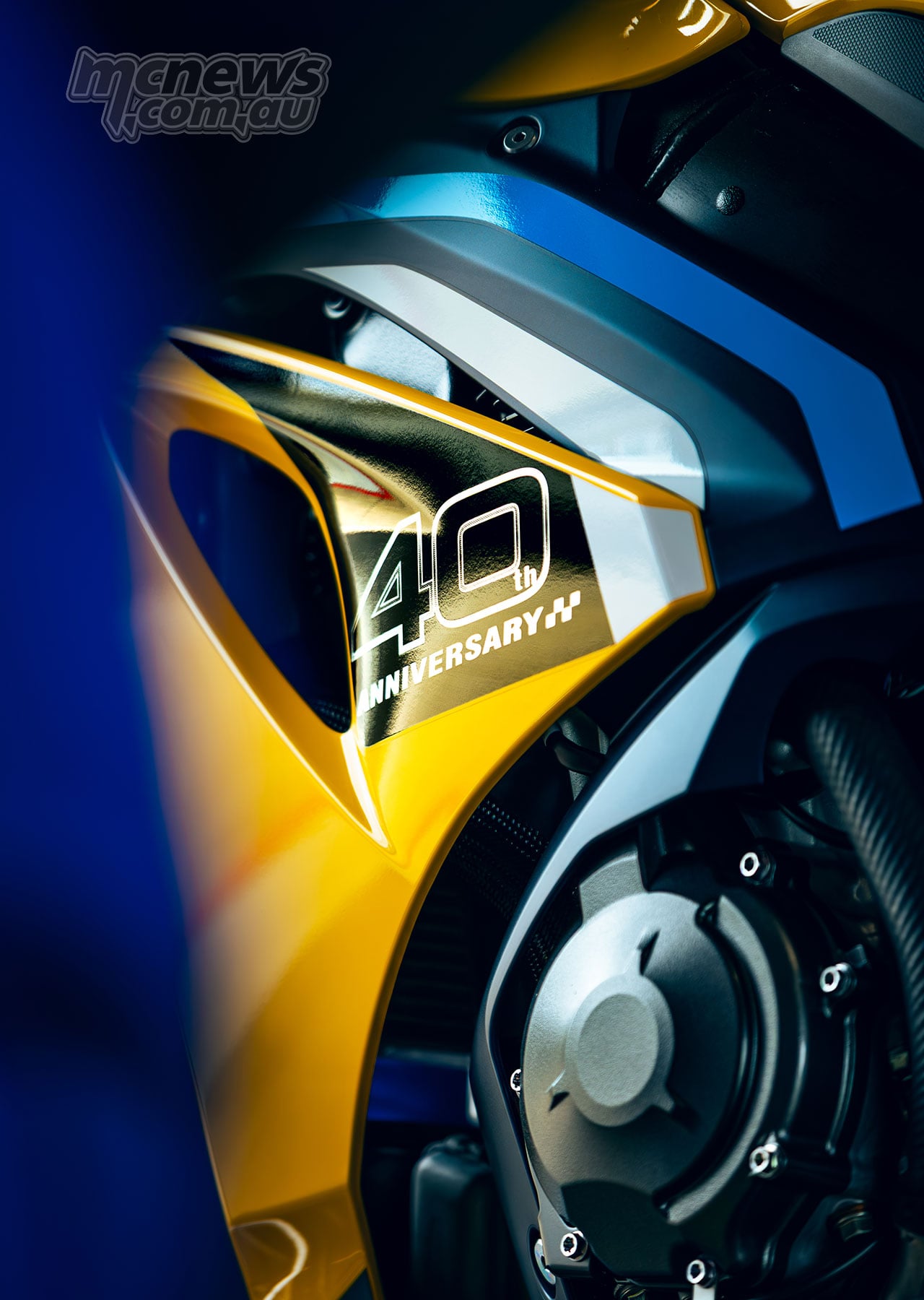
Forty years! It’s been forty years since Suzuki released the original race-replica Superbike: the GSX-R750. Other manufacturers quickly followed with machines such as the RC30, FZR1000 and ZXR750, then, nearly a decade later, the 916. Yamaha smashed the established order again in 1998 with the first brutal YZF-R1, effectively forging the modern litre-bike category. But make no mistake, the Gixxer had already invented the modern sportbike formula with the GSX-R750.

Then came Suzuki’s first litre-class GSX-R, the K1 GSX-R1000, in 2001, and it promptly leapfrogged the superbike opposition. With 160 hp and a dry weight of just 170 kg, it was not only 10-plus horsepower stronger than most of its rivals, but lighter as well.
Over the years, that engine grew into a legend, with the K5 mill widely regarded as one of the greatest motors ever produced. Compared with its competitors, it had a relatively long-stroke engine, resulting in a colossal mid-range. No TC or modes back then, just mechanical excellence.
And underlying all of that was reliability. From the first GSX-R, durability has been a cornerstone of both the model and the Suzuki brand. GSX-Rs earned a reputation for making serious power, copping a hiding and continuing to do it.
While Suzuki won a World Superbike Championship with Corser and dominated both the AMA and Australian Superbike Championships through much of the decade from the early 2000s, it prized the World Endurance Championship above all others.
The Japanese manufacturer saw it as the ultimate way to demonstrate its reliability and engineering prowess. And win they did. Suzuki now credits itself with 21 Endurance World Championship titles, 20 of those achieved on GSX-R machinery, while the GSX-R1000 itself has contributed 15 FIM Endurance World Championship titles since its arrival in 2001.
That is a compelling reliability record, and it helps explain some of the engineering decisions behind this latest generation.
Still unmistakably GSX-R
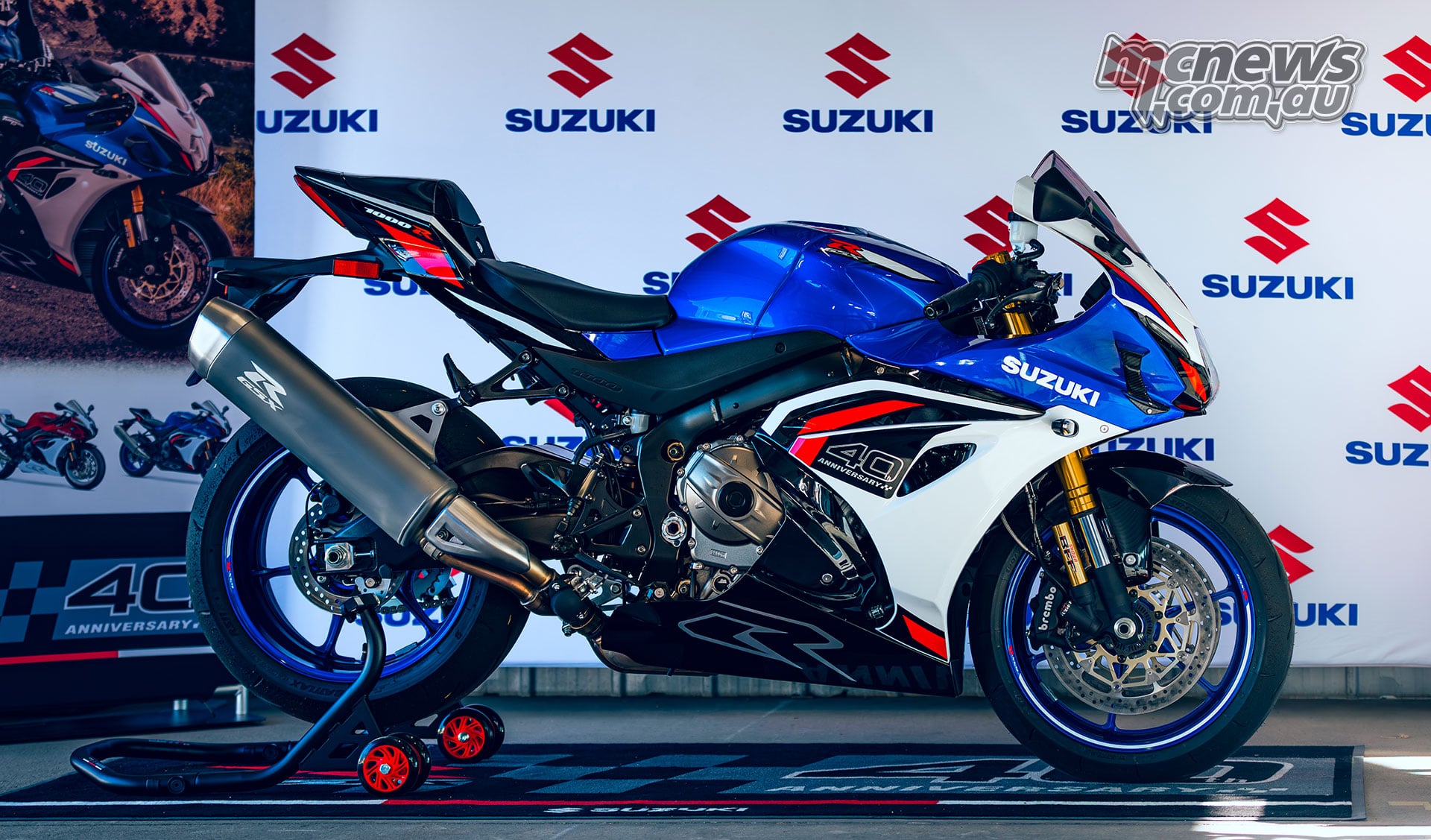
The latest Gixxer thousand embodies everything that has led up to this point. It is quintessentially GSX-R. Despite refinement over the years, it remains instantly recognisable, and I have to say – I love that.
There is a certain nostalgia to the design language that makes me smile and appreciate that not everything has to look as though every line was dictated by a wind tunnel and then AI-developed to within an inch of its life…
Ironically, of course, Suzuki has done plenty of wind-tunnel and racetrack work on it. They just haven’t thrown away that familiar GSX-R silhouette in the process.
Make no mistake, though; a fair bit is going on under the skin with the latest updates. The global headline is that the GSX-R1000 is back in Euro 5+ compliant form, but it took serious engineering to get there without throwing away what made the engine so good in the first place.
A very thoroughly revised engine
The 999.8 cc in-line four retains its 76 x 55.1 mm bore and stroke, but Suzuki has scrutinised almost everything involved in breathing, combustion, and durability.

The forged pistons are new, reshaped to help deliver the fairly hefty jump in compression from 13.2:1 to 13.8:1 while also making room for exhaust valves that have grown from 24 to 25 mm.
The underside ribbing of each piston has also been revised to save three grams, while short DLC-coated wrist pins help reduce friction and new circlip material adds another little piece to the durability puzzle.
Those larger exhaust valves reside in reprofiled cylinder-head ports designed to improve both intake and exhaust efficiency and are driven via revised F1-style finger followers working with thin-wall hollow camshafts.
The finger followers themselves are lighter than a conventional bucket-tappet arrangement, allowing accurate valve control at high rpm, and Suzuki has changed their shape on both the intake and exhaust sides to suit the new cam profiles. The new followers are ready for some hot cams to be dropped in, should one choose to do so.

The cam chain is wider too, with the changes aimed at reducing friction losses when running the low-viscosity oils typically used in racing and endurance competition.
The new crankshaft has journals beefed up from 35 to 37 mm, specifically to better withstand higher loads, pressures and temperatures. The crankcases have been redesigned to suit the new crankshaft.
That is a pretty good illustration of Suzuki’s priorities. This isn’t simply about scraping through an emissions test. They’ve strengthened areas of the engine with the expectation that people are going to race the thing – and potentially race it for a very long time.

Cooling received attention as well. The coolant passages through the cylinder head have been refined to eliminate stagnation areas and improve heat transfer.
A high-efficiency curved radiator is backed by twin electric fans for when things get properly hot, yet improved flow through the engine means the GSX-R needs less coolant volume than before, adding another small weight saving.
Big throttles, beautifully smooth delivery
The electronic throttle bodies have grown from 46 to a substantial 48 mm, with new single-stage velocity stacks and dual injectors for each cylinder. The primary injectors have also gone from ten holes to eight, while the secondary top-feed injectors live above the funnels and come into play at higher rpm. Fuel-pump pressure has been increased too.
What’s remarkable is how cleanly and smoothly the Suzuki still pulls from low rpm despite those big holes feeding the engine. You don’t feel like you have to keep it singing its head off to make it work.
A big part of that is Suzuki’s SR-VVT variable valve timing system, which remains beautifully simple. No oil-pressure actuators or electric motors are involved. It is entirely mechanical. Twelve steel balls sit in slanted grooves inside the intake cam sprocket. As centrifugal force increases with engine speed, the balls move through those grooves, rotating the sprocket and retarding the intake valve timing to favour high-rpm breathing without sacrificing the low and mid-range. It’s wonderfully clever in its simplicity and traces its development back to Suzuki’s MotoGP programme, where it was a winning formula.

The cam profiles themselves have changed too. Maximum lift remains the same, but overlap has been reduced as part of the Euro 5+ work. That reduction in overlap helps explain, at least in part, why the new engine gives away a little peak output compared with its predecessor, while retaining such a fat and linear spread of torque.
The headline numbers are 192 horsepower at 13,200 rpm and 110 Nm at 11,000 rpm.
And yes, some of you will note that is down a little on the previous generation in the pursuit of Euro 5+ compliance, but let’s be serious here for a minute – you won’t notice that on your Sunday ride with your mates.
A slimmer exhaust – and a better-looking one
The new 4-2-1 exhaust deserves a little more discussion than simply noting that the muffler is smaller. Suzuki has moved to a larger elliptical catalytic converter positioned closer to the engine so it heats more quickly, along with oxygen sensors before and after the cat to meet the latest emissions standards. Doing that has allowed the muffler itself to shrink from 8.3 litres to 5.5 litres – a 33 per cent reduction in volume.
More importantly, from where I’m standing, it now looks longer and more slender rather than having the somewhat stubby appearance of its predecessor.
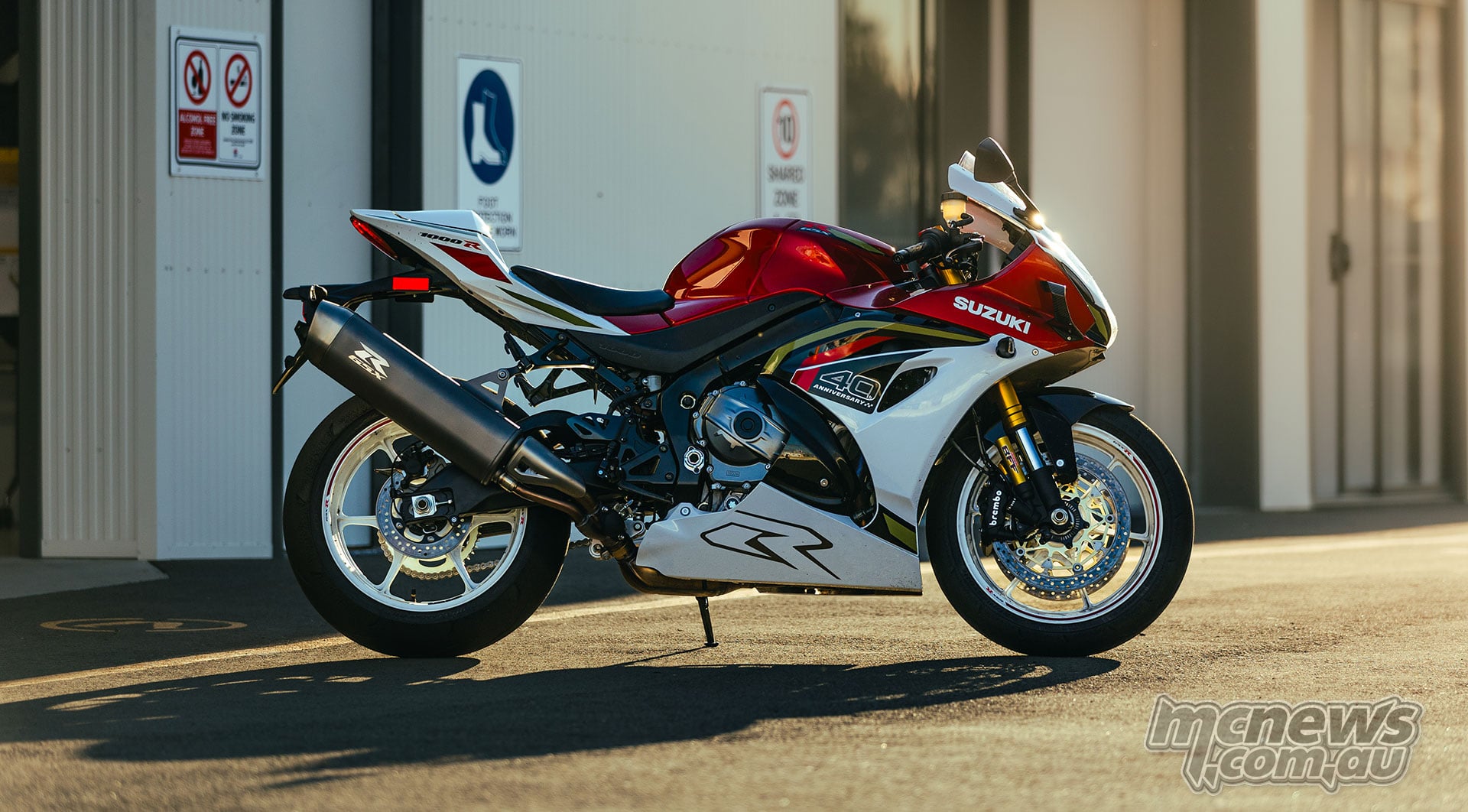
It accentuates the GSX-R’s long, low and relatively traditional sportsbike silhouette, setting it apart from many of the more aggressively truncated and aero-driven superbikes currently coming out of Europe and Japan.
And there is obviously some serious weight and performance sitting there waiting to be liberated if you replace that lot with a full system for dedicated track use…
Smart TLR – ten settings, but one integrated system
Let’s talk electronics for a bit. Specifically, the TLR. No, not the thumping V-twin from back in the day, but Suzuki’s new Smart TLR system.
TLR combines Traction Control, Lift Limiter and Roll Torque Control into one integrated system. There are ten intervention levels plus Off, with the selected level determining the amount of traction, wheelie and cornering torque intervention together.
That last part is important. You don’t separately dial in traction control at three, wheelie control at five and Roll Torque at two. Pick Smart TLR level three, for example, and the system applies Suzuki’s predetermined combination of all three at that level.
Separate from that are the three SDMS throttle maps: A for Active and the sharpest response, B for Basic and a more linear delivery, and C for Comfort and the softest response.
All three ultimately deliver the same maximum power; they simply change how it arrives at your right hand.
The whole electronic package is underpinned by a Bosch six-axis – technically three-axis, six-direction – IMU monitoring pitch, roll and yaw, while the engine is fully ride-by-wire.
That gives the ECU the authority required for TLR, launch control, the quick-shifter, cornering ABS and the various throttle maps to do their thing.
But what I really like is that you don’t constantly feel all that technology working underneath you.
Despite the ride-by-wire throttle and the fairly sophisticated electronic safety net, the connection between your right wrist and the rear tyre remains remarkably direct and linear. Almost analogue.
That might sound contradictory on a motorcycle with a six-axis IMU and this much processing power, but it’s perhaps one of the greatest compliments I can give it. The electronics work around the fundamental GSX-R character rather than defining it.
Combined with the simple dual-button arrangement on the left switchblock, the important settings are also quick and easy to alter on track.
All of it is easy to read on the GSX-RR-inspired, retro-looking, negative-lit LCD dash layout that I also love.
Yep, an LCD rather than a fancy TFT. I don’t care. It works, it suits the bike, and you can see what you need to see.

Quick-shifter and slip-assist clutch
A bi-directional quick-shifter is standard, with its interruption time tuneable between 50 and 75 milliseconds, or you can switch the system off altogether.
Upshifts momentarily cut power to unload the gear dogs, while downshifts automatically blip the ride-by-wire throttles to match engine speed.
The clutch itself is Suzuki’s SCAS slip-and-assist design. Under acceleration, its ramps pull the clutch pack together, allowing softer springs and a lighter lever action, while on deceleration the slipper function reduces back-torque and helps keep the rear settled.
Put the two systems together, and the shifts are smooth, precise and very Suzuki. You can also flip the linkage to race pattern if you prefer.
Time to ride it
But how does it all come together, I hear you ask?
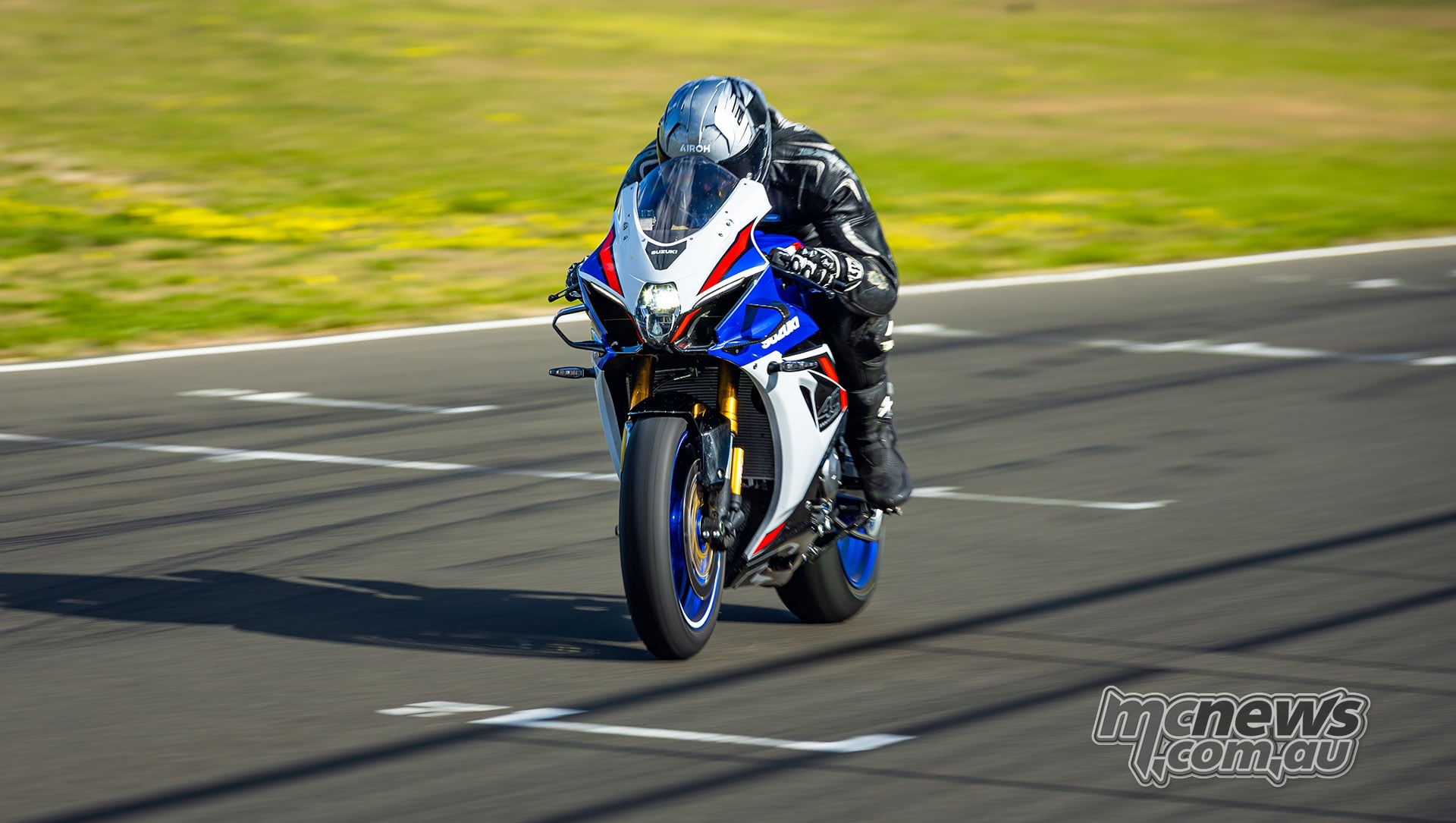
Well, we were lucky enough to spend some time getting acquainted with the new bike at Goulburn’s One Raceway – formerly Wakefield Park – and I came away super impressed.
The bike feels just… right.
Smaller than I expected. Narrower. And on the go it’s incredibly easy to flick from side to side. Super stable too. Incredibly so.
Very unintimidating and absolutely confidence-inspiring.
The perfect bike to learn a new track on, as it turned out.
If you haven’t been to One Raceway, it’s a deceptively challenging track to get right. We were lucky enough to have a certain three-time Aussie Superbike Champion, Shawn Giles, lead us around for a couple of laps to give us newbies some lines, then cut us loose.
I will happily admit my first couple of sessions weren’t that pretty.
I got the hang of the first half of the track pretty quickly, especially the glorious combination that is turns two and three, banked over on the right: kiss the inside kerb, drift out to the outside, then sweep back into the inside kerb of three, all on a constant arc.
Lovely.
But I was still out at sea from turn eight onward – the downhill tight left-hander through to the final 180-degree right into left kink that brings you onto the main straight.
The last right in particular took forever to find the right braking point and line, because you enter it blind and the right line is nowhere near where you think it is…
But by session three, things started to gel. Map B, with TLR set to 3. That gave me plenty of drive out of corners while still giving me a safety net. I’d found my happy place and was within a couple of seconds of the fastest of the fellow journos who’d raced there before.
Oh so GSX-R
My key takeaway was just how easy the bike was to ride, which came down to two factors.
First, the way the bike delivers its power is deceptively smooth.
I was literally using third gear everywhere except the main straight. The combination of those large 48 mm throttles, ride-by-wire and the purely mechanical variable valve timing system is superb.
Incredibly linear. Monster mid-range. Great throttle. This engine is magnificent.
It’ll happily pull from surprisingly low revs without complaint, then just keeps building. There isn’t that hollow feeling down low that you might expect from an engine breathing through throttle bodies this large and designed to make nearly 200 horsepower at more than 13,000 rpm.
And despite everything between your wrist and the rear tyre now being electronically managed, the way it drives still has this wonderfully mechanical, almost analogue quality to it.
Smooth, predictable and linear, but never sterile.
It feels oh so GSX-R.
The DNA remains.
And even with the stock muffler, it sounds terrific.
And second, the way it corners.
Only turn nine required any real effort to change direction. That one reminded me of the Hayshed at Phillip Island. You came out of the previous left-hander at reasonable speed, and I was chopping the throttle a little to help initiate turn-in and get it settled on its side to spot my exit reference.
Despite being easy to flick into a turn, the front just feels planted. Super stable.
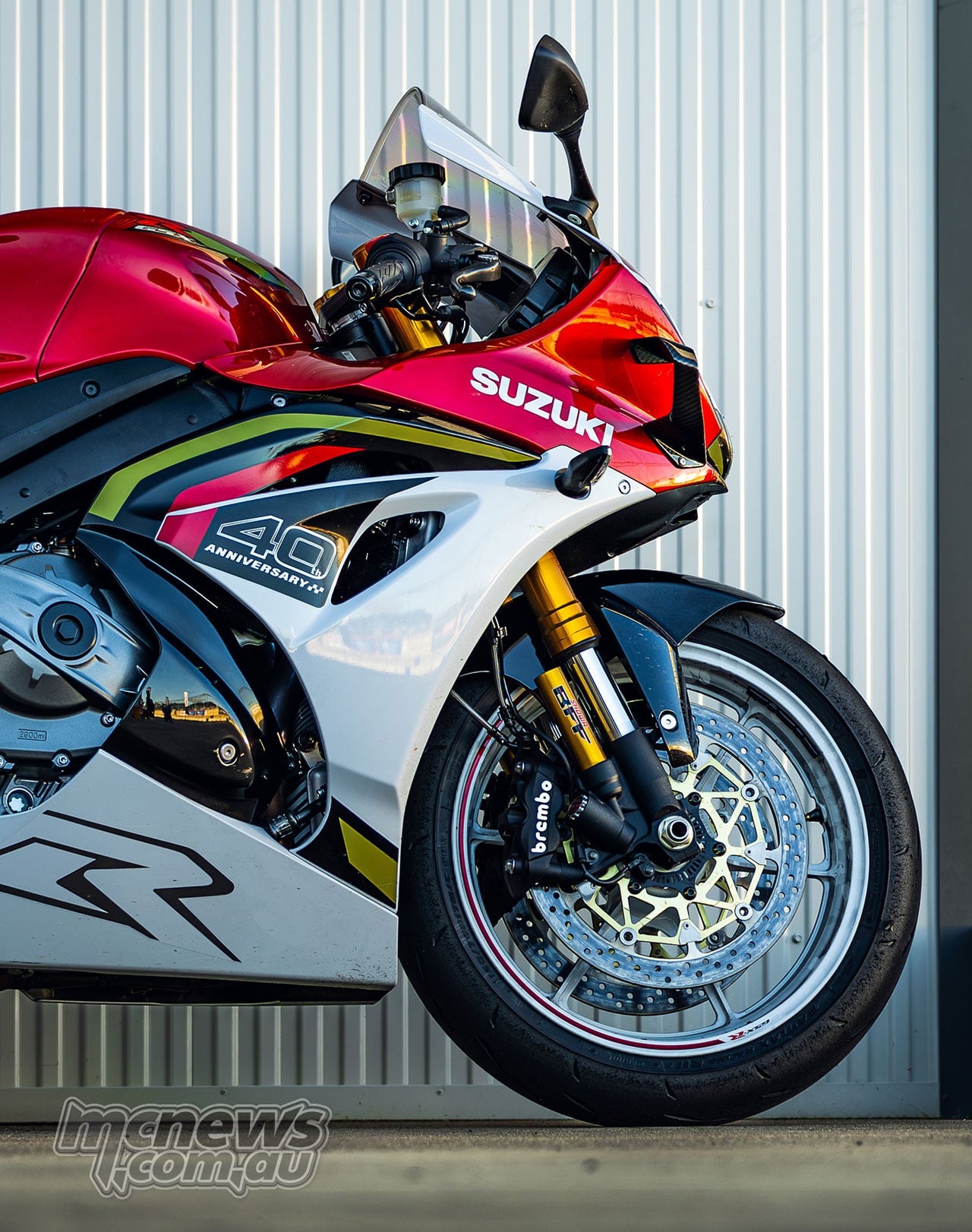
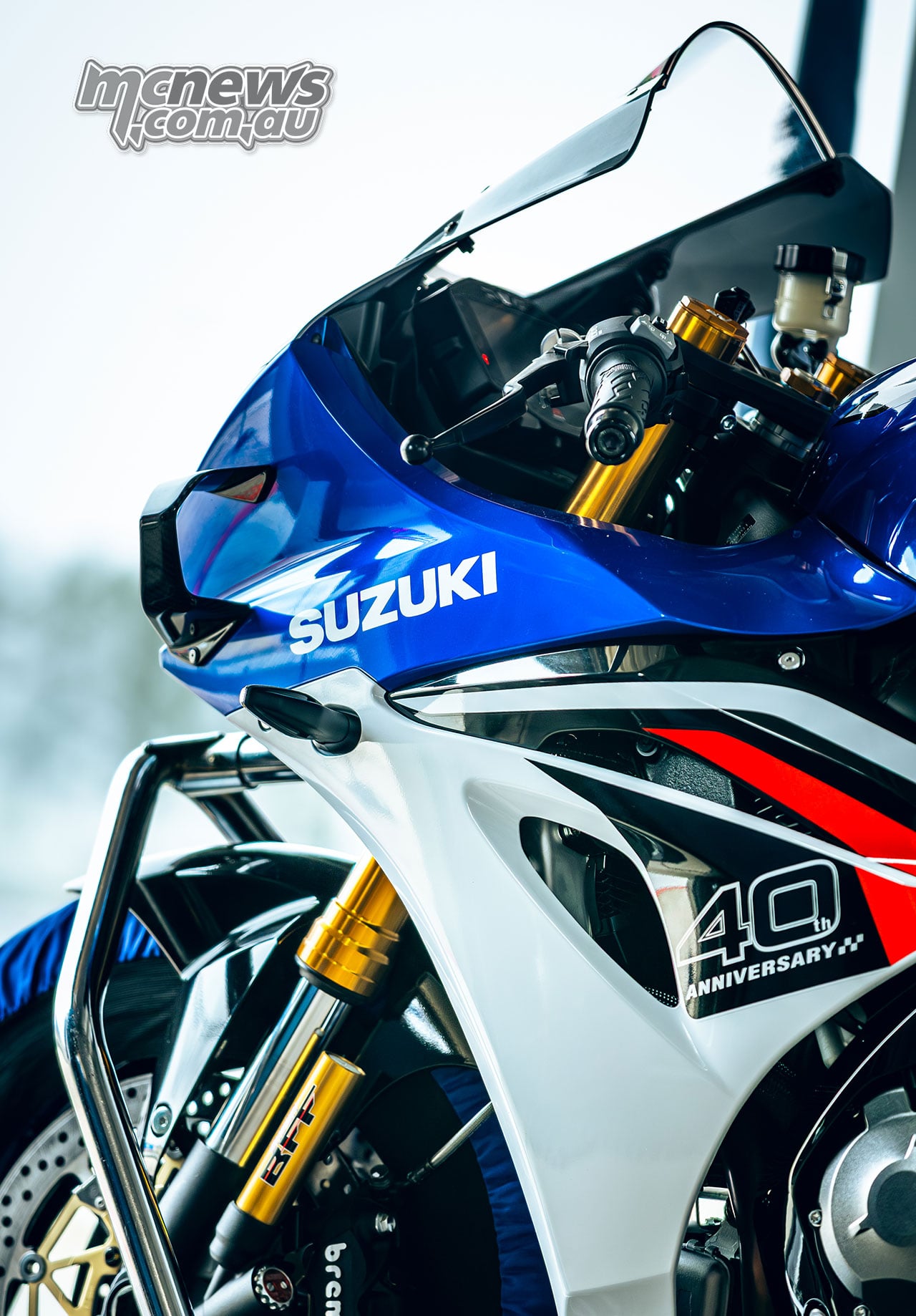
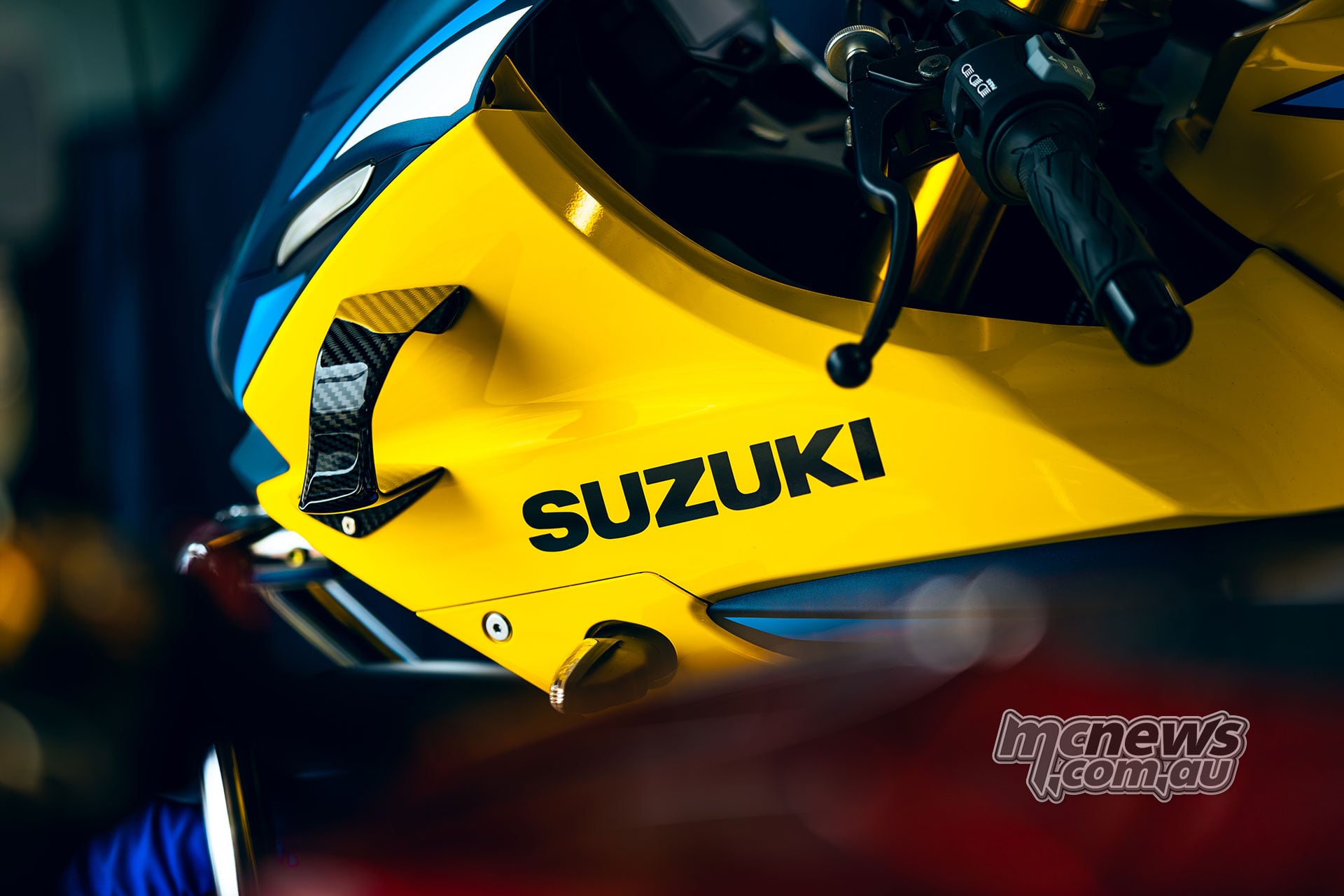
I suspect the carbon winglets – which Australia gets as standard along with a colour-matched seat cowl – are having an impact here.
Suzuki claims an 8.4 per cent reduction in front-end lift from the winglets, which weigh only 58.3 grams apiece and use the same basic shape as those developed for Suzuki’s CN Challenge Suzuka 8 Hour machine.
The Showa BFF fork and BFRC-lite shock need praise as well. Obviously we didn’t get a chance to test on-road conditions for big-hit absorption, but the support under heavy braking was terrific with only a minor addition of compression and rebound damping. Excellent communication of just what that front wheel was doing.
Not Brembo’s latest – but bloody good brakes
Another interesting callout is the brakes.
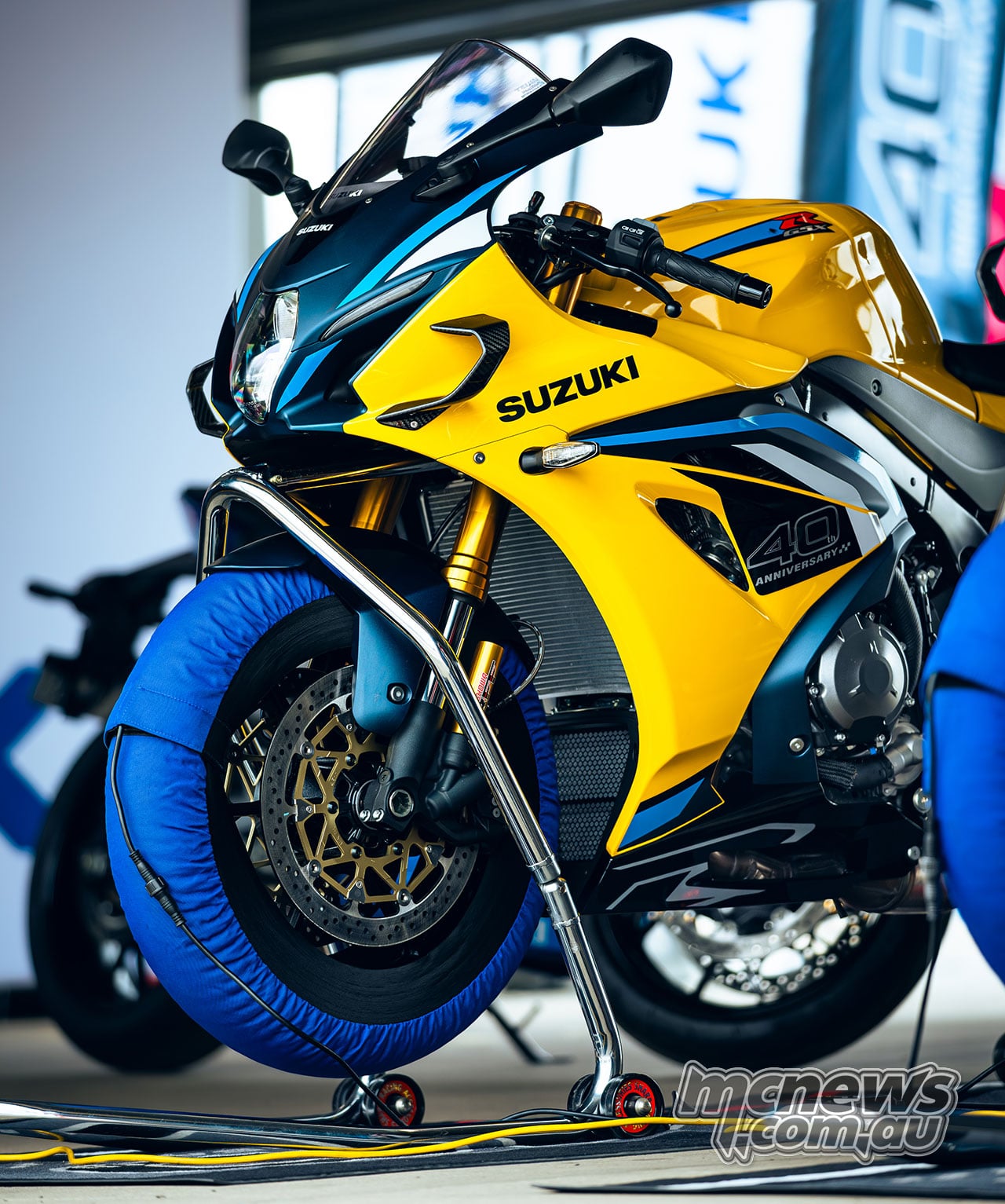
The new Gixxer runs radial-mount four-piston Brembo Monobloc calipers on 320 mm rotors up front, matched to a Nissin master cylinder. The rear relies on Nissin hardware, while braided lines are standard.
The front discs themselves use an interesting hybrid arrangement combining five conventional spring-loaded floating pins with five Brembo T-drive mounts. The aim is to gain some of the weight and performance advantages of T-drive hardware without accepting as much rattle as a pure T-drive arrangement.
The calipers themselves aren’t the latest word from Brembo. They’re a generation behind the latest Hypure hardware and also sit a rung below Stylema, which has become almost expected on high-end European superbikes. Did that matter on track? Not one bit. Their performance was exemplary.
Lovely lever feel, excellent consistency and more than enough outright power to repeatedly haul the Gixxer down from serious speed. Which is another useful reminder that there is far more to how a braking system performs than whatever name happens to be cast into the caliper.
They’re backed by Suzuki’s Motion Track Brake System, with the Bosch IMU allowing the ABS to take lean angle and machine attitude into account rather than relying solely on wheel-speed information.
The latest Astemo ABS unit is also more compact and 51 grams lighter than the previous unit, with much finer pressure modulation. Suzuki rather neatly illustrated the difference at the presentation as going from ‘tap… tap… tap…’ to ‘ta-ta-ta-ta’. It’s less noticeable at the lever and more effective.
Slope Dependent Control is also part of the package, using IMU information to adjust brake pressure when braking downhill and help keep the rear wheel on the deck.
9500 rpm and hit go
We ended the day testing out the launch-control system off the grid.
Press and hold the start button when the bike is running and it goes into launch mode. It holds the engine at 9500 rpm, controls torque and works with the Lift Limiter, leaving you to concentrate on feeding out the clutch. Then you’re flung forward.
The system switches itself off when you shift into third gear or close the throttle. It’s a brilliantly simple system to use and brutally effective.
Where does it sit in 2027?
In terms of comparing the bike with the front-running superbikes in the category, this update isn’t the ‘leapfrog the competitors’ move that Suzuki has pulled out of the bag more than once in the past.
I think those days are gone.
It remains to be seen how it will perform in competition, but I think as a road bike that gets used for track days, it is a fine thing.
Realistically, it’s probably not going to be as outright capable at the absolute pointy end as your Panigale V4 S, M 1000 RR or some of the other exotic top-tier superbikes that have been in near-constant development.
But those bikes also live at another level of the price list.
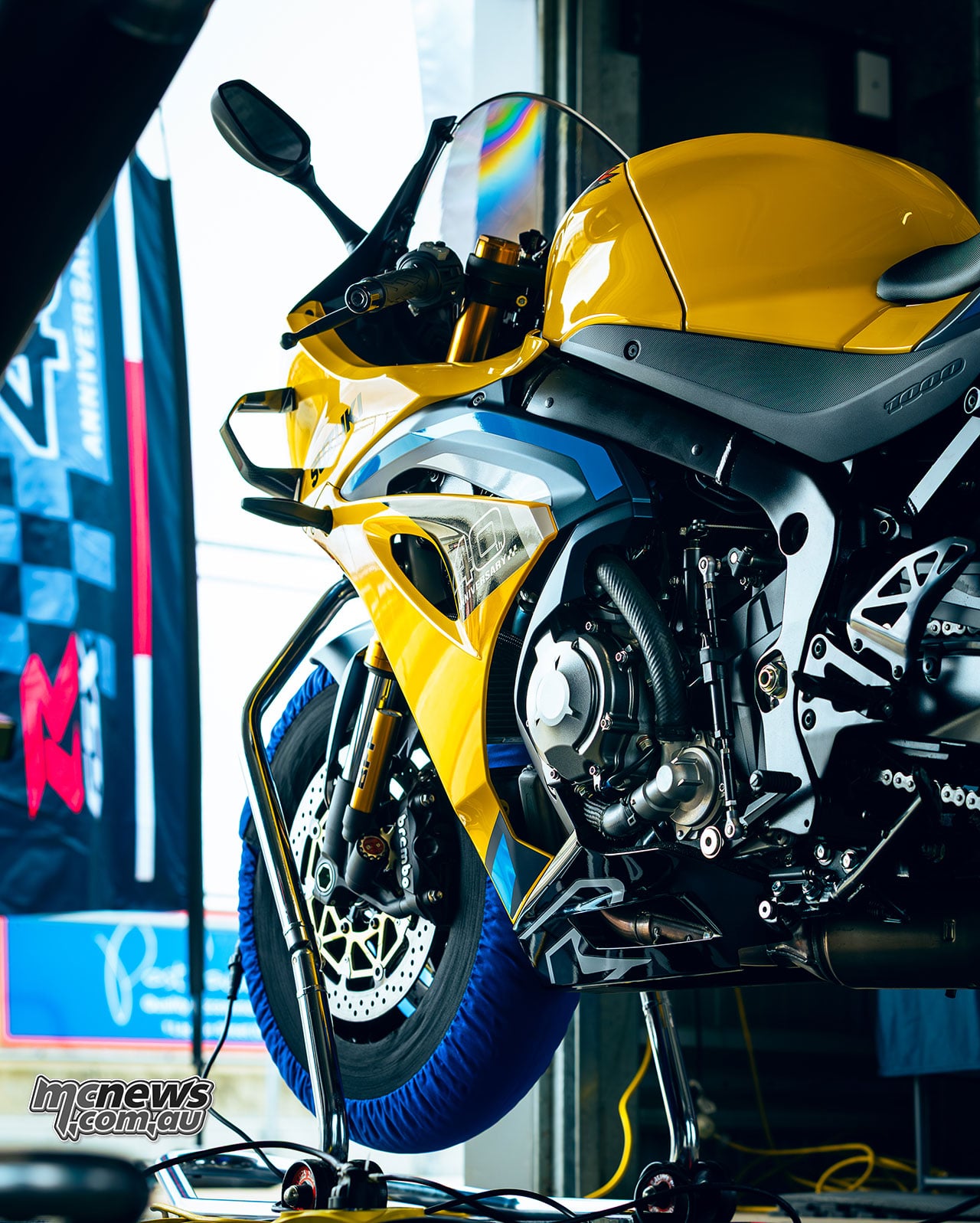
At $30,990 ride-away, the Suzuki remains at the comparatively affordable end of serious litre-class superbikes. It also comes with a three-year warranty and, while some markets have offered more than one GSX-R1000 specification, Suzuki only brings in the top-shelf GSX-R1000R here in Australia, complete with carbon winglets and a colour-matched seat cowl.
I’d say the BMW S 1000 RR is probably the most direct competitor once you start looking at that price-and-performance equation, though I think the Gixxer occupies a special place in the heart of many riders in a way that is difficult to quantify on a spec sheet.
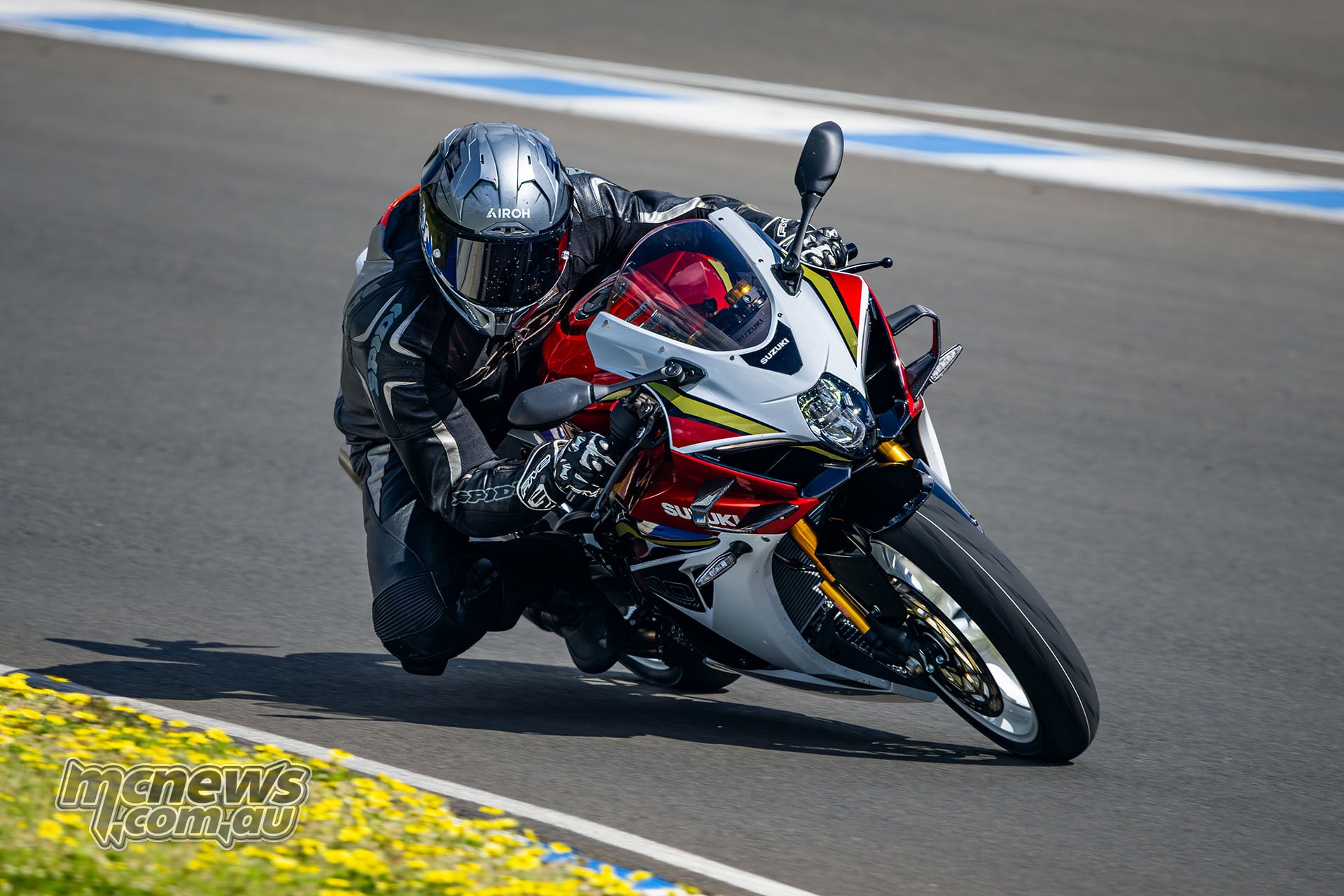
Suzuki fans can rejoice that they’re back.
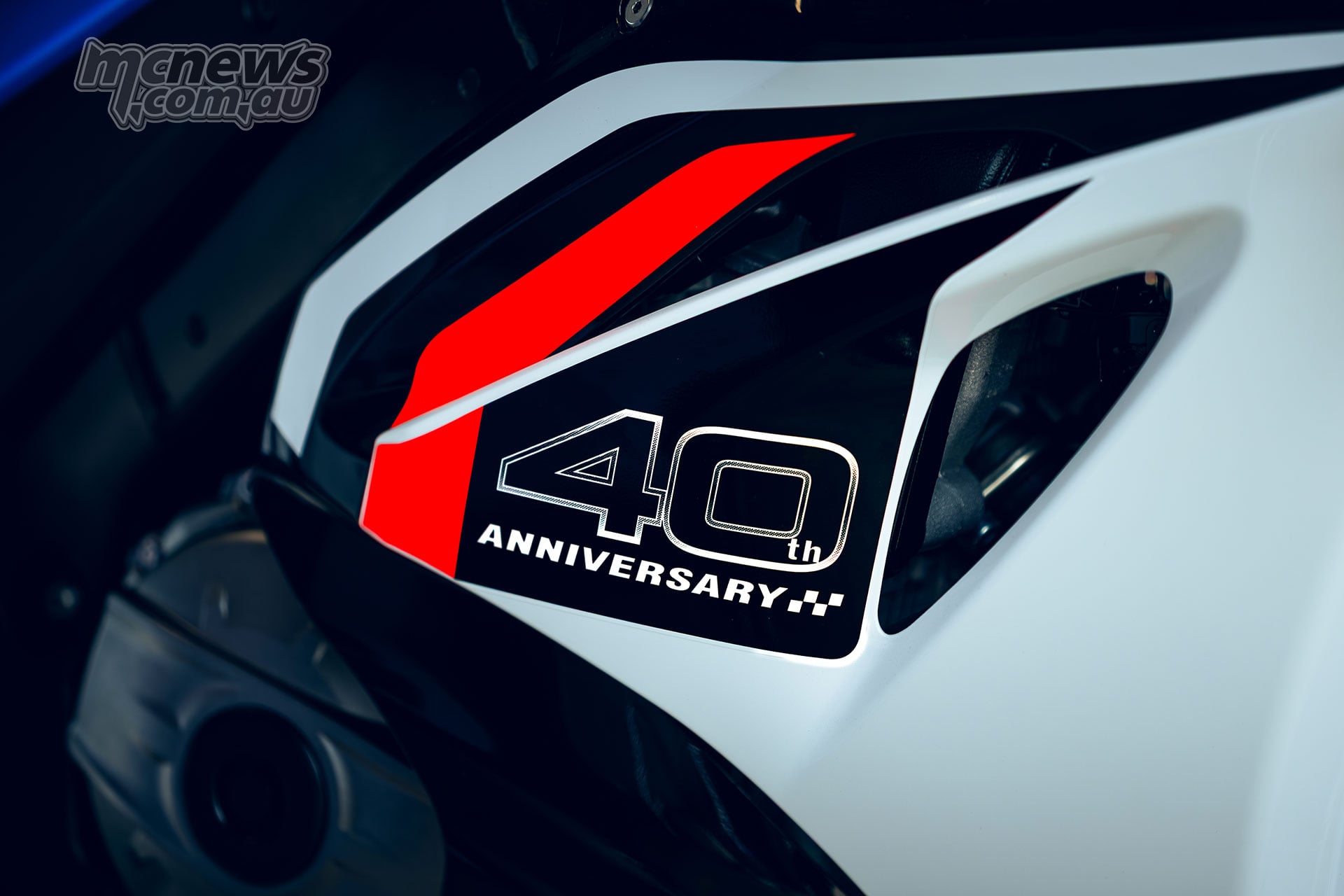
The tougher decision for them will be which of the three colour schemes to choose. I bounced between red and blue being my favourite… and still don’t know which I’d choose!
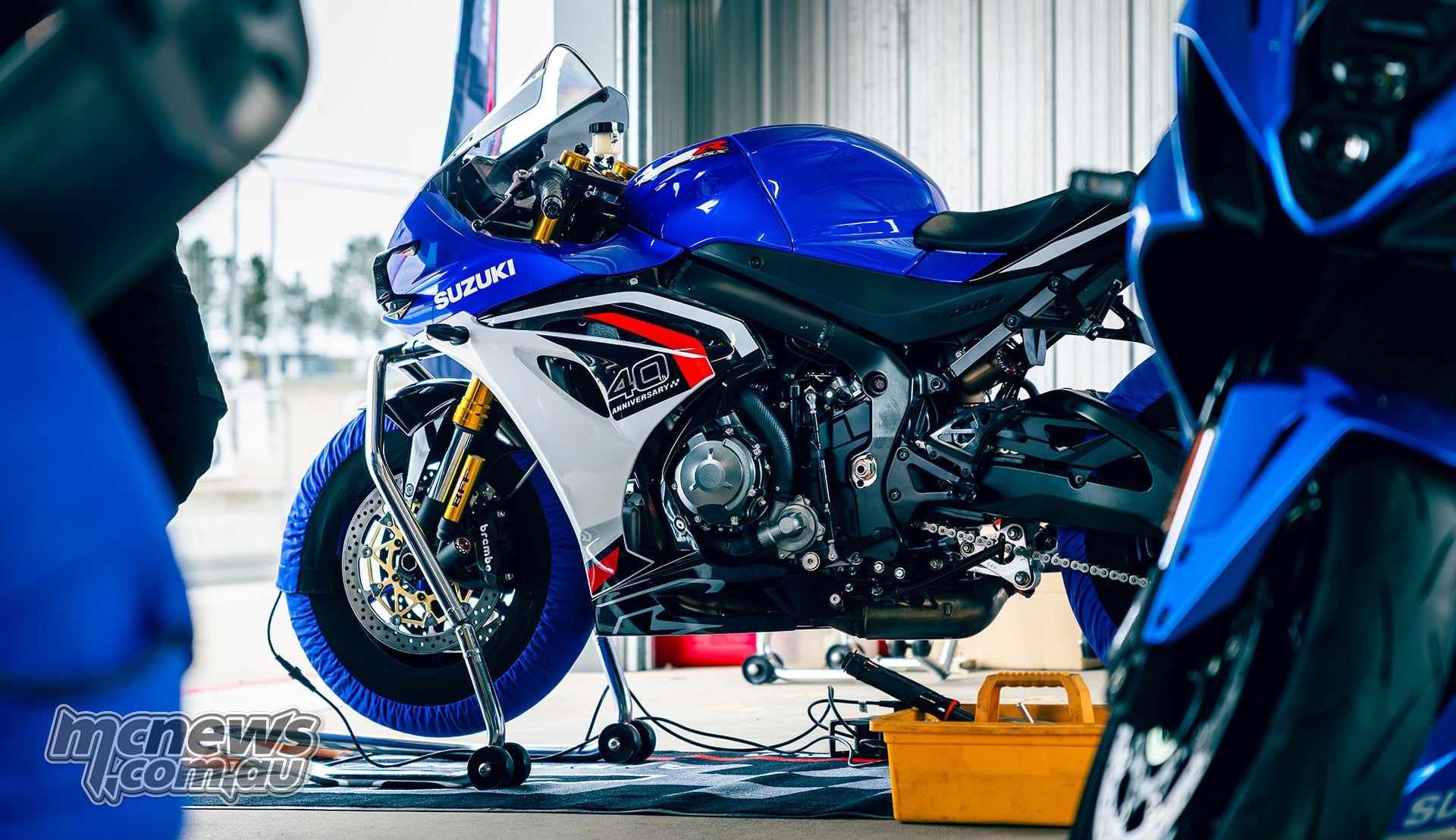
Now if we could just get a properly updated 750…
Or maybe just do an 850 V4 and a surprise re-entry into MotoGP!
Hey, a boy can dream…
40th Anniversary GSX-R1000R hits
- Incredibly easy-to-ride package. Stable, agile and confidence-inspiring.
- That engine: super smooth, mega mid-range and beautifully linear.
- Ride-by-wire and modern electronics haven’t diluted the traditional GSX-R character.
- Subjective, but I love that it still looks and feels like a ‘proper’ Gixxer.
And misses
- While the combined Smart TLR system makes on-track adjustment easy, I’d still prefer independent wheelie-control adjustment.
- No cruise control.
2026 Suzuki GSX-R1000R Specifications
| 2026 Suzuki GSX-R1000R Specifications | |
|
Engine Type
|
4-stroke, 4-cylinder, liquid-cooled, DOHC
|
|
Bore x Stroke
|
76.0 mm x 55.1 mm (3.0 in. x 2.2 in.)
|
|
Engine Displacement
|
999.8 cm³ (61.0 cu. in.)
|
|
Compression Ratio
|
13.8:1
|
|
Maximum Power
|
143.5 kW (195 PS) @ 13,200 rpm
|
|
Maximum Torque
|
110.0 N-m @ 11,000 rpm
|
|
Fuel System
|
Fuel injection
|
|
Starter System
|
Electric
|
|
Lubrication System
|
Wet sump
|
|
Fuel Consumption (WMTC)
|
14.7 km/L (6.8 L/100km)
|
|
CO₂ Emissions (WMTC)
|
158 g/km
|
|
Emissions Level
|
Euro 5+
|
|
Overall Width
|
705 mm (27.8 in.)
|
|
Overall Height
|
1,145 mm (45.1 in.)
|
|
Wheelbase
|
1,420 mm (55.9 in.)
|
|
Ground Clearance
|
130 mm (5.1 in.)
|
|
Seat Height
|
825 mm (32.5 in.)
|
|
Curb Weight (EU/USA)
|
203 kg (448 lbs.)
|
|
Transmission
|
6-speed constant mesh
|
|
Suspension (Front)
|
43 mm Showa BFF, fully-adjustable
|
|
Suspension (Rear)
|
Showa BFRC Lite, fully-adjustable
|
|
Rake / Trail
|
23°20’ / 95 mm (3.7 in.)
|
|
Brakes (Front)
|
Brembo T-Drive 320 mm discs, four-piston radial monoblock calipers
|
|
Brakes (Rear)
|
Disc
|
|
Tyres (Front)
|
120/70ZR17M/C (58W), tubeless Bridgestone RS11
|
|
Tyres (Rear)
|
190/55ZR17M/C (75W), tubeless Bridgestone RS11
|
|
Ignition System
|
Electronic ignition (transistorised)
|
|
Fuel Tank Capacity
|
16.0 L
|
|
Oil Capacity (Overhaul)
|
4.0 L
|
|
Fuel Consumption (WMTC)
|
14.7 km/L (6.8 L/100km)
|
|
CO₂ Emissions (WMTC)
|
158 g/km
|
|
Emissions Level
|
Euro 5+
|