

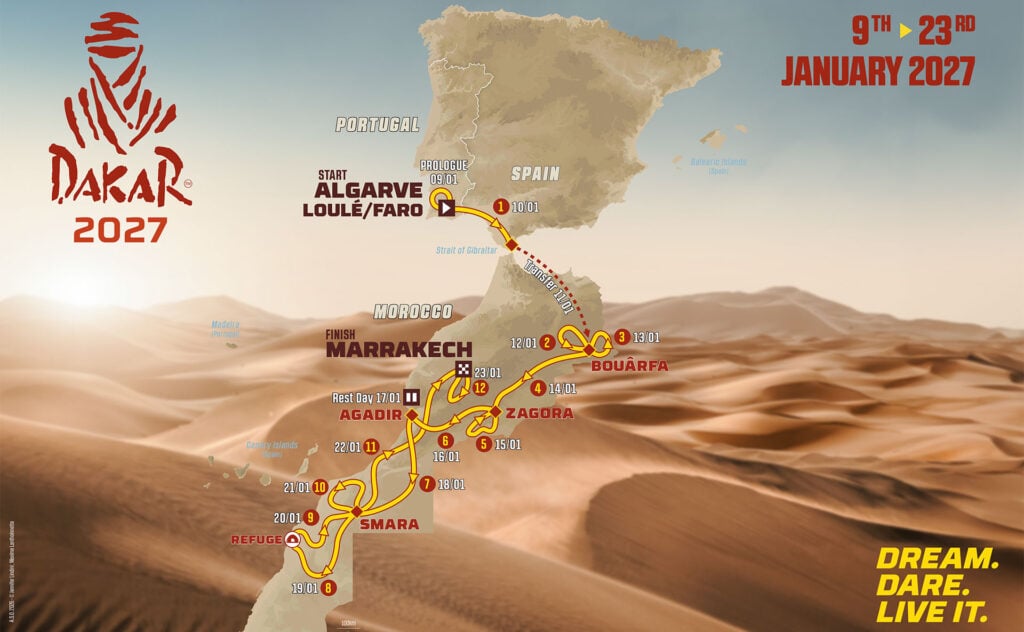
Dakar 2027 Route
The Dakar Rally will return to Africa in January for the first time in 20 years, with organisers confirming a route from Portugal’s Algarve to Marrakech for the 2027 event.
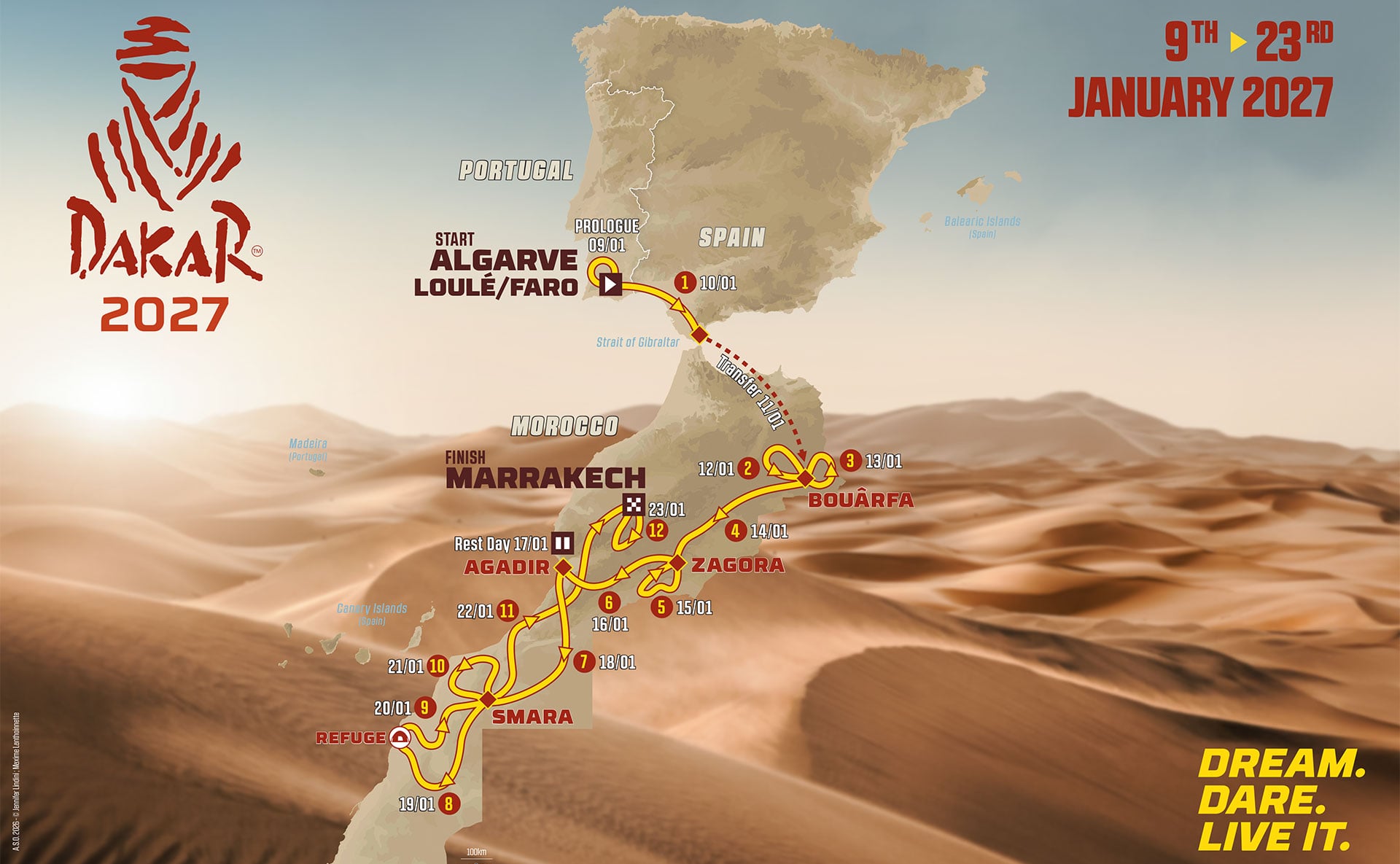
The 49th edition will cover 7,824 kilometres, including 4,341 kilometres of timed specials, with a prologue and 12 stages scheduled from January 9 to 23. An overnight ferry crossing will carry the field from Europe to Africa, while a remote marathon bivouac and a penultimate day of more than 1,000 kilometres promise plenty of work once they get there.
The route announcement follows our earlier report on Dakar’s departure from Saudi Arabia and proposed return to Africa. Portugal and Morocco are now confirmed as the replacement hosts, with ASO still planning to take the rally back to Saudi Arabia in 2028 for its 50th edition.
An African return, 20 years in the making
A European departure, a sea crossing and a long ride into the African desert will stir memories for anyone who followed Dakar before its years in South America and Saudi Arabia.
Thierry Sabine’s idea for the event grew out of his experience of becoming lost in the Libyan desert during the Abidjan–Nice rally. The first Paris–Dakar left the French capital on December 26, 1978, reaching Senegal in January 1979, with Cyril Neveu winning on a Yamaha XT500.
Those early singles gave way to increasingly specialised desert racers. Neveu later helped make Honda’s NXR750 one of the defining motorcycles of the African era, the big twin winning four consecutive Dakars from 1986 to 1989. Our look back at Honda’s Dakar history traces that development and the machinery it inspired.
Portugal also has a direct connection with the rally’s last African chapter. Lisbon hosted the 2007 start and was preparing to do so again in 2008 when terrorist threats forced the cancellation on the eve of departure.
Dakar moved to South America in 2009, then Saudi Arabia in 2020. Security concerns had driven it away from Africa; the Middle East conflict has now brought it back. The 2027 itinerary finishes in Marrakech, with Mauritania and Senegal outside the route.
Australia’s own Dakar milestones came during those intervening chapters: Toby Price became our first winner in 2016 in South America, while Daniel Sanders claimed his first victory in Saudi Arabia in 2025.
Portugal, then an overnight crossing
The Algarve Stadium at Loulé-Faro will provide the setting for the start. The service park opens on January 5, followed by administrative and technical checks from January 6 to 8.
Competition begins with a 29-kilometre prologue on January 9, on a course through the trees designed to reward riding skill. Stage One follows on January 10 with 100 kilometres against the clock in Portugal, before the transfer to the ferry and an overnight Mediterranean crossing to Nador.
January 11 is a transfer day to the first African bivouac at Bouarfa. Racing in Africa begins on January 12, with a 390-kilometre special across the Rekkam plateau, where faint tracks will put navigation under scrutiny immediately.
Merzouga, Chegaga and the road to Agadir
Two loops around Bouarfa open the African competition before Stage Four heads to Zagora. Its 490-kilometre special is the longest of the opening week and includes the rally’s only passage through the Merzouga dunes, along with camel grass that will demand some mechanical sympathy.
Stage Five takes riders into Erg Chegaga, with around 50 kilometres of dunes split by a rocky section. Winding sandy tracks add a navigation test to a day spent entirely off the tarmac.
Another 365-kilometre special follows on Stage Six, including roughly another 50 kilometres of dunes. With liaison sections included, the journey to Agadir totals 760 kilometres, the longest day of the opening week. The rest day falls on January 17.
A marathon near Dakhla
The restart offers little time to ease back into things. Stage Seven, from Agadir to Smara, contains the longest special of the rally at 500 kilometres, with fast tracks and demanding navigation. ASO says this section reconnects with Dakar’s historic route south towards Mauritania.
Stages Eight and Nine form the marathon section, taking riders from Smara to a remote refuge bivouac near Dakhla before returning to Smara the following evening. Across the two days they will cover 1,150 kilometres, including 745 kilometres of specials, without their assistance crews at the overnight stop.
The bivouac will use traditional tents, with the Dakhla lagoon in the distance. Getting there means negotiating little-used sandy tracks, small dunes and open plateaus; getting back means doing it again with whatever condition the bike and rider have carried through the night.
A 470-kilometre loop around Smara follows on Stage Ten, mixing fast plateaus, sand, small dunes, wadis and sandy canyons.
More than 1,000 kilometres before the final day
The penultimate stage is the longest day of the rally: 1,035 kilometres from Smara to Marrakech, made up of a 455-kilometre special and 580 kilometres of liaison.
The timed route works towards the Atlantic coast and includes around 20 kilometres on Plage Blanche, before a maze of tracks brings further navigation challenges towards the end of the special.
Only 22 timed kilometres remain on the final stage around Marrakech on January 23, followed by the finish celebrations. Dakar 2027 will also open the FIM World Rally-Raid Championship season.
 Castera promises a full Dakar challenge
The route has been assembled in weeks, drawing on the organisers’ existing knowledge and fresh reconnaissance. Portugal’s ACP, which has run a W2RC round since 2024, will support the European opening, while the African itinerary stretches well beyond the usual Rallye du Maroc format.
David Castera – Dakar Director
“Despite the short timeframe we have had to work with, we have designed a true Dakar.”
The distances give that claim substance. From the first African stage through to the penultimate day, every special exceeds 350 kilometres. For the motorcycle field, the return to Africa brings two weeks of navigation, endurance and bike preservation through some of Dakar’s old surroundings.
Dakar 2027 itinerary
| Date | Stage | Route | Total km | Special km |
|---|---|---|---|---|
| 9 Jan | Prologue | Loulé-Faro loop | 129 | 29 |
| 10 Jan | 1 | Loulé-Faro loop | 300 | 100 |
| 11 Jan | Transfer | Loulé-Faro – Bouarfa | 590 | – |
| 12 Jan | 2 | Bouarfa loop | 490 | 390 |
| 13 Jan | 3 | Bouarfa loop | 490 | 410 |
| 14 Jan | 4 | Bouarfa – Zagora | 750 | 490 |
| 15 Jan | 5 | Zagora loop | 540 | 365 |
| 16 Jan | 6 | Zagora – Agadir | 760 | 365 |
| 17 Jan | Rest day | Agadir | – | – |
| 18 Jan | 7 | Agadir – Smara | 790 | 500 |
| 19 Jan | 8 | Smara – Refuge bivouac | 525 | 355 |
| 20 Jan | 9 | Refuge bivouac – Smara | 625 | 390 |
| 21 Jan | 10 | Smara loop | 560 | 470 |
| 22 Jan | 11 | Smara – Marrakech | 1,035 | 455 |
| 23 Jan | 12 | Marrakech loop | 240 | 22 |
| Total | 7,824 | 4,341 | ||
Dates remain subject to approval by the FIA World Motor Sport Council.