

Christoph Ettenhuber
Head of Continental Motorcycle Business Unit
Trevor Hedge: Tell us a little about yourself and your job description.
Christoph Ettenhuber: “Hi, my name is Christoph, I head the Motorcycle Tyre Team at Continental. I’ve been with the company for quite some time – 13 years in various functions, and now for four years, I’m heading the Motorcycle Team.”
Trev: Were you with a different company or background before? Where did you study?
Ettenhuber: “I studied economics, and then started in banking before joining Continental, and had various functions from sales, operations, and finance.”

Trev: So, developing this tyre and the business plan for it, you are the final man who signs off, and everyone presents to.
Ettenhuber: “It’s generally a team effort. It’s typically triggered by product management or sales and then developed in a cross-functional team. We also decide as a team whether a project should continue or not. But yes, the business plan is a critical factor in deciding whether we invest more resources in a project.”
Trev: The TKC80 has been around forever, and adventure bikes are now much heavier while pumping out some massive torque numbers. Ten years ago, there were pretty much only two choices when it came to a 50-50 tyre for big adventure bikes, the TKC80 or the Karoo, but now, due to the massive boon in popularity of the adventure segment, buyers are spoiled for choice as every brand seems to now have an offering in this space. Is it this massive increase in competition that has somewhat forced your hand in bringing this new generation of TKC80 to market?
Ettenhuber: “It’s been successful for quite some time, and over the years we’ve of course had the idea to come up with a successor to the tyre. In many instances, customers told us not to; they liked it, they didn’t want to see a new one. It was so popular over the years that we just didn’t touch the pattern for such a long time. But I mean, the existing TKC80 has been upgraded; you saw in the presentation, we’ve upgraded so many things along the way.“
Trev: It didn’t seem like a lot, little tweaks here and there, some tyre sizes. I saw there was mention of carcass modifications some years ago.
Ettenhuber: “Carcass material, reinforcement materials, and compound have changed along the way. As you can see on the OE specs, we had BMW and KTM, using it as an OE fitment, and they test the tyres, so they know that things have been upgraded to fit the requirements.
“We never touched the pattern, because of the popularity of the pattern. But over the years, we have collected so many ideas as to how, also from feedback from customers, as to what they would like to see changed, that we’ve come to a point where we had to touch the pattern, and once we touch the pattern, it has to have a new name.
“That was the trigger point to come up with the successor. The project itself has taken quite a long time, you saw some of the tests that have gone into it, the radial trials that we had, given some competitors are using a different construction, we started from scratch. We wanted to see what the best balance is for the tyre, and we’ve now come up with quite a lot of changes that you see in the presentation, the carcass, the compound, and the pattern. So it is really a step forward in the overall development.”
Trev: If you had to describe the product in one technical sentence, with the marketing head, what is the TKC80 Gen2 optimised to do better than the outgoing TKC80? I guess everything?
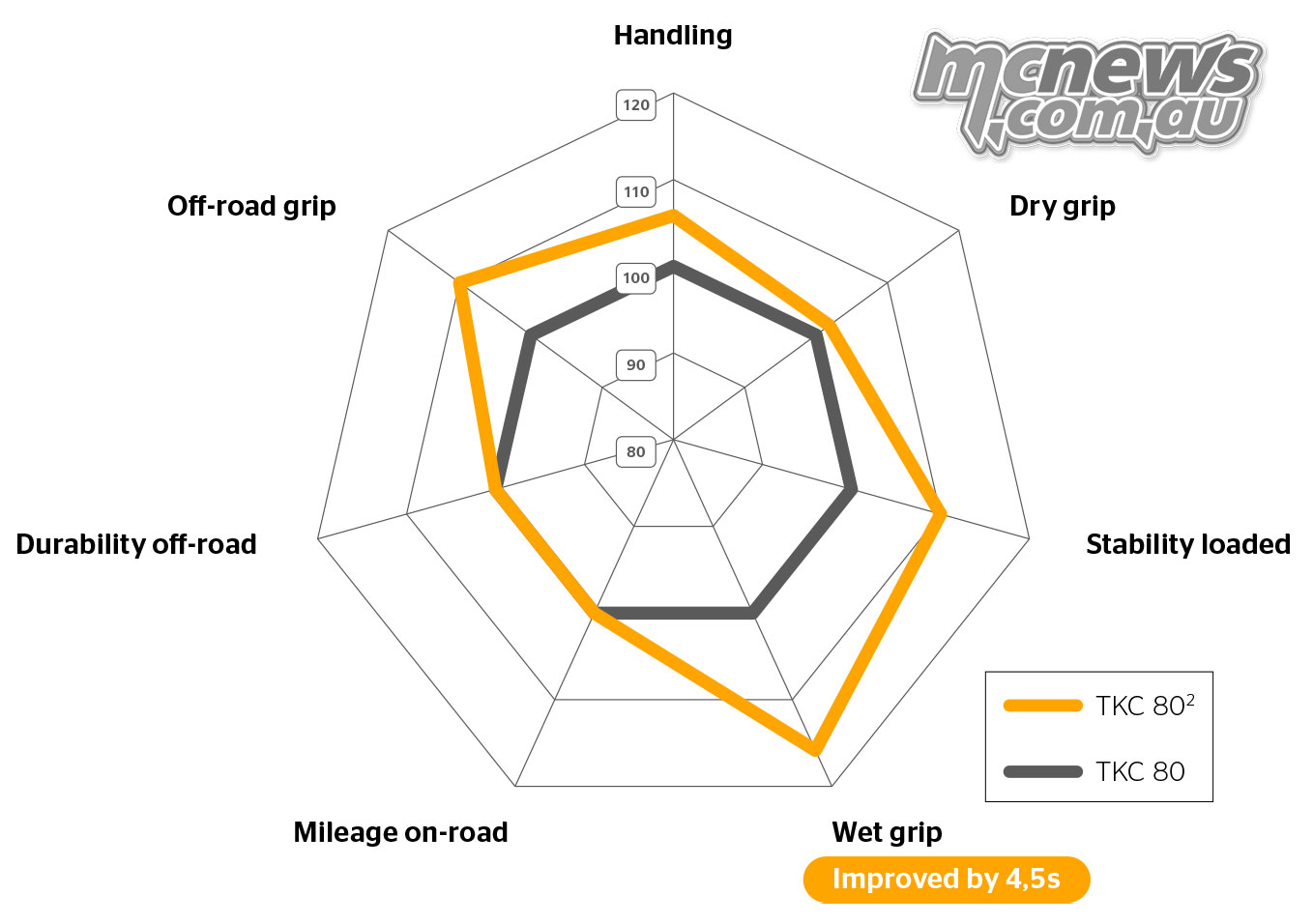
Ettenhuber: “You look at the spidergram, and you see it, the wet was one topic, stability was a topic, the heavier bikes you referenced play a role, and off-road is better, so those were the three biggest leaps that we did. When you touch these things, and you want to keep the balance of the overall tyre, so you find it a really difficult tyre to push the envelope, because you can’t push it on one side, because it drops somewhere else. So you have to push everything.”
Trev: In a modern tyre like this, what’s the biggest cost driver? Economics is your background, and when you go into how you produce a tyre and what goes into a tyre, can you break down what those costs are? What’s the most expensive part of the tyre, to actually produce, after the R&D is done? What are the relatively simple and fairly affordable processes, or what’s a big dollar part of the process that’s unavoidable?
Ettenhuber: “The materials are a big chunk for sure, choosing your materials has a big impact on the overall cost structure. Certain performance characteristics as well. But I think the biggest driver is process, given you are pushing the boundaries of the performance of the tyre, and at the same time you have a lot of technical requirements, it narrows your window and you have to control your processes really really well, to repeat that performance and meet all the ever more enforced technical requirements, regulations, that are out there.”
Trev: Does that mean you have to replace certain parts of your tooling after a certain number of tyres, or does it degrade or…?
Ettenhuber: “You have to increase your process stability, you typically have more controls, you check more, and more often along the process. Is the material on target? Is the carcass on target? Is it within a very narrow range to make sure your final product actually meets those requirements?”

Trev: Where are more of the raw materials coming from? Where are those mixed into the special sauce, and where is this tyre made?
Ettenhuber: “The tyre is made in Thailand in our brand new factory with state-of-the-art materials, individual tyre tracking, huge automation in the process controls, which helps us a lot.“
Trev: How many chemists/scientists work in the motorcycle division, or do you borrow some from the car division?
Ettenhuber: “We benefit from many of the bigger resources from the different product groups. The global team is spread across the world, with a strong base in Germany.“
Trev: How many people do you think, roughly, are in that R&D team that primarily work on motorcycles?
Ettenhuber: “We share resources, and with other product groups, we wouldn’t be able to pin that down.”
Trev: You talked about how strictly you have to control the process to ensure repeatability. How has that changed over the last decade, as you say, with automation and related developments? Has there been a generational leap there that redefines the parameters of what you can do and where that comes from?
Ettenhuber: “We digitalised a lot of our production over time. A new plant gives you the opportunity to take one big step to get you up to speed, but we also digitalise and upgrade all the existing equipment we have. So huge steps have been made over the last 10-15 years in the industry in terms of traceability, process control, compound mixing… huge steps.”
Trev: Where do you think there’s going to be another generational leap, in the next three to five years, in performance, or durability, or something, and where is that most likely to come from? Chemistry improvements, I would imagine?
Ettenhuber: “The new TKC80 was a fantastic example of how much there is still out there, and we even had to make a cut-off, at where we stop it there, as otherwise there’s just too many iterations of this process. But there’s a lot of opportunities left, both in chemistry and construction. So I see there is still a lot going on in the future.”
Trev: I know that when we talk chemistry, people say ‘that’s just a bit of rubber,’ I know there are actually polymers and chemical compounds in there that actually chemically repel water, etc. And obviously that’s a much, I would imagine, inform me if I’m wrong, and that’s a much bigger thing for a sports or sports touring tyre. How much of that chemistry can you explain to us, whether the chemistry levels or chemistry investment in a TKC80, how that compares to a sports-based tyre?
Ettenhuber: “A sports-based tyre has a narrower requirement book, I think that, as Emily said in the presentation, the chemical and compound development for the new TKC80 was probably more challenging because of the many use cases and applications that you want to achieve.
“That balance is so difficult, and unless you really push wet grip on the road, or durability on the off-road, if you want to have a balance for you, to have as many options as possible, that’s a really tough development. So it was a huge project for us, and I think there are still a lot of options out there to even go much further.
“One more aspect, the other area to the compounding and chemistry side, where we were working heavily, is on the sustainability side of it. So getting more sustainable and recyclable materials into motorcycle tyres, that’s one of the big areas that will be a huge step. It will require a lot of testing, and a lot of research and development.”
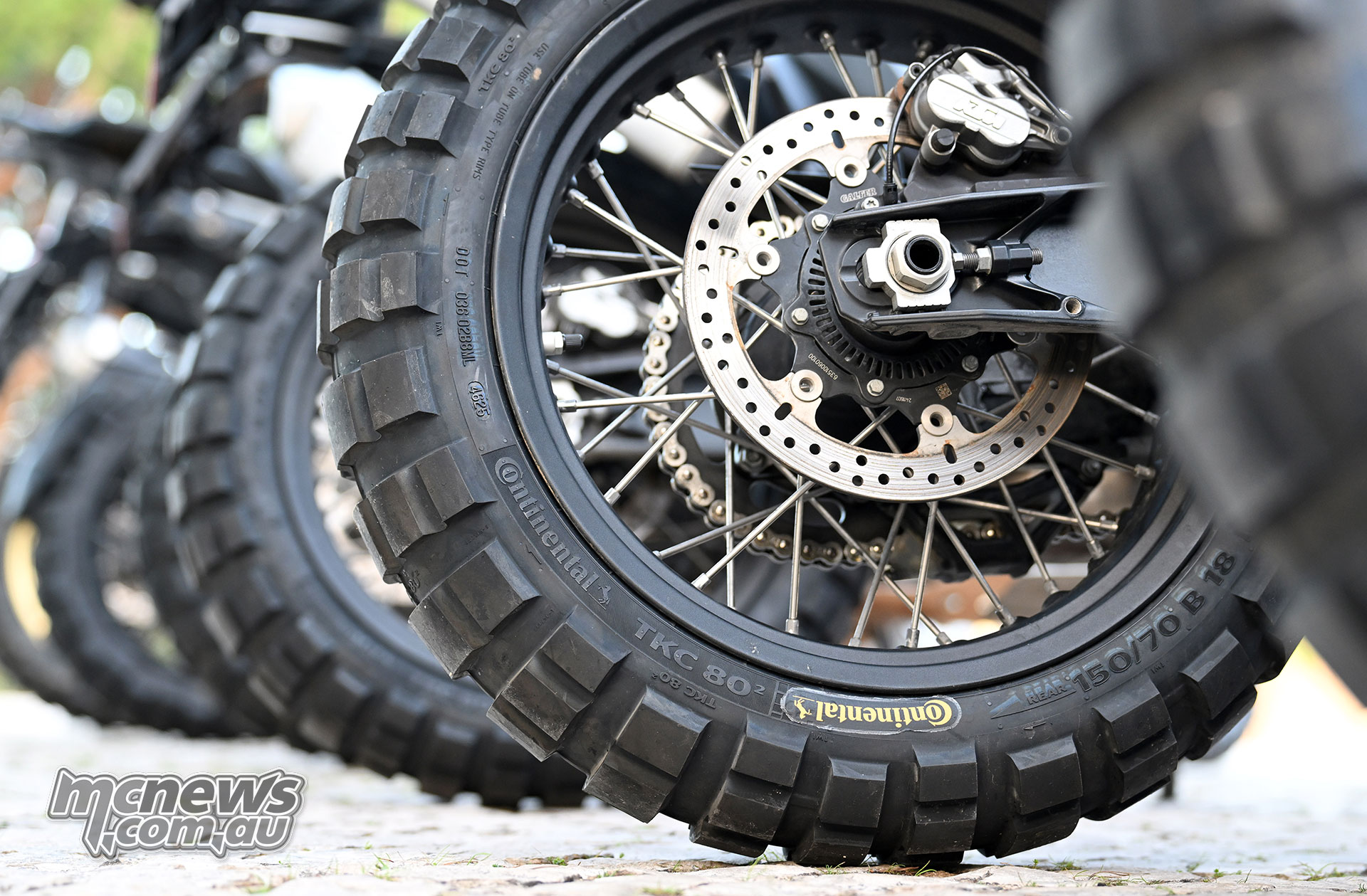
Trev: You mentioned that a lot of people said, “Don’t change the tyre.” So obviously, you’ve got those loyalists. There is a certain batch of loyalists that, if you change anything, they won’t be happy, and obviously, as much as it is a change, you can still tell it’s a TKC80 from 20 paces, when you see that big blocky tread pattern, and I’m guessing that was very much a conscious decision?
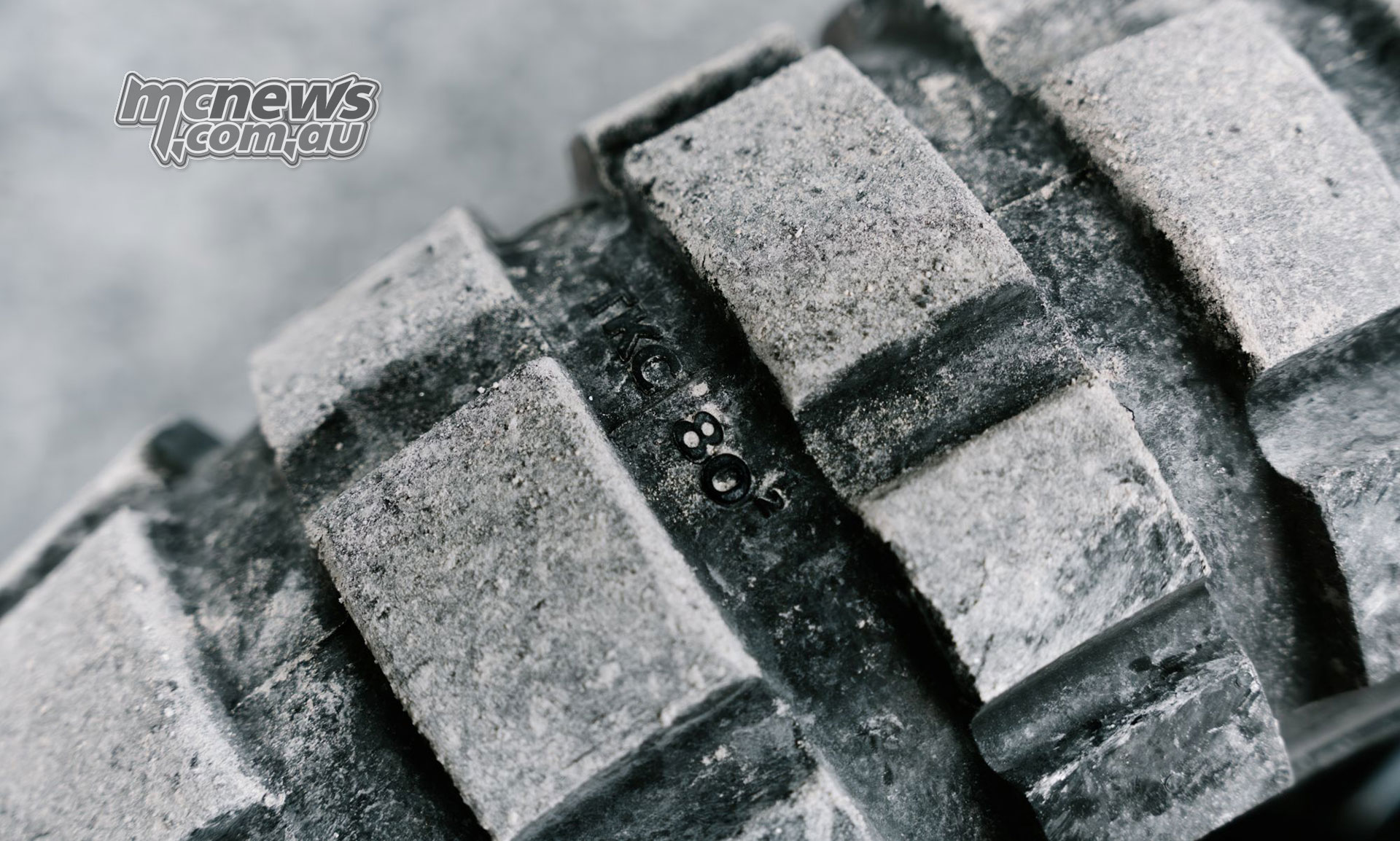
Ettenhuber: “Absolutely, the requirement book specified it has to be identifiable as a successor or one of the family of the TKC80. The block pattern was a chocolate bar design that people really like, and we wanted to preserve it.
“However, you saw the pattern, the biting edges and the asymmetrical shoulders, which I think give it more off-road drive, which makes it perform well in the off-road, and the blocks that have changed are not symmetrical anymore, they vary, different sizes, so you still have the chocolate bar kind of design, but it looks more modern. It is really a development that will give you more performance.”
Trev: If you have to name one hard compromise, you accepted to deliver the overall package, as in wet grip, wear, off-road, vs noise, etc, what was the biggest area that you perhaps had to compromise, or that you had the biggest decision to compromise on?
Ettenhuber: “Actually, you saw the spider diagram where we pushed wet and stability, the challenge was to keep the rest on a similar level. The balance of the compromise that you mention, of course, we wanted to push the entire spider outside, so the compromise that you saw was that we wanted to focus on stability in the wet and on handling as well.”