

Emily Altenhofen
Continental Head of Motorcycle Tyre Development and Industrialisation
Trevor Hedge: Tell us a little bit about your background, where did you grow up, where did you go to school, how long have you been with Continental?
Emily Altenhofen: “My name is Emily Altenhofen, and I’m a 31-year-old industrial engineer. I grew up in Germany. I started with Conti in 2012. Since 2018, I have been working in various tyre development roles in Germany and the US before I took my current role as Head of Motorcycle Tyre Development in late 2023.”
Hedge: Would that have been when the TKC 80² process was started?
Altenhofen: “It takes some time, you’ve seen how many pieces we have built in the development, so I joined right after the start of the project.”
Hedge: A lot of people don’t understand the chemistry involved in tyre compounds and how there is actually a chemical reaction that you guys put into the tyre, that effectively repels water, the same as magnets repel each other. One would imagine that a sports tyre would require much more development in those chemical compounds and interactions, but I spoke with Christoph earlier, and he said perhaps the new TKC is even more of a challenge from a chemistry point of view?
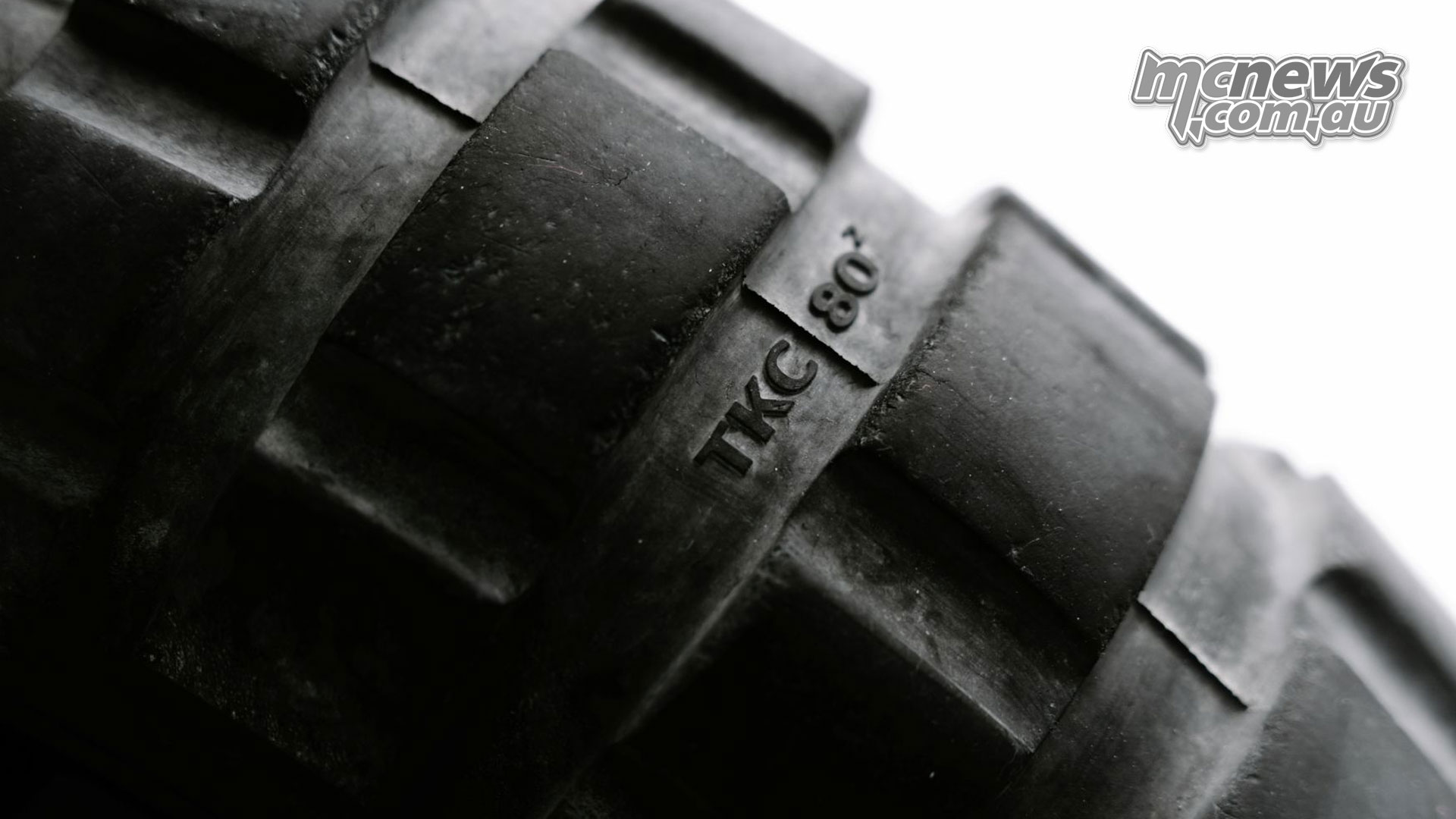
Altenhofen: “I would definitely say working on 50-50 tyres is really developing something that needs to fit everything, so you have to make every part of the rider happy, and that means great grip on the road, that means great trust or traction off-road, so definitely developing a compound for a 50-50 tyre is a big task and also very demanding.”
Hedge: So how many chemists would you have had working on the compound for TKC80 Mk2?
Altenhofen: “We have a dedicated team of chemists in tread compounding, developing, and we have our headquarters of RnD in Hanover. They all work together when working on compounds for new tyre generations.”
Hedge: And it is your job to bring those people together to work towards the primary goal of the TKC80? To choose who you work with, and to collaborate to come up with the final special sauce?
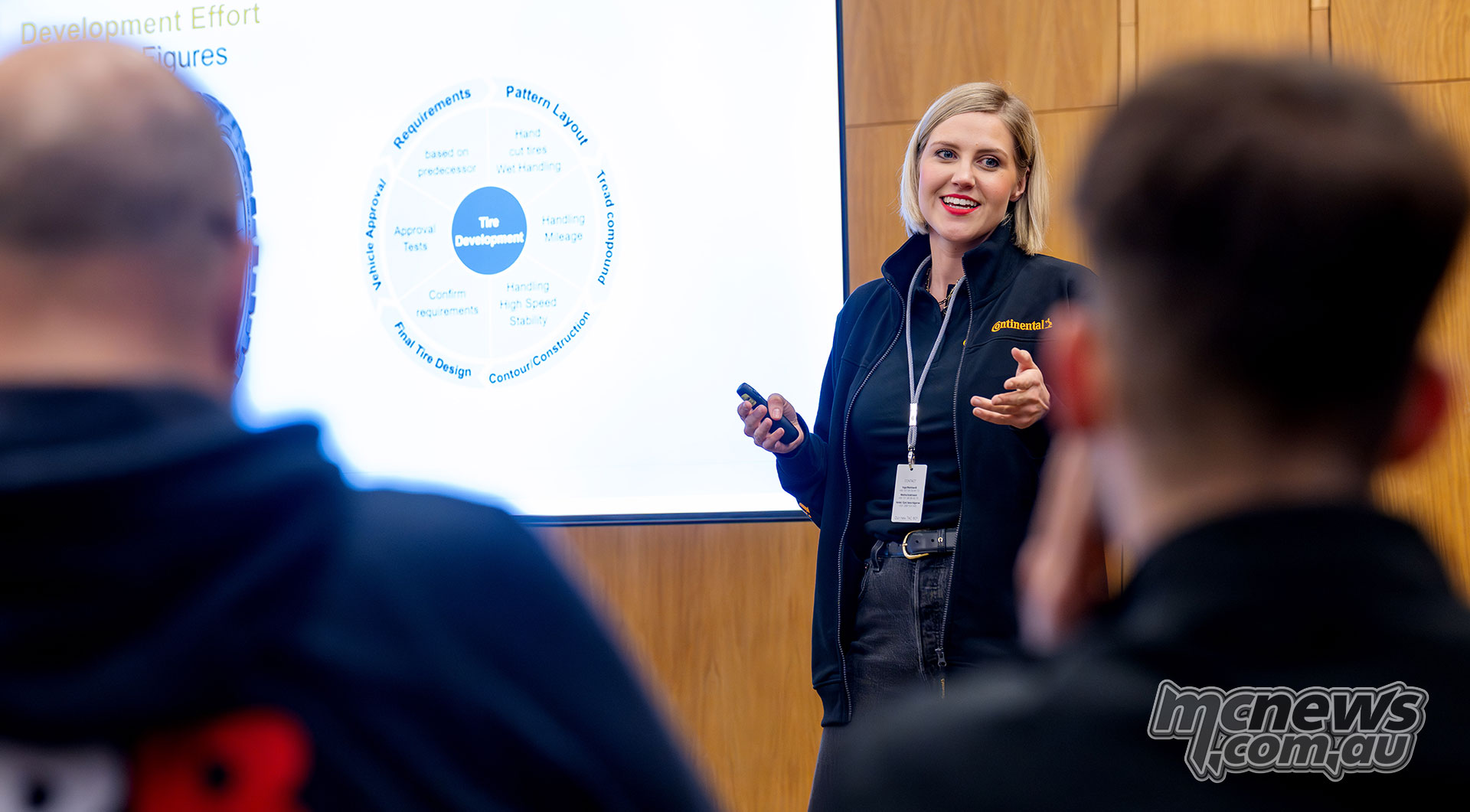
Altenhofen: “Exactly, the TKC 80 Gen 2 is a special project. So whenever you get a set of requirements, which I talked about earlier, you set up a team of special experts, like what do you need, you need a new compound, you need patterns, designers who do industrial design thinking on how you can design patterns, noise vibration harshness engineers, chemists, there’s a team that has to work together. A tyre developer on construction, mould drawings, there’s a big team involved in setting that up, because it’s so highly specialised.“
Hedge: You brought up NVH, and obviously, with Euro5, 5+ and going to Euro6, I know a major challenge for motorcycle manufacturers is trying to reduce the noise in so many areas of the motorcycle, so then they can produce the noise they want to produce. In the earlier presentation, you mentioned you had microphones placed in specific locations around the bike. I imagine you’d also have ride-by setups as well. So I guess you have acoustic analysis engineers who specialise in studying and working on that? Because I’d imagine that right now, that’s probably more important than it’s ever been?
Altenhofen: “The importance of noise has increased over the years, as we all know, environmental protection is getting more important, but also riders have higher… back in the day, you had a knobby tyre, and it’s loud. It’s not like that anymore. The world changes, the requirements change, and we have many different noise vibration, harshness engineers, people who focus on it. When you talk about pass-by noise, that’s one part. Internal noise on a motorcycle is more what a rider perceives, a subjective noise, but there’s also indoor noise testing. So that’s a big part, and getting more and more important.”
Hedge: When developing the tread design, what compromises were made to reduce noise?
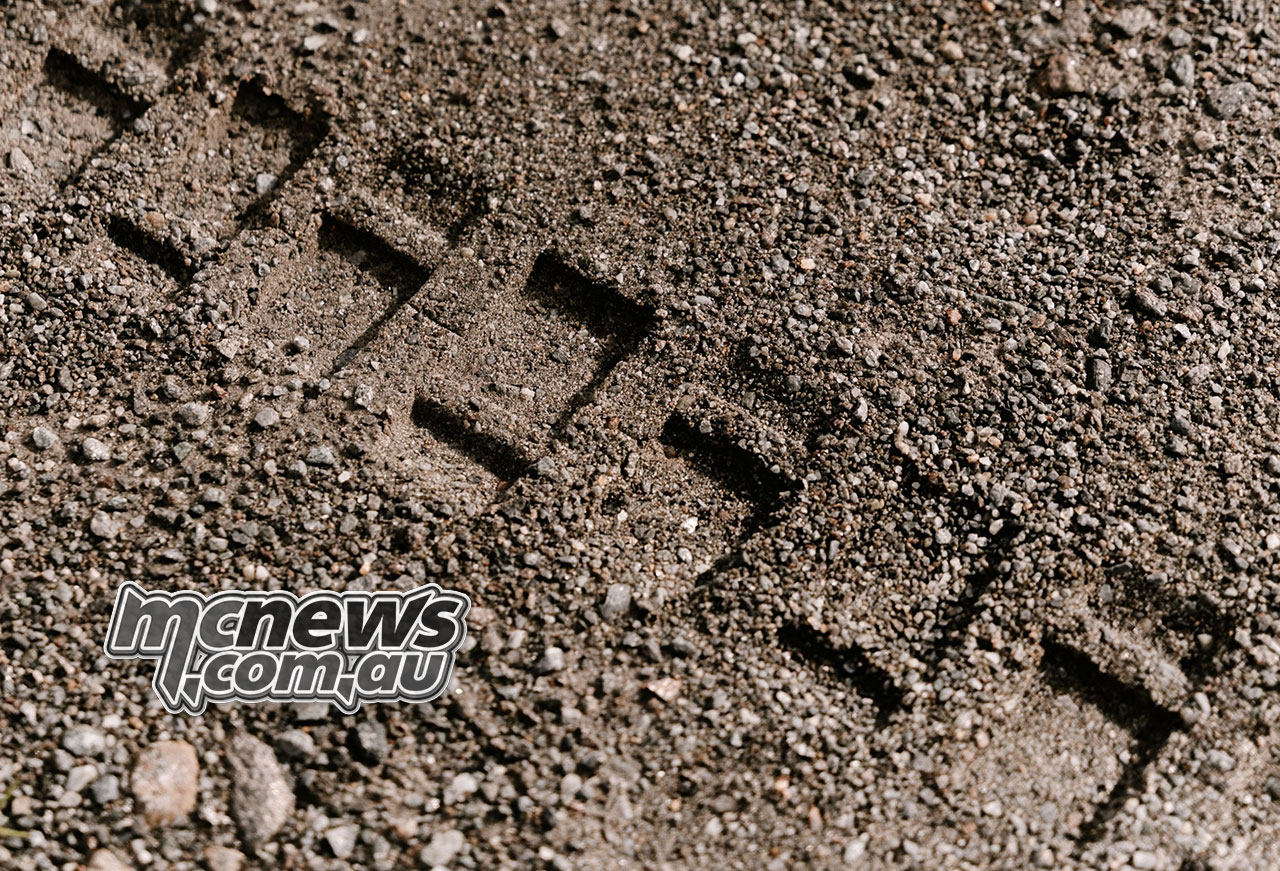
Altenhofen: “Developing the tread pattern for the TKC 80² and optimising it on noise is just a matter of using the best simulation methods. How you distribute the block around the tyre. With the better development simulation methods, you have really great opportunities to have the best tread pattern, which you need in the market for a 50-50 tyre.”
Hedge: You mentioned how you shifted that tread pattern around the tyre so that it is asymmetric, so you don’t have that repetition, so it spreads more of the noise over more of the noise spectrum?
Altenhofen: “Exactly, it’s like the howling noise of a tyre. It’s about self-amplifying frequencies, and you have to break them. If we think about it, every motorcycle is different, so it’s also a tyre/motorcycle interaction which you have to consider. But we have put a lot of work into that topic.“
Hedge: Since the earlier iterations of the TKC80, adventure bikes have gotten a lot heavier, and are now stupendously powerful, with mountains of torque, so I imagine through the different size ranges, there must be some pretty massive differences in carcass strength to cater for the different motorcycles? Are we getting to the point where you’re going to, perhaps in the future, have a heavy load and light load version of something like the TKC 80². Is that something you’ve considered?
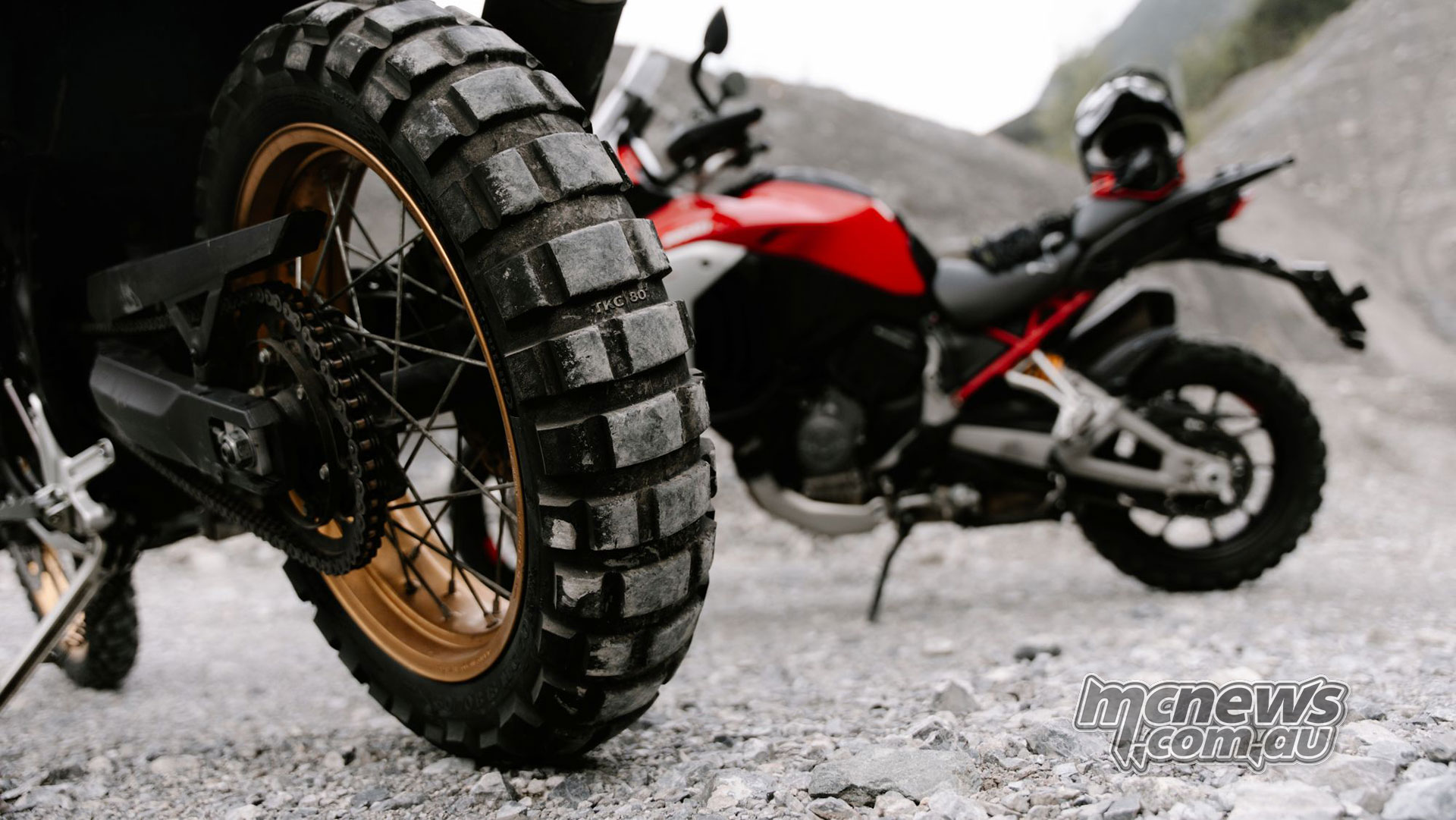
Altenhofen: “Every tyre has a different construction, it is very dependent on the size. You can actually read it on the sidewall; you can really see, depending on the size and the bikes on which those tyres go. Every single carcass is optimised for the specific size.
“And even if you talk about the tread pattern, different bikes like the 890 Adventure with the 90/90-21 front and 150/70-18 rear, the 90/90-21 front is common for more off-road applications, and you will see the pattern looks a little bit different than a 120/70-19 which goes on a big 1300 GS and that’s also because of the application of that size. It’s not only the construction, but also sometimes how the pattern is scaled to a specific size to fit that more diverse application of adventure bikes.”
Hedge: And despite a lot of evaluation and consideration of going the radial route for this new generation TKC80, you stuck with a bias ply construction. There are pros (primarily sidewall strength, puncture resistance and load capacity favouring bias) and cons of both approaches. Tell us why, despite your trials with radials, you chose Bias, and have the latest cross-ply construction production methods reduced the negatives normally associated with cross-ply tyres.
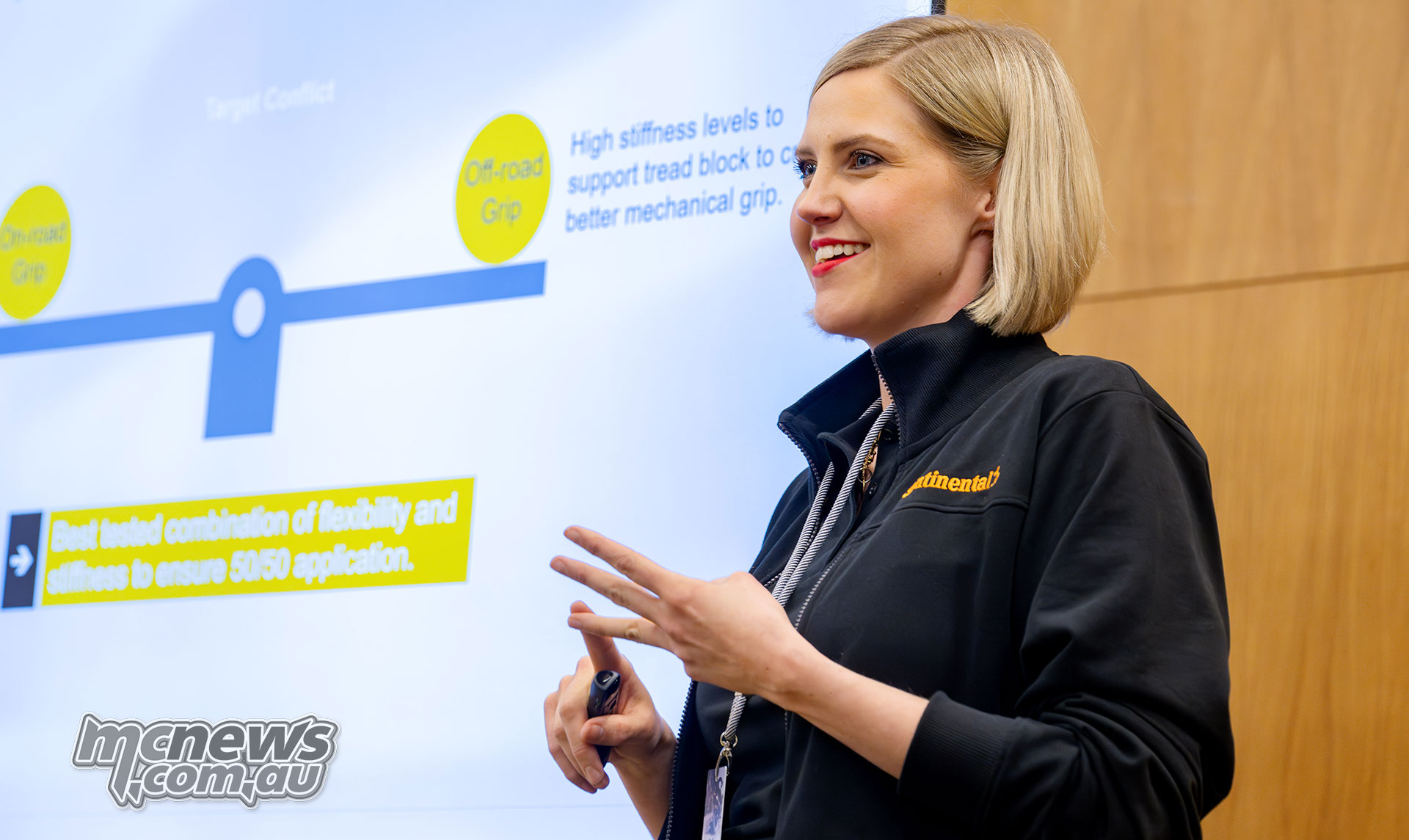
Altenhofen: “We chose to continue with a full bias range because this construction simply performed exceptionally well in the tested conditions. For the type of off-road use the TKC 80 Gen 2 is designed for, the natural advantages in sidewall stiffness, puncture resistance, and overall off-road durability were very convincing in our tests. These characteristics gave us the confidence that bias ply construction remains the best solution for us for this product’s intended purpose.“
Continental Head of Motorcycle Tyre Development and Industrialisation
Hedge: These tyres will be used in both tubeless and tubed applications. Is there anything specific about the way the tyres are built to also allow them to accept tubes? With so much technology now in tyres, what should buyers consider when choosing replacement tubes, and how can this affect performance and longevity? Are we getting to the point where we need a somewhat matched pair, tyre and tube, from the same manufacturer to achieve the best performance?
Altenhofen: “Our tyres are all designed to be compatible with both Tube and tubeless applications. TKC 80 gen 2 will accept all types of rubber & butyl tubes, but also heavier heavy-duty tubes.”
Hedge: What about heat considerations? It gets much colder here (Portugal) than in Thailand, where the tyres are made, and in Australia, we have to make the tyres work in zero to 40-degree ambient temperatures, and perhaps tarmac temperatures that exceed 50 degrees. Again, the compromises there must be hard to achieve.
Altenhofen: “With the newly introduced tread compound, of part silica, we’re also reducing the heat build-up in the tyre, so the tyre is more durable towards heat, and we have, as you see, over 90 extended duration high speed tests, and that’s really testing the tyre to the max of its capability. So this has been tested thoroughly at Continental, as that’s what we focus a lot on in tyre development.”
Hedge: And how did you engineer, for the big heavy bikes, which can tear tread blocks quite easily especially on rocky ground, is there any particular strategy that you think has made a big improvement in this next generation?
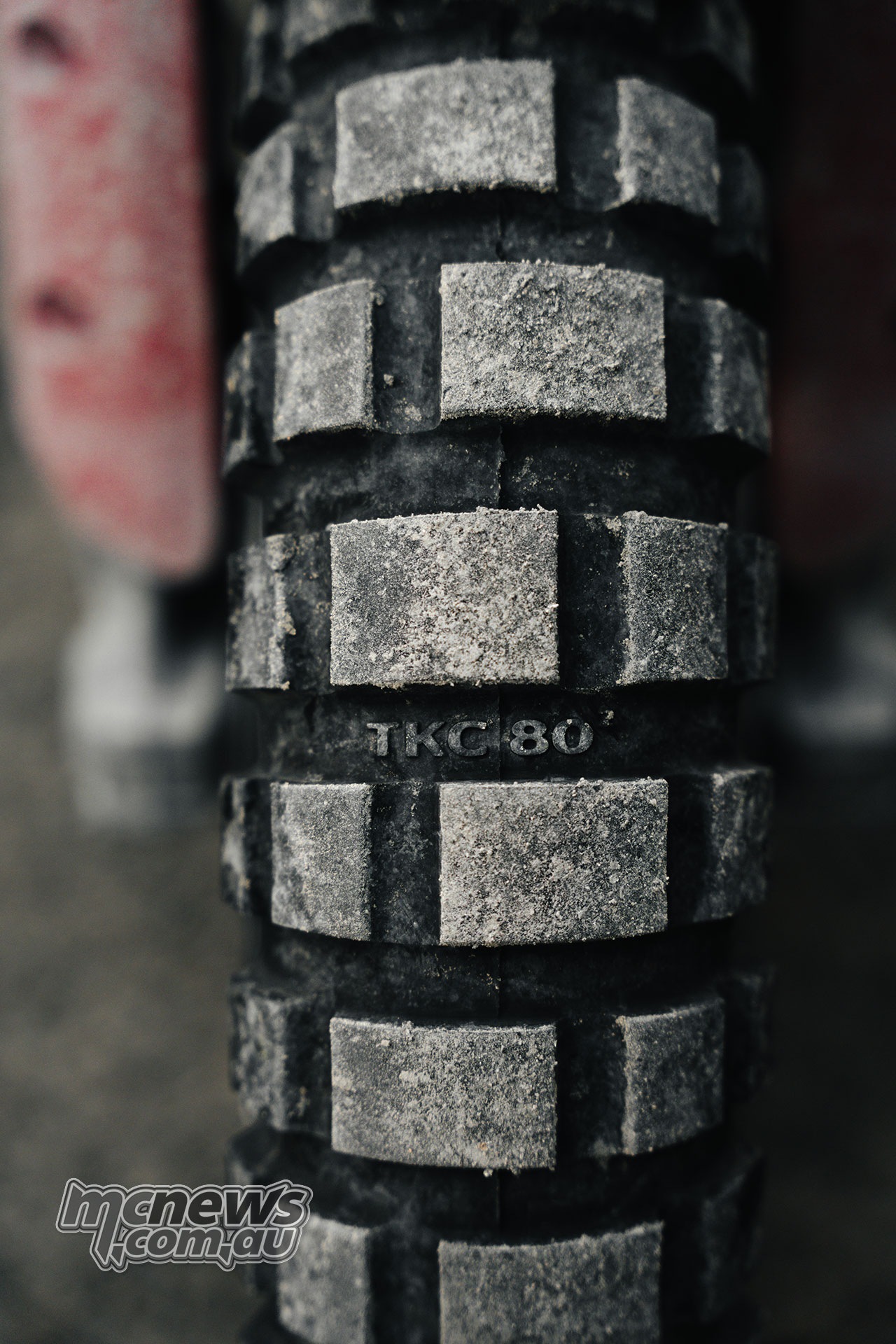
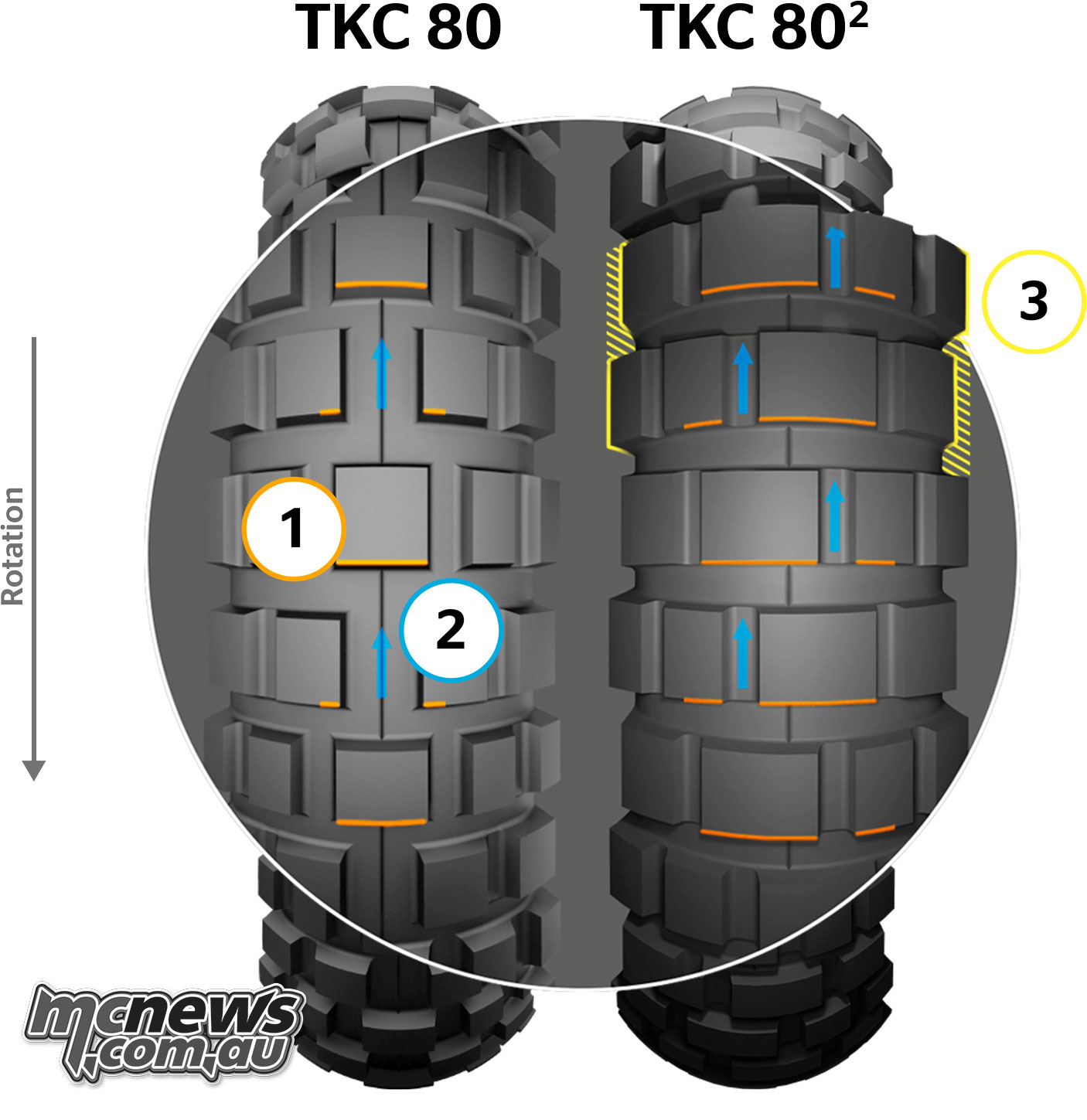
Altenhofen: “I think one of the main changes, and main aspects which make the gen 2, the TKC 80², are the bigger blocks, more blocks, making the pattern more stiff to really ensure that the tyre works well in the off-road for big bikes with high torque. So I’d definitely say the size and increased blocks.”
Hedge: What about the actual production process itself? What’s the most challenging part of the production process, making an adventure tyre like this?
Altenhofen: “Tyre production over the past years really has made huge steps forward, you have the newest advanced mixing machines, the advanced tyre building machines, top notch technology, excellent engineers, I feel like we have come such a long way with tyre production, consistently with high quality, and that’s something we’re really proud of as well. So that’s what I could say to that.”
Hedge: Looking ahead to the next generation, what do you see as the next generational leap forward for motorcycle tyre technology as a whole? Is it going to be in, maybe a generation leap in chemistry and compounds, or do you think it’s going to be in how the tyres are made? Where do you think or hope to make the next leap forward?
Altenhofen: “Looking at the future of tyres, it’s very difficult, generally if you think about technology, 10 years ago, would you think that we would have iPhones as we have now? We probably thought we were at the edge of technology, and now there’s something new. I think it’ll be a combination of both, especially fine-tuning all those production, mixing processes, compound technology, carcasses, to really find the sweet spot. I think that is probably the future too, use what you already have and which works really well by themselves, but combining them to the perfect symbiosis, for the future of tyres.”
Hedge: You started out with your traineeship at Continental and have been with them ever since?
Altenhofen: “Yes, I have. In Germany, we have work and study programs, where you do three days at school and three days with an employer that sponsors your studies. You jump from one department to another, get work experience, get to know the company and then work your way up.”
Hedge: Let’s talk about boundaries, you’re still quite young, you’ve got an incredibly important role, and you’re a woman. Are you somewhat unique in this industry in that role? And on multiple fronts, you must be the youngest product manager in a role like this, and one of the very few women. I am guessing you must be pretty good at it!
Altenhofen: “I honestly don’t think about my role in terms of age or gender. For me, it’s always been about the team and the mix of personalities and strengths we bring together. We are only as good as the team behind us, and I’m fortunate to work with incredibly skilled people. Continental provides great opportunities for those who are driven, and I strongly believe success should be based on skills, competence, and hard work—not gender.”
Hedge: I think you’re right, perhaps in your role, as you say, there are inherent character traits more common in women that I think probably do have an advantage on a collaborative project involving a large team.
Altenhofen: “It’s always a matter of diversity, you need something of everything, nationality, age, gender, I think really that’s how it should be.”