

Continental TKC 80²
Motorcycle Tyre Reviews
A decade or so ago, if you had a large-capacity adventure motorcycle and were planning to go seriously bush, there were pretty much two choices: Continental’s TKC80 and Metzeler’s Karoo. Just as the adventure motorcycle market now presents a vast array of choices from almost every brand, tyre options have also expanded to suit.
Large-capacity adventure motorcycles have all but replaced the traditional sports-tourer in the motorcycle marketplace, to the point that most motorcycle brands now invest most heavily in their adventure platform, then spin off variants with varying degrees of off-road chops or sports-touring capability catering to different buyers. These bikes run various combinations of 17, 18, 19 and 21-inch rims, shod with tyres of varying widths to suit their respective tarmac or dirt roles.
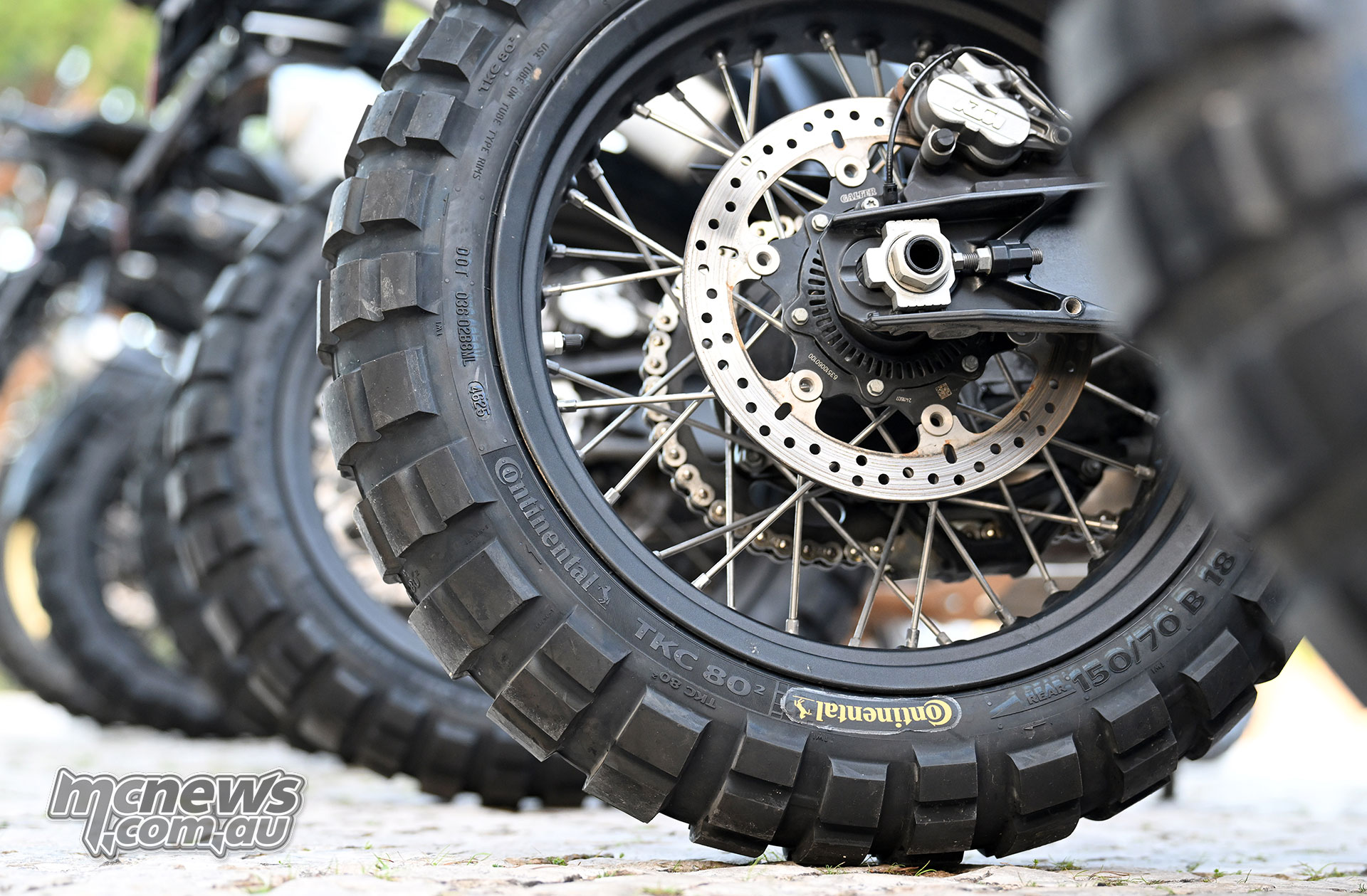
Continental first introduced the TKC80 around 40 years ago and has tweaked the formula over the years, including some major carcass changes in 2023, but 2026 marks the biggest step change in the history of the tyre with the introduction of the TKC 80².
The German brand also continues with the TKC70, which is marketed as better suited to 70 per cent road use and 30 per cent off-road, while the TKC80 remains Continental’s more dirt-ready 50/50 option under the catchcry, ‘Maximum Adventure’.

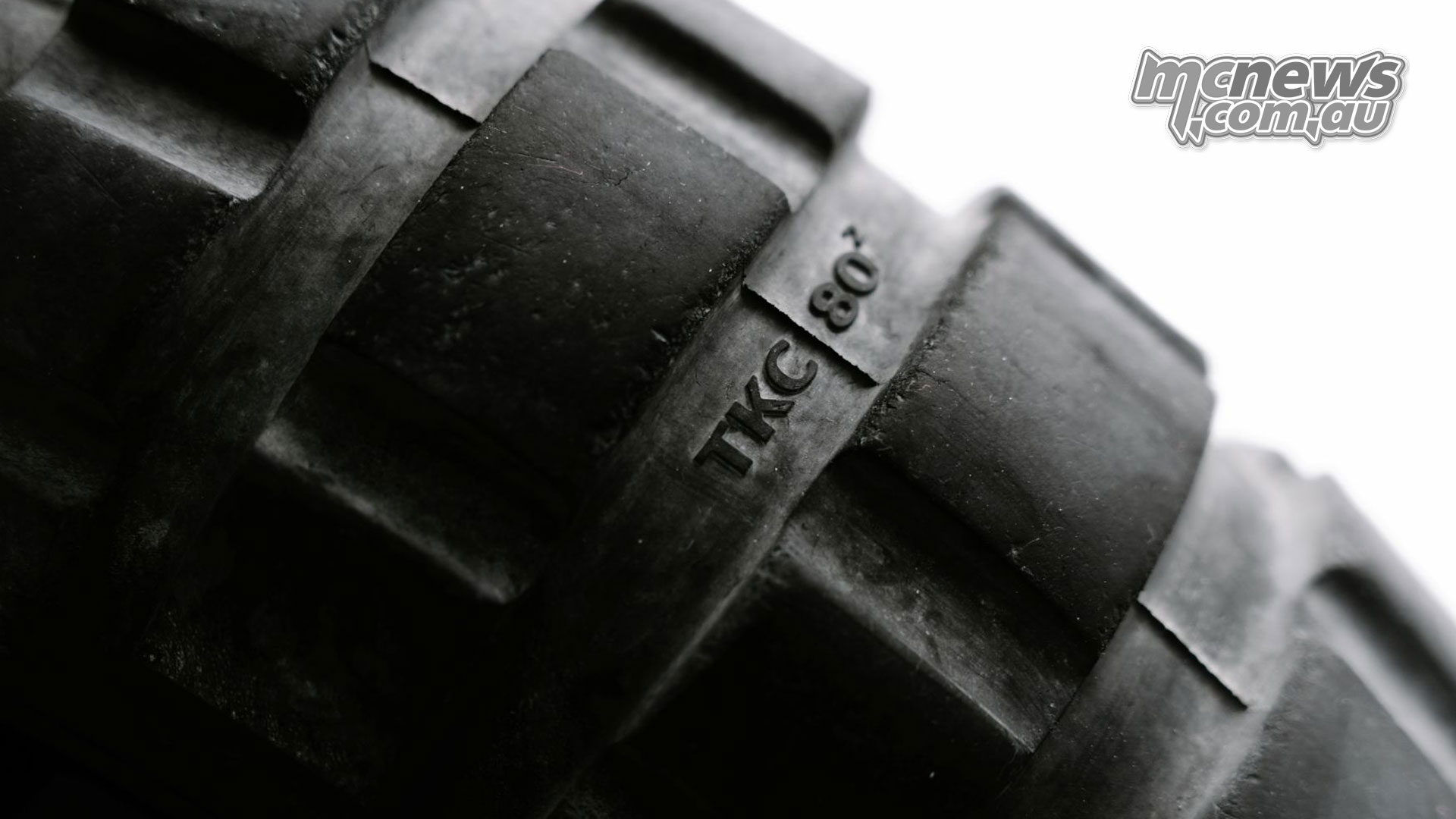
While the TKC 80² is essentially all new, one glance from 20 paces lets you know the trademark rugged look of the tyre is retained. That was no accident. Keeping the iconic silhouette of the TKC80 was part of the brief from the start. As Christoph Ettenhuber, Head of Continental’s Motorcycle Business Unit, told MCNews.com.au, “It has to be identifiable as a successor or one of the family of the TKC80… The block pattern was a chocolate bar design, and is something that people really like, and we wanted to preserve.”

Market research suggests looks do matter, even when it comes to tyres, and that is clearly seen on the road with the various scrambler-style bikes shod with chunky-looking off-road rubber despite never seeing a gravel trail, let alone any proper off-road work.
But beneath that familiar look, the work is highly technical. Continental’s brief was not to reinvent the TKC80 for the sake of it, but to retain the qualities people already liked while improving some known weak points. Wet grip, off-road drive and stability were clearly central targets. Ettenhuber summed it up neatly: “The wet was one topic, stability was a topic, the heavier bikes you referenced play a role, and off-road is better, so those were the three biggest leaps.”
That sounds straightforward enough until you consider the balancing act involved. Emily Altenhofen, Continental’s Head of Motorcycle R&D and Industrialisation, made the point well in our separate interview: “Working on 50-50 tyres is really developing something that needs to fit everything… developing a compound for a 50-50 tyre is a big task and also very demanding.” If you want the deeper technical dive on that side of the story, her interview is well worth reading alongside this review.
Continental told us it benchmarked the TKC80 against 190 tyres during the research, verification and testing process. It also evaluated 527 bias prototypes and 243 radial prototypes before arriving at the final bias design for the TKC 80², backed by 94 high-speed tests, 54 endurance tests and 30 outdoor scoring evaluations. Whatever you think of the marketing around any tyre launch, that is a substantial development program.
I recently spent a very busy day on a route specially crafted by the hugely experienced planners at Edelweiss to put the new TKC 80² to the test in its intended 50/50 role.

The ride brief mentioned something like 1200 corners, which I initially thought must have been a figure plucked from thin air, but by lunchtime, I reckoned we had already gone a long way towards proving it plausible.
Out of the hotel car park in Albufeira we were immediately into nadgery little back lanes with a bit of mud and a bit of sand before heading into the barrocal Serra do Caldeirão mountain range that rises above the Algarve. The surface was a mix of various igneous rocks and basalt terrain, somewhat reminiscent of parts of my own backyard in the Victorian High Country. The ascents and descents were not highly technical, trials-bike work taken at a crawl, but they still demanded constant focus. In the almost 300 kilometres we covered that day, there was scarcely a stretch of more than 100 metres that did not involve some sort of curve. Busy is the adjective that best fits the experience.

I started the day on a Tiger 900 Rally Pro, then switched to a Ducati Multistrada V2 S, before finishing on a BMW R 1300 GS for the tarmac run back down to Albufeira.
That final road section was a proper test of how much road performance Continental has managed to keep in a tyre that still looks every inch a real adventure knobbly. The bitumen was a sinuous ribbon that let me use the tyres right to the edge of their knobs, and my testicular fortitude.
What impressed me most was not outright grip in the sports-tyre sense, but how clearly and calmly the tyre communicated where its limits lay. The TKC 80² told me when I was approaching the edge of its design brief, but it did so reassuringly. A little movement right on the edge was not alarming, more a gentle tap on the shoulder from the guardian angel to say, ‘hey champ, that was about enough’.
On more road-specific tyres, the pace could certainly have been higher, but that rather misses the point. This is still a 50/50 tyre on large adventure motorcycles, and the speed it carried on the road was more than respectable. Better still, it did not feel vague or unsettled doing it.
Stability, in particular, stood out. At the recommended manufacturer pressures we were running, there was very little hint of the tyres walking around, the carcass deflecting excessively, or the knobs themselves squirming under load.
On the first tighter run of tarmac aboard the Tiger I deliberately asked a bit too much of the rear on corner exit to provoke a slide with an overly aggressive right hand. Both the tyre and bike gathered it up smoothly with some peg pressure and throttle modulation. Credit there goes not only to the tyre, but also to the Rally Pro’s rear shock. Even so, it was a good reminder that the TKC 80² seems to let go and recover in a predictable, manageable way.
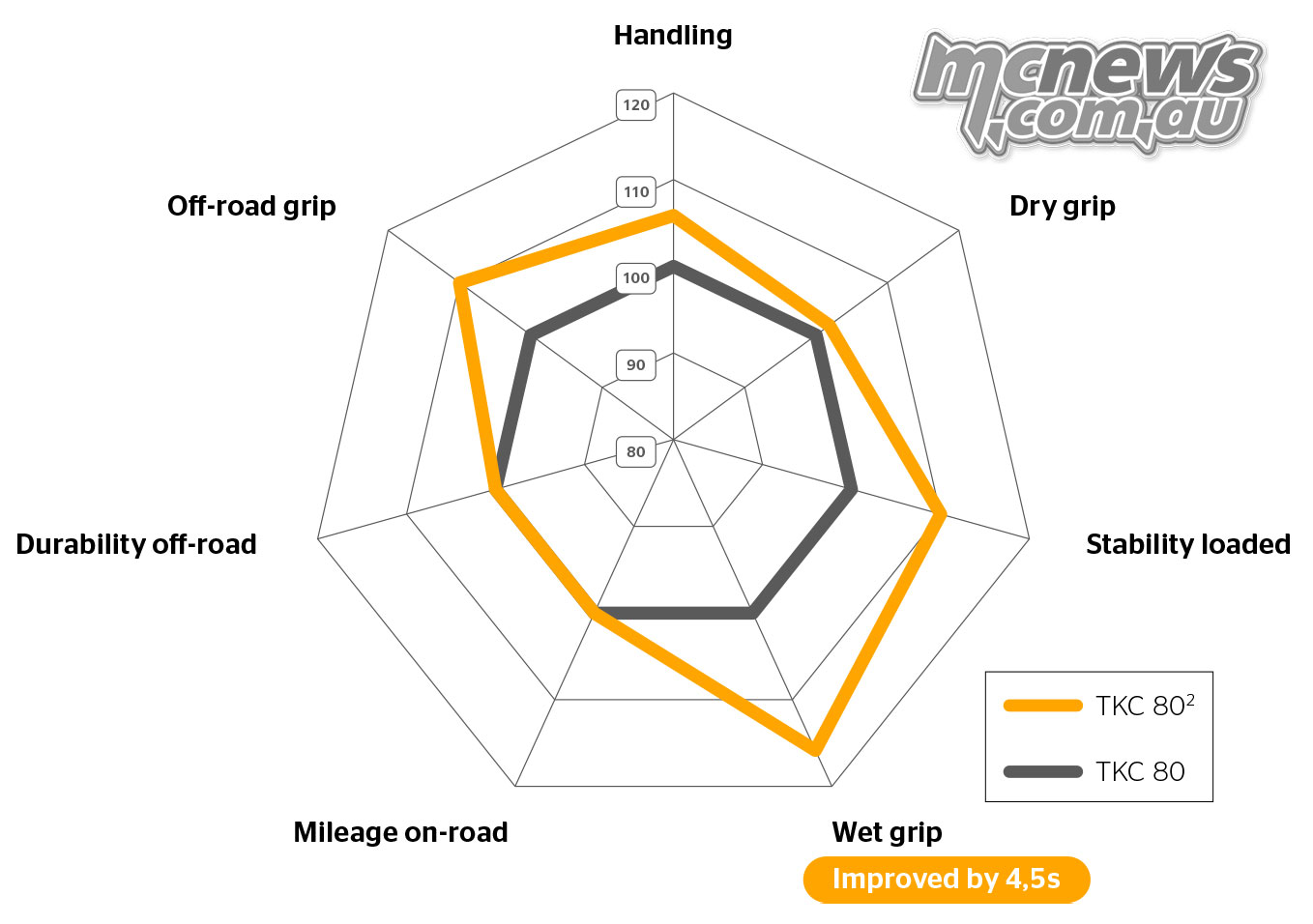
Biggest gains are claimed in wet grip, stability and off-road grip
I did not get to test Continental’s much-improved wet-grip claims for myself, and it is important to be upfront about that. Continental says wet performance is the single biggest leap made with the move to the TKC 80², quantifying it as a 4.5-second improvement per lap on one of its 95-second wet test loops when tested back-to-back against the previous-generation TKC80. That is a significant claim, but one I cannot independently verify from this launch.
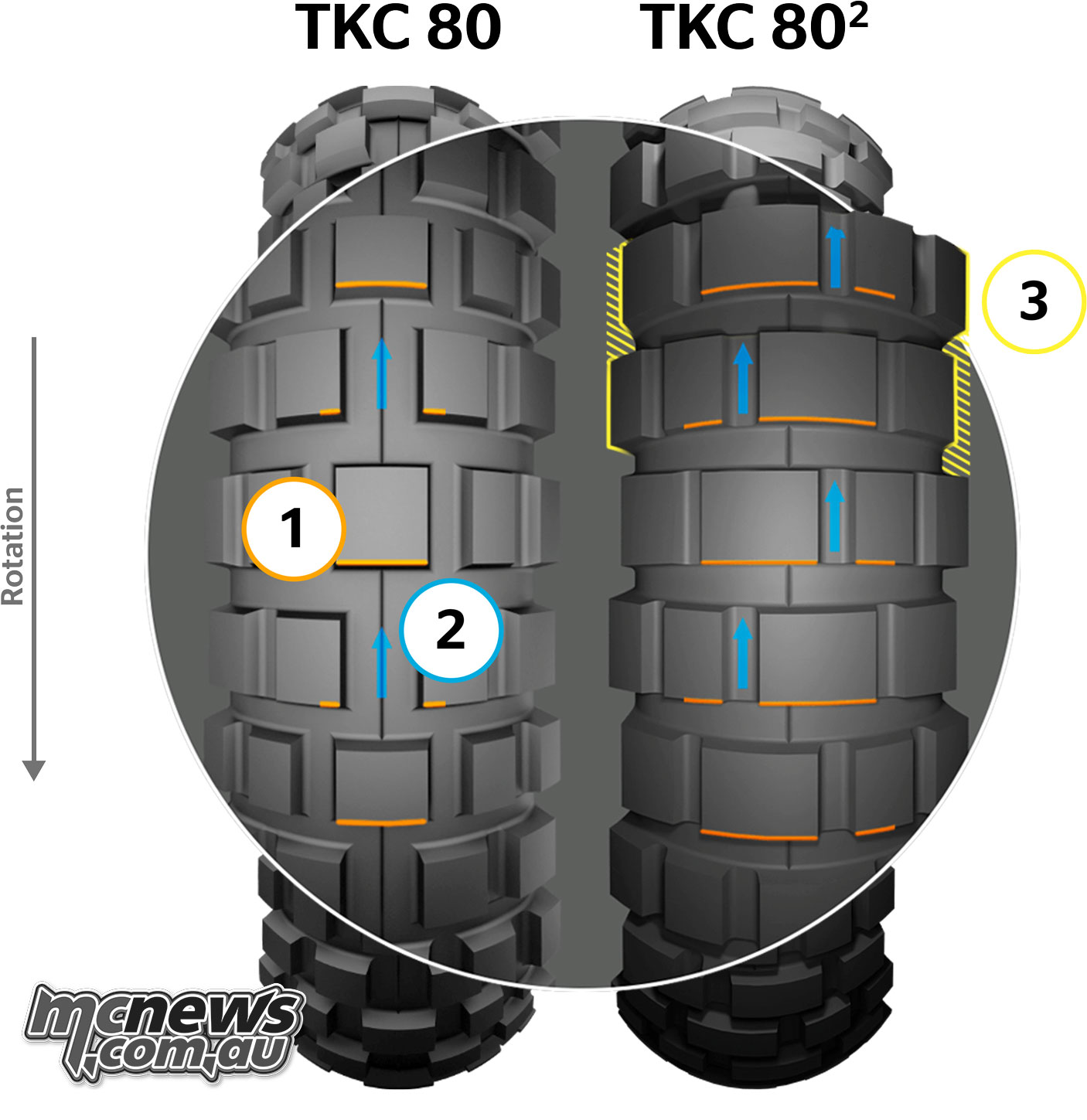
Staggered shoulder blocks (3) boost grip in soft terrain by increasing edge engagement.
Still, both the technical briefings and the interviews suggested wet grip was a major focus from the beginning. Ettenhuber admitted that once you start pushing a tyre in one area, “you can’t push it on one side, because it drops somewhere else. So you have to push everything.” That is probably as concise an explanation as any for why it took Continental so long to replace such a well-liked tyre in the first place.
Noise was another area where the development team clearly spent plenty of effort. With Euro 5 and Euro 6 regulations tightening and the TKC80 appearing as OEM fitment on some motorcycles, tyres play an increasingly important role in the overall noise equation. Beyond regulation, there is also the simple reality that the drone or howl of a knobbly tyre can become tiresome across long days in the saddle.
During testing, Continental uses microphones in various positions to determine where the noise is coming from and how changes in pressure, compound, pattern and construction influence it. Altenhofen explained that the key was breaking up repeated frequencies in the tread design. “It’s about self-amplifying frequencies, and you have to break them. You have to make it asymmetrical so no frequency or amplitude is reaching that level which is not really nice for the rider to hear.”
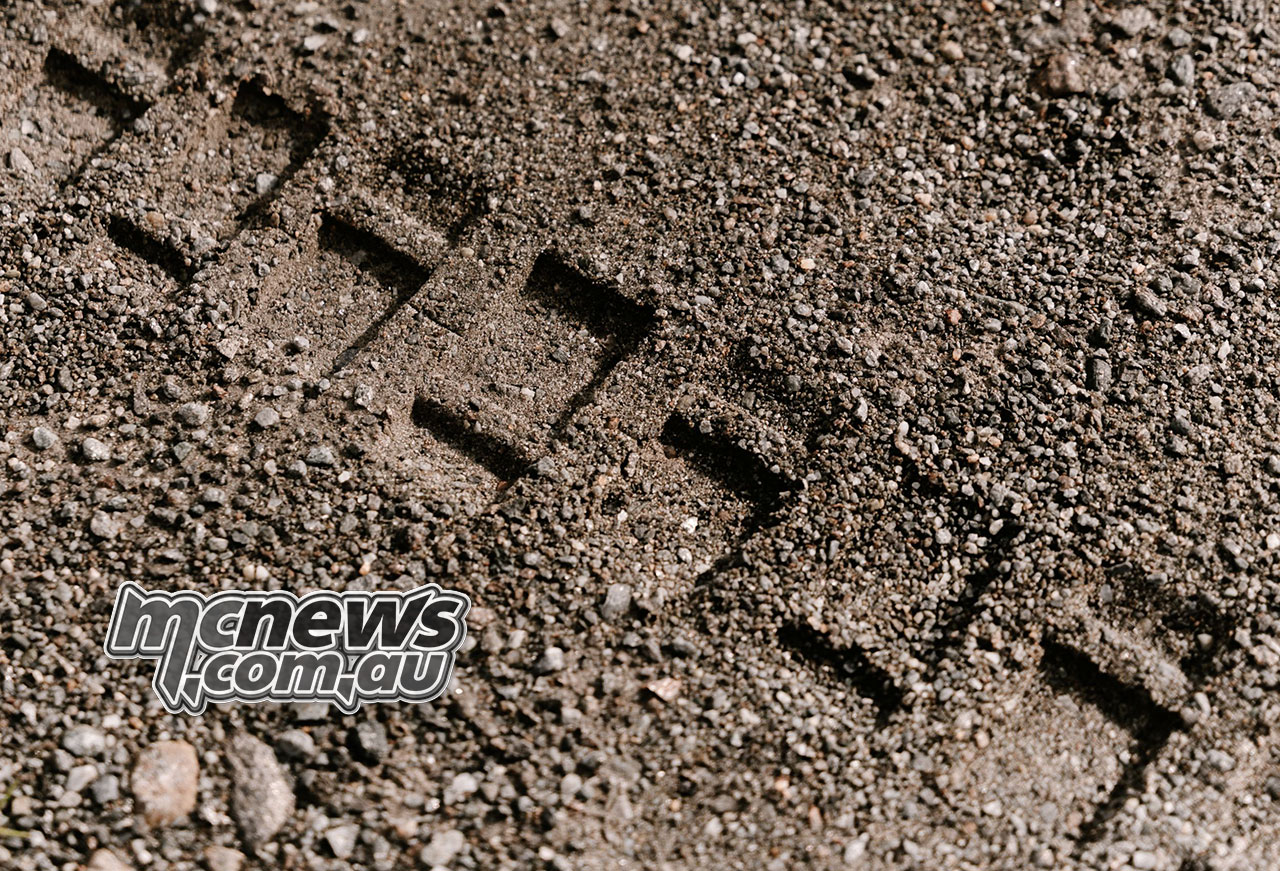
That led to the introduction of a fully asymmetrical block pattern designed to spread the noise signature rather than amplify one annoying frequency. Without riding the TKC 80² back-to-back with the old tyre, I cannot tell you exactly how much quieter it is, but I can say that during my time on the bikes, I never once noticed tyre noise. On a knobbly tyre, that is a positive result in itself.
Of course, noise, vibration and feel can all change as tyres wear. That remains one of the longer-term questions. Continental says the new design wears more evenly and therefore produces less vibration as it ages. That is a claim that will need validation over time, but the bikes we inspected after more than 600 hard launch kilometres appeared to be wearing evenly and showed no obvious excess distress across the array of motorcycles present, despite the 600 km of debasement wrought on them by spoiled journalists that didn’t have to pay for the tyres they were abusing.

Notably, Continental is not claiming longer tyre life than the previous-generation TKC80, which I think is worth noting because it lends credibility to its claims elsewhere. It would have been easy enough to say everything had improved, but they have not. Continental, instead, talks more carefully about performance throughout the life of the tyre, and that seems the more believable pitch. Based on what I saw, there is at least a reasonable case for that.
The chemistry side of all this is easy to dismiss as black magic until you spend some time speaking with the people involved. But modern tyre development is an exercise in balancing polymers, fillers, silica, structure, temperature control, rolling resistance, noise and wear, all while trying to satisfy wildly different use cases. As Ettenhuber put it, a sports tyre has “a narrower requirement book”, whereas the TKC 80² had to cover many more use cases. Altenhofen made a similar point from the R&D side, describing the project as one that required chemists, construction engineers, pattern designers and NVH specialists all working together. Again, for readers wanting the deeper technical detail, the separate interviews flesh that out well.
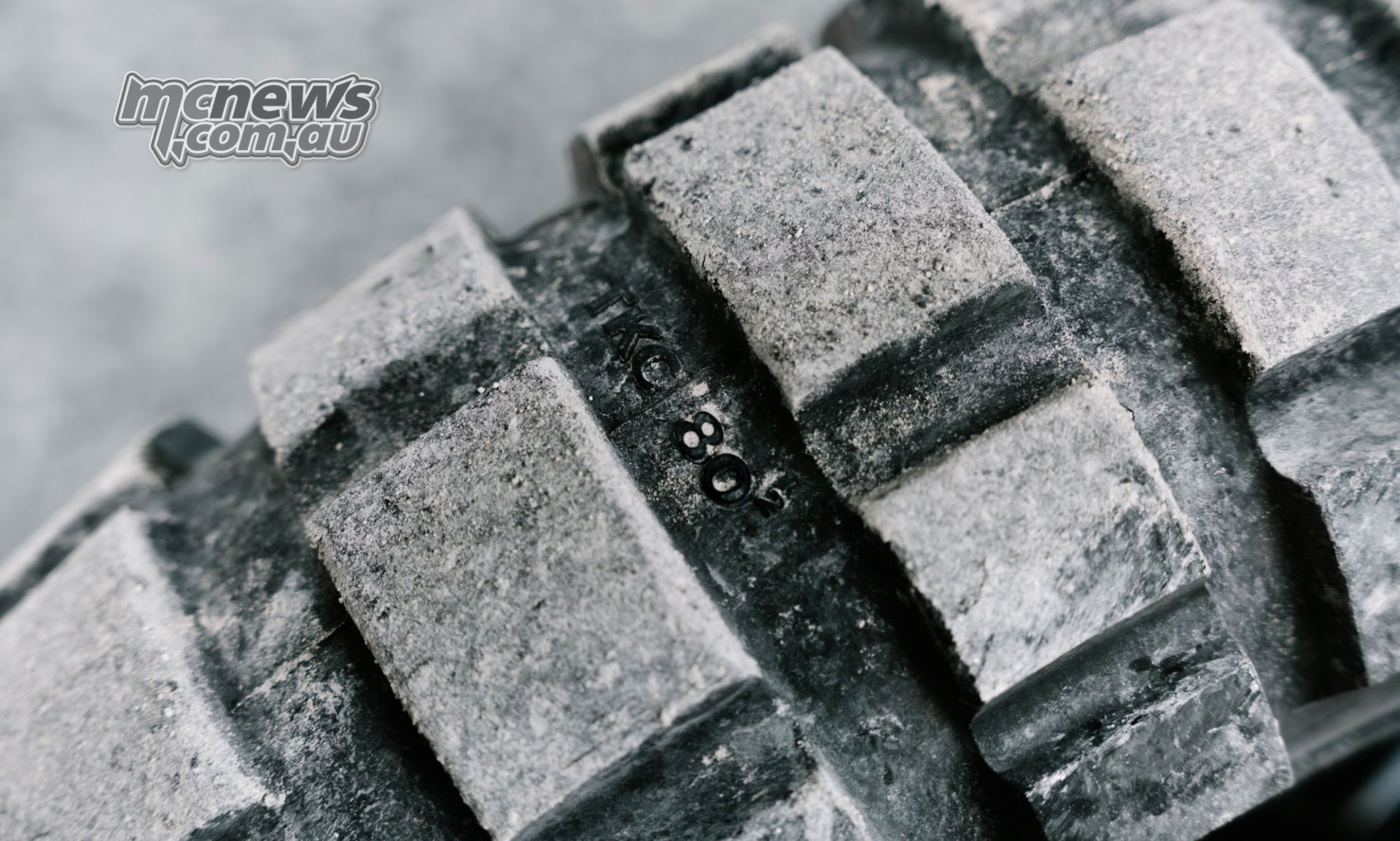
Continental suggests only a marginal improvement in dry grip, but more significant gains in stability, handling and off-road grip. That strikes me as about right based on what I experienced.
The net tread area in the centre of the tyre is up 17 per cent, and every second row of blocks has uneven edge lengths. Staggered shoulder blocks increase the voids for better grip in soft terrain, while the block angles are steep on the drive side and ramped on the trailing side, reversing front to rear. Altenhofen also pointed to “bigger blocks, more blocks, making the pattern more stiff” as one of the key changes aimed specifically at helping the tyre cope with big, high-torque adventure bikes off-road.
One of the inherent advantages of a bias-ply construction over a radial is sidewall strength and puncture resistance, while radials traditionally hold some advantages in outright high-speed stability and heat management. Continental explored radial concepts during development, but ultimately stuck with a bias design for the TKC 80². That decision makes sense for a tyre that still needs to deal with rocks, square edges, tubes in some applications and large motorcycles being ridden well away from help. It also seems Continental believes it has narrowed some of the usual compromises through improvements in carcass design, compound technology and production control.

On that last point, Ettenhuber said, “Huge steps have been made over the last 10-15 years over the industry in terms of traceability, process control, compound mixing.” Altenhofen also pointed to Continental’s new Thailand plant, with newer mixing and tyre-building machinery helping deliver more consistent quality. It is not the most glamorous part of tyre development, but consistency matters just as much as the headline claims.
The previous-generation TKC80 will remain available in 10 of the less common sizes, while the TKC 80² will roll out across 25 sizes.
So where does that leave the verdict?
Based on one very full day in Portugal, the TKC 80² shapes as a well-judged evolution rather than a radical reinvention. It retains the familiar visual identity and general character of the old TKC80, but feels more composed and more polished in the way it goes about its work, particularly on the road. I cannot sign off on the wet-weather gains from personal experience, and mileage remains something that only time and real ownership will answer, but the initial impression is positive.
More importantly, it feels like Continental has not lost sight of what made the TKC80 so popular in the first place. The TKC 80² still looks like a proper adventure tyre, still behaves like one, and on first ride seems to offer a broader operating window without dulling the original concept.
Continental motorcycle tyres in Australia can be ordered through motorcycle dealers nationwide.