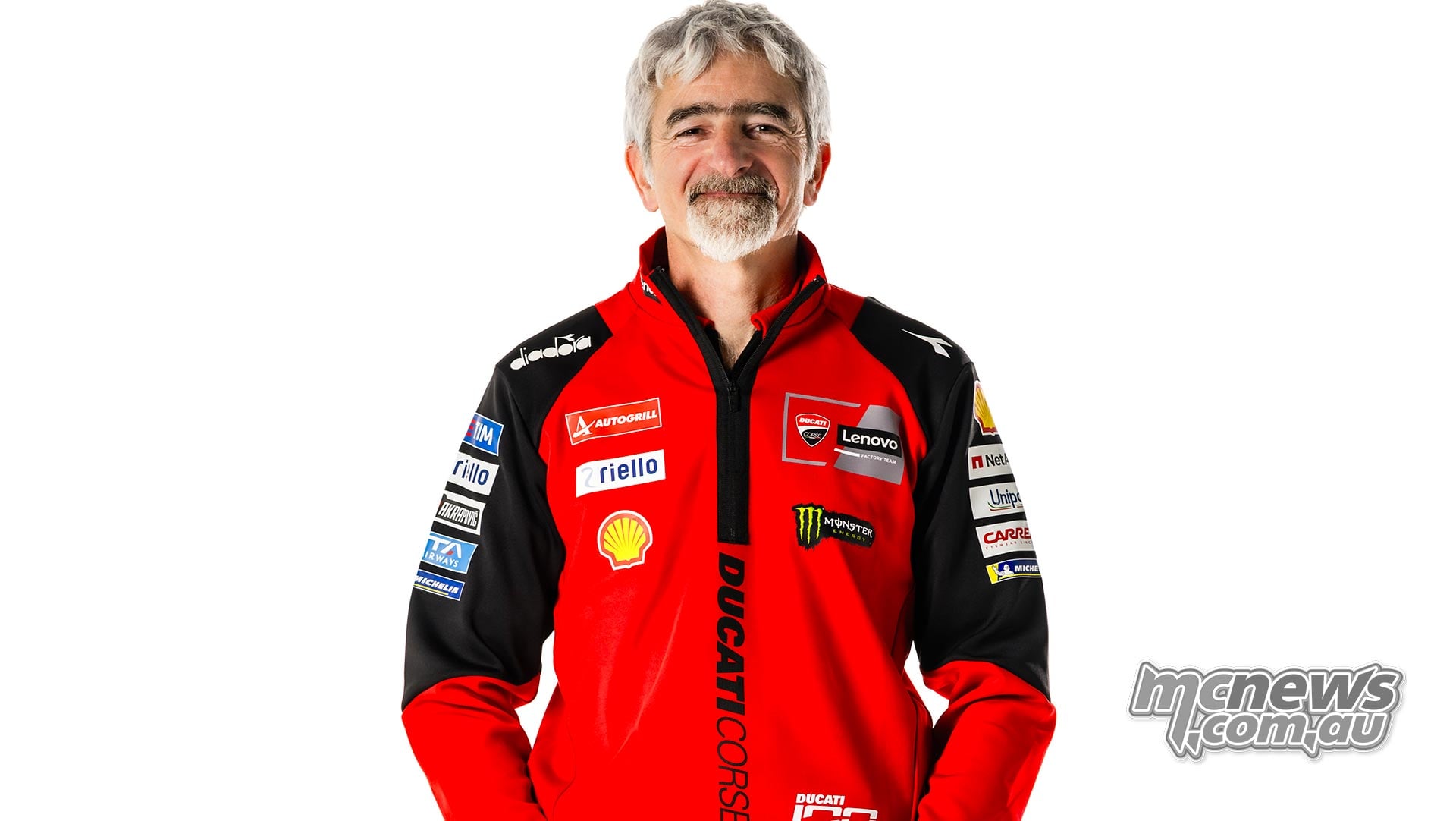


One-on-one with Gigi Dall’Igna
Where does engineering genius live in modern MotoGP?
Ducati Corse General Manager Luigi “Gigi” Dall’Igna talks racing ABS, electronic suspension, AI, tyre-pressure modelling, WorldSBK electronics, Aprilia’s progress and why Ducati’s next MotoGP bike starts from a clean sheet.
Luigi “Gigi” Dall’Igna is usually asked about results, riders, and whether the Desmosedici remains the benchmark in MotoGP.
Despite having only just arrived at World Ducati Week, Dall’Igna was ushered straight into our interview and proved both generous with his time and gracious in his answers, giving MCNews.com.au almost 25 minutes to look beyond results and riders, and explore the technical direction of MotoGP, WorldSBK and Ducati itself.
Spec electronics, tighter aero restrictions, the coming ban on ride-height devices and greater GPS data sharing from 2027 all point towards a championship trying to contain costs and keep technology from running too far ahead of the show. But Dall’Igna, one of the most influential technical minds of the modern MotoGP era, still sees plenty of space for engineers to make the difference.

Cost control versus freedom to invent
MotoGP has steadily moved towards more controlled technology over recent years. For an engineer, that inevitably creates tension. The instinct is to develop, test, invent and push. The commercial reality of racing, however, is different, particularly at a time when motorcycle markets are facing pressure in many parts of the world.
Dall’Igna does not hide which side his heart is on, but he also accepts the broader picture.
Luigi “Gigi” Dall’Igna
“Cost control is really important at the moment.
“I think the motorcycle market has some difficult years ahead because of duties in the US and a lot of things like that. So it is important to control the costs of MotoGP, and racing in general.
“We have to find a balance between technology development and cost. I am an engineer, so I prefer to have the freedom to invent new things and new parts. But at the moment it is necessary to find a proper balance between cost and technology development.”
Asked which area he would reopen if given the choice — not simply to help Ducati, but for the good of the sport and for road-bike relevance — his answer was not aerodynamics, engine development or suspension.
It was braking.
“I think it could be related to the brake area, like ABS or something like that, in order to improve the safety of the system.
“I think this could be really important also for a street bike, because this is an area where we can develop a lot. We learned quite a lot about traction-control systems, and I think we can use the knowledge we have from that area also with ABS.”
That was a revealing answer. Racing ABS is not the first technology many fans would think of when discussing MotoGP’s future, but from Dall’Igna’s point of view, it represents that rare combination of potential safety gains, road-bike relevance, and genuine technical development.

Electronic suspension and the ride-height problem
Electronic suspension was the next obvious example. MotoGP does not allow it, yet modern production motorcycles increasingly use sophisticated semi-active systems. For road riders, progress has been enormous, particularly on high-end sports, touring, and adventure machines, where electronic suspension can dramatically broaden the motorcycle’s operating window.
Dall’Igna acknowledges the potential, but he also immediately sees the regulatory problem. Allow electronic suspension in MotoGP and, in effect, the sport may simply reopen the door to ride-height control through another route.
Luigi “Gigi” Dall’Igna
“At the end, the ride-height device is similar to the suspension system.
“If you allow electronic suspension, you come back with the ride-height device, because for sure you can control the centre of gravity of the bike with the suspension.
“Of course it would be amazing, but I think we would have to spend a lot of money to develop a proper system for racing.
“But it is true, it is an area where I think we can develop a lot.”

That neatly sums up the difficulty facing the rule-makers. A technology can be relevant to road bikes, fascinating for engineers, and genuinely useful for performance, yet still be a difficult fit within a racing rulebook that seeks to reduce cost and complexity.
More live data for the fans
One area where Dall’Igna is more open is the idea of giving television audiences more meaningful live technical information.
For fans watching at home, MotoGP’s sophistication can often be invisible. Throttle position, brake pressure, engine-brake strategy, traction-control intervention and other rider-aid metrics could help explain what the rider and motorcycle are doing in real time.
Dall’Igna believes that kind of information could be shared, provided genuinely sensitive data was protected.
Luigi “Gigi” Dall’Igna
“I think so.
“Maybe we can add some gain or offset between the real value and the value that we send to the broadcast, but I think it is important to be closer to the fans.
“It is important that the fans can understand what the riders are doing on the bike, and how the bike reacts to all these things. So I think we have to send the broadcast people more information than we do now.”
It is an important point. As MotoGP becomes more technical, the show arguably needs better tools to explain that technology, rather than hiding it from the audience.
Spec ECU does not mean spec thinking
To many fans, the term “spec ECU” suggests electronics are no longer a major battleground in MotoGP. Dall’Igna sees it differently. The base hardware and software may be common, but what each factory does with the available tools remains a major separator.
Luigi “Gigi” Dall’Igna
“It is important.
“And it is also important to have the tools and the software that you can use in order to put the best possible data into the unified software. The electronic engineers have a lot of work to do on that, and they have done a really good job in previous years.”
In other words, the battle has moved. It is no longer simply about having different electronics hardware or unrestricted software freedom. It is about how quickly and accurately a factory can interpret data, simulate outcomes, develop strategies, and deliver a motorcycle that behaves predictably at the limit.
Simulation is now central to that process.
“The simulation now is part of the development programme.
“From 10 years ago to today, the software has developed quite a lot. For sure, we still miss something, above all in some areas, but in other areas we are really precise and we have really good feedback from the simulation programme.”

Engine braking and the invisible detail war
Asked for a practical example of where Ducati might find performance during a race weekend, engine-brake control was put forward as one possible area. Dall’Igna confirmed that it remains important, but stressed that no single system can be considered in isolation.
Luigi “Gigi” Dall’Igna
“It is true, but it is not only the engine brake.
“The riders can control the rear wheel also with the rear brake, so they can adjust a little bit the engine brake with the foot or with the thumb.
“For sure, engine brake is one of the areas where we have to work a lot during the race weekend, but it is not only that. Also traction control, also the stability of the bike.
“Every single area is important because the racing is really close, and the fight between the riders is really close. You have to really work on the details.”
That answer is a useful reminder of how fine the margins have become. When lap times are compressed across the grid, gains are rarely found in one large step. They come from small improvements in braking stability, rear-wheel behaviour, traction control, tyre management and rider confidence.
Lenovo, simulation and tyre-pressure modelling
Ducati’s technical partnership with Lenovo has become an increasingly visible part of the factory’s MotoGP programme. Dall’Igna says the greatest value is in simulation, not simply in helping riders compare data during a race weekend.
Luigi “Gigi” Dall’Igna
“We are working really hard with the Lenovo guys, above all on simulation.
“Not only to prepare the race, but also to develop the bike. From the aerodynamics point of view, we perform a lot of simulation — different fairings, different details, different wings — in order to improve the performance of the bike.
“Also on tyre modelling, we have done a good job in the last years. We work quite a lot, for example, to define the starting pressure in order to arrive at the end of the race respecting the rules, but staying at the limit to have the best possible performance from the tyres.”

That one example says a lot about modern MotoGP. Tyre pressure is modelled, predicted, and managed against regulatory limits and the tyre’s real-world behaviour over race distance.
Dall’Igna would not reveal how many people are involved in that process over a race weekend, but made it clear that the operation is significant both at the circuit and back at the factory.
“I cannot tell you how many people, but I guarantee it is quite a lot at the racetrack and also at home.
“Above all on the tyres, the people normally work at home. We are three different teams and every team needs engineers.”
When pushed, I did get Dall’Igna to admit that it was more than 20.
AI and the problem of too much data
Artificial intelligence is now part of Ducati’s technical process, but Dall’Igna does not present it as a magic answer. Instead, he sees AI and traditional physics-based models working alongside each other.
Luigi “Gigi” Dall’Igna
“We are working a lot on AI.
“There are some aspects of the bike that are better understood with AI than with a normal physical model. Some areas are better with the physical model, and in some other areas you are more precise if you use AI.”
That also creates a management challenge. The more data a factory has, the easier it is for the useful signal to be lost in the noise. Dall’Igna says the organisation of that data flow is crucial.
“It is really important to organise very well all the data flow between the racetrack and the people at home.
“All the people who have to interpret the data with the software — a lot of work has to be done before you start to work in reality.”
Why WorldSBK still matters to Ducati
WorldSBK gives Ducati a different kind of technical freedom compared with MotoGP. The most obvious difference, according to Dall’Igna, is software.
Luigi “Gigi” Dall’Igna
“In Superbike, you do not have to use a single software, so you are allowed to develop your own software.
“That is important for us, above all for the street bike, because we have one engineer working to understand what we do in racing and transfer the algorithms to the street-bike software.
“This is, I think, the most beneficial thing we have from the Superbike rules.”
That is a key distinction. MotoGP may be the premier prototype category, but WorldSBK is arguably more directly relevant in certain areas of production electronics because the software development path can be closer to what eventually reaches the customer.

National Superbike rules and 1100 cc futures
Dall’Igna is also supportive of greater standardisation of electronics across national Superbike championships. Ducati races in many different markets, and each country having its own technical approach creates significant complexity.
Luigi “Gigi” Dall’Igna
“For us, the standardisation of the national championships is the target.
“It is important for us to be present in a lot of countries and a lot of national championships — the US, Australia, Great Britain and so on — and every single nation has something different.
“So, for us, it is really difficult to prepare all the maps for the engine, for example, for every single national championship.”
The discussion then turned to whether domestic championships could allow larger-capacity road-going superbikes, such as 1100 cc V4 machines, to compete under a controlled framework.
Dall’Igna was open to the idea in principle, but very clear that it could not be rushed.
“At the moment, we are still racing in World Superbike, so we have to prepare a 1000 cc bike for that championship.
“We have our own 1000 and we spend a lot of money to develop that machine, so for us it is better to use a single capacity engine for all the championships.
“For the future, but not for tomorrow, it could be a good thing, because almost all the main manufacturers have 1100 cc engines. It would be better if everybody could use the same capacity engine.”
The warning time, he says, is vital.
“For me, the rules cannot be done for the next year.
“If you have to introduce important changes, it is better to introduce them after three or four years, because everybody knows and everybody can develop a proper programme for the future.
“The cost is important. If you know what happens in the future, you can organise your work better, and in the end you can spend less money.”
That was one of the strongest themes of the interview. Dall’Igna does not oppose technical change, but he wants serious regulation changes to be predictable. Surprise rule changes cost money. Long lead times allow factories to plan properly.

Aprilia’s step forward
Ducati remains a MotoGP powerhouse, but Aprilia has become an increasingly serious threat. Asked where Aprilia has made its gains, Dall’Igna did not point to a single magic-bullet area. Instead, he identified overall balance.
Luigi “Gigi” Dall’Igna
“I think we have to do some work in aerodynamics and also on the set-up of the bike.
“Not at all racetracks, but at some racetracks, Aprilia at the moment has the best balance between all the different aspects of the bike.”
That is a meaningful acknowledgement, and probably a more useful one than any dramatic claim about power, electronics or aero alone. At the highest level, the best motorcycle is not necessarily the one with the strongest single feature, but the one that brings every part of the performance package into the right window at the right time.
A blank sheet for 2027
The 2027 MotoGP rules reset will force every manufacturer into a major rethink. Engine capacity changes, the ban on ride-height devices and the move to different tyres mean the next-generation Ducati MotoGP machine cannot simply be a lightly evolved Desmosedici.
For Dall’Igna, the most important thing Ducati carries forward is not hardware, but know-how.
Luigi “Gigi” Dall’Igna
“The most important thing is the know-how that you have.
“That, for sure, you carry to the future. But there are not a lot of things you can carry over, because with the ban of the ride-height device, different engine capacity and different tyres, in the end you have to build a completely new bike.”
That does not intimidate him. Quite the opposite.
“Absolutely, it excites me.
“When you can start from a completely new piece of paper, for an engineer this is the best toy you can have.”
Why MotoGP bikes converge
As an enthusiast, it is easy to miss the days when different engine configurations brought different sounds, strengths and weaknesses to the premier class. Twins, triples, V4s and inline-fours all once offered different technical stories. Modern MotoGP has inevitably converged towards a narrower set of solutions.
Dall’Igna sees that as the natural outcome of stable rules.
Luigi “Gigi” Dall’Igna
“I think when the rules are fixed for a long period, at the beginning you can start with different ideas and different solutions.
“But in the end you have to follow the best solution, because it is normal that only one solution is the best.
“If the rules do not change too much, this is normal. If you completely change the rules, you can restart with different ideas and different architectures.
“If you have money, this is the best. If you do not have money, I think it is better to stabilise the rules and work on that.”
That answer again returns to cost. Variety is exciting, but variety is also expensive. Technical diversity is easier to justify when budgets are expanding. When the sport is trying to contain spending, stable rules inevitably push everyone towards the same answer.

MotoE, hybrid thinking and Ducati’s electric reality
Electric motorcycle racing has struggled to capture the imagination of many traditional race fans. One theory put to Dall’Igna was that control categories do not give engineers enough freedom to create different solutions and different stories.
His answer took an interesting turn. Rather than arguing simply for a more open electric category, he revealed he had pushed for hybridisation in MotoGP’s 2027 rules.
Luigi “Gigi” Dall’Igna
“Honestly, I would like to have a small electric motor on the ’27 bike.
“I pushed at the beginning to have this sort of hybridisation of the bike. But from the cost point of view, for sure this is quite difficult.
“But I think we can learn something. Creativity becomes important again if you introduce this kind of solution.”
Ducati’s MotoE project, he says, was useful because it allowed the company to build internal understanding of electric technology, even if a full electric Ducati production motorcycle is not imminent.
“We did this when we started to work on the MotoE bike.
“We worked together in order to build a proper machine, and in case we have to produce some electric bike, or some electric component — not maybe a complete electric bike — we can understand what we have to do.
“At the moment, the technology is not good enough to produce an electric bike, so we do not want to work on it in the next few years. But you never know what could happen in the future, and you have to be prepared.”
That is a pragmatic Ducati position: electric knowledge matters, but the company does not yet see current battery technology as ready for the kind of motorcycle it wants to sell at scale.
Marc, Pecco and Di Giannantonio
Dall’Igna finished by reflecting on Ducati’s riders and the different ways elite riders create lap time. Even with access to data, telemetry and video, he says some things cannot simply be copied.
Luigi “Gigi” Dall’Igna
“Every rider has a different style.
“Even if they are trying to copy each other, it is impossible. For example, the riding style of Marc on left corners is impossible to copy. Sometimes it is impossible to copy Pecco in the braking area.
“There are different riding phases where different riders perform a lot better than the others.”
Asked where Fabio Di Giannantonio stands out, Dall’Igna was direct.
“Corner speed.
“He is one of the best. The corner speed is really very good in that riding phase.”
Ducati may operate in a world of simulation, AI, modelling and deep electronics strategy, but the rider remains the irreplaceable variable. The data can show what is happening, but it does not mean another rider can simply reproduce it.
Where engineering genius now lives
The discussion began with the question of where true engineering genius still lives in an increasingly controlled MotoGP world. Dall’Igna’s answers suggest it has not disappeared. It has moved.
It lives in braking systems that could one day make racing safer and road bikes better. It lives in the interpretation of spec electronics, not just in the electronics themselves. It lives in simulation, tyre-pressure modelling, aero detail, AI-assisted analysis, and the organisation required to prevent data from becoming noise.
It also lives in the patience to understand where racing should allow freedom, and where freedom simply becomes another cost arms race.
For 2027, Ducati and its rivals face something rare in modern MotoGP: a genuine new beginning. The bikes will be smaller, the tyres different, ride-height devices gone, and much of the current hardware knowledge only partly transferable.
For many factories, that will be daunting. For Dall’Igna, it is something else entirely.
A clean sheet of paper.
The best toy an engineer can have.