

Inside Sidi’s Maser factory
How racing, craftsmanship and repairability shape its motorcycle boots
Sidi is one of those brands that has been part of motorcycling’s visual landscape for decades. The logo has appeared on the feet of road racers, motocross riders, hard enduro exponents, adventure travellers and plenty of ordinary riders who simply wanted a proper boot rather than a fashion item pretending to be protective gear.
Yet a visit to Sidi’s Maser premises in Italy reveals something slightly different from what many might expect. This is not a vast, anonymous footwear metropolis churning out products with little human involvement. The facility is cleaner, more compact and more hands-on than that image suggests, with development, production knowledge, repairability and racing feedback all still closely connected.

Sidi is now trying to grow without becoming just another logo attached to outsourced products. Since Italmobiliare took ownership, the company has gone through a period of renewal, investment and strategic repositioning. The message from inside Sidi is clear: the aim is not to turn the company into something else, but to make it more authentically Sidi again.

I spent some time with Sidi’s Massimiliano Mirabella at the company’s Maser headquarters to learn more about Sidi and its products.
Sidi after Italmobiliare
Italmobiliare is not a short-term private-equity flip of the kind some riders might imagine when they hear that an old Italian name has changed ownership. Massimiliano described the group as having deep roots in Italian industrial history, originally connected with concrete, infrastructure and large-scale manufacturing before evolving into an investment holding company focused on supporting Italian businesses.
That industrial background appears to have shaped the way Italmobiliare views Sidi. The fact that Sidi still has real factories, production knowledge and manufacturing capability is seen as an asset rather than a problem to be rationalised away.
Massimiliano Mirabella
“They do not have an exit mentality. They do not have a short-term mentality. They come from an industrial background, so they actually like the fact that Sidi has factories.”

After the acquisition, Sidi appointed a new CEO and brought in experienced managers from both the cycling and motorcycle industries. The first job, according to Sidi, was to look at the product portfolio rather than simply repackage the brand.
Massimiliano Mirabella
“The core of the company was, is, and will always be that Sidi is a hardcore product company.”
The company then refreshed its branding, not because the old identity was unloved, but because the design language had been around for a long time and Sidi wanted to communicate more clearly with modern consumers and younger riders.
Just as importantly, Sidi wanted to reconnect more strongly with racing. That has meant bringing new racers and fresh energy back into the product loop, not merely as sponsored names, but as demanding testers capable of pushing development.

Built to last, not built to throw away
One of the strongest themes throughout the discussion was that Sidi does not want to move towards disposable motorcycle boots.
That sounds obvious enough, but the boot market has changed. A lot of modern gear is designed around faster product cycles, lower-cost production, less repairability and more frequent replacement. Sidi argues for the opposite: a premium boot should be worth maintaining.
That thinking influences material selection, construction methods and spare-parts availability. Sidi says many of its plastics are sourced in Europe, while most of its serious motorcycle boots are designed with replaceable parts. Soles, protectors, buckles, straps, dials and many other components can therefore be replaced rather than consigning the entire boot to the bin.
Massimiliano Mirabella
“The idea is that you buy something of superior quality and you want to maintain it for a long time.”

There is a sustainability argument in that, but also a performance argument. A boot that can be repaired, resoled or refreshed is not only less wasteful; it also allows a rider to keep using something that has already broken in, suits their foot and feels natural on the bike.
That point came up repeatedly, especially when discussing racers. Sidi says riders often become attached to particular boots and want them maintained rather than constantly replaced.
Italy, Romania and why Sidi still wants to make things
Sidi’s production is not concentrated in one place. Across its motorcycle and cycling ranges, the company described the Italy/Romania production split as roughly 50/50, although the exact balance varies with workflow, demand and product type.

In broad terms, higher-end products are more likely to be made in Italy, while mid-range products are more likely to come from Romania. Sidi was careful, however, not to present the two facilities as perfectly interchangeable.
The Romanian facility has particular strengths, including the machinery and manual skills required for certain stitched motocross boots. That is not a small point. Sidi says many competitors have moved towards glued-sole construction in Asia, whereas some of the traditional construction methods Sidi still values are increasingly rare.
Massimiliano Mirabella
“When you have a factory, you have to manage a factory. You manage people, issues, supply and materials. Depending on the workflow, we might vary, so Italy and Romania are not 100 per cent interchangeable.”

The company already works with external facilities for certain categories, including more casual CE-certified riding shoes, but its strategic position is that Sidi must remain a manufacturer, not merely a brand.
Massimiliano Mirabella
“Our idea is to remain a producer. We do not want to be just a brand. We want to be somebody who makes stuff.”
That line probably sums up the whole Maser visit better than any polished marketing claim could.
What riders do not see in a premium boot
From the outside, riders see a boot and its price tag. What they do not always see is the development, testing, iteration and tooling behind a serious piece of motorcycle footwear.
Sidi says its product-development process starts with a structured brief drawing input from three broad areas: the market, consumers and racing. The balance changes with the product. A high-end motocross boot will draw more heavily from racing, while a touring or adventure boot will lean more heavily on consumer use, comfort and real-world wear.
The design then has to be industrialised for production, which is often the longest part of the process. Having the factory close to the development team allows Sidi to make, test and modify parts far more quickly than would be possible if everything had to be managed remotely.
Malcolm Stewart provided one example. When he wanted a different feel from a component on the Crossair, Sidi’s development team went downstairs, hand-cut four variations, established the right direction and industrialised the final version within about a month. Sidi says the same process could take six months elsewhere.
Massimiliano Mirabella
“The people making the boots are talking to the people designing the boots. That is very cool.”

Testing does not stop with elite racers. Sidi says racers are excellent at pushing a product to its limits, but they are not necessarily representative of a typical customer. A racer may use a boot for 30 minutes or an hour at a time, while an ordinary rider might wear a touring or adventure boot for six hours or more. Racers also tend to be young, fit and highly tolerant of discomfort when the performance benefit is clear.
Sidi therefore tests more broadly before deciding whether a product is ready.
Massimiliano Mirabella
“Racers are the best at bringing the extreme, but they do not pay for the product. They use it for 30 minutes, one hour, maybe every day, but they do not use it for six hours.”

The final test, according to Sidi, is whether the product feels unmistakably like a Sidi. If it does not, it does not go to market.
The ankle problem
A motorcycle boot has to satisfy several contradictory demands. It needs to protect the foot, ankle, shin and lower leg while still allowing the rider to operate the bike properly. It must be stiff enough to protect, but not so stiff that it becomes unwearable. It has to support the ankle, yet every ankle is different.
Sidi says joints, particularly ankles, are always the most difficult part of the equation.
Massimiliano Mirabella
“Ankles are always a problem. The toughest thing is always finding the right balance between safety and wearability.”

That is one reason Sidi offers multiple boots within a racing category rather than trying to force every rider into the same shape and feel.
Sidi describes the Crossair X, for example, as offering extremely high levels of active and passive protection through its shell structure and tripod-style ankle system. The company also recognises that riders with slimmer ankles may prefer the Crossfire and its much closer feel.
This is where some riders misunderstand the brand. Someone may try a Crossfire SRS, find it too tight around the toe box or ankle, then conclude that all Sidi boots are too tight. Sidi argues that is the wrong conclusion: different models are intended to suit different feet and riding priorities.
Why a motocross boot should not feel like a sneaker
The other point Sidi wants riders to understand is break-in.
Some modern boots feel soft and comfortable immediately in the shop. That can be appealing, but Sidi argues that immediate softness is not always a virtue in a proper motocross boot.
Massimiliano Mirabella
“It is a motocross boot. It is not a sneaker. It should never be like a sneaker, because it is something to go on a machine that does jumps, rocks and insane forces.”

The point is blunt, but fair. If a motocross boot is already soft when new, Sidi says it can become too loose after five, six or ten hours of riding. A break-in period is therefore not necessarily a flaw. It can be part of the design.
The challenge, particularly at dealer level, is explaining that distinction to customers comparing boots in a showroom. The boot that feels best in the first five minutes may not be the one that works best across a full season.
Soles, sharp pegs and Malcolm Stewart’s number 11 compound
Sidi also spoke about the amount of development that goes into sole compounds, particularly for motocross and Supercross.
Sharp footpegs can destroy soles, and some manufacturers chase maximum life by using very hard compounds. Sidi is cautious about that approach because a sole that does not grip properly simply creates a different problem.
While developing one of its current sole compounds, Sidi worked with Malcolm Stewart and supplied around 20 subtly different variations. Stewart selected compound number 11 as offering the right balance.
Massimiliano Mirabella
“We prefer to do assessment and find the right balance. If it does not grip, you have a problem.”

That balance between grip, durability and safety is something most riders never consider until it goes wrong. The sole has to survive aggressive footpegs, allow movement, provide feel, resist becoming slippery and still work while the rider is landing, dabbing, wrestling or saving the bike.
Sidi says some elite motocross riders can go through 15 or 16 pairs of boots across a full season, particularly once training, racing and colour changes for team kit are taken into account. Many of its sponsored riders spend three to four hours on the bike almost every day, which generates an enormous amount of wear and tear.
Adventure boots and the Taurus GTX
Adventure boots present another set of compromises.
I wore the Sidi Taurus GTX to the Maser facility, by which time they had already been through a proper Australian baptism. My first ride in them covered around 1200 kilometres in constant rain, including mountain roads with poor visibility. The next day they were pressed into service on a Harley-Davidson launch that included road riding and even laps of a racetrack.
By the week of my Sidi visit, they had also endured Italian traffic and heat, including autostrada running with the dash showing 36°C. The following week, I wore them in Iceland for the Norton Atlas launch.
That is the adventure-boot brief in a nutshell. One boot is expected to cope with touring, rain, heat, cold, walking, light dirt, awkward footing, road riding, adventure bikes and very long days.
Sidi says many boots in the adventure segment miss the mark in opposite directions. Some sit too close to motocross boots, making them impractical for long, multi-environment travel. Others are little more than tall touring boots, leaving them short on ankle support and meaningful off-road protection.
Massimiliano Mirabella
“A lot of other boots on the market are just taller touring boots. To me, suitable for adventure means you can go through different environments for a long time.”
Sidi’s original Adventure boot became an icon for the brand because it gave riders real ankle support, useful sole grip and enough long-distance comfort to make sense on proper trips.
The Taurus GTX is presented as the next step in that thinking. It aims to preserve protection and ankle support, but in a slimmer, lighter and more flexible package.
A boot that has to grip rocks and survive long roads
Massimiliano offered a simple example involving Iceland, where I was heading after Italy. You ride through a river, put a foot down on a wet rock, the boot slips and suddenly the bike is on its side. On a modern adventure bike, that can become an expensive, holiday-ending mistake.
That is why Sidi assesses adventure boots by their sole grip and all-day usability, rather than simply their height and waterproofing.
Massimiliano Mirabella
“You are riding big machines. The boot has to wrap your foot, and at the same time it has to have real ankle support.”
The Taurus GTX moves the concept forward with slimmer construction, a revised last shape, updated sole technology, abrasion-resistant SuperFabric panels and Sidi’s NUUN dial system. The goal is to retain the protection of the earlier Adventure-style boot in a more compact and flexible structure.

In my own early use, that formula has worked well. The Taurus GTX has been genuinely waterproof, comfortable across very long days and not oppressively hot in Italian summer conditions. It has also been comfortable with light ankle socks, rather than requiring thick boot socks simply to fill space or manage pressure points.
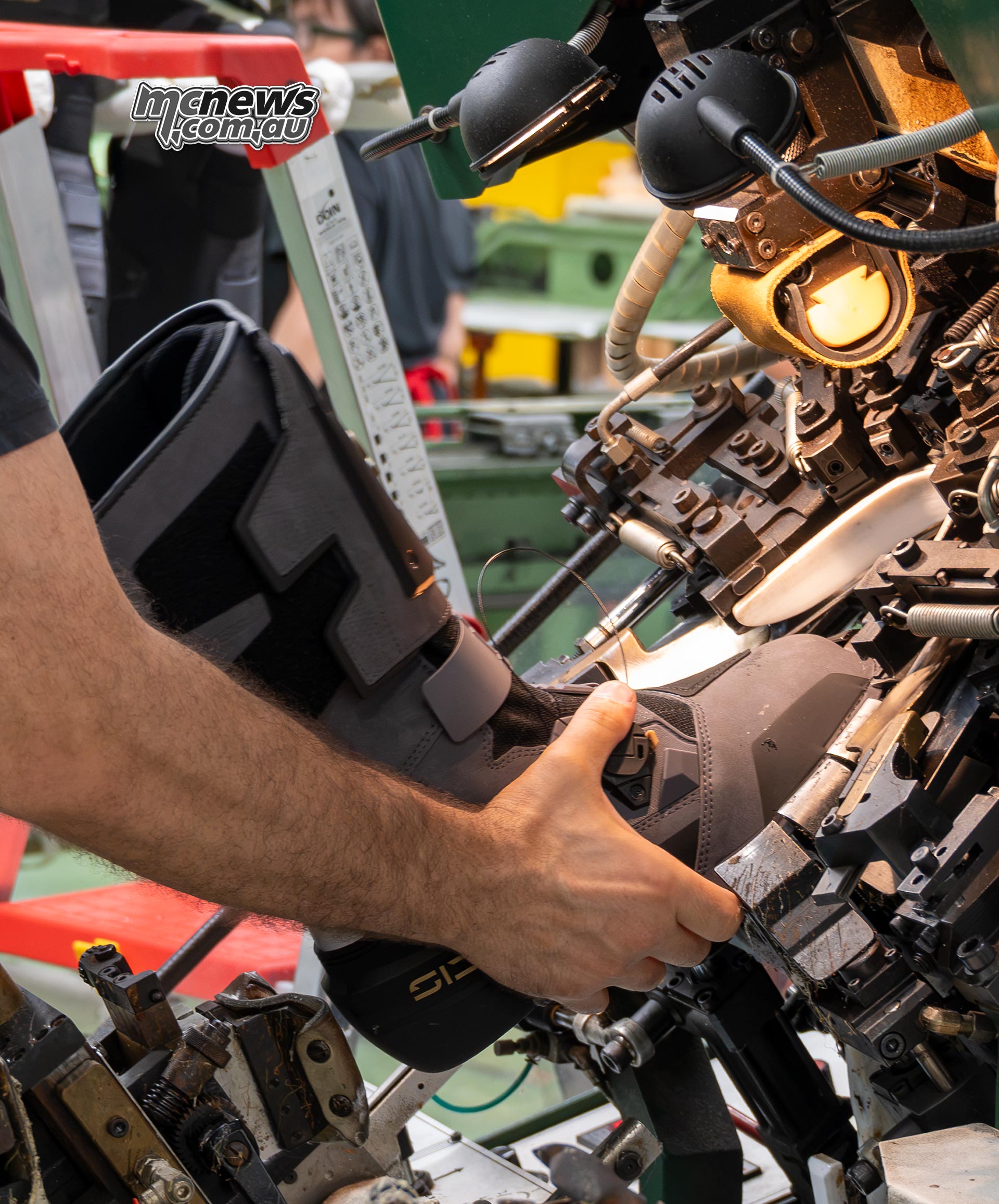
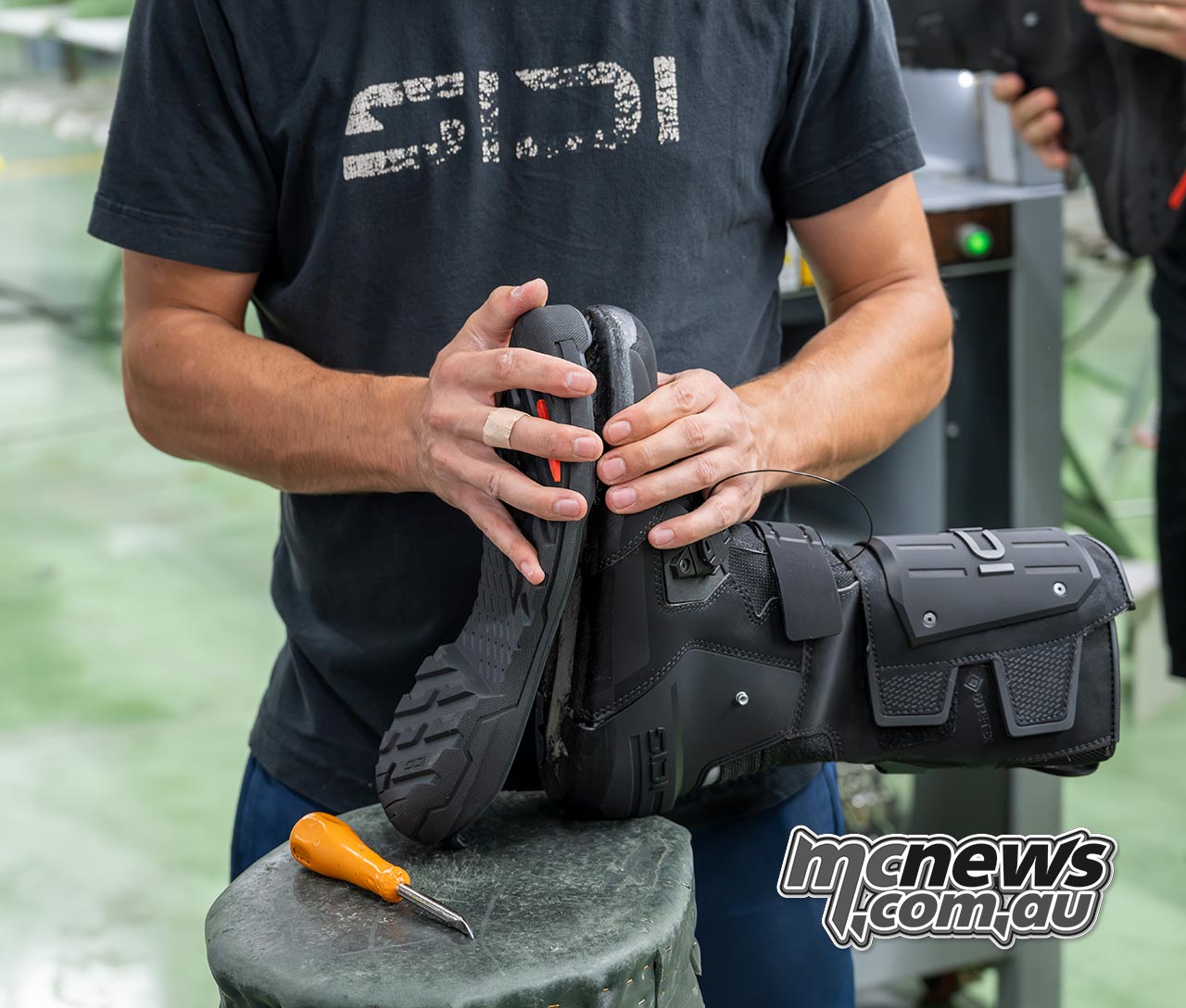
At the bottom of this page is a gallery I shot during the visit as Sidi staff assembled Taurus GTX boots from go to whoa. You might be surprised by how much hands-on labour remains involved.
Why Sidi uses NUUN dials
Dial closure systems divide opinion. Some riders love the convenience, while others look at the cables and wonder how they will cope with mud, dust, grit, water and repeated abuse.
Sidi’s answer starts with its founder, Dino Signori. According to Sidi, Signori developed an early dial closure concept in the 1990s, initially for mountain and ski boots, before the idea moved into cycling and later motorcycle footwear.
The goal was not novelty. It was problem-solving.
Massimiliano Mirabella
“He was more looking for the next solution. It was a genuine approach, not necessarily a business approach. It was more, ‘I want to fix people’s problem’.”

For adventure riding, the argument for the dial is simple. Riders need different levels of tension across a day. On a quiet road section, they may want the boot slightly looser; before a dirt road, rocky trail or prolonged standing section, they may want it tighter. The dial allows those adjustments while seated on the bike and without removing the boot.
Massimiliano Mirabella
“You do not have to take off your boot. If you tighten it too much, you can release it a little bit again. It is really good for adventure.”
Sidi says the most common concern is cable failure, but argues that failure is rare with the materials used and tends to develop gradually rather than occur without warning. The system is also replaceable.
Mud and dirt are another concern. Sidi points to the system’s use in mountain-bike World Cup conditions as part of its validation, noting that the dial housing has an outlet path and can be opened and washed.
How riders should look after expensive boots
One of the most useful parts of the discussion was also the simplest: how to care for boots properly.
Sidi’s first warning is not to store boots where they cannot breathe. Do not leave them sealed in a plastic bag or packed in a gear bag long-term, even if that bag has some ventilation. Be careful with humid garages, because prolonged moisture can be hard on adhesives and materials.
Massimiliano Mirabella
“Never keep your boot in a plastic bag. Never do that.”
If the boots are soaked, Sidi’s advice is to let them dry naturally with airflow. Do not put them directly in front of a fire. Do not attack them with a hairdryer. Excessive heat can affect the glue and weaken the construction over time.
Massimiliano Mirabella
“Just try to get some airflow to it, because too much heat may reactivate the glue. You do not want too much heat.”
Cleaning should also be kept simple. Sidi recommends water or its own cleaning kit rather than unfamiliar chemical products that may react with materials, membranes or adhesives.
A simple ownership checklist would be:
- Do not store boots in plastic bags.
- Do not leave them packed away in a gear bag.
- Avoid long-term storage in humid garages.
- After heavy rain or water crossings, dry them with airflow, not high heat.
- Do not use harsh or unsuitable chemical cleaners.
- Use water or a suitable boot-cleaning kit.
- Inspect soles, buckles, dials, straps and protectors regularly.
- Use the original box or another breathable, dry storage solution.
It is not complicated, but it is the sort of thing many riders get wrong.
Repairability is part of the price
Sidi is well aware that replaceability adds cost. Screws, fittings, removable soles, buckles, straps and protectors all have to be engineered into the boot from the outset. That can make it more expensive than a simpler, disposable design.
But Sidi argues that this is central to the brand.
Massimiliano Mirabella
“We think it is a big ESG (environmental, social and governance) piece because we are telling you that you can maintain your product for longer. You do not have to trash it.”
For Australian riders, the challenge is after-sales support. In Europe, it is easier to return boots for service or repair. In markets such as Australia and the United States, the distances are greater, and the distributor and dealer network must play a bigger role.
Sidi says one of its major future challenges is delivering the same level of product support in distant markets that it can offer closer to home.
The next challenge: being Sidi while growing
Asked about the company’s next major challenge, Massimiliano did not nominate a new product category or a specific model. His answer was simpler: remaining Sidi while growing.
That means not launching new technology unless Sidi believes it represents genuine innovation. It means not changing a boot merely to call it new. It also means educating riders about break-in, fit differences and long-term value while much of the industry moves towards faster turnover and more disposable products.
Massimiliano Mirabella
“Our biggest challenge is being Sidi while growing. That means remaining a brand that does innovation only when it is real innovation.”
That is not necessarily the fastest path. Sidi admits that a boot requiring break-in, or a range with noticeable fit differences between models, demands a slower customer-education process. The upside is retention: Sidi says it keeps around nine out of every ten customers it wins.
Massimiliano Mirabella
“Whenever we get a consumer, nine out of ten, we maintain that. But we have to get them back, and that is a more serious process. It is a slower process.”
Between two wheels
One of the more interesting observations from Sidi is that the brand does not see motorcyclists and cyclists as completely separate tribes. Its strategic territory is effectively anything that happens between a front and rear wheel.
A road cyclist chasing speed and a track-day rider chasing lap time are not as different as they may appear. A downhill mountain-biker and a hard enduro rider such as Billy Bolt have more in common than either camp might admit. The speeds, distances and presence of an engine may change, but the appetite for motion, risk, control and escape is often similar.
That thought provides a better ending to the Sidi story than simply talking about factories, ownership or boot construction.
The riders Sidi is trying to reach are not only buying protection. They are buying gear that enables them to do something difficult, physical and often deeply personal. They want to ride further, ride harder, ride alone, ride with mates, cross a river, stand on the pegs, survive a crash or simply finish a 1200-kilometre wet day without hating their feet.
The challenge for Sidi is to keep building boots that can do that while the company grows, modernises and fights against cheaper, more disposable alternatives.
After walking through the Maser facility, that appears to be the real story. Sidi is not simply trying to preserve an old Italian bootmaker. It is trying to prove that craft, repairability, racing feedback and genuine manufacturing still matter in a motorcycle-gear market increasingly tempted by shortcuts.
Sidi Taurus GTX Production Line Images