

MotoGP 2027
New Qualifying Format, 850cc Machines and Big Questions
MotoGP will undergo its biggest weekend format overhaul since introducing Saturday Sprint races in 2023, with separate qualifying sessions to determine the Sprint and Grand Prix starting grids from the start of the 2027 season.

The FIM Grand Prix Commission confirmed the changes on October 7, with MotoGP subsequently outlining a revised three-day programme that will produce two different starting grids at every round.
However, while separating the grids addresses one of the more contentious aspects of the current format, the solution introduces another dedicated qualifying shootout, requires every rider to participate in Saturday’s Q1, reduces practice time and does away with Sunday’s traditional Warm Up.
Consequently, more of the weekend will be devoted to outright qualifying attacks, despite reduced overall scheduled track time.
And with the championship simultaneously preparing to introduce radically different 850 cc motorcycles, new Pirelli tyres and substantially revised technical regulations, 2027 is shaping up as one of the biggest transformations of MotoGP in decades.
Sprint Qualifying moves to Friday
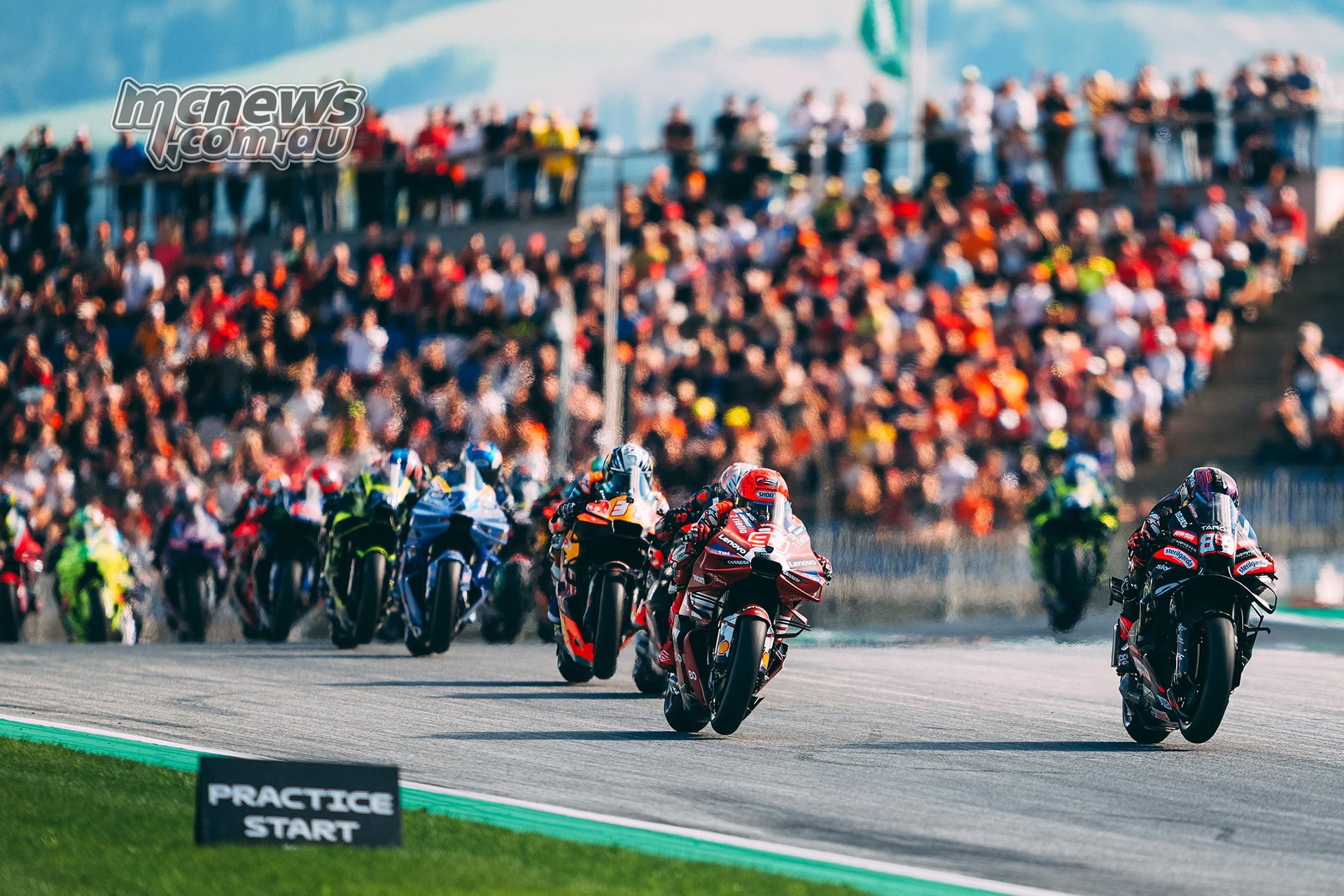
Friday will continue to commence with a 45-minute FP1, but the current 60-minute Practice session will disappear.
In its place will be a 30-minute FP2, which will have no bearing on progression into qualifying.
Friday will then conclude with a new 15-minute Sprint Qualifying session involving the entire MotoGP field. That session alone will establish the grid for Saturday afternoon’s Sprint.
That represents a fundamental change from the current system, under which Friday afternoon Practice is effectively the first stage of qualifying. The ten fastest riders in that session presently progress directly into Saturday’s Q2, while the remainder must contest Q1 for the final two places.
From 2027 there will be no such Friday shortcut.
Saturday will begin with a shortened 20-minute FP3, after which qualifying will start again, this time to set the grid for Sunday’s Grand Prix.
Every rider will participate in the 15-minute Grand Prix Q1 session.
The fastest 12 from Q1 will then progress into another 15-minute session, Q2, which will decide pole position and the first four rows of the Grand Prix grid.
Those eliminated in Q1 will fill the remaining grid positions based on their Q1 times.
Thus, every MotoGP rider will face a dedicated qualifying attack on Friday and another on Saturday. The fastest 12 on Saturday will then have to go all-out for a third time in Q2.
Traffic is also a factor. With the entire field participating in both Friday’s Sprint Qualifying and Saturday’s Q1, riders will try to find clear track while everyone else is chasing the same thing.
Managing slipstreams, slower riders preparing for flying laps, yellow flags and the inevitable gamesmanship surrounding qualifying could become even more complicated. And potentially dangerous.
Less track time, but more qualifying pressure
MotoGP says the revised programme balances the spectacle with track time for riders, teams and manufacturers, and the reduction in practice is certainly significant.
The current schedule provides 135 minutes of practice across Friday and Saturday before qualifying is taken into account: 45 minutes of FP1, 60 minutes of Practice and 30 minutes of Saturday FP2.
That becomes just 95 minutes in 2027, comprising 45 minutes of FP1, 30 minutes of FP2 and 20 minutes of FP3.
Forty minutes of practice time disappears.
Across the complete Friday and Saturday programme, including all qualifying sessions, scheduled MotoGP track time actually falls from 165 minutes to 140 minutes.
For a front-running rider who currently progresses directly into Q2, the available Friday and Saturday track time falls from 150 minutes to 140 minutes.
However, that same rider goes from participating in one dedicated 15-minute qualifying session on Saturday to three 15-minute qualifying sessions spread across Friday and Saturday.
Of course, present-day Friday Practice already becomes a qualifying shootout in its closing stages, so it would be misleading to suggest riders are not currently making maximum-attack laps on Friday.
Nonetheless, the weekend’s character is changing. A greater proportion of the available time will be spent competing for grid positions, rather than experimenting with race set-up, tyre behaviour and longer runs.
Another all-out time attack raises safety concerns
Qualifying laps are among the most demanding kilometres completed during a MotoGP weekend.
Riders generally run fresh soft tyres and minimal fuel loads, pushing braking points, corner entry, lean angles, and throttle application to their absolute limits. Some have described having to ‘take their brain out’ for these sessions when it comes to risk evaluation. The margins are extraordinarily small. Crossing those margins can have substantial consequences.
From the early reaction when the proposal first emerged during the Austrian Grand Prix weekend, the introduction of another dedicated time attack appears far from universally popular with the riders.
Fabio Di Giannantonio was particularly concerned about the implications for rider health. The Italian acknowledged the promoter’s desire to increase the spectacle, but questioned whether continuously intensifying an already demanding programme was the right approach. Di Giannantonio would prefer to retain opportunities for more relaxed practice sessions rather than continually converting track time into competitive shootouts.
DiGi raised these concerns before the final schedule was confirmed, and therefore before the precise reduction in practice time was known. Nonetheless, the central question about the intensity of those sessions remains relevant.
Francesco Bagnaia also expressed reservations about adding to the competitive workload. He supported the principle of having different grids for the Sprint and Grand Prix, having experienced the frustration of a poor qualifying result compromising both races. However, he wanted a solution that did not simply add another qualifying session to an already demanding weekend.
Bagnaia even suggested using riders’ fastest laps from the Sprint itself to establish Sunday’s Grand Prix grid, thereby providing two different starting orders without requiring another dedicated time attack. That idea has not been adopted.
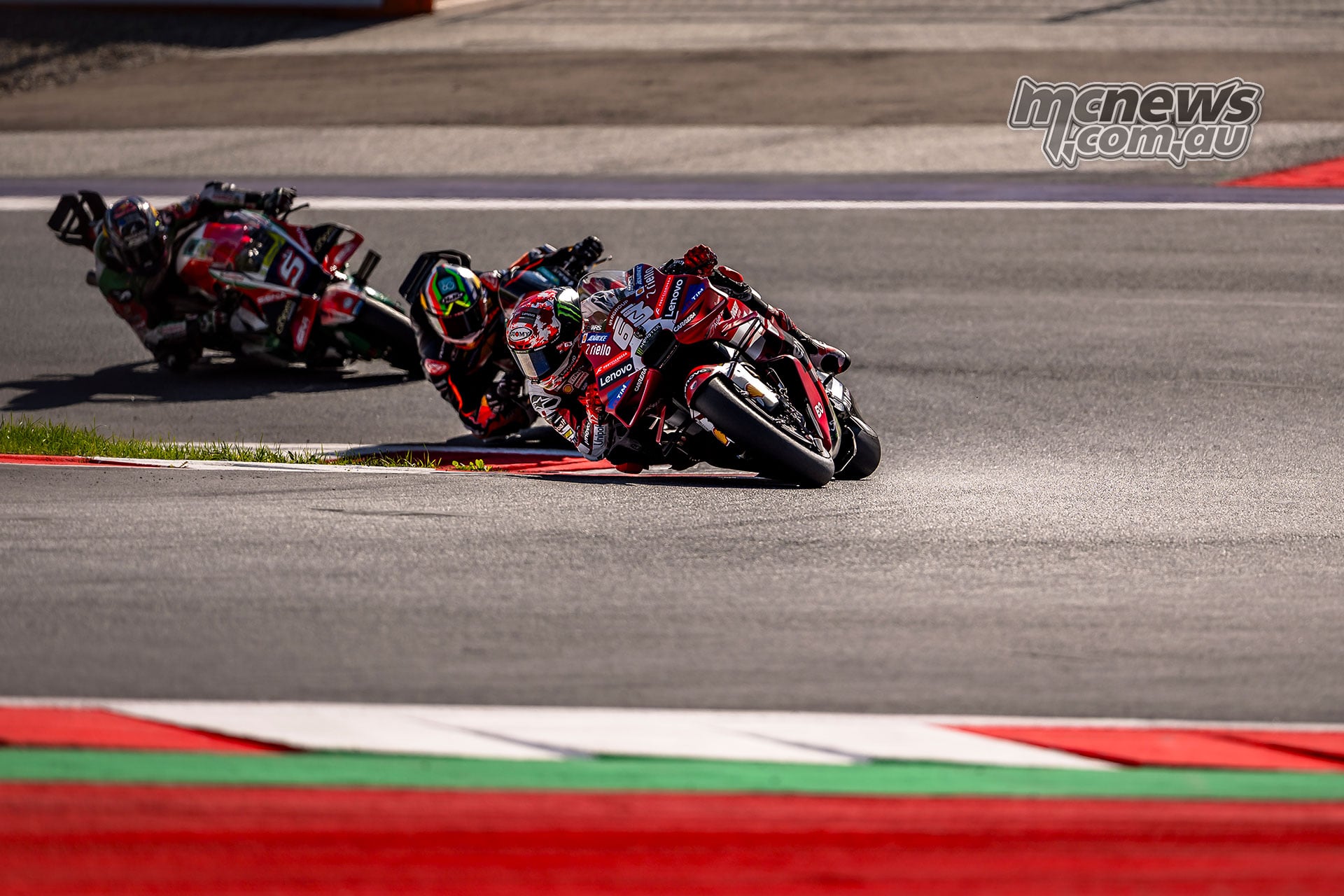
The revised format offers a legitimate benefit. A mistake, crash or badly timed yellow flag during qualifying will no longer automatically compromise a rider’s starting position in both races.
But another maximum-attack qualifying session, and the requirement for the entire field to contest Q1 on Saturday, introduces additional occasions when riders must operate at the absolute limit.
Whether the reduction in practice time sufficiently offsets the physical and safety implications remains open to debate.
Márquez explains the increasingly narrow limit
Another interesting dimension to this debate is one Marc Márquez touched on when MCNews.com.au sat down with him at World Ducati Week earlier this year.
Discussing the evolution of MotoGP machinery, Márquez explained that modern aerodynamic development has fundamentally changed the way riders find and exploit the limit.
He contrasted his earlier MotoGP machinery, which moved around and provided more warning before a crash, with today’s heavily aerodynamically loaded motorcycles.
Modern MotoGP bikes are more planted and precise, but they can be considerably less forgiving when a rider exceeds the available grip.
Sliding the motorcycle, once such a fundamental part of extracting lap time, can now disrupt aerodynamic performance and actually make the rider slower.
Márquez also explained that riders can reach a point in qualifying where trying harder does not produce a faster lap. The motorcycle has a performance ceiling, and going beyond that ceiling can cost time rather than gain it.
He even drew a comparison with Formula One, saying:
“It is like a Formula One car.”
His point was that the rider must be extraordinarily precise rather than simply aggressive. I, for one, miss seeing Marc in maximum attack mode with the bike moving around beneath him; modern MotoGP and its aero have effectively robbed us of that spectacle.
Sprint Saturday arrived in 2023
MotoGP announced Sprint races in August 2022, with the new format taking effect from the opening round of the 2023 season. The inaugural MotoGP Sprint was held at Portimao on March 25, 2023, with Francesco Bagnaia taking the victory.
Unlike Formula One, which only stages Sprint events at selected rounds, MotoGP introduced Sprints at every Grand Prix from the outset.
The Saturday races have undoubtedly created additional championship intrigue, with points now available on both Saturday and Sunday. They have also substantially increased the amount of competitive racing riders undertake during a season.
Since their introduction, Saturday qualifying has determined the starting order for both the Sprint and Grand Prix. That created the anomaly in which one mistake in qualifying could effectively punish a rider twice.
The revised format removes that problem, giving riders separate opportunities to secure competitive starting positions for Saturday and Sunday.
Sunday Warm Up disappears
The traditional ten-minute MotoGP Sunday morning Warm Up will disappear, replaced by a ten-minute pitlane opening ahead of the Grand Prix.
Riders will be permitted to complete multiple sighting laps during that period, which MotoGP says will provide an opportunity to shakedown the motorcycle before the race.
While this still allows riders to check the machine, it is not the same as a conventional Warm Up session. Sunday morning Warm Up has traditionally provided an opportunity to assess overnight set-up changes, tyre behaviour and prevailing track conditions before committing to the Grand Prix.
The revised arrangement shifts that activity closer to the race itself and changes how teams will approach their final preparations.
Moto3 and Moto2 will race before the premier class, with the MotoGP Grand Prix using the grid established by Saturday’s Q1 and Q2 sessions.
2027 MotoGP weekend format
Friday
FP1 – 45 minutes
FP2 – 30 minutes
Sprint Qualifying – 15 minutes, all riders
Sprint starting grid established
Saturday
FP3 – 20 minutes
Grand Prix Q1 – 15 minutes, all riders
Grand Prix Q2 – 15 minutes, fastest 12 from Q1
MotoGP Sprint – grid determined by Friday Sprint Qualifying
Sunday
Moto3 Grand Prix
Moto2 Grand Prix
Ten-minute MotoGP pitlane opening with multiple sighting laps
MotoGP Grand Prix – grid determined by Saturday Grand Prix qualifying
The Grand Prix Commission, comprising representatives of the FIM, IRTA, the manufacturers’ association and MotoGP’s commercial rights holder, formally approved the changes which will take effect from the beginning of the 2027 season.
The much bigger gamble arrives with the 850s
The weekend format is only one element of the reset awaiting MotoGP in 2027. The current 1000 cc motorcycles will give way to 850 cc machinery, aerodynamics will be reduced and more tightly controlled, ride-height and holeshot devices will disappear, and Pirelli will replace Michelin as the championship’s control tyre supplier.
The objective is to reduce outright speeds, control costs, improve safety and, hopefully, create motorcycles that are easier to race closely.
There is a temptation to assume that less engine performance, reduced aero and fewer devices will automatically produce closer racing and easier overtaking.
Marc Márquez has already warned us not to make that assumption.

During our exclusive conversation with Márquez, we asked whether his early experience on the 2027 prototype left him optimistic that the new regulations would create different styles of racing and improve overtaking.
His answer was distinctly cautious.
“At the moment, I am not very optimistic about that.”
Márquez explained that although the 850 has less engine performance, it does not necessarily make the braking phase easier.
The reduced speed can shorten braking zones, while riders may actually brake harder and more aggressively over a shorter distance. That could make overtaking more difficult in some circumstances rather than easier.
He also pointed out that the 850 remains an extraordinarily powerful motorcycle. On many straights, current 1000 cc machines do not even exploit their full available torque, whereas the smaller engine may allow riders to use more of its performance when accelerating out of corners.
And when asked which aspect of the new regulations would have the greatest influence on the racing, his answer was revealing.
“The biggest difference will be the tyres.”
For Márquez, the characteristics of the Pirelli rubber may ultimately influence how the motorcycles race more than the reduction in engine capacity itself.
On aerodynamics, Márquez was more enthusiastic about the direction of the new rules. He believes the present generation of aerodynamic packages makes following another motorcycle substantially harder, with riders losing performance in disturbed air and struggling to maintain the proximity required to attempt an overtake.
Indeed, he would prefer MotoGP to go even further in reducing aerodynamic dependency.
But his early impressions of the 850 demonstrate that less capacity and less aero do not automatically guarantee the desired result.
Gigi gets his clean sheet
From an engineering perspective, Luigi “Gigi” Dall’Igna sees the same reset rather differently.
When MCNews.com.au sat down with the Ducati Corse General Manager, Dall’Igna explained that very little of the present Desmosedici can simply be carried into 2027.
The different engine capacity, new tyres and disappearance of ride-height devices mean Ducati effectively has to create another motorcycle rather than merely evolve the existing one.
What carries forward is the knowledge accumulated by Ducati’s engineers, rather than the existing hardware.
That prospect does not intimidate Dall’Igna. Quite the opposite.
“When you can start from a completely new piece of paper, for an engineer this is the best toy you can have.”
That enthusiasm is encouraging. The cleverest engineers in the paddock have effectively been handed a new problem and the opportunity to explore different solutions.
There is also an important distinction between the MotoGP reset and what Formula One has experienced this year.
Dall’Igna has long argued that substantial technical regulation changes need to be defined years in advance so manufacturers can establish proper development programmes and control expenditure.
In our conversation, he suggested three or four years of warning was preferable when making major changes.
MotoGP’s 2027 technical regulations were announced back in May 2024, giving manufacturers considerable time to prepare for the new engine formula, aerodynamic restrictions and other technical changes.
Of course, advance notice doesn’t guarantee the regulations will work as intended, but it has set the direction of the technical reset well ahead of its introduction.
Interestingly, Dall’Igna also revealed that he had initially pushed for a small degree of hybridisation in the 2027 MotoGP regulations.
He saw adding a small electric motor as an opportunity for engineering creativity and technical learning, while acknowledging the considerable cost implications.
That is worth keeping in mind when discussing the problems Formula One has encountered. Hybrid technology itself is not necessarily the problem; it is how the technical regulations influence the racing.
MotoGP cannot afford an F1-style own goal
Hopefully MotoGP’s carefully planned technical revolution proves considerably more successful than the debacle Formula One has produced with its own new regulations this year.
Formula One’s 2026 formula has increasingly become an exercise in electrical energy management, deployment strategies, super-clipping, harvesting and drivers sometimes deliberately sacrificing performance in one section of a lap to ensure they have sufficient energy available elsewhere.
That is a very different proposition from the traditional racing instinct to brake later, carry more corner speed and get back on the throttle earlier.
Some of Formula One’s most prominent drivers have openly revolted against aspects of the formula, with Max Verstappen among its most outspoken critics.
Verstappen has repeatedly questioned whether the new power units reward the qualities that traditionally separated the best drivers from the rest, while Oscar Piastri and others have raised safety concerns about the considerable differences in electrical deployment between cars.
The consequences have extended well beyond drivers complaining about how the cars feel.
Formula One’s governing body has already been forced to revisit the regulations during their first season.
Following concerns raised after the opening races, the FIA and Formula One agreed to changes to energy-management parameters intended to reduce excessive harvesting and encourage more consistent flat-out driving.
Further changes to rebalance the contribution of the combustion engine and electrical systems for 2027 and 2028 have also been agreed in principle.
As if that were not enough, last weekend’s relocated Bahrain Grand Prix at Sepang descended into further technical controversy when an energy-management software problem in wet conditions caused multiple cars to lose power during the formation laps, delaying the start.
The FIA has launched an investigation into the circumstances of that failure.
For this scribe, the overall direction of Formula One’s 2026 formula has rendered much of the series basically unwatchable from the perspective of a racing purist.
There is no denying the extraordinary engineering sophistication involved. But clever engineering does not automatically translate into compelling racing.
When drivers must deliberately compromise their performance to satisfy increasingly complex energy-management requirements, something fundamental is being lost.
It is perhaps ironic that Márquez himself reached for a Formula One comparison when explaining the behaviour of today’s heavily aerodynamically loaded MotoGP motorcycles.
He was not commenting on Formula One’s 2026 regulations. Rather, he was illustrating how modern MotoGP machinery increasingly rewards precision over aggression, and how the old visual language of a rider wrestling with a motorcycle can now work against outright performance.
That raises an important question about MotoGP’s future direction. Grand Prix motorcycle racing has always been a technological contest and should remain one.
But it must also remain a contest between riders whose differing skills and approaches can make a decisive difference.
That was another point Dall’Igna made during our interview. Despite Ducati’s enormous investment in simulation, electronics, artificial intelligence and data analysis, he explained that the best riders possess individual strengths that cannot simply be copied.
Marc Márquez has a remarkable ability in left-hand corners, Bagnaia can be extraordinarily effective in the braking phase, and Di Giannantonio’s corner speed is exceptional.
Even when the data is available for everybody to study, reproducing those individual abilities is another matter entirely.
That is the human element MotoGP must preserve.
The best motorcycle racers should be able to distinguish themselves through braking skill, corner speed, throttle control, racecraft, bravery and their ability to manage a motorcycle at the limit.
The 850 cc regulations have worthwhile objectives. Reducing outright speeds is sensible. Pulling back the aerodynamic arms race makes sense. Removing ride-height devices should return more responsibility to the motorcycle’s fundamental mechanical characteristics and the rider’s skill.
But Márquez’s warning is clear enough: none of those measures automatically guarantees closer racing or easier overtaking.
Meanwhile, Dall’Igna’s excitement demonstrates just how profound the engineering opportunity is.
The challenge is to find the right balance between those two perspectives.
Hopefully the people responsible for writing and administering MotoGP’s new regulations have watched what happened in Formula One very closely, and learned from those mistakes to ensure nothing remotely similar happens to the motorcycle racing spectacle.
Two grids, three qualifying attacks, but at what cost?
Returning to the weekend format changes, the sporting logic behind separate Sprint and Grand Prix grids is difficult to argue with.
One bad qualifying session should perhaps never have dictated a rider’s starting position in two separate races.
But whether another dedicated maximum-attack session, combined with making every rider participate in Saturday’s Q1, is the best way to solve that problem is another matter.
On paper, the format provides two opportunities to qualify well, while simultaneously reducing total scheduled track time.
In reality, it asks riders to devote more of their weekend to operating at the absolute limit.
Early rider reaction suggests that is not a universally welcome trade-off.
And with MotoGP about to embark on its most substantial technical transformation in decades, riders, teams, and manufacturers will have no shortage of other challenges to contend with in 2027.
Hopefully, the end result is genuinely better motorcycle racing.