

Marc Márquez is back in the title fight, but his right arm is nowhere near back
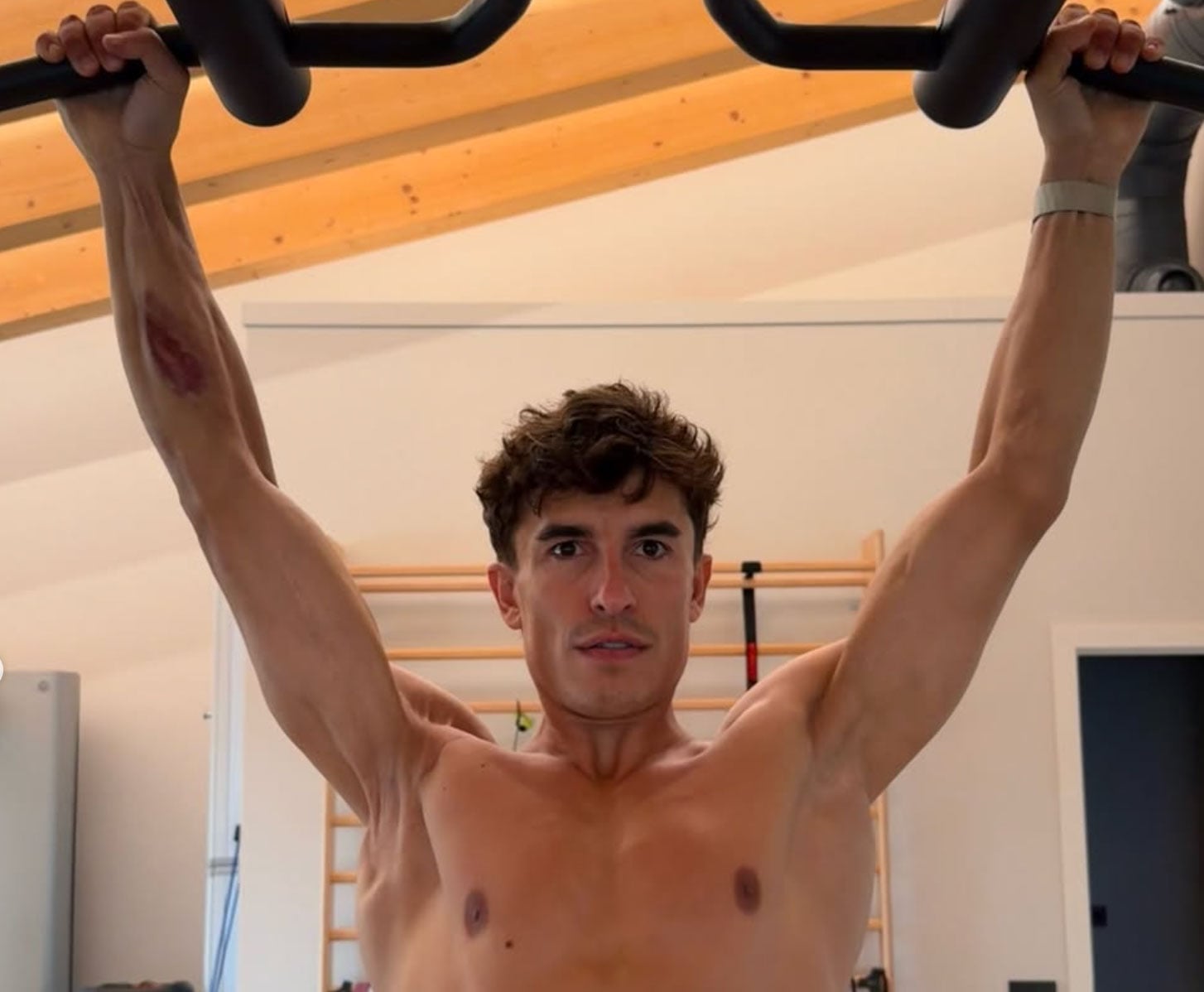
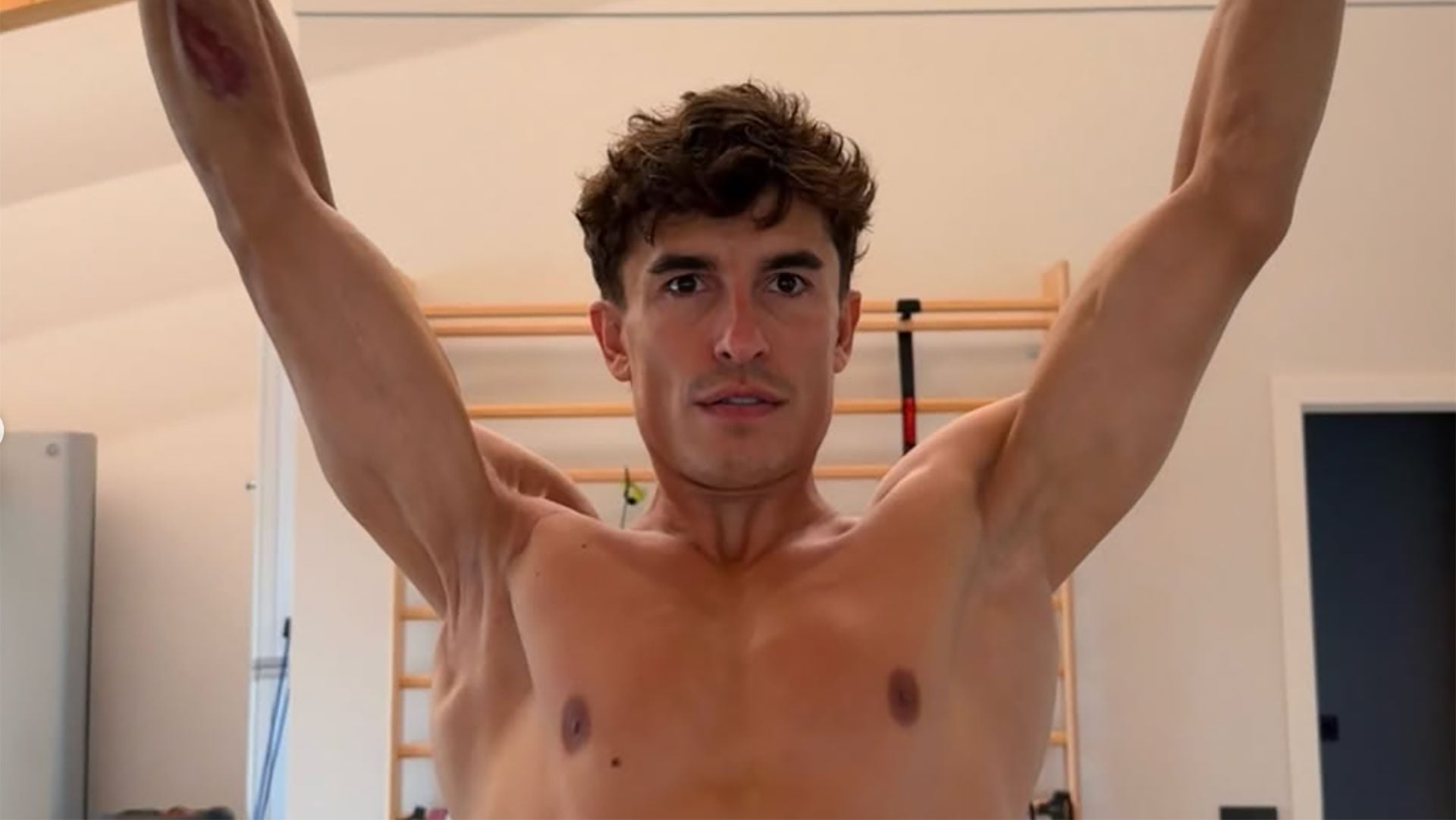
The first impression from Marc Márquez’s recent training image isn’t the surgical scarring. It is the extraordinary difference between his two arms.

Márquez is facing the camera with both arms raised, placing his right arm on the left side of the image. The loss of muscle bulk around the right upper arm and shoulder is impossible to miss when compared directly with his left side.
The photo clearly reveals the physical asymmetry and muscle wastage in every aspect of the shoulder; the more you look, the more you see… That visual evidence matches the limitations recently described by the surgeon who has treated Márquez.
Dr Samuel Antuña has explained that the principal continuing problem is a considerable loss of strength in the right biceps. The arm remains heavily compromised and, while further improvement is possible, Antuña does not expect it ever to return to normal.
That makes Márquez’s current form almost as remarkable as any of the extraordinary saves, victories or championship performances from the first phase of his MotoGP career.
Seven operations from shoulder to humerus
Márquez has now undergone seven operations involving his right shoulder and humerus.
The sequence began with a Latarjet procedure in December 2019 to address repeated right-shoulder instability. A Latarjet is substantially more involved than simply repairing soft tissue: a section of the coracoid bone and its attached conjoint tendon, which includes the short head of the biceps, is transferred to help stabilise the front of the shoulder joint.
Then came the catastrophic right humerus fracture at Jerez in July 2020. The initial fixation was followed by another operation after the plate failed and a third procedure involving a bone graft that December. A further operation at the Mayo Clinic in June 2022 rotated the humerus to correct the substantial torsion remaining in the arm.
Márquez eventually rebuilt himself sufficiently to win the 2025 MotoGP World Championship, but the collision with Marco Bezzecchi at Mandalika late that season caused a fracture at the base of the coracoid and damage to the acromioclavicular ligaments.
After an initial period of immobilisation failed to stabilise the injury, Márquez underwent surgery to stabilise and repair the acromioclavicular ligaments.
The effects continued into 2026. A bone fragment and two screws associated with the earlier Latarjet procedure had shifted and were compressing the radial nerve. Antuña has explained that this compression could cause Márquez to lose control of the arm when it reached particular positions.
The problem was addressed on May 10, when doctors removed the screws and displaced bone fragment. During the same visit to theatre they stabilised the fifth metatarsal Márquez fractured in his scary Le Mans Sprint crash.
Some things just can’t be sped up
Even those of us that have undergone comparatively routine shoulder reconstruction involving tendon repair and relocation of a biceps attachment now find that it requires long rehabilitation to get anywhere close to normal strength. Returning to basic function and having a shoulder feel normal again are very different milestones, and progress can continue to be measured in months and years rather than weeks.
Márquez’s situation is vastly more complicated. His shoulder has been reconstructed, reinjured and reopened, while the humerus below it has been plated, grafted and surgically rotated. The radial nerve compression then added a neurological component to an already heavily altered structure.
Yet Márquez returned at Mugello only 19 days after the May operation. At that point he was ninth in the championship and 85 points from the lead. He publicly cautioned that thinking immediately about the title would invite another injury and said his first objective was to rebuild the right arm.
Nine days later he won the Hungarian Grand Prix, recording the 100th victory of his World Championship career. At Aragón he subsequently won the Sprint and Grand Prix to collect the maximum 37 points.
Márquez now heads to Misano second in the championship, only 19 points behind Jorge Martin and five ahead of Marco Bezzecchi.
The key distinction is that Márquez is not winning because his right arm has returned to normal. He is winning while compensating for what it can no longer do, adapting his preparation and riding technique around a permanent physical deficit.
Misano poses the next question
Misano has historically been one of Márquez’s strongest circuits. He has six MotoGP victories there and has won the San Marino Grand Prix in each of the past two seasons.
It is nevertheless a demanding test for a rider still rebuilding strength. The flat, clockwise layout contains ten right-hand corners, several sustained high-speed changes of direction and braking zones that place a heavy load through the front of the motorcycle. Maintaining precision across the 13-lap Sprint and 27-lap Grand Prix will require both strength and endurance.
Four months after his latest operation, the visible muscle wastage makes it clear that the physical recovery remains unfinished. His surgeon’s assessment suggests that, in an absolute sense, it always will be.
What Márquez has recovered is the ability to extract winning speed from himself and the Ducati. From 85 points behind at the end of May to 19 points behind entering Misano, he has transformed what appeared to be a lost season into a fight for a tenth World Championship.
Misano will tell us whether that resurgence can continue. Whatever happens, it should now be viewed with a proper understanding of the arm with which Márquez is achieving it.