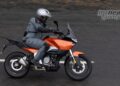


Norton Atlas and Atlas GT break cover
Reborn brand gets adventurous
MCNews.com.au has already spent plenty of time looking under the skin of Norton’s latest rebirth. That story started in earnest with the new Norton Manx R, a 206 horsepower V4 statement bike that we rode in Spain, and continued through a series of interviews with the senior people tasked with making sure this latest comeback is not simply another optimistic restart trading on one of motorcycling’s most famous names.
During the Manx R launch, we sat down with Norton Executive Director Richard Arnold to talk TVS backing, distribution, parts supply, Australia and why this new chapter has to be structurally different from previous Norton revivals. We also dug into the engineering with Norton CTO Brian Gillen, and the design direction with Norton Head of Design Simon Skinner.
For the ride impression, our 2026 Norton Manx R review explored whether the reborn Anglo-Indian V4 could work not only as a road and track motorcycle, but as a credibility marker for the TVS-backed Norton project. The answer there was largely positive, even if the Manx R is clearly a premium, specialist, relatively low-volume proposition.

The next new model cab off the rank for the reborn Norton is a very different proposition. The new Atlas and Atlas GT move Norton into the middleweight adventure-touring space, and while the Manx R is the halo product, the Atlas is arguably the more commercially important motorcycle.

This is where Norton’s new reality becomes even more interesting. The Manx R leans heavily on Norton’s Solihull base and European premium componentry, while the Atlas project more directly leverages the industrial and financial might of Indian juggernaut TVS. The Atlas and Atlas GT have been designed and developed with Norton’s European-based team, but unlike the Manx R, the Atlas platform is set to be produced within TVS facilities in India, giving Norton access to a scale, cost base and manufacturing discipline that the old company could never realistically claim.
2027 Norton Atlas at a glance
- 585 cc liquid-cooled 270-degree parallel twin
- 69 bhp / 70 PS / 51.5 kW at 9300 rpm
- 57.5 Nm at 7300 rpm
- Atlas: 19-inch front wheel, 180 mm travel, 845 mm seat height
- Atlas GT: 17-inch wheels, 140 mm travel, 815 mm seat height
- Bosch six-axis IMU, cornering ABS, traction control and five ride modes
- Eight-inch TFT with connectivity and OTA update capability
Norton heads for the middleweight adventure market
The new Atlas family gives Norton two interpretations of the same basic middleweight platform. The Atlas is the more traditional adventure-touring model, running a 19-inch front and 17-inch rear wheel combination, 180 mm of suspension travel and a taller 845 mm seat height. The Atlas GT takes the same core ingredients but points them more squarely at the road, with a 17-inch front wheel, 140 mm of suspension travel and a lower 815 mm seat height.

Both are powered by a new 585 cc liquid-cooled DOHC parallel twin with a 270-degree crankshaft. Norton quotes 69 bhp / 70 PS / 51.5 kW at 9300 rpm and 57.5 Nm at 7300 rpm. The engine uses a 78 mm bore and 61.2 mm stroke, 12.2:1 compression, ride-by-wire throttle, multi-point sequential fuel injection and an APS-coated cylinder surface.
Norton quotes the Atlas at 188 kg wet, excluding fuel, which suggests it should sit around the 200 kg mark with its 15.4-litre tank filled.
The 270-degree crank is now a familiar formula in the middleweight twin class, but for good reason. It gives a parallel-twin more character, better traction feel and a more interesting pulse than a traditional evenly spaced firing order. Norton’s language around the Atlas engine is very much about usable torque, clean pick-up, tractable mid-range and a willingness to rev without demanding that the rider wring its neck everywhere.
The gearbox is a six-speed unit with a standard bi-directional quick-shifter, while a cable-operated assist-and-slip clutch should help smooth out downshifts under brakes. Final drive is by X-ring chain.
Atlas versus Atlas GT
The split between Atlas and Atlas GT is simple enough on paper. The Atlas is the one with the more adventure-biased stance, longer travel suspension and 19-inch front wheel. The Atlas GT is the more road-focused model, using 17-inch wheels front and rear for sharper steering, broader road tyre choice and a lower seat height.

That makes the Atlas the more obvious choice for mixed-surface touring and fire trails, while the GT looks aimed at riders who like the upright ergonomics and practicality of an adventure bike but spend almost all of their time on sealed roads.
Norton has not yet released full pricing and final specifications for the Atlas GT, with the press material stating that those details will be announced closer to market launch. For now, the most important known GT differences are the 17-inch front wheel, 140 mm suspension travel and 815 mm seat height.

Chassis and suspension
The Atlas family is built around a high-strength steel trellis frame, with the engine used as a stressed member. A cast aluminium twin-sided swingarm is used at the rear, while suspension comes from KYB at both ends.
On the Atlas, the front end is a fully adjustable 43 mm KYB USD fork with 180 mm of travel. Norton says the fork offers 20-step compression and rebound adjustment. At the rear, a KYB monoshock provides 180 mm of travel and hydraulic preload adjustment, which should be useful for riders swapping between solo commuting, two-up work and luggage-heavy touring.

The Atlas GT pares travel back to 140 mm front and rear, in keeping with its more road-focused brief. Norton says the geometry and damping have been tuned to prioritise road feedback, turn-in response and cornering composure rather than chasing off-road ability for its own sake. More Transalp than Tuareg, then…
Claimed wet weight without fuel is 188 kg for the base Atlas and 192 kg for the Atlas Apex. Those numbers do not include the 15.4-litre fuel load, but they still place the bike in an interesting position in the middleweight adventure-touring segment, particularly given the level of equipment fitted as standard.
Brakes, wheels and tyres
Braking hardware comprises dual 310 mm semi-floating front discs with radially mounted Bybre calipers, backed by a 270 mm rear disc and Bybre caliper. Norton is talking up the braking package as a strong point, not just for outright power, but for progressive feel when the bike is loaded or ridden in variable conditions.
The Atlas runs a 19 x 2.50-inch front and 17 x 4.00-inch rear wheel combination, with Eurogrip Explo R Plus tyres in 110/80 ZR19 and 150/70 ZR17 sizes. Norton lists both cast-alloy and spoked-steel wheel options in the technical material.
The Atlas Apex specification lists wider 19 x 3.00-inch front and 17 x 4.50-inch rear wheel dimensions, again with the same quoted 110/80 ZR19 and 150/70 ZR17 tyre sizing.
The Atlas GT, meanwhile, moves to 17-inch cast-alloy wheels front and rear, which should sharpen the bike’s road manners and open the door to a wider choice of road-biased tyres.
Electronics are a major part of the pitch
Norton has thrown a serious electronics suite at the Atlas family, built around a Bosch six-axis IMU.

The package includes lean-sensitive ABS, cornering traction control, drag torque control, rear lift control, rear slide control, wheelie control and dynamic cruise control. There are five ride modes: Urban, Rain, Sport, Tour and Enduro.
The Apex variants add electronic combined braking and hill hold control, giving the higher-spec models an even more complete safety and convenience package.
That level of electronics is an important point. Many middleweight adventure bikes still ask buyers to choose between low weight, value and technology. Norton appears to be trying to carve out a more premium space by giving the Atlas a full rider-aid suite from the start.
Eight-inch TFT and connected features
The cockpit is centred on an eight-inch colour TFT touchscreen with 720p resolution. It supports Bluetooth and Wi-Fi connectivity, multimedia control, turn-by-turn navigation, GoPro control, ride telematics, Norton Rider app integration and over-the-air software and firmware updates.
Keyless ignition is also standard, along with an electronic steering lock, seat lock, and fuel filler cap operation, while a USB-C charger is provided for device charging.
On paper, that places the Atlas closer to the premium European end of the middleweight adventure-touring segment than the more basic Japanese interpretation of the class. The question, as always, will be how intuitive the interface proves to be once riders are actually trying to use it in rain, dust, traffic, and bright sun. As TVS is in the heartland of India’s Silicon Valley, the local expertise is certainly there to fulfil that brief.
Practicality and touring kit
The Atlas has clearly been developed with touring use in mind. Norton claims CFD and wind-tunnel work were used to shape the aerodynamic package and reduce rider fatigue, while the bodywork has been designed to support both seated and standing riding positions.
The Atlas seat height is 845 mm, while the GT drops that to 815 mm. Both models use adjustable hand levers and footpegs, tapered aluminium handlebars and radiator ducting designed to direct heat away from the rider.
The Atlas Apex adds several practical items as standard, including heated grips, tyre pressure monitoring, an easy-adjust windscreen, LED cornering lights, a puddle lamp, rear luggage and pillion handle kit, and additional sump protection.
The accessory list includes an integrated heated rider seat, touring windscreen, brass-coated chain, engine guards, all-terrain sump protection, front axle spindle protection, a 50-litre pannier system and a 34-litre top case.
The Atlas name
The Atlas name is not new to Norton. The original Atlas arrived in 1962, aimed primarily at export markets, particularly the United States, where riders wanted more displacement, greater torque, and high-speed touring capability.
That makes the name a neat fit for Norton’s new middleweight project. The old Atlas was about broadening Norton’s appeal beyond narrow British roadster thinking. The new one has a similar job, albeit in a very different market. It needs to take Norton out of the low-volume nostalgia and exotic superbike conversation and into a segment where real riders cover real miles, commute, tour, carry luggage, and expect the bike to be their reliable, go-to every-day commuter.
Pricing and Australia
UK pricing starts at £8,250 for the Atlas and £9,450 for the Atlas Apex. European pricing is listed at €9,250 for the Atlas and €10,525 for the Atlas Apex.
On a straight currency conversion, that lands broadly in the mid-to-high teens in Australian dollars before freight, taxes, compliance costs, distributor margin and dealer charges. Official Australian pricing, timing and distribution remain unconfirmed.
That price point would make the Norton very competitive in what is a red-hot middleweight adventure market.
Atlas GT pricing and full specifications are still to be announced. Australian pricing, timing and distribution details have also not yet been confirmed.

That Australian question remains important. Norton representatives previously told MCNews.com.au that Australia is on the radar, but the reborn brand still needs a local distributor and an aftersales structure capable of properly supporting customers. That matters even more for the Atlas than for the Manx R, because adventure-touring riders are generally less forgiving of boutique-brand romance if parts, warranty, and support are not in place. Norton indicates that service intervals will be 10,000 kilometres and that the machine will be backed by a three-year warranty.
Why Atlas matters more than the Manx R
There is a world of difference between building an expensive, low-volume V4 superbike that exists partly to prove what a brand can do, and building a middleweight adventure-tourer that has to make sense against established rivals from Yamaha, Triumph, BMW, KTM, Honda, Suzuki and Ducati.
On the numbers released so far, the Atlas has plenty going for it. The 585 cc twin is not chasing class-leading capacity or peak output, but offers a tractable 70 hp, a full electronics suite, adjustable KYB suspension, radial brakes, an eight-inch TFT, keyless functionality, and a roughly 200 kg ready-to-adventure specification sheet.
At 585 cc the Atlas sits within the LAMS capacity ceiling, but with 51.5 kW and a sub-200 kg wet-fuel estimate, the full-power version would almost certainly sit well above Australia’s learner-approved power-to-weight threshold. A dedicated detuned LAMS variant, however, could bring new riders directly into the Norton fold from the start. I am sure that whoever is negotiating to be the local distributor for Norton will be pushing that angle hard with TVS.
The bigger story, though, is not just the hardware. It is the manufacturing model. Norton is now trying to combine British design identity, European development input and TVS industrial scale. If that works, the Atlas could be the model that moves Norton from an interesting revival story to a functioning global motorcycle brand.
That is the real test. The Manx R showed that Norton can build something truly desirable with performance to match. The Atlas now has to show whether Norton can build something desirable, useful, attainable and supportable in the numbers required to underwrite the future of the brand.
Norton Atlas Specifications
| Engine Type | Liquid-cooled 585 cc DOHC 270-degree crank parallel twin |
| Bore x Stroke | 78 mm x 61.2 mm |
| Compression Ratio | 12.2:1 |
| Fuel System | Multi-point sequential fuel injection, ride-by-wire throttle |
| Maximum Power | 69 bhp / 70 PS / 51.5 kW @ 9300 rpm |
| Maximum Torque | 57.5 Nm / 42 ft-lb @ 7300 rpm |
| Exhaust | Steel 2-into-1 system with upswept silencer |
| Transmission | Six-speed with bi-directional up/down quick-shifter |
| Clutch | Cable-operated assist and slip multi-plate wet clutch |
| Primary Drive | Constant mesh; ratio 40:81 |
| Final Drive | X-ring 116 chain, 16T front sprocket, 47T rear sprocket |
| Gear Ratios | 1st 16.445, 2nd 12.268, 3rd 9.447, 4th 7.647, 5th 6.514, 6th 5.678 |
| Frame | Steel trellis, engine as stressed member |
| Swingarm | Cast aluminium twin-sided swingarm |
| Front Suspension | KYB 43 mm USD forks, 180 mm wheel travel, fully adjustable |
| Rear Suspension | KYB monoshock RSU, 180 mm wheel travel, adjustable damping with hydraulic preload adjustment |
| Front Brakes | 2 x 310 mm semi-floating discs, radially mounted Bybre calipers |
| Rear Brake | 270 mm rear disc, Bybre caliper |
| Front Wheel | Cast alloy / spoked steel, 19 x 2.50 inch |
| Front Tyre | Eurogrip Explo R Plus, 110/80 ZR19 |
| Rear Wheel | Cast alloy / spoked steel, 17 x 4.00 inch |
| Rear Tyre | Eurogrip Explo R Plus, 150/70 ZR17 |
| Wet Weight | 188 kg, no fuel |
| Fuel Capacity | 15.4 litres |
| Seat Height | 845 mm |
| Ground Clearance | 220 mm |
| Wheelbase | 1465 mm |
| Rake | 25.7 degrees |
| Trail | 101.7 mm |
| Ride Modes | Urban, Rain, Sport, Tour, Enduro |
| Electronics | Bosch 10.3MB six-axis IMU, drag torque control, ABS, tractive effort control, dynamic cruise control, wheelie control, rear lift control, rear slide control |
| Display | Eight-inch full-colour touchscreen TFT, 720p resolution |
| Connectivity | Bluetooth, Wi-Fi, multimedia control, turn-by-turn navigation, GoPro control, OTA updates, ride telematics, Norton Rider app integration |
| Service Interval | 12 months / 6000 miles / 10,000 kilometres |
| Warranty | 36 months; market mileage terms vary |
| Fuel Consumption | 23 km/L / 65 mpg Imperial / 54 mpg US |
| Emissions | Euro5+, Bharat Stage VI, California and US compliant |
| Colour Options | Matrix Black, Trophy Silver, Verona Green cost option, Sinopia Orange cost option |
| UK Pricing | Atlas £8,250 / Atlas Apex £9,450 |
| EU Pricing | Atlas €9,250 / Atlas Apex €10,525 |
Norton Atlas Apex Additional Equipment
| Weight | 192 kg wet, no fuel |
| Front Wheel | Cast alloy / spoked steel, 19 x 3.00 inch |
| Rear Wheel | Cast alloy / spoked steel, 17 x 4.50 inch |
| Suspension | KYB 43 mm USD forks and KYB rear monoshock, 180 mm travel, full hydraulic adjustment |
| Extra Rider Aids | Vehicle Hold Control and Electronic Combined Braking |
| Extra Equipment | TPMS, integrated heated grips, easy-adjust windscreen, LED cornering lights, LED puddle lamp, rear luggage and pillion handle kit, all-terrain sump protection kit |
| Colour Options | Matrix Black, Trophy Silver, Verona Green, Sinopia Orange, Glacier Blue cost option |
Norton Atlas GT Known Details
| Engine | Same 585 cc liquid-cooled DOHC 270-degree parallel twin as Atlas |
| Maximum Power | 69 bhp / 70 PS / 51.5 kW @ 9300 rpm |
| Maximum Torque | 57.5 Nm @ 7300 rpm |
| Front Wheel | 17-inch cast alloy |
| Rear Wheel | 17-inch cast alloy |
| Suspension Travel | 140 mm front and rear |
| Seat Height | 815 mm |
| Positioning | Road-focused adventure/sport-touring model |
| Pricing | To be announced closer to market launch |
| Full Specifications | To be announced closer to market launch |