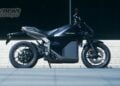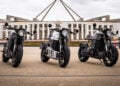


Beachman brings the electric classic movement to two wheels
Converting classic cars to electric power has evolved from a fringe workshop curiosity into a substantial industry in its own right.
Everything from old Land Rovers and Jaguars to classic Porsches is now being rebuilt around batteries and electric motors, offering vintage styling with quiet operation, dependable starting and fewer oily mechanical dramas.
Whether those conversions represent preservation or sacrilege depends largely on who you ask, but there is no denying they have become a genuine movement within the classic-car scene.
Cars do, however, give conversion specialists a considerable head start. There is space beneath the bonnet, under the floor, through the transmission tunnel, and inside the luggage area for distributing battery modules and associated electrical hardware.
The additional weight still needs to be managed, but there is generally more freedom to move that mass around the vehicle and compensate with revised suspension rates.
A motorcycle is much less forgiving.
There is nowhere to hide a large battery, and even relatively small changes in total mass or its location can have a major effect on steering response, braking behaviour, suspension performance and overall chassis balance.
That makes Beachman Bikes’ latest project particularly interesting.
The Canadian company has launched a new Special Vehicles Division with a fully electric conversion of a 1974 Honda CB500 Four, rebuilding the motorcycle from the frame up rather than simply dropping a generic battery into the space once occupied by its engine.

Beachman’s engineers have attempted to install a meaningful electric powertrain into a steel motorcycle frame designed more than 50 years ago to carry an air-cooled four-cylinder engine, carburettors, gearbox and exhaust system. In packaging terms, that may be an even trickier assignment.

Saving a damaged Honda rather than sacrificing a survivor
The donor CB500 was reportedly approaching the end of its useful life when it arrived at Beachman, with both the engine and clutch having failed.
That makes the project considerably easier to defend from a preservation standpoint than stripping the functioning engine from a healthy and original CB500 Four.
Beachman says its Special Vehicles Division is not interested in destroying viable classics merely to create electric showpieces.
“If someone brings us a classic bike that rides great, we won’t touch it,” said Beachman COO and Special Vehicles head Steve Payne.
Instead, the division is intended to accept made-to-order commissions involving motorcycles that might otherwise be abandoned, dismantled or sent to the scrap heap.
The CB500 was completely restored before its frame was digitally scanned to establish how much battery capacity could be accommodated without destroying the original Honda’s silhouette.
Beachman then commissioned a bespoke lithium-ion battery pack tailored to the available space inside the frame.
The company says the pack was produced by the same battery supplier that produces its production-grade UL-certified batteries, although it has not stated whether the complete one-off CB500 pack carries a separate certification.
A nominal 14.4 kWh battery
Beachman describes the pack as having a capacity of 200 amp-hours and operating at 72 volts. Multiplying those figures gives a nominal energy capacity of 14.4 kWh, although the company has not revealed how much of that capacity is available to the rider.
That is a substantial amount of stored energy for a converted motorcycle and roughly twice the nominal 7.2 kWh capacity quoted for the purpose-built Stark VARG.
Beachman has not disclosed the motor’s maximum or continuous output, torque figure, controller rating or peak current draw.

The difficult matter of weight and balance
The original Honda CB500 Four was valued in part for offering much of the refinement and styling of the larger CB750 in a lighter, more manageable package.
Changing that age-old recipe by mounting a large battery too high could make the bike reluctant to change direction. Too much mass concentrated at the rear could compromise front-end feel, while a substantial overall weight increase would affect braking, suspension control and low-speed manoeuvrability.
Beachman says the battery was designed to maintain suitable ride weight and balance, but has not published the finished kerb weight or front-to-rear weight distribution.
Without those figures, or preferably a proper road test, it is impossible to know whether the electric CB500 preserves the approachable nature of the Honda or merely preserves its silhouette to some extent.
Classic outside, extensively changed underneath
Beachman has worked to maintain the recognisable proportions of the original CB500, retaining the fuel tank, steel frame and traditional café-racer stance.
The battery enclosure has been positioned where the engine once sat, while the electric motor is mounted lower in the chassis and drives the rear wheel by chain.
The original fuel tank no longer carries petrol but remains an important part of the motorcycle’s appearance. A vintage-inspired charging connection has also been incorporated to avoid an obviously modern socket disrupting the period presentation.
The finished machine successfully passed Ontario’s DriveON safety inspection and was registered for road use before being delivered to its owner.
That is an important achievement for a heavily modified one-off motorcycle, although it should not be confused with the full homologation and type-approval process required to manufacture and sell a new motorcycle model in volume.
Plenty of questions remain unanswered
Beachman describes the CB500 as genuinely highway-capable, rather than a short-range urban conversion, but has not supplied the figures needed to assess that claim in detail.
There is no stated maximum speed, tested highway range, motor output, charging power or full-charge time.
The company has also not revealed the finished weight, usable battery capacity, regenerative braking strategy, or the extent of any suspension and brake upgrades.
Beachman does say the custom battery design could be reproduced for future CB500 projects, suggesting that this first commission may serve as the basis for additional conversions rather than remaining a complete one-off.
Preservation, reinvention or something in between?
An electric CB500 Four will inevitably divide opinion.
The Honda’s air-cooled four-cylinder engine, four carburettors, five-speed gearbox and distinctive exhaust note were central to its appeal. Removing those elements creates a fundamentally different motorcycle, regardless of how faithfully the original styling is retained.
On the other hand, this particular machine reportedly arrived with a failed engine and clutch and might otherwise have been dismantled or discarded.
What remains to be demonstrated is whether all that effort has produced a genuinely satisfying motorcycle…