

How Brembo is rethinking MotoGP brakes for the 850 cc era
Brembo is removing weight and cooling fins from its next MotoGP caliper, despite Marc Marquez reporting harder braking on the coming 850 cc machinery. The distinction is between the total energy the brakes must absorb and the intensity of each application.
During our visit to Brembo, Performance Motorcycle Market Manager Andrea Pellegrini explained how the new GP4 caliper saves weight while retaining familiar piston dimensions. Brembo’s launch figures put the saving at 75 grams per caliper, with stiffness increased by approximately five per cent. Brembo expects lower thermal demand, but the final requirements will depend on the new motorcycles and tyres.

Less energy, but how much less?
Under the 2027 MotoGP regulations, engine capacity falls from 1000 to 850 cc, aerodynamics are restricted, and ride-height and holeshot devices are banned. Pirelli also replaces Michelin as the premier class tyre supplier.
Brembo’s early, confidential data from Misano and Brno supported its expectation of reduced brake energy. Pellegrini stressed, however, that the information remained limited and the tyre specification was still evolving.
Andrea Pellegrini
“For sure, the energy will be less,” Pellegrini said. “But how much, I don’t know now.”
Kinetic energy increases with the square of speed, so a relatively small reduction in braking entry speed can significantly reduce the energy that must be dissipated. The amount shed depends on both entry and exit speeds, while aerodynamic drag and engine braking determine how much of that work falls to the brakes.
Pellegrini expects a clearer reduction in top speed at circuits with long straights, such as Mugello, Barcelona and Qatar. At Jerez or Assen, where maximum engine power is less decisive, the difference may be smaller. Braking demand will not fall by the same percentage everywhere.
Why Marquez can still talk about harder braking
In his interview with MCNews, Marquez described shorter braking zones on the 2027 prototype, while observing that “the way we brake is harder”. He also said riders could use more of the smaller engine’s available torque where the current 1000 cc machine cannot.
A shorter, harder application can produce high peak hydraulic pressure while dissipating less energy overall. Lower total energy therefore does not automatically mean lower peak demand.
Cooling time also matters. Several heavy braking zones close together allow less recovery than comparable stops separated by longer stretches of track. Brembo must account for that repeated heating and cooling throughout a race.

The tyre still sets the limit
Usable braking force depends on grip and stability. Aerodynamics influence tyre loading, while the bike’s ride height and attitude affect weight transfer and rear-wheel lift. The 2027 rules change that combination as teams also adapt to Pirelli.
Pellegrini highlighted the effect of reduced load at the front contact patch.
Andrea Pellegrini
“You don’t have a lot of load on the tyre, so you have more locking of the tyre,” he explained. “You have to release the brakes for this reason.”
He expects earlier braking points in some situations. Riders might initially apply the brake firmly, then have to ease pressure sooner as the front approaches its grip limit. The outcome will depend on the corner, tyre, chassis and aerodynamics.
That makes the final Pirelli specification important to Brembo: it influences usable brake pressure, deceleration, time on the brakes and the feedback riders use to judge the limit.

Where Brembo has saved weight
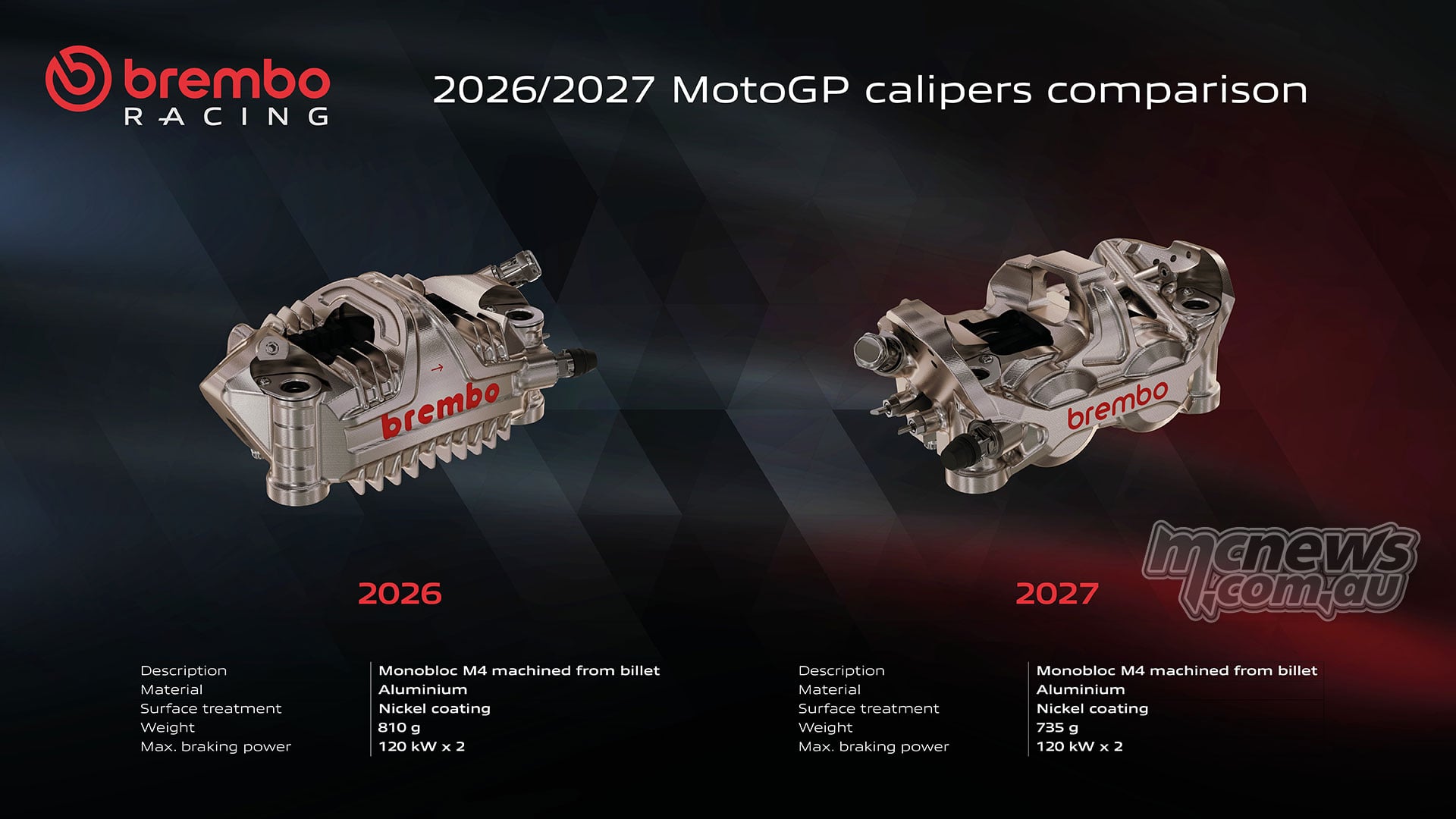
Brembo’s comparison figures put the new GP4 at 735 grams, down from 810 grams for the current caliper. That is a saving of 75 grams per caliper, or 150 grams across the front pair, and a weight reduction of approximately 9.3 per cent.
The new caliper body retains material where it contributes most to strength and stiffness, and removes it elsewhere. A central backbone forms the core of the revised structure. The prominent cooling fins have also gone, reflecting the expected reduction in thermal demand.
The openings have a dual purpose: removing weight and promoting ventilation. Cooling remains part of the design, with the body’s shape, holes and machining features helping it manage heat.
As part of the unsprung assembly, the calipers move with the wheel over bumps, so reducing their weight reduces the mass the suspension must control. They do not rotate, however, so the effect differs from removing weight from a disc or wheel rim.
Brembo claims the new GP4 is also approximately five per cent stiffer. The body must withstand the loads generated as hydraulic pressure clamps the pads against the disc. Excessive flex would alter the relationship between lever movement and pad force.
Both generations are machined from aluminium billet and use a nickel coating. Brembo’s comparison also lists the same maximum braking-power figure for each generation: 120 kW x 2.
Keeping a familiar feel
Brembo has retained the piston diameters. With the same master cylinder, this preserves the hydraulic ratio and gives riders a familiar starting point for lever effort, fluid displacement and clamping force. Stiffness, temperature and pad behaviour will still affect overall feel.
The new caliper retains the existing hydraulic architecture, accepts the current pads and discs, and is interchangeable at the mounting points. It also retains Brembo’s booster and anti-drag concepts, allowing teams to assess it without changing the entire brake package.
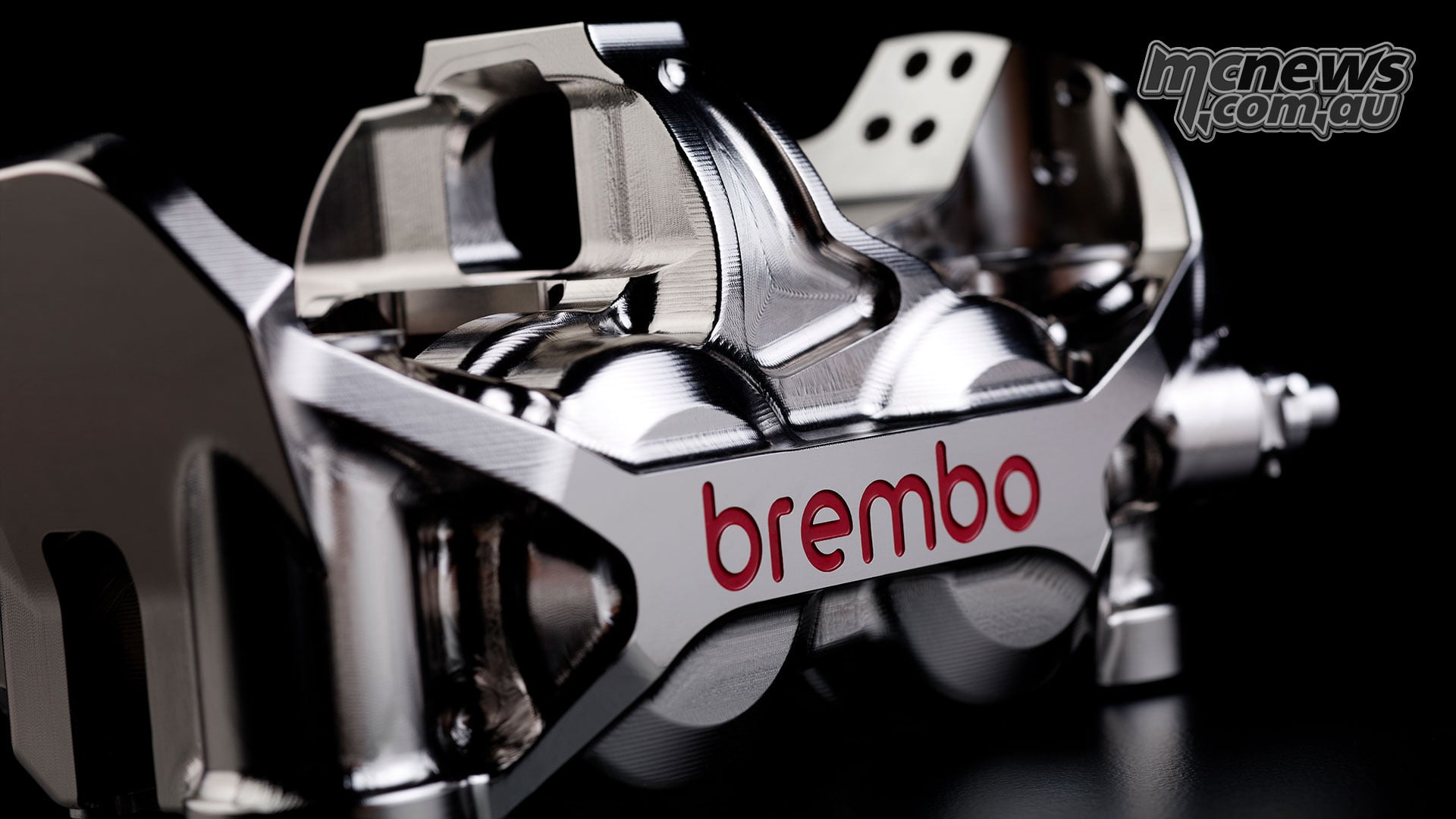
The booster uses inclined pad guides to convert some of the force from the rotating disc acting on the pads into additional clamping force. This produces more braking torque for a given hydraulic input.
The anti-drag mechanism helps retract the pads when the lever is released, reducing unwanted disc contact. Pellegrini also said the valve he described as an anti-shaking valve had moved from the caliper to the master cylinder.
Disc choice will evolve with the motorcycles
Brembo’s MotoGP carbon-disc range includes 340 and 355 mm options, with different masses and cooling configurations. Diameter influences braking leverage, while mass and construction affect heat absorption and cooling. The choice depends on the circuit, conditions and motorcycle performance.

Pellegrini suggested that the thinner 355 mm configuration might be unnecessary initially, but could become useful in 2028 as manufacturers recover performance. The lighter caliper is a starting point; the wider brake package will continue to evolve with the bikes.
Brembo’s new caliper is just one of countless pieces in MotoGP’s 850 cc puzzle. Smaller engines, reduced aerodynamics, Pirelli tyres and the removal of ride-height devices all have to work together. We are still waiting to see who puts those pieces together best, but we will get our first answers when the manufacturers reveal how complete their respective puzzles are at the season opener in Thailand, on 5–7 March 2027.