


From molten aluminium to superbike
Inside BMW’s frame manufacturing process
A motorcycle frame might appear to be a relatively straightforward piece of engineering. It holds the engine, provides mounting points for the suspension and connects the steering head to the swingarm pivot.
But beneath that apparently simple job lies an extraordinarily complicated balancing act.
A good motorcycle frame needs to be stiff, but not too stiff. It needs to resist some forces while deliberately yielding to others. It must be light without sacrificing strength, maintain its geometry under enormous loads, and deliver useful feedback to the rider through the handlebars, seat and footpegs.
And whatever characteristics the engineers achieve during development must be reproduced consistently on a production line.
BMW Motorrad has offered an unusually detailed look at how all this comes together, using its third-generation M Motorsport frame for the 2027 M 1000 RR as an example.
We covered the announcement of that frame back in July, but BMW’s latest technical information goes considerably further, taking us from digital modelling and chassis development through aluminium casting, welding, machining and quality control.
It provides a fascinating insight into just how sophisticated modern motorcycle frame design and construction have become.
Why the stiffest frame isn’t necessarily the best
At one point, increasing chassis stiffness was often presented as an unqualified improvement.
A stronger, more rigid frame was associated with better handling, greater steering precision and improved stability.
And there is good reason for that thinking. A motorcycle frame must resist substantial forces generated by braking, acceleration and cornering while maintaining a predictable relationship between the steering head and swingarm pivot.
Allow too much movement in the wrong places, and the motorcycle can become vague, unstable or reluctant to follow the rider’s intended line.
But rigidity is only part of the equation.
The frame is not an isolated structure. Its behaviour interacts with the forks, swingarm, suspension linkages, wheels, tyres, and the mounting points that connect everything.
Each of those components has some degree of flexibility, and their combined behaviour determines how effectively the motorcycle responds to road loads.
Engineers are increasingly concerned not simply with how much the frame flexes, but precisely where it flexes, in which direction, and how much force it takes to produce that movement.
The answer differs for a road-going adventure bike, a lightweight sports motorcycle, and a superbike expected to perform at extreme lean angles on racing slicks.
A motorcycle needs compliance when leaned over
Consider what happens when a motorcycle encounters a bump.
When the machine is travelling approximately upright, its suspension is well positioned to absorb much of the disturbance. The forks and rear suspension move through their designed travel, letting the wheels follow irregularities while controlling the motorcycle’s movement.
Now imagine the same motorcycle leaned over at 55 or 60 degrees.
The relationship between the road surface and the motorcycle’s suspension axes has changed considerably.
A disturbance that was primarily aligned with suspension movement when upright now has a substantial component acting laterally across the leaned-over motorcycle.
The suspension still performs an important role, but it cannot accommodate those forces in exactly the same manner.
Some of the movement must be taken up through the flexibility of the tyres, wheels, forks, swingarm and frame.
This is why carefully engineered lateral compliance can be valuable.
By allowing a controlled amount of movement, those components can help the tyres maintain contact with the surface instead of transmitting every disturbance directly through the chassis.
Excessive flexibility can introduce its own handling problems, including unwanted steering responses, imprecise feedback and oscillation.
Rather, the objective is to provide just enough compliance in the appropriate direction without compromising the structural stability required everywhere else.
BMW says its latest M Motorsport frame is designed around exactly this distinction.
At significant lean angles, it allows a defined degree of lateral flex to supplement the suspension in absorbing road-surface disturbances.
Longitudinally, meanwhile, BMW says the structure retains a high degree of stiffness to transmit braking and acceleration forces accurately.
The company claims the result is more consistent tyre contact, clearer rider feedback and more even tyre wear.
Those benefits remain manufacturer claims rather than independently demonstrated improvements, but the engineering principles behind them are well established.
Taking weight out without losing what matters
BMW’s third-generation M Motorsport frame is approximately 1.3 kilograms lighter than its predecessor.
That is a substantial reduction for an individual chassis component on an already highly developed superbike.
Reducing mass contributes to the overall effort required to change the motorcycle’s direction, although the effect depends on where that mass is removed.
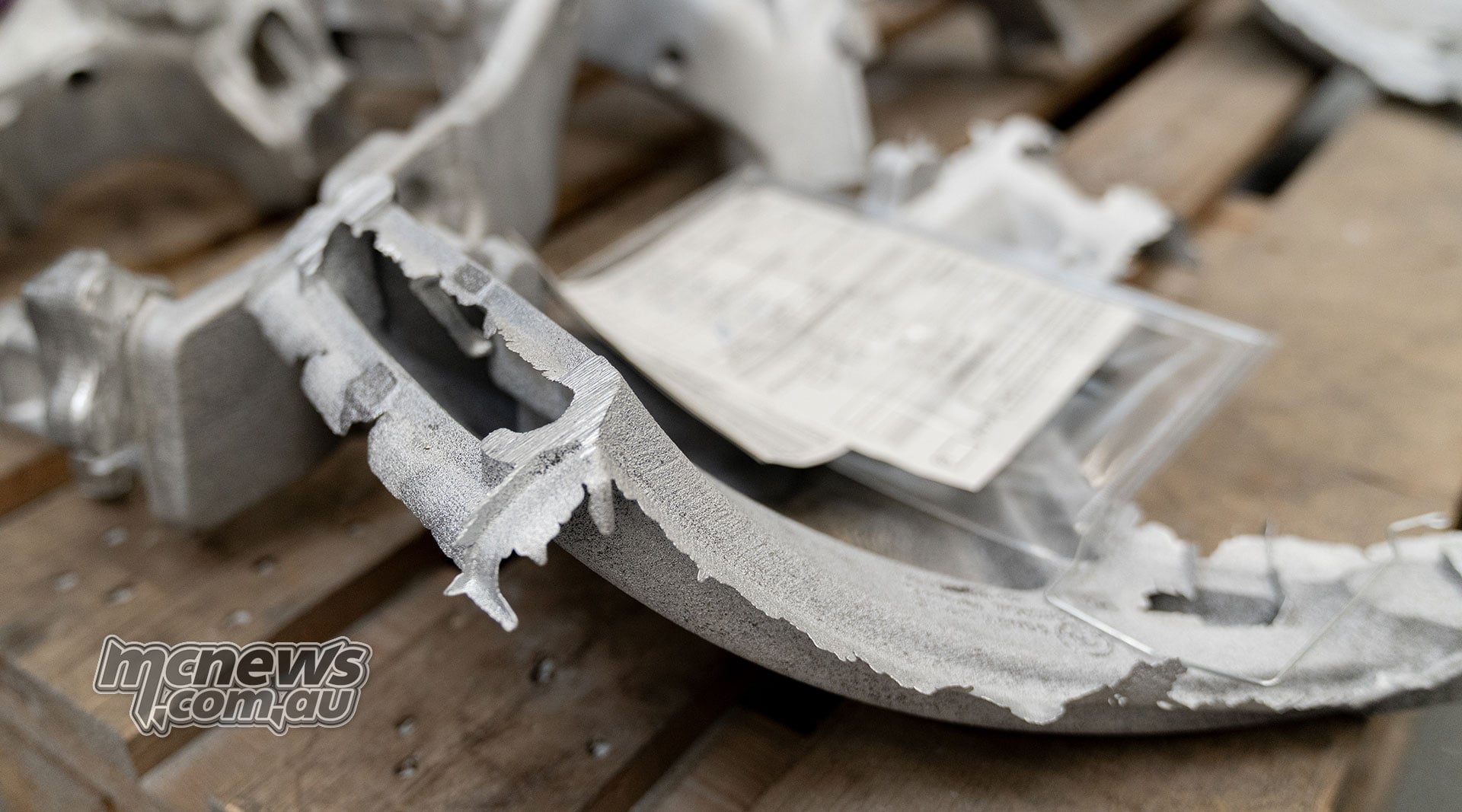
The manufacturer says wall thicknesses have been reduced by as much as 30 per cent, allowing engineers to alter the frame’s stiffness and flexibility characteristics.
That does not mean the entire frame is 30 per cent thinner, nor does it mean the resulting structure is uniformly less rigid. Instead, the distribution of material can be varied to suit the loads experienced by different areas.
Regions subjected to substantial stresses require sufficient material and the correct geometry to withstand them, while other regions can be made thinner to save weight or provide controlled compliance.
The most efficient frame is not necessarily the one with the least aluminium. It is the one that puts the necessary material in the right places and avoids carrying unnecessary material elsewhere.
Material selection is only part of the answer
Motorcycle manufacturers have adopted numerous approaches to frame construction over the decades.
Tubular steel structures, aluminium perimeter frames, cast sections, extruded beams and combinations of different construction techniques have all been employed successfully.
Each brings its own advantages and compromises.
Steel has a higher elastic modulus than aluminium, meaning it is intrinsically more resistant to elastic deformation for an equivalent shape and cross-section.
Aluminium, however, is substantially lighter, allowing engineers to use larger or more elaborate sections while keeping overall weight under control.
And the shape of those sections is enormously important. Changing a structural member’s dimensions, cross-sectional profile, or wall thickness can substantially alter its resistance to bending and twisting.
This is one reason an apparently simple comparison between steel and aluminium frames tells us relatively little about how the finished motorcycle will handle. The complete structural design matters far more than the material label.
BMW’s latest approach relies on complex aluminium castings that let engineers vary both the shape and thickness of the structure in ways that would be difficult to achieve with conventional straight extrusions or simple fabricated sections.
This approach offers considerable freedom, but it also creates substantial manufacturing challenges.
From computer simulation to real-world testing
The development process begins at BMW Motorrad’s engineering facilities in Munich.
Here, engineers develop the frame geometry, material distribution, and desired stiffness characteristics digitally.
Computer modelling allows engineers to investigate how a proposed structure is likely to respond under different loading conditions.
They can examine the behaviour of individual sections, assess the effect of changing wall thicknesses and explore alternative geometries before committing to physical manufacturing.
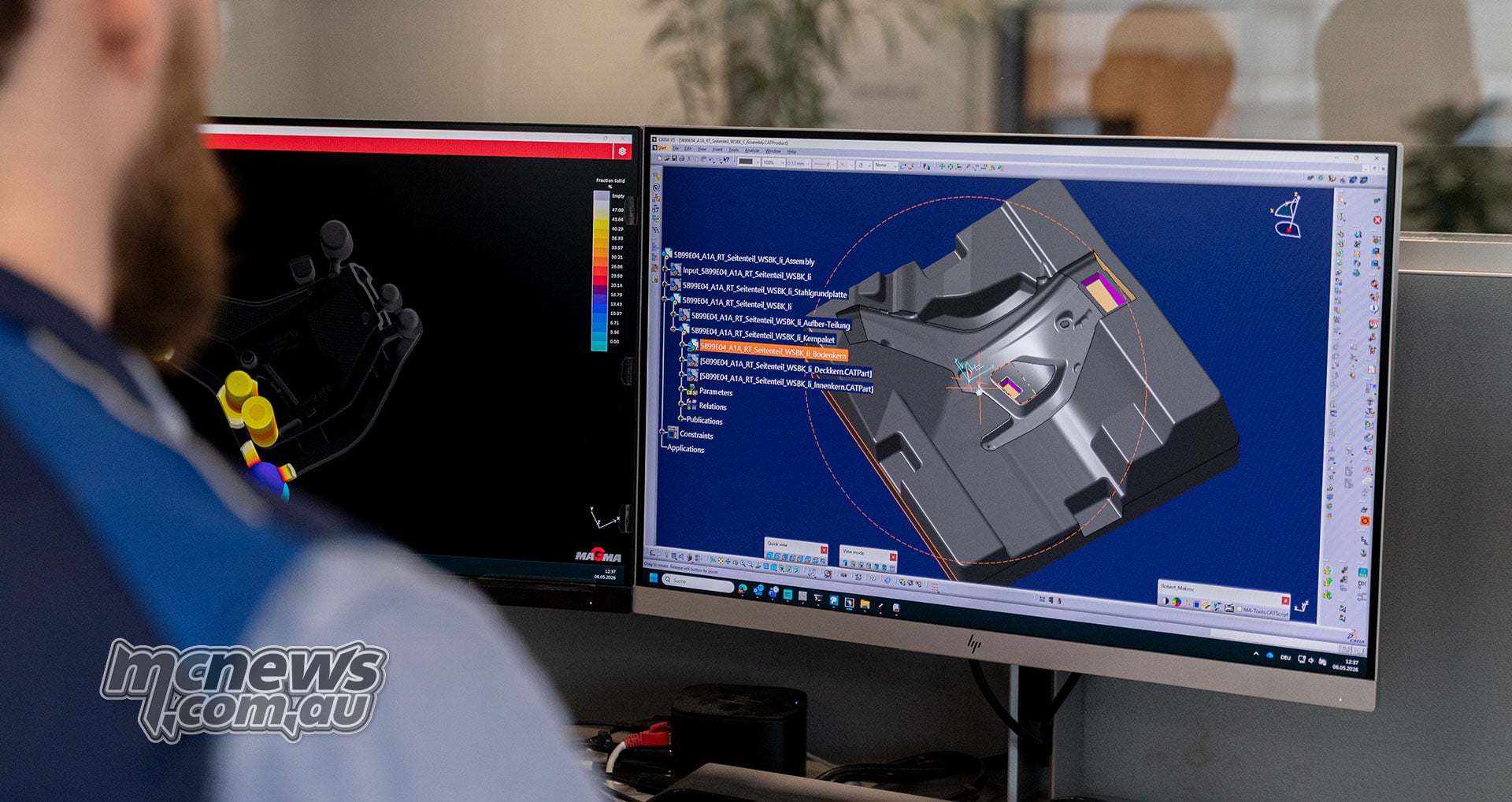
But simulation is not the end of the process. BMW says its designs are subsequently validated using test rigs and actual riding tests. That combination is important because a chassis can meet prescribed structural targets without necessarily delivering the feel or responses a rider wants.
Rider feedback also brings another dimension to the development process. The way a motorcycle responds to a bump near maximum lean, the confidence it inspires while turning towards an apex, and the information transmitted through the contact points are not always easily reduced to a single engineering measurement.
Nor can frame behaviour be considered independently of tyre construction, suspension setup and the characteristics of the motorcycle as a whole.
For BMW, development feedback also comes from its international racing activities, including factory teams and customer racing programmes. That provides experience across different circuits, riders and operating conditions rather than relying exclusively on one testing environment.
Four castings form the heart of the structure
Once the frame design has been finalised, manufacturing moves to BMW Group Plant Landshut.
The new M Motorsport frame is constructed from four principal aluminium castings: the steering-head section, left and right side sections, and a rear section.
Producing these components as castings provides considerable design freedom.
Complex external shapes, internal cavities and changes in section thickness can be incorporated into the components during manufacture.
That flexibility is particularly useful when engineers are attempting to manage stiffness and mass simultaneously.
However, producing a relatively thick, solid aluminium casting is one thing. Manufacturing a highly stressed, thin-walled structural component with intricate internal cavities is quite another.
Small variations in material quality, wall thickness or internal defects can become significant when so much effort has gone into eliminating unnecessary mass.
This is where BMW’s manufacturing methods become particularly interesting.
Why BMW uses low-pressure aluminium casting
At Landshut, BMW employs a low-pressure casting process.
Rather than simply pouring molten aluminium into a mould and relying on gravity to fill every cavity, the metal is introduced under controlled pressure.
This permits more carefully managed mould filling, reducing turbulence and the risk of entrapped air.
Both are important considerations when manufacturing aluminium components.
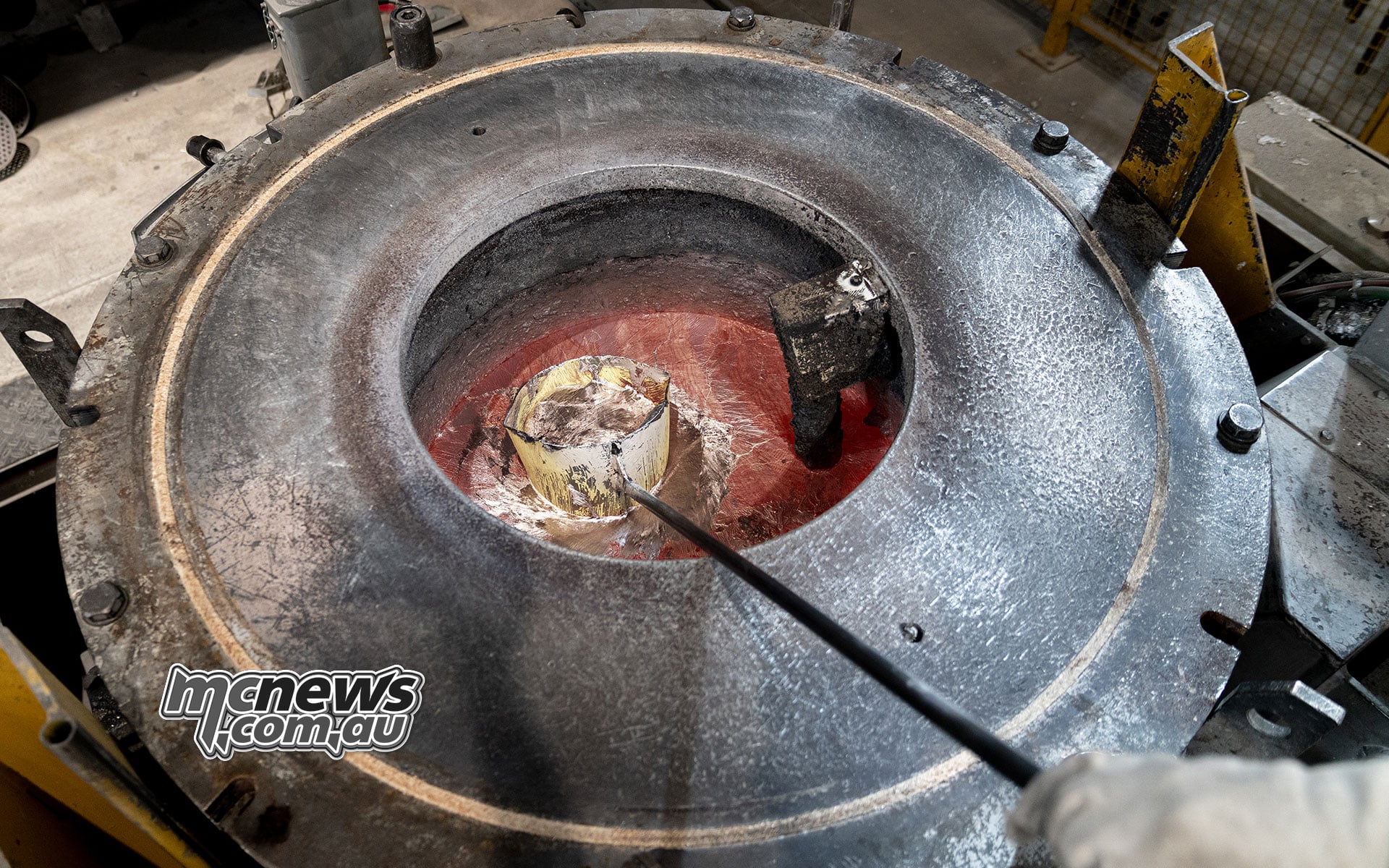
Unwanted gas inclusions and other internal casting defects can compromise material integrity, particularly in a structure that will experience repeated and substantial loading throughout its service life.
Low-pressure casting does not eliminate every potential defect, but it gives engineers greater control over the process.
That control becomes increasingly valuable as the castings become more complex and the walls thinner.
It also contributes to another requirement that is sometimes overlooked when discussing high-performance components: consistency.
Producing one satisfactory frame is not enough. A production process must be capable of making thousands of components to the required standard.
The complicated business of making hollow aluminium sections
Creating the frame’s internal cavities requires another manufacturing process.
BMW uses temporary cores made from quartz sand to form the hollow sections within the aluminium castings.
These cores occupy the spaces that must remain empty when molten aluminium fills the surrounding mould.
Once the metal has solidified, the sand cores can be removed, leaving the required internal geometry.
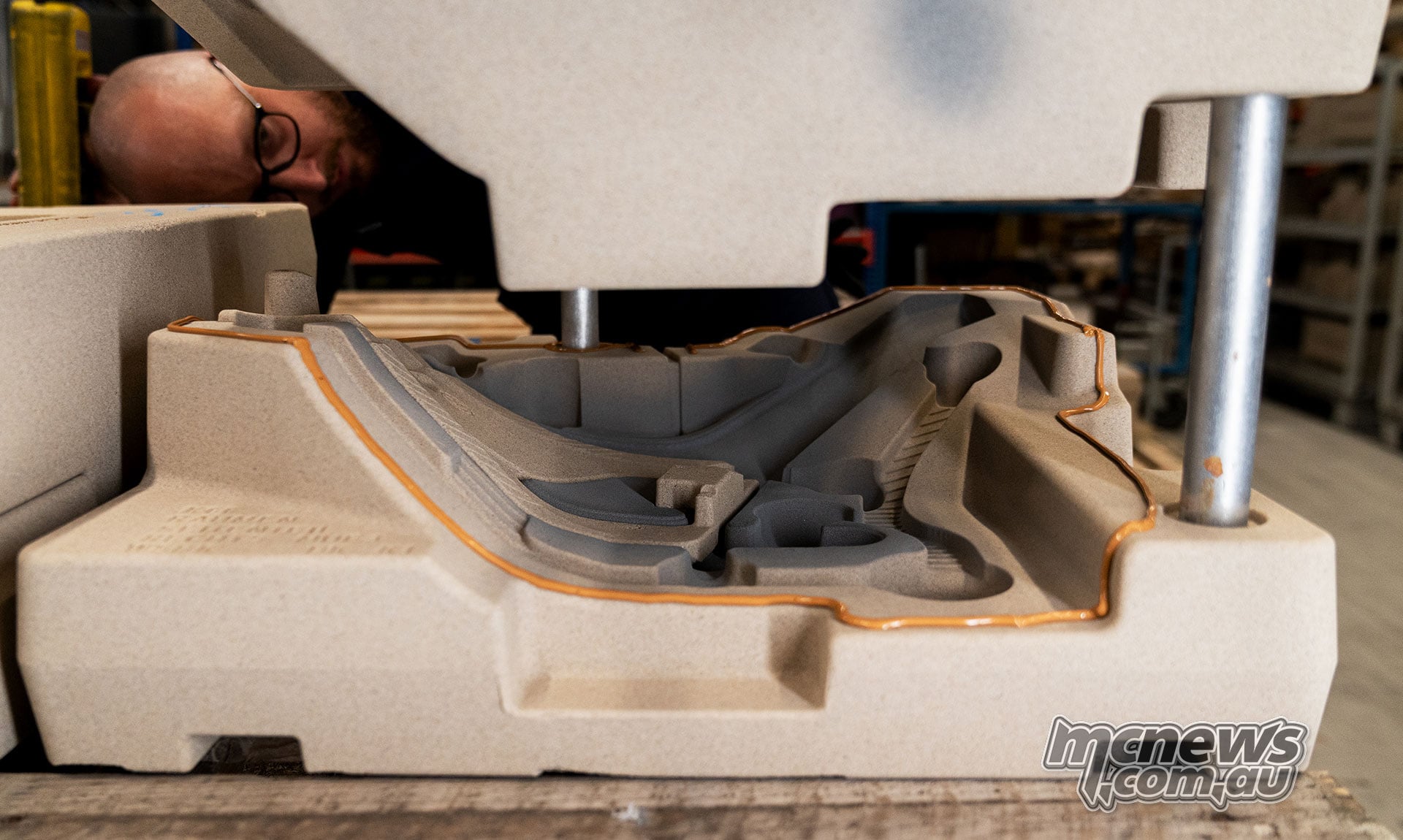
The principle sounds straightforward, but the preparation of the cores is a highly sophisticated operation in its own right.
BMW employs what is known as the cold-box process, in which shaped sand cores are chemically cured before being positioned within the casting mould.
Before the tooling is even manufactured, BMW digitally simulates the production of those cores.
The simulations examine how the sand-air mixture flows into the tooling, how densely the sand packs into the required shapes, and how the curing process develops.
Engineers use those results to determine the position of the sand-shooting nozzles and vents.
The objective is to produce cores that reproduce the intended geometry reliably, without poorly filled sections or other imperfections that could compromise the finished casting.
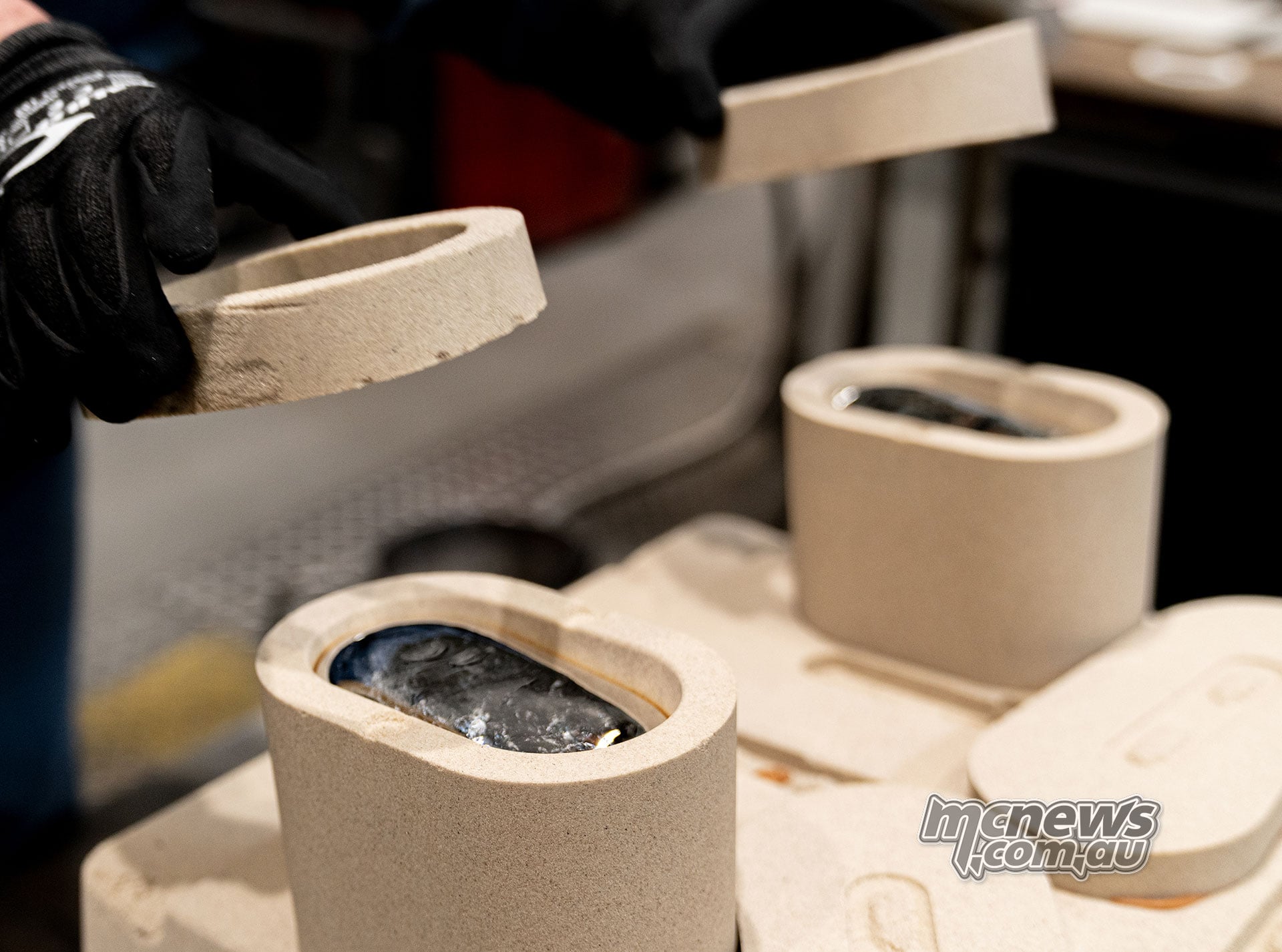
This is an interesting example of the development work that sits several stages removed from the actual motorcycle.
BMW is not merely simulating the frame. It is also simulating the process used to manufacture the temporary components that make the frame possible.
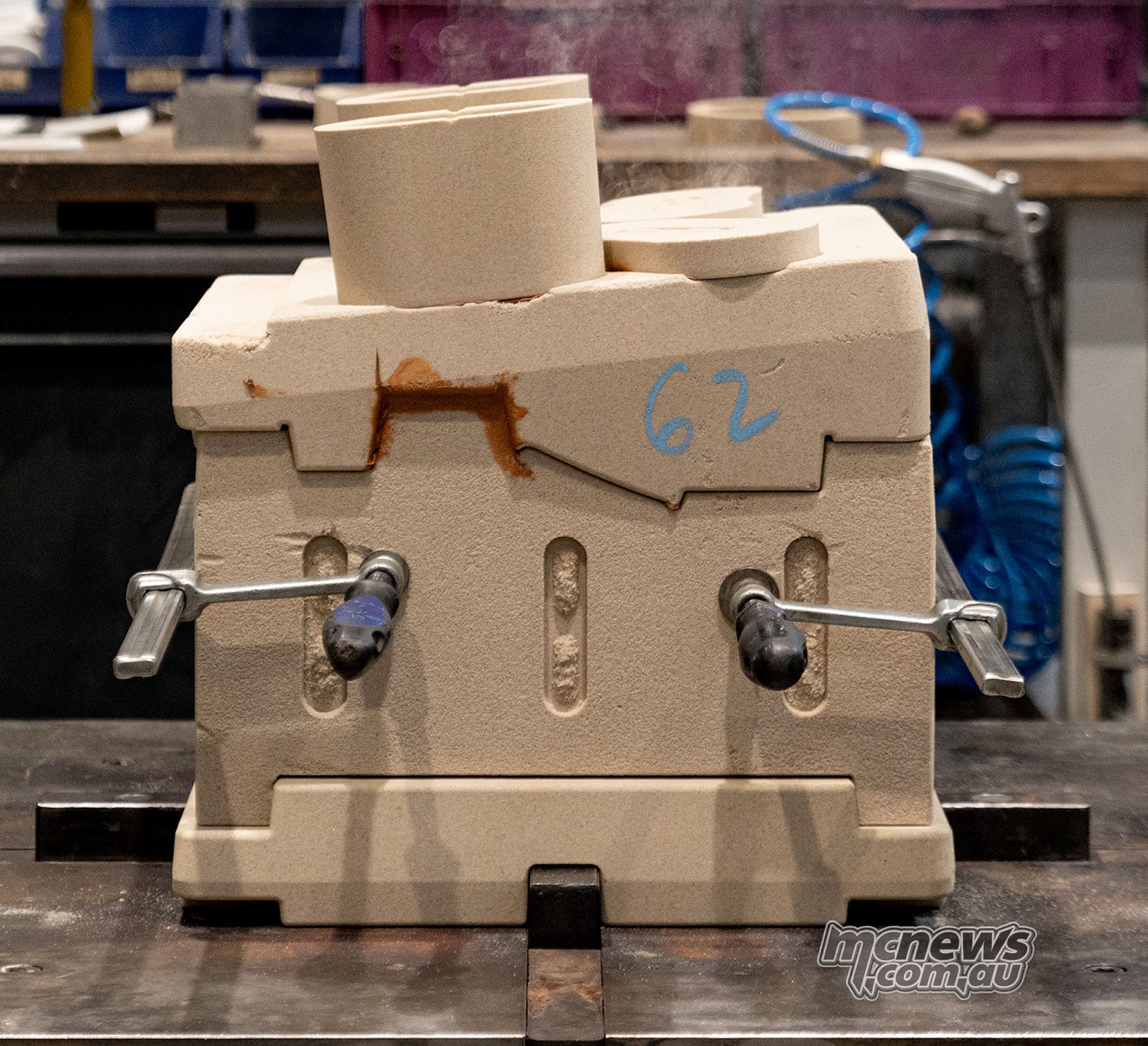
Once casting is complete, the sand cores must be removed from the solidified aluminium.
That leaves the complex internal cavities specified by the design and clears the component for its subsequent finishing and inspection processes.
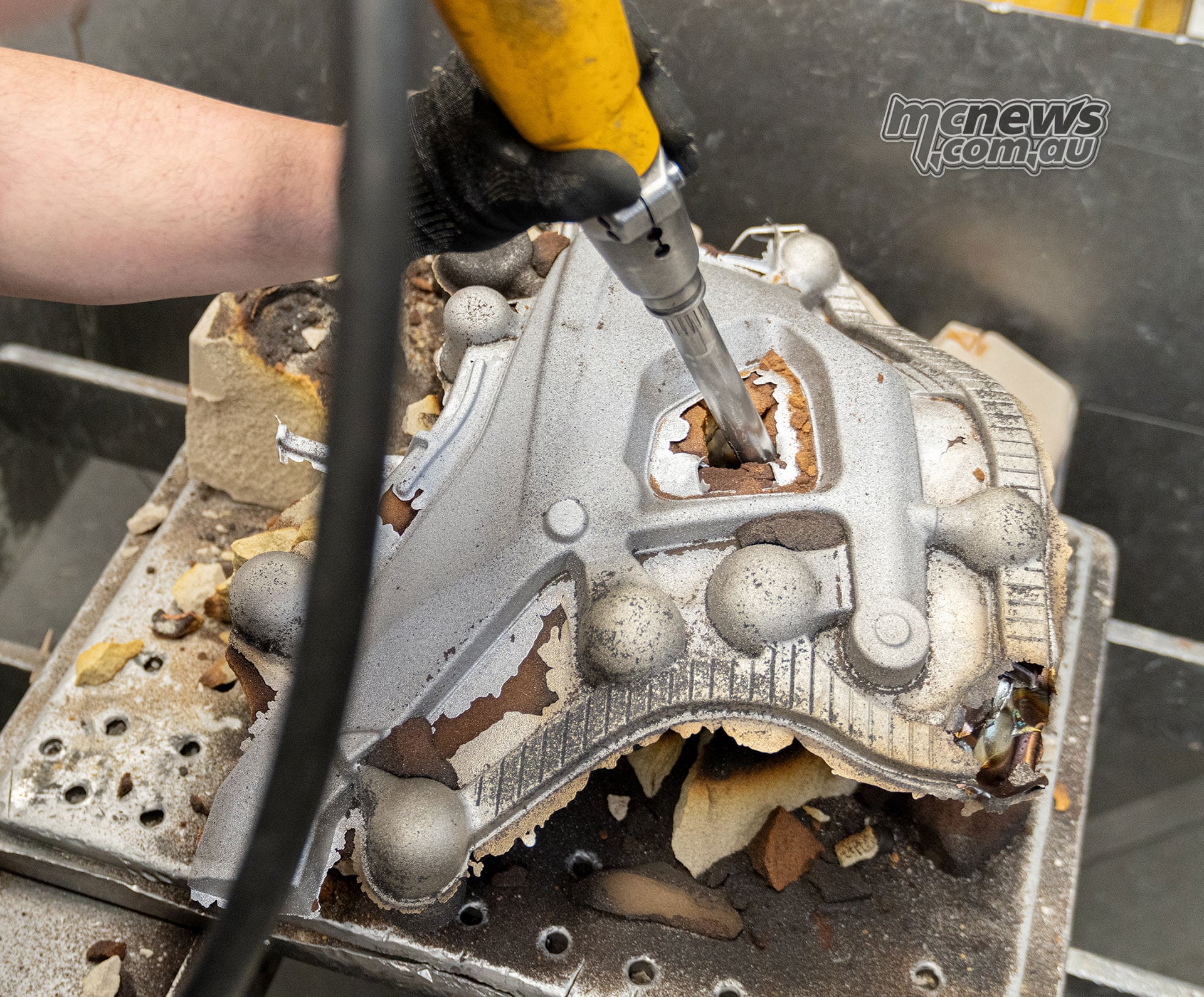
Checking what cannot be seen
Once the aluminium has solidified and the sand cores have been removed, the castings undergo further processing and inspection.
BMW uses X-ray examination to assess their internal quality. This allows defects that might not be apparent from an external visual inspection to be detected before the components progress further through production.
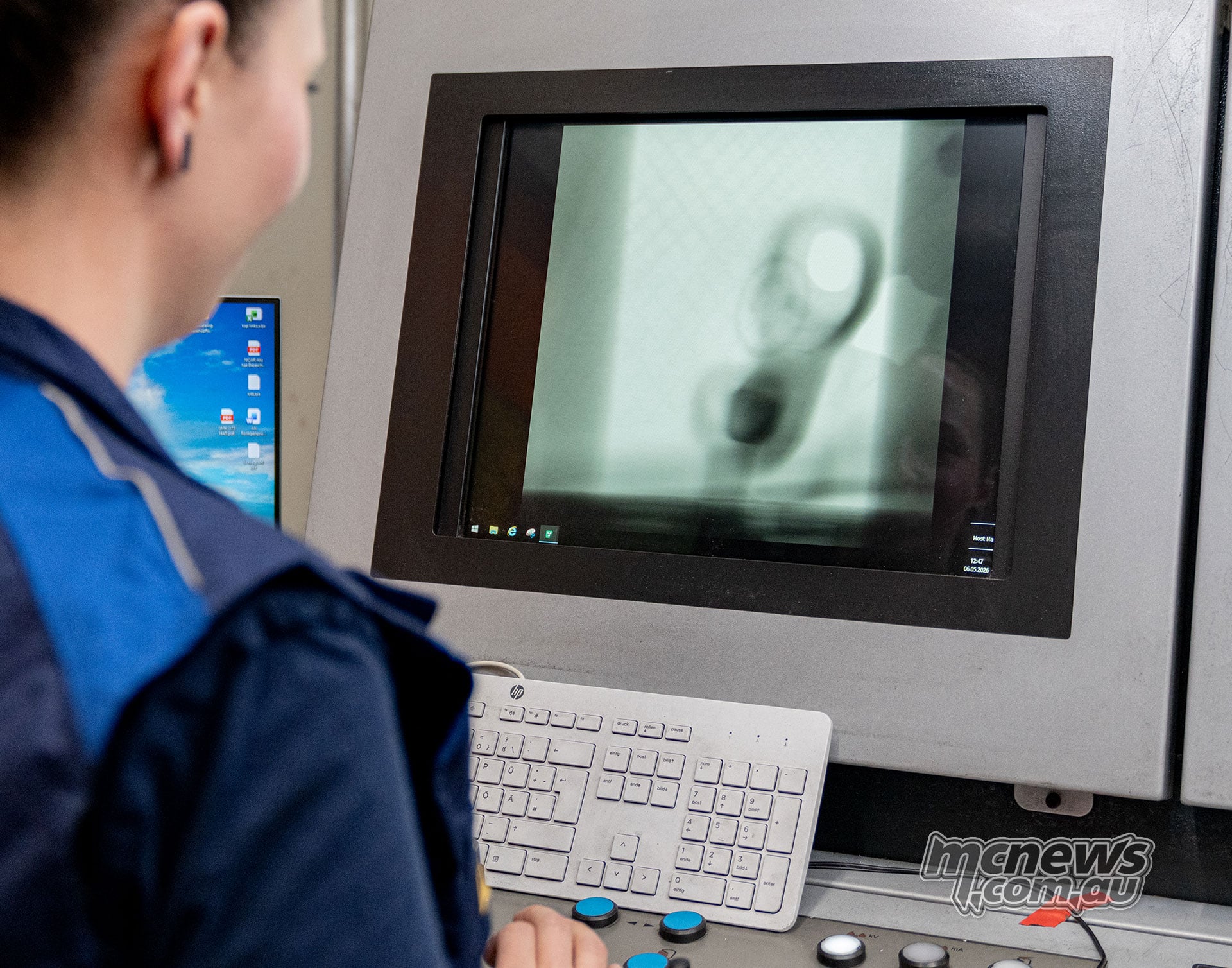
Machining operations refine the cast components and bring relevant surfaces closer to their required dimensions.
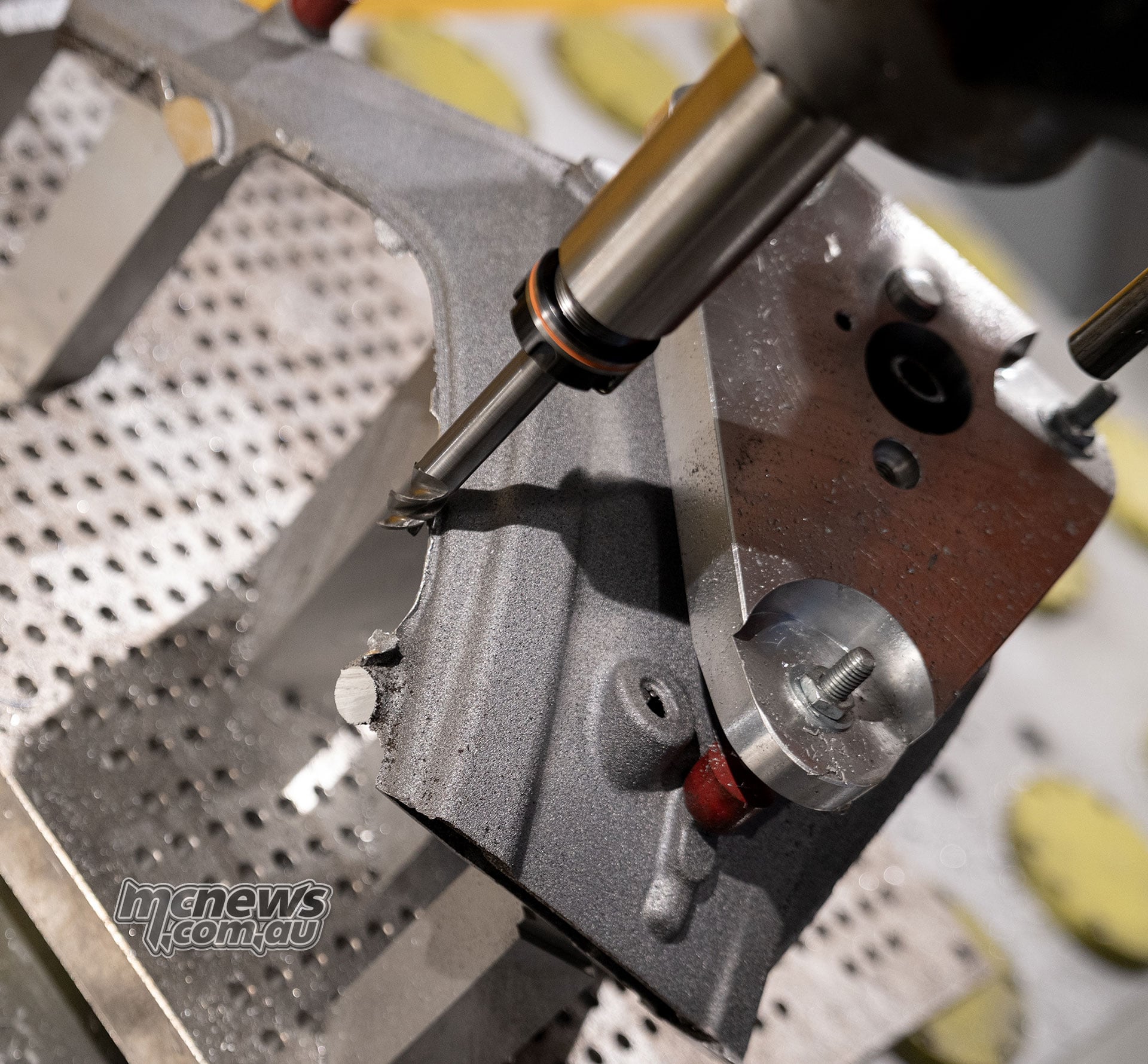
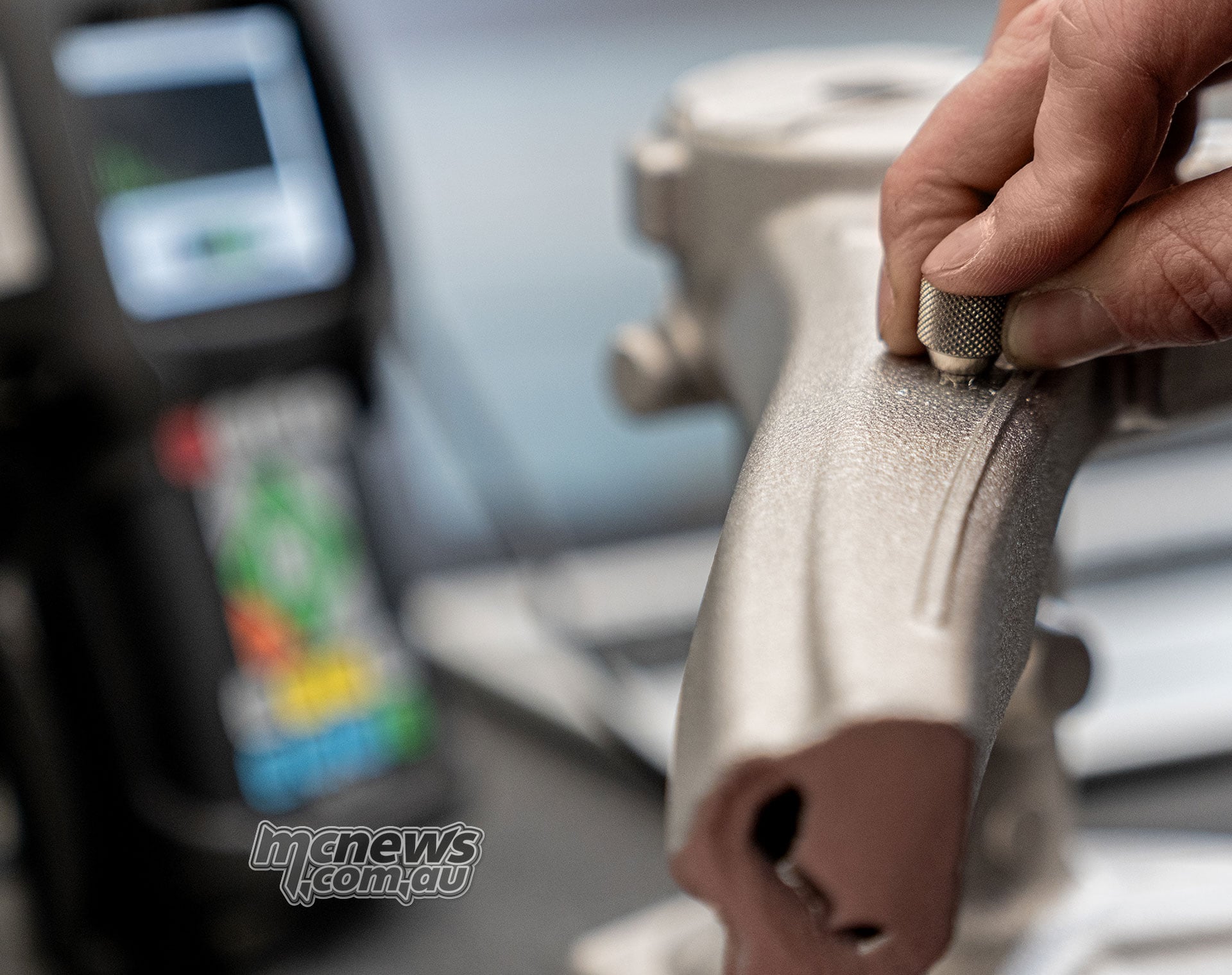
Wall-thickness measurements verify that the manufactured sections meet their specified dimensions. These measurements are especially important when the component’s structural characteristics depend on carefully controlled material thicknesses and geometry.
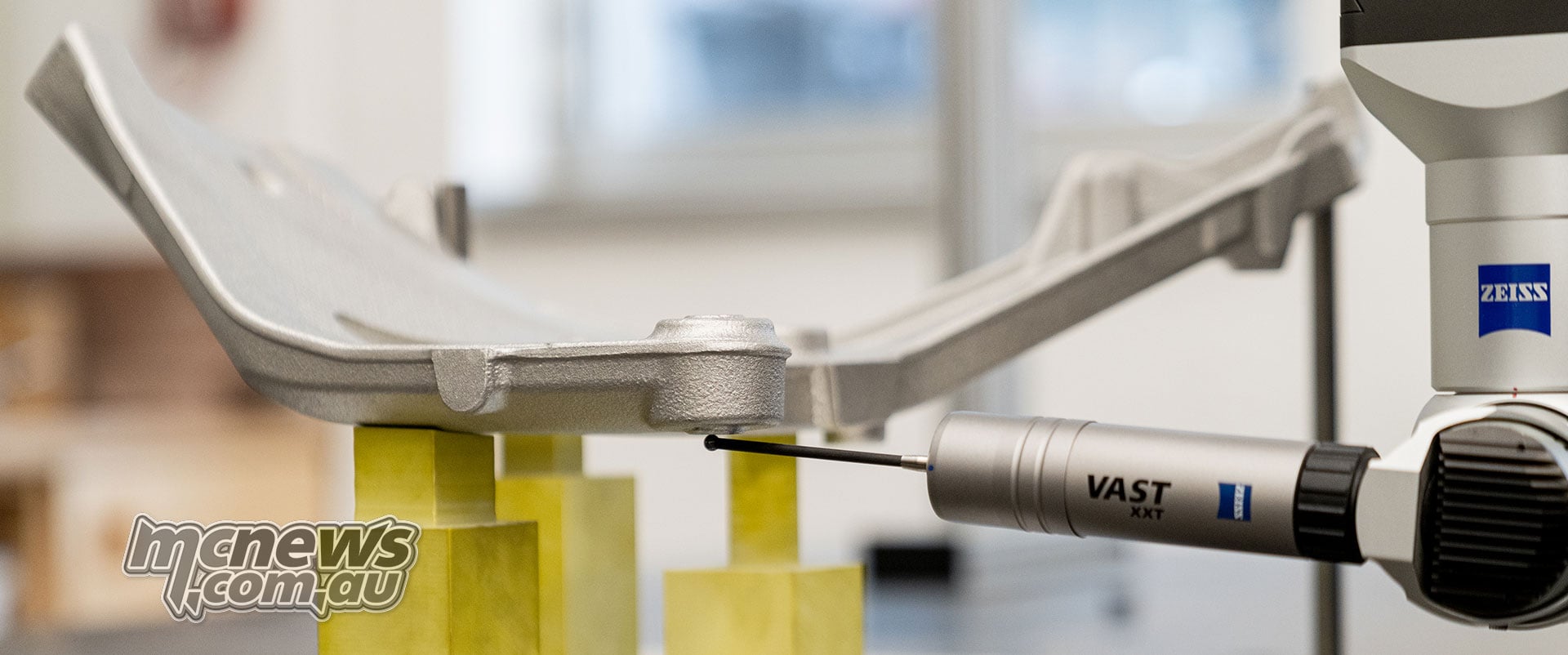
Coordinate measurements also check dimensional accuracy. A component that looks correct externally might still have an unacceptable internal defect, an improperly formed cavity or insufficient material in a critical area.
Welding the frame together in Berlin
From Landshut, the four cast components are transported to BMW Group Plant Berlin.
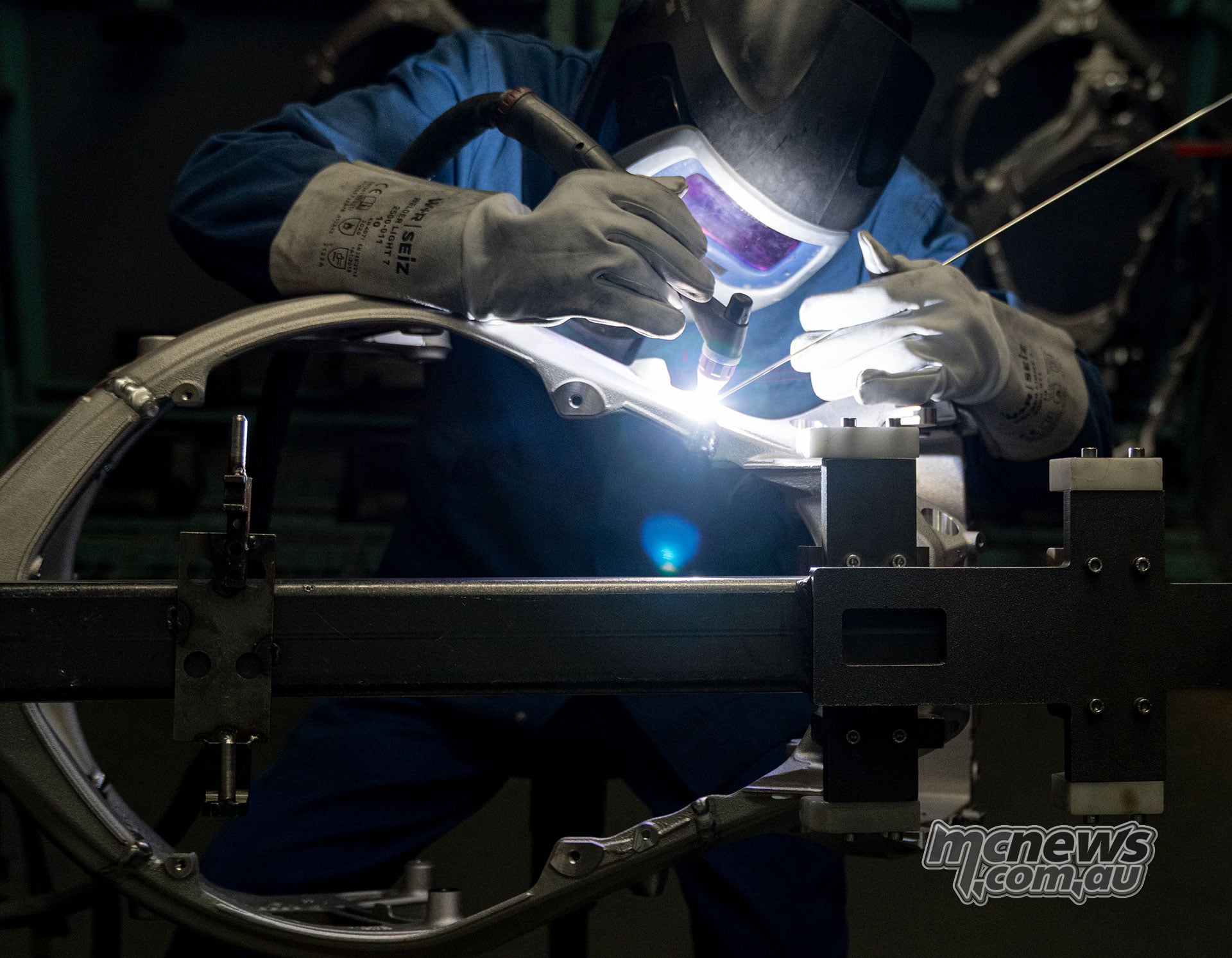
Here, workers precisely position and join the individual pieces using TIG welding. This is a critical stage of the manufacturing process. The individual castings may have been manufactured within tight tolerances, but they must still be assembled into a complete structure with the correct geometry.
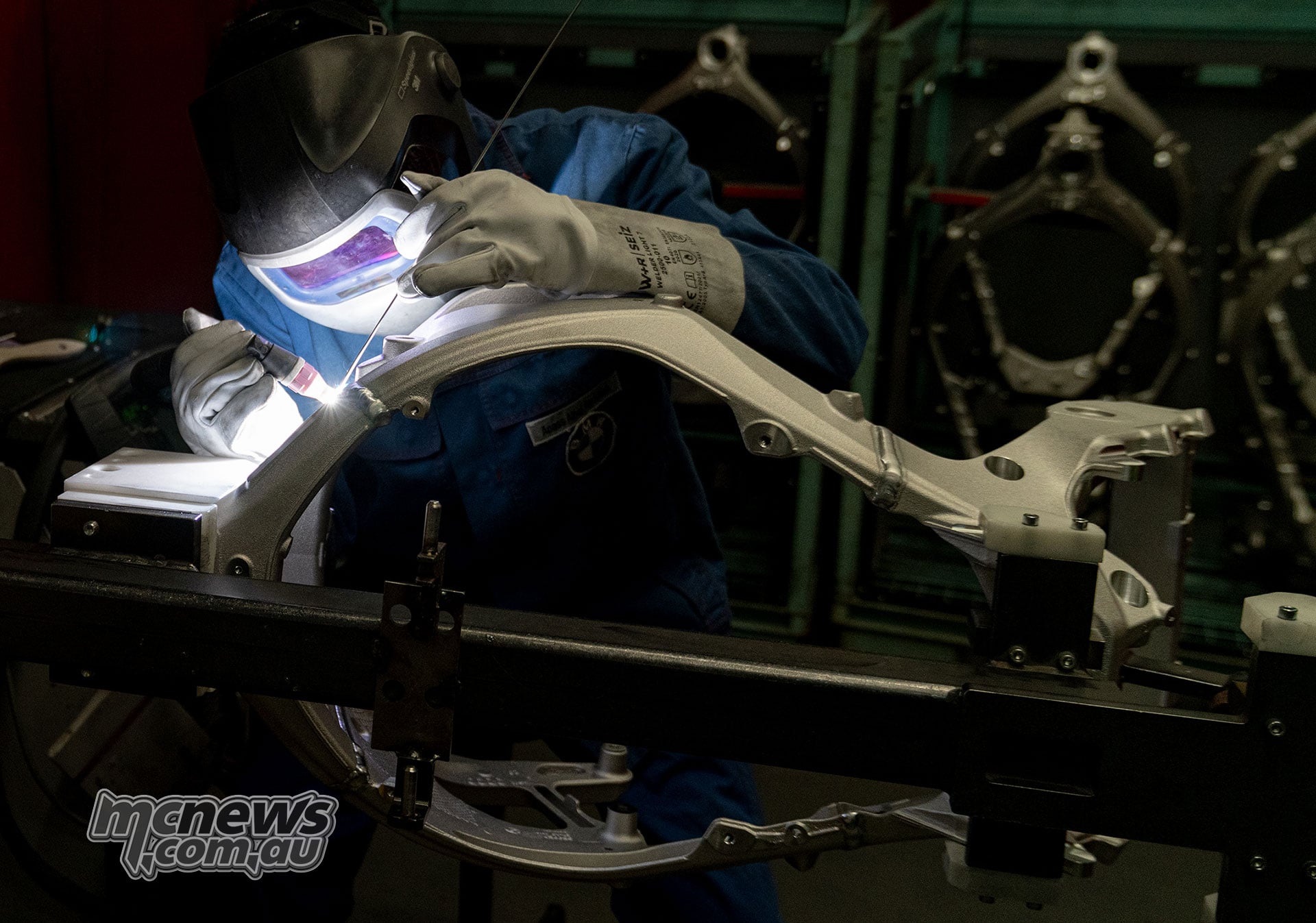
Welding introduces considerable localised heat, with the potential for thermal distortion as components expand and contract.
Maintaining the required relationship between the steering head, engine mounting points and swingarm pivot is essential to the motorcycle’s handling and alignment.
The welding process must therefore be controlled not only to produce sound joints but also to preserve the dimensional integrity of the completed assembly.
Corrosion protection reaches inside the frame
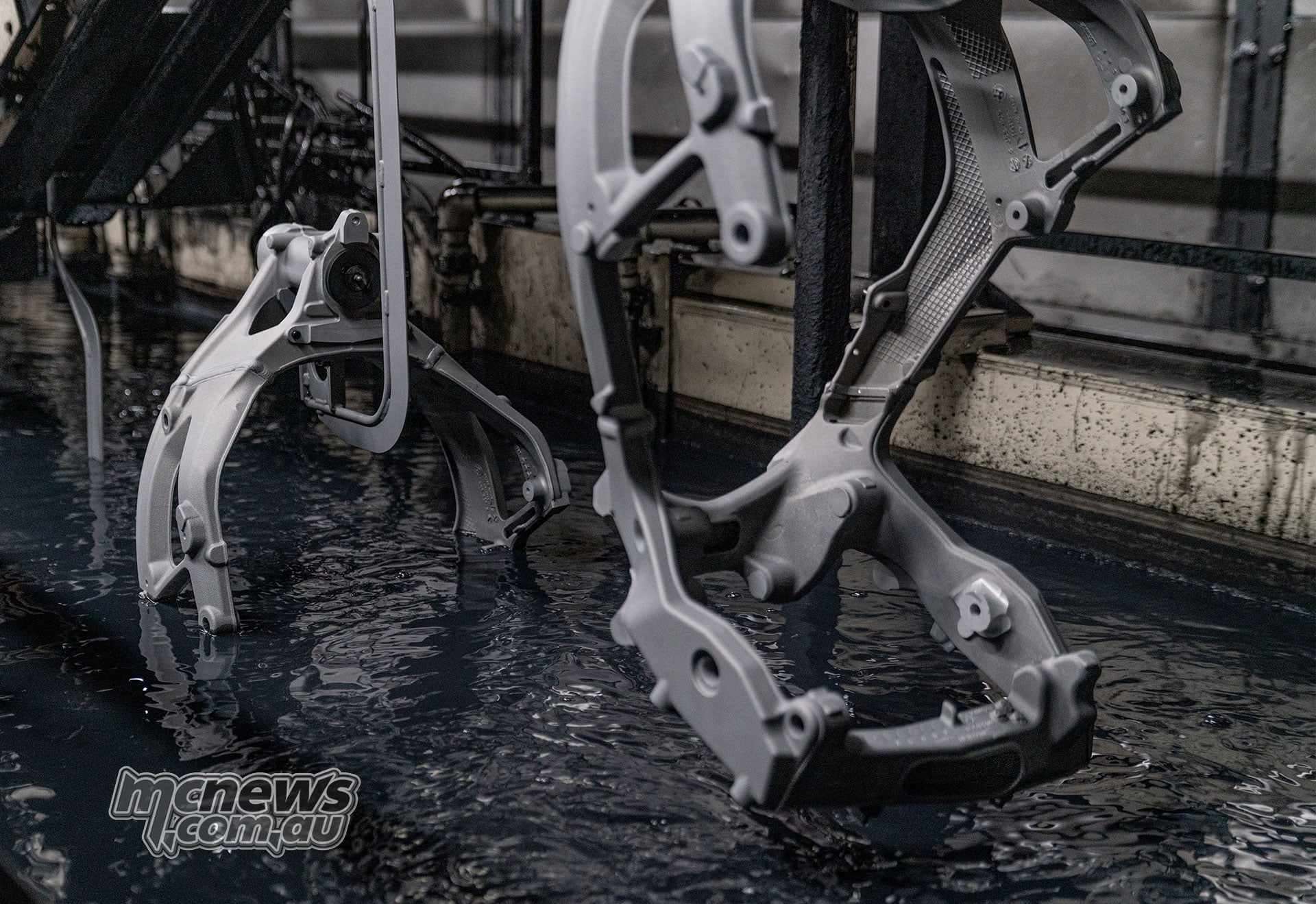
Following welding, BMW applies cathodic dip coating to protect the frame against corrosion.
This process is particularly well suited to complex structures because it can provide protection within enclosed cavities as well as across accessible external surfaces.
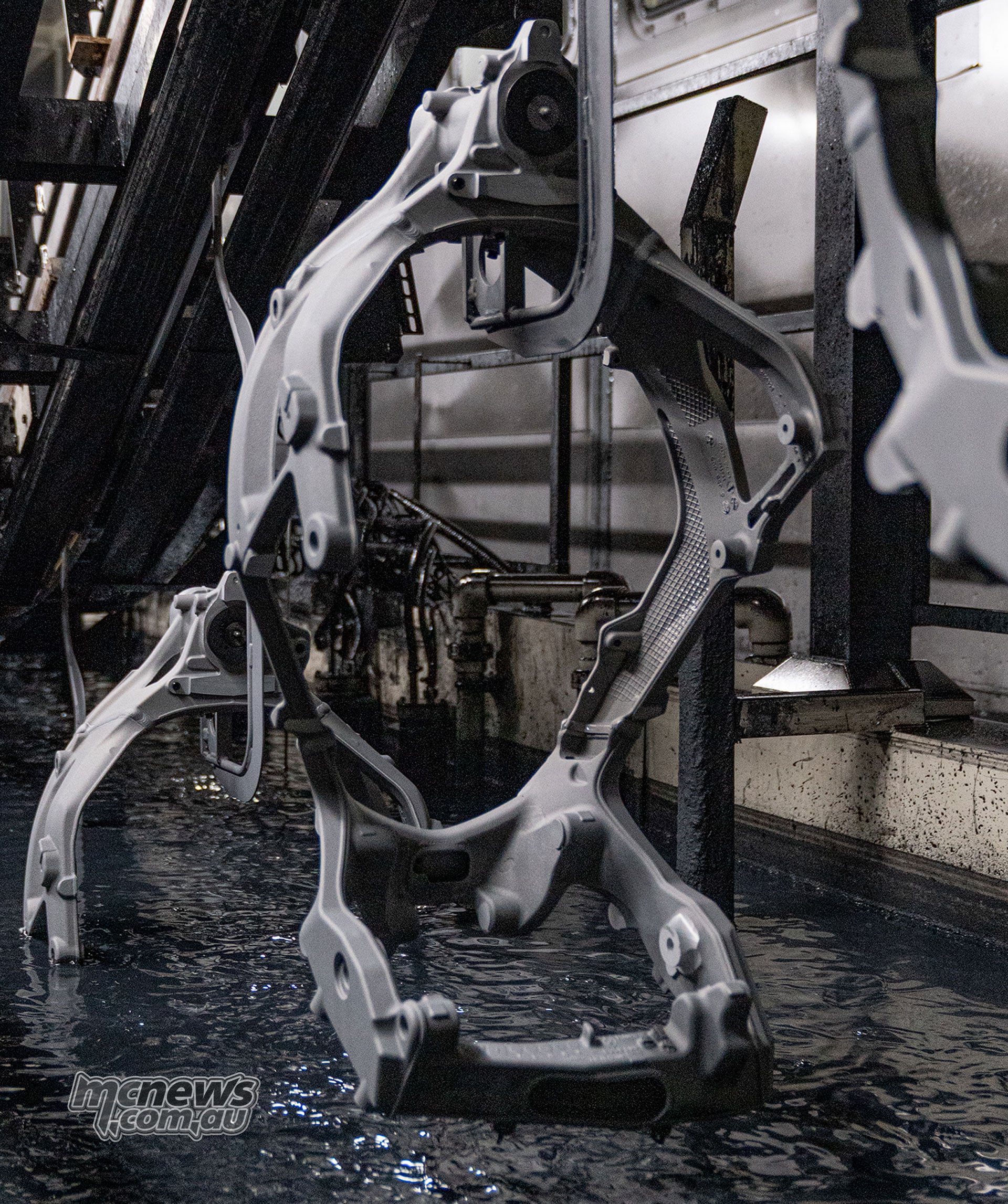
Cathodic dip coating uses an electrically assisted coating process to deposit a protective layer on the component.
Compared with simply spraying paint onto accessible surfaces, immersion allows the protective coating to reach areas that would otherwise be difficult to cover.
That includes the enclosed and partly enclosed regions created by the frame’s intricate cast construction.
Even after the frame has been welded and coated, however, the manufacturing process is not finished.
Final machining and dimensional accuracy
The assembled frame undergoes final milling to bring its functional surfaces and mounting points to the specified dimensions.
By carrying out final machining after the castings have been joined, BMW can establish the required dimensions on the completed structure rather than relying solely on the accuracy of each part before welding.
The frame also incorporates carefully machined mounting interfaces that contrast with the rougher texture of the surrounding cast material.
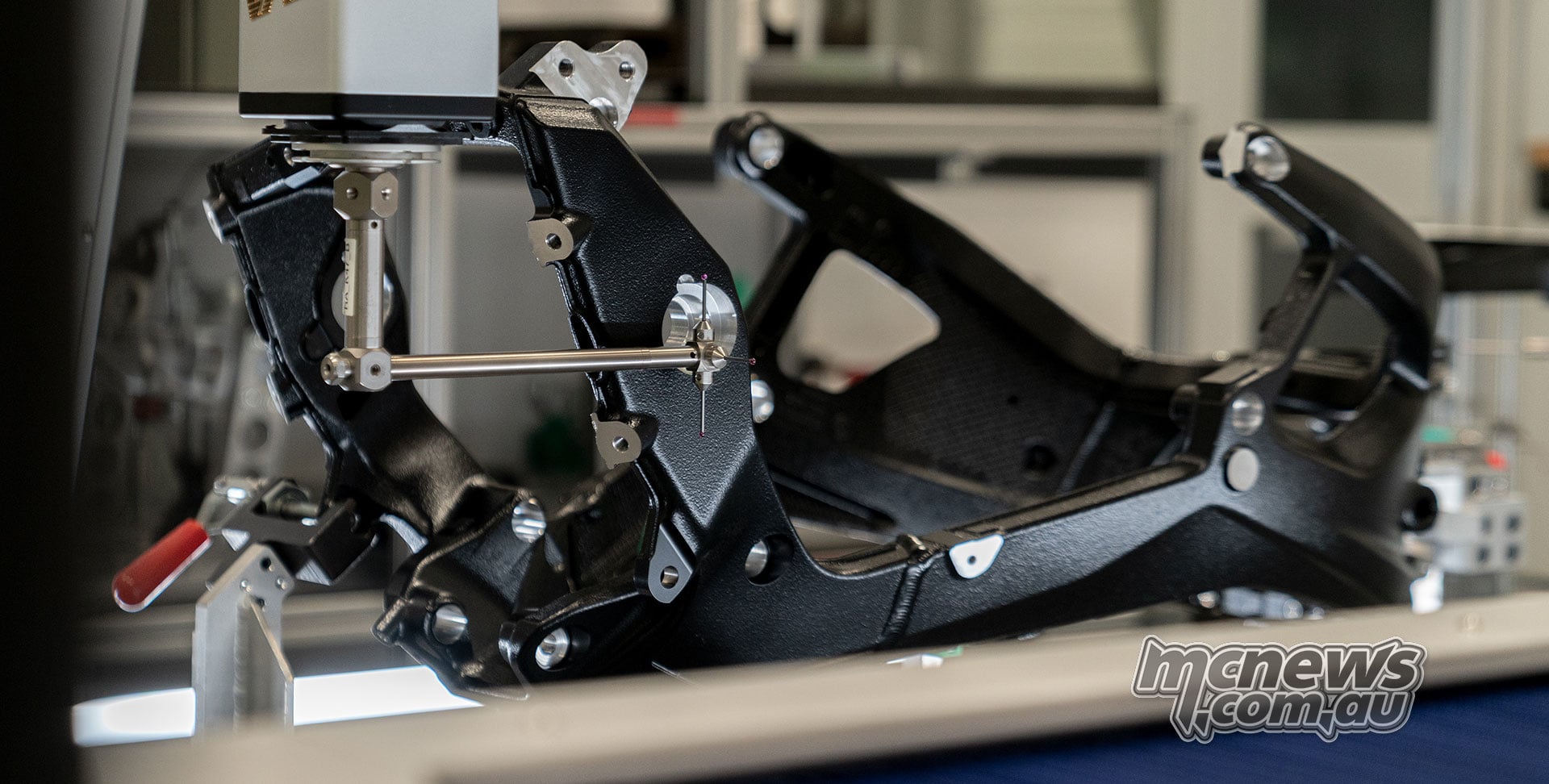
A further coordinate measurement verifies the dimensions of the assembled frame. These measurements are essential to preserving the intended steering geometry and the positioning of critical mounting points.
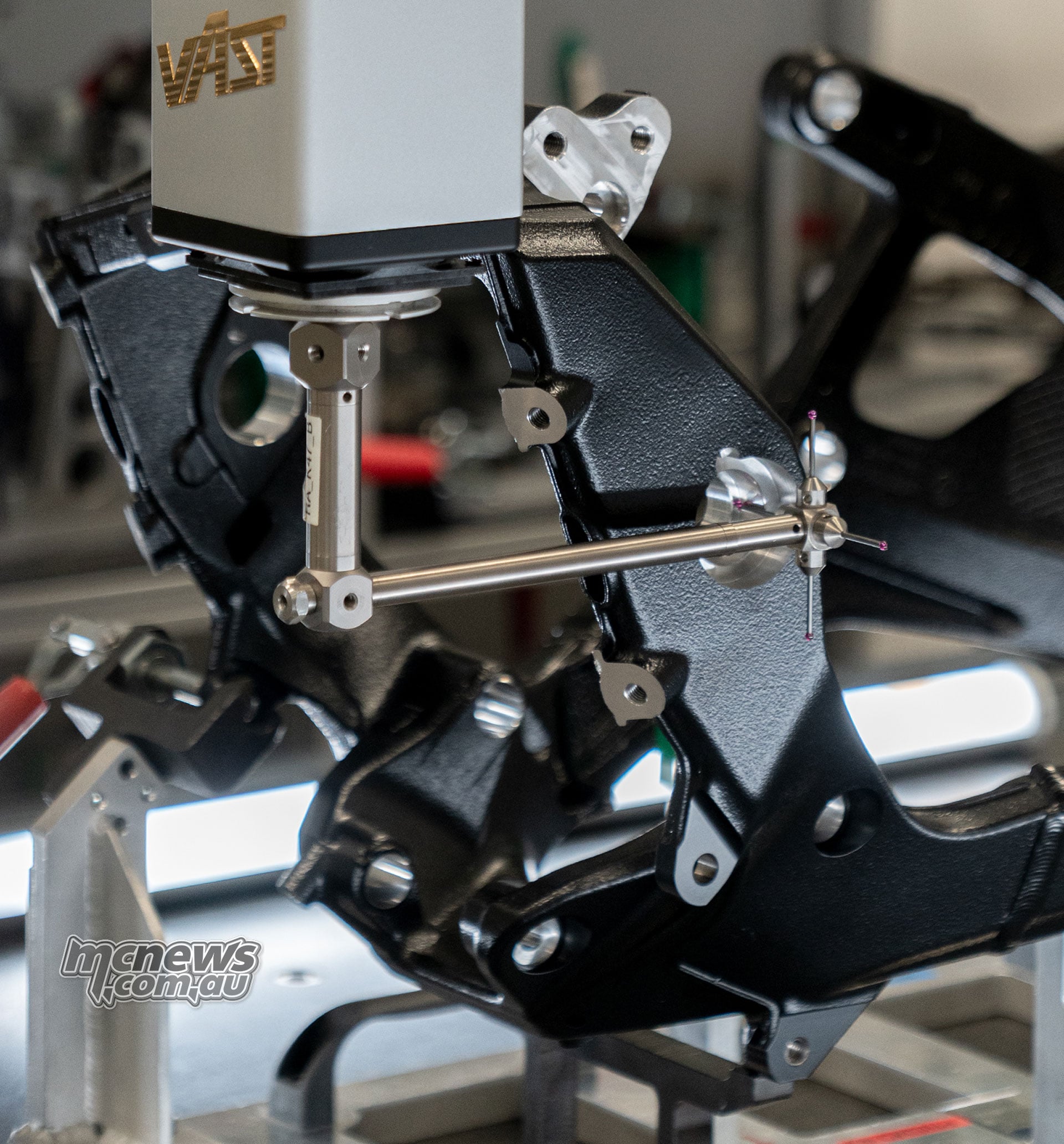
The probing system checks reference points on the assembly against the design specifications, confirming that the completed structure meets the required geometry.
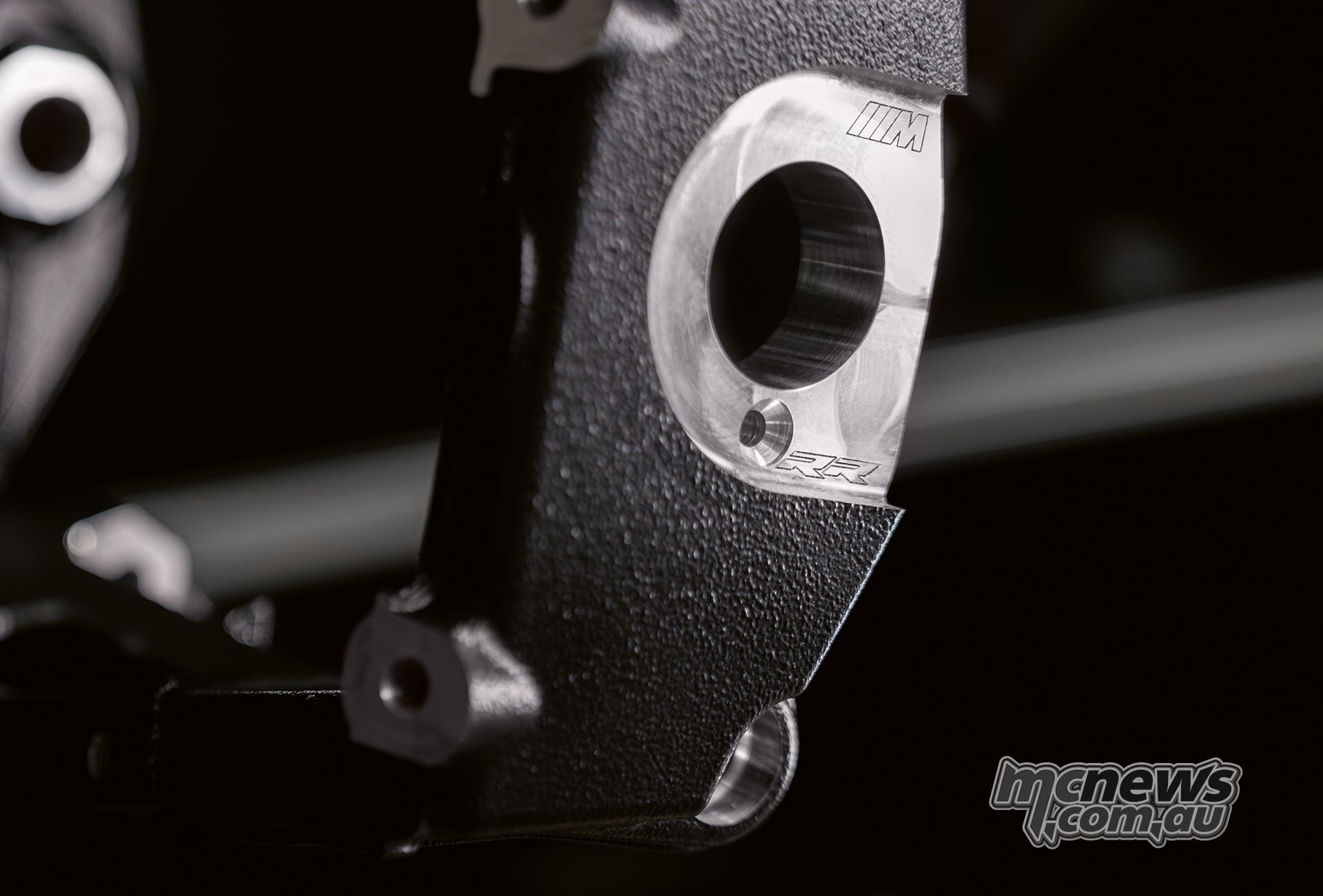
Only after this inspection is the frame approved for motorcycle assembly.
What began as a digital model in Munich has now passed through precision sand-core production, aluminium casting, multiple inspections, welding, corrosion protection and final machining.
What racing contributes to road-going development
BMW’s third-generation M Motorsport frame is intended to serve both its production motorcycle and its wider racing activities.
The manufacturer says development information from factory racing and customer teams feeds directly into the production design.
The loads experienced by a superbike under heavy braking and sustained cornering forces make it an unusually demanding environment in which to assess structural performance.
A development that improves stability under one set of conditions may not necessarily work as effectively with another tyre, suspension setup or circuit configuration.
This is why the ability to tune the characteristics of a frame matters more than pursuing stiffness or lightness in isolation.
BMW Motorrad Motorsport head Sven Blusch emphasises the relationship between those objectives.
Sven Blusch – Head of BMW Motorrad Motorsport
“The new M Motorsport frame combines consistent lightweight construction with precisely tuned stiffness and flex characteristics.”
Of course, the demands of professional racing differ considerably from those of everyday road use. Nevertheless, the manufacturing knowledge and structural development techniques involved are relevant well beyond the racetrack.
What does all this actually achieve?
BMW attributes more precise turn-in, clearer feedback, more consistent tyre contact and improved confidence at high lean angles to the characteristics of its latest frame. It also claims more even tyre wear.
The 1.3 kg reduction in frame mass is a measurable engineering achievement, while the wall-thickness changes illustrate the extent to which the structure has been revised.
And on a modern superbike, the interaction between the frame, tyres, suspension, wheels and electronics makes it difficult to attribute every change in handling behaviour to one component.
What is clear is the extraordinary amount of work now involved in developing a structure that might, at first glance, appear to do little more than connect the front and rear of a motorcycle.
The new M Motorsport frame becomes standard equipment on the model-year 2027 BMW M 1000 RR.