

Rieju Aventura Rally 307 Review
Re-ay-hoo. Re-ah-ooh. Aventura Rally 307. My Spanish isn’t awesome, but I do try to get names and pronunciations right rather than butcher them. As such, I’m told either of those first two is acceptable. What it definitely isn’t is Rye-joo or Ray-joo.
You know what it is, though? A super-fun, lightweight, rally-styled adventure bike. What does that mean in layman’s terms to you and me? A long-distance-capable dual-sport machine that’s easy to ride and fun for riders of all levels.
Let’s be clear up front: it’s not a rally bike. Just like its most direct competitor and the bike it will inevitably be compared with – the Honda CRF300 Rally – it isn’t one either. But the Rieju shades the Honda in a number of key areas: suspension adjustability, power, fuel capacity and price.

A little Spanish history
A quick recap on the brand for those unfamiliar. The Rieju name dates back to 1934 and combines the surnames of founders Luis Riera and Jaime Juanola—RIEra plus JUanola. The company began building bicycles before moving into powered two-wheelers and became best known for mopeds and smaller-capacity motorcycles.
In 2020, after the KTM group took control of GasGas, Rieju acquired the former GasGas enduro platform and brought it into its own range as the MR ‘Hard Off-Road’ line.
The Aventura Rally 307 is not part of that enduro family; it’s a line in its own right. I’m told the bike was designed in Spain, uses a Chinese-built Loncin engine and then undergoes final assembly and inspection at Rieju’s Figueres plant in Spain.
Back on local soil, Rieju obviously doesn’t have a dealer network the size of Honda’s, but it has a surprisingly decent footprint, with the bikes available and supported through around 30 Australian locations. That number surprised me, to be honest, but there you go. You can check the current Rieju Australia dealer network here.

Let’s talk key specs
Time to dive into the spec highlights a little more before we talk riding impressions.
It runs a 293 cc Loncin YF300 engine whose basic architecture closely mirrors Kawasaki’s KLX300 unit: an identical 78.0 x 61.2 mm bore and stroke, a liquid-cooled DOHC four-valve layout, a six-speed gearbox, and a near-identical compression ratio. That doesn’t prove the engines are identical, but they clearly share a fair bit of DNA.
Rieju claims 33.5 hp and 27 Nm in standard trim. The Honda makes around 27 hp and 26.6 Nm, which gives the Rieju roughly a 24 per cent advantage in claimed peak power.

There’s also an optional Rally 307 Power Kit. It combines a high-performance CDI, high-flow air filter and catalyst-free IXIL exhaust, with Rieju claiming gains of 5 hp and 4 Nm. That would take it to 38.5 hp and 31 Nm. Because the kit removes the catalysts, I’d have a chat with the dealer about the implications for road use and warranty coverage before ticking that box.
The chassis spec is equally eye-catching. There’s a 43 mm inverted fork adjustable for compression and rebound, while the progressive rear shock offers preload, compression and rebound adjustment. Both ends provide 235 mm of travel. The Honda’s suspension is non-adjustable at both ends.
Then there’s the 21-litre fuel tank, which is over 60 per cent larger than the Honda’s 12.8-litre tank. Rieju claims more than 500 km of range, although we’d need a longer test to verify that in the real world, I’d be confident of 450+ kms though.

Rieju quotes a 137 kg dry weight and also gave us a 153 kg wet figure at launch. On paper, that puts it level with the Honda’s quoted 153 kg kerb weight, despite the Rieju carrying considerably more fuel.
Tech-wise, you get a big seven-inch vertical TFT with smartphone mirroring, full LED lighting and dual-channel ABS that can be switched off completely. The 21-inch front and 18-inch rear spoked wheels also come with rim locks at both ends.
The spec looks impressive. And that’s before you consider the introductory price of $8,990 ride-away.

So what’s it like on the trail?
Surprisingly fun. And easy to ride.
That quoted seat height of 890 mm just doesn’t feel right, to be honest. I don’t know whether it’s because the seat is nice and narrow or what it is, but it feels quite low in practice, which makes the bike super user-friendly and encouraging.
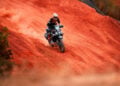
Any time you come across an obstacle on the trail, you have the confidence that your feet are only an easy dab away from terra firma. Ironically, that means you’re more likely to hold a little more momentum and not need to put a foot down at all. And with a quoted ground-clearance figure of 260 mm, rest assured it is very capable of working its way through rocks and logs on the trail.

The other key takeaway is the suspension. Out of the box, it’s surprisingly good, and adjustable if you want to firm it up for faster or more demanding riding. I found it held itself more in the mid-stroke, where you want it, than I remember the non-adjustable CRF doing. It was also far more reluctant to bottom out. We even jumped a few water bars without finding the end of the travel.
We were running the standard 50/50 tyres as delivered, which meant some caution was called for where conditions became slick. I noticed the front felt as though it had a little less grip than the rear. That could have been the tyre, but it might also have been helped with a little preload tweaking to put more weight on the front.
It was only a half-day ride on the trails, but that gave me enough of a feel to know I’d personally dial in a little more rear preload and add some front compression damping. Then it would be close enough. I’m guessing most riders wouldn’t need to spend extra on suspension, which is something plenty of owners end up doing on the CRF.
For the real enthusiast, upgrade options include an Öhlins shock and Andreani fork cartridges. The available 20 mm bar risers would also be something I’d consider for riders accustomed to a more upright adventure-bike riding position. The standard bars are reasonably flat and dual-sport-like.

That engine seems familiar…
There are some mixed signals as to whether the engine is exactly the same as the one used in the Kawi KLX300 or merely a close relative. At the very least, aftermarket parts catalogues suggest there is considerable cross-compatibility.
Whatever the family tree, it’s a stout little performer. It pulls hard off the bottom and revs out well. The speedo ran into the mid-140s on a flat section of track before the engine ran out of revs.
Truth be told, I’d probably go up one tooth on the front sprocket, which I reckon would benefit it on both the road and trail. First gear is very low, as even reasonably tight single-track was handled in second.
I found the fuelling a little touchy initially, particularly when closing the throttle on what was essentially a brand-new bike. It was more noticeable on the road than on the trail, but by the end of the day I was getting used to it. The gearbox was also loosening up quickly and was happy to accept clutchless shifts both up and down on the trail without complaint.
I’d be very interested in riding one with the optional Power Kit. Rieju says it boosts both the mid-range and top-end, while sharpening response and reducing heat and weight. I also suspect it may tidy up that fuelling.

Tech and brakes
That dash is certainly a massive step up on the competition. Smartphone mirroring is available out of the box, putting your preferred navigation app on the big seven-inch vertical TFT. I didn’t really get a chance to test the system, though. My understanding is that it’s exactly that, a non-interactive mirror image of your phone, so you set the destination on the handset and then follow it on the bike’s screen.
In terms of modes and options, there isn’t a lot to fiddle with. You get dual-channel ABS that can be switched off completely, which will suit plenty of riders once they leave the bitumen.
I found the front brake a little weaker than expected at speed on the road and would personally go for a slightly more aggressive pad. It’s excellent off-road, though, and if you aren’t playing silly buggers trying to slipstream some pretty handy racers on a V-max run, it probably won’t be an issue…

Summary time—who’s it for?
In the end, it’s a hugely compelling package. It has better suspension out of the box than its direct rivals and a useful power advantage in standard trim.
Being such an easy bike to ride, I can see it appealing to a wide range of riders, from beginners to seasoned vets. On the trails it feels far more like a fun trail bike than an enduro bike, which makes it easier, less tiring and less intimidating.
And that 21-litre tank has no real rival in the class. Rieju claims more than 500 km from it. Even allowing for harder use, a range in the high 400s looks realistic, but we’ll need a longer test to prove it.
Fun, affordable and capable. What’s not to like?

Rieju Aventura Rally 307 Hits
- Huge value.
- Class-leading claimed power and fuel capacity, plus the best standard suspension I’ve sampled in its immediate class.
- The 890 mm seat feels much lower in practice, making it very user-friendly and fun.
Rieju Aventura Rally 307 Misses
- Not a lot. The fuelling isn’t perfect, but you get used to it – I suspect the Power Kit would improve it.
- I’d add one tooth to the front sprocket for more relaxed road revs and a slightly taller first gear.
- I’d look at a more aggressive front brake pad for harder road use.

Rieju Aventura Rally 307 Specifications
| Rieju Aventura Rally 307 Specifications | |
|---|---|
| Price | From $8,990 ride-away (introductory pricing; location-dependent charges may vary) |
| Engine | 293 cc liquid-cooled DOHC four-valve single-cylinder four-stroke; electric start |
| Bore × stroke | 78.0 × 61.2 mm |
| Fuel system | Electronic fuel injection |
| Maximum power | 33.5 hp / 25.0 kW (claimed) |
| Maximum torque | 27 Nm (claimed) |
| Power Kit output | 38.5 hp and 31 Nm (claimed; optional kit) |
| Transmission | Six-speed; chain final drive |
| Clutch | Wet multi-plate slipper clutch |
| Frame | High-strength steel spine frame |
| Front suspension | 43 mm inverted fork; compression and rebound adjustable; 235 mm travel |
| Rear suspension | Progressive shock; preload, compression and rebound adjustable; 235 mm travel |
| Front wheel/tyre | Spoked 21-inch; 80/100-21 tyre; rim lock |
| Rear wheel/tyre | Spoked 18-inch; 120/80-18 tyre; rim lock |
| Front brake | 300 mm wave disc; two-piston caliper |
| Rear brake | 240 mm wave disc |
| ABS | Dual-channel; fully switchable |
| Fuel capacity | 21 litres |
| Claimed range | More than 500 km |
| Dry weight | 137 kg |
| Wet weight | 153 kg (quoted at Australian launch) |
| Seat height | 890 mm |
| Ground clearance | 260 mm (quoted at Australian launch) |
| Wheelbase | 1,420 mm |
| Dimensions (L × W × H) | 2,120 × 850 × 1,470 mm |
| Display | Seven-inch vertical TFT with day/night modes, ambient-temperature display and smartphone Mirror Link |
| Lighting | Full LED |