

2027 BSB regulations
The British Superbike Championship will undergo one of the most fundamental technical changes in its modern history in 2027, with a new torque-managed Balance of Performance formula, a new Mectronik control electronics platform and the return of electronic rider aids to the premier class.
The new “Next Generation” Superbike framework is designed to broaden the range of machinery capable of winning races, reduce development and engine costs, and address an increasingly fragmented litre-class sportsbike market.
At the centre of the new regulations will be a Mectronik torque-based electronic management system. The initial target is for machines to produce around 200 horsepower, but concentrating simply on that peak power figure misses much of what is significant about the change.
Each eligible motorcycle will be calibrated to operate within defined BSB performance parameters, with torque delivery managed across the rev range to help equalise motorcycles of different generations, engine configurations and underlying performance potential.
Once racing begins, data gathered on track will then be used to evolve what initially amounts to a balance of power into a broader balance of overall performance.
Perhaps even more significant is the change in electronics philosophy. Controlled inertia-based traction control, anti-wheelie and launch control will all form part of the new package, reversing one of the defining characteristics of the modern BSB era.
And while the scale of the changes is substantial, so too is the timing.
BSB has promulgated the broad direction of the 2027 regulations before the current championship has even been decided, and almost six months before the new season is expected to get underway.
That gives manufacturers, teams and prospective entrants a substantial lead time to assess machinery, budgets, engine programmes and electronics requirements before the first race of the new era.
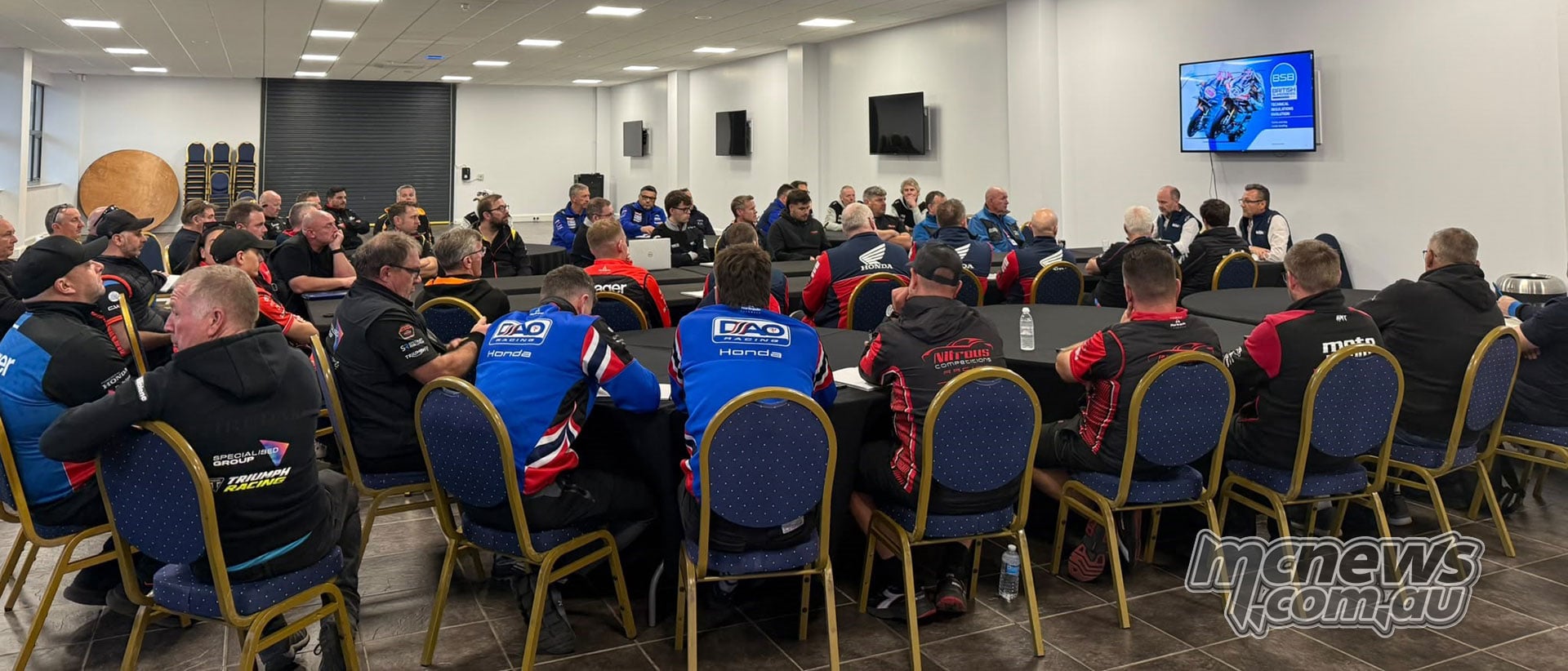
MCNews has been expecting this direction
MCNews.com.au has followed the development of these regulatory philosophies particularly closely over recent years, especially through our extensive discussions with Dorna Director of Technology and BSB Technical Director Scott Smart.
In our three-part discussion with Smart in 2025, we specifically explored where the increasingly successful Next Generation approach might eventually take production-based road racing.
At that time, MCNews raised the prospect of a derivative of the Next Generation Supersport philosophy eventually finding its way into Superbike, along with the likelihood that a control ECU and torque-managed performance balancing would become central to achieving parity between increasingly divergent motorcycles.
Smart outlined essentially two possible paths for the litre-class machines: a much stricter Balance of Performance framework for existing 1000 cc Superbikes, requiring what he described as a much firmer regulatory hand, or ultimately a move towards machinery based more closely on the Next Generation philosophy.
His observation at the time that “the key to all BOP starts at the ECU” now looks particularly prescient.
It is important to point out that BSB has already used a control ECU for many years. What changes for 2027 is the sophistication and purpose of that control architecture.
The existing BSB formula has used common electronics primarily to contain costs and remove sophisticated rider aids. The new Mectronik system instead becomes one of the principal tools through which the championship can actively manage the performance characteristics of different motorcycles.
That brings the Superbike philosophy much closer to what we have already seen successfully employed in Next Generation Supersport, where different motorcycles are effectively torque-mapped and otherwise regulated to create performance parity across markedly different engine capacities and configurations.
A different solution to the Superbike problem
The regulations respond to a problem increasingly confronting production-based Superbike racing. Fewer genuinely new 1000 cc sportsbikes are entering the marketplace, while manufacturers update their platforms at very different rates.
At the same time, the performance potential and sophistication of the newest homologation specials has continued to move away from older designs that might otherwise remain perfectly viable racing motorcycles.
Some manufacturers also no longer have a clear long-term commitment to producing ever more extreme litre-class sportsbikes at all.
Trying to accommodate all of those machines within one conventional technical formula therefore becomes increasingly difficult.
BSB’s answer is not simply to restrict every motorcycle to an identical peak horsepower figure. The Mectronik system will allow performance to be shaped across the engine’s operating range, giving the organisers considerably more scope to manage how different motorcycles accelerate and deliver performance, rather than relying predominantly on peak power and rev limits.
The targeted figure of around 200 hp therefore needs to be viewed together with the torque curve and the way that performance is delivered.
New bikes closer to standard
The rules will also recognise that the motorcycles entering BSB are not all at the same point in their development cycle.
New-generation Superbikes will remain substantially closer to standard specification, while established models will be permitted defined components where required to bring them within the prescribed performance window. That represents an important change in philosophy.
Rather than requiring every manufacturer to chase an increasingly expensive technical ceiling, the objective becomes bringing available machinery into a competitive window and then letting the team and rider combination make the difference.
In theory, that should reduce the extent to which competitiveness is dictated simply by which manufacturer has most recently developed an expensive new flagship sportsbike.
It could also considerably lower the barrier facing manufacturers considering entering, or returning to, BSB without requiring an extensive development programme simply to reach the outright performance potential of the latest homologation machinery.
Around 200 hp should also reduce costs
Cost control is another major element of the new formula. The reduced performance ceiling should ease stresses on engines, improving reliability and potentially allowing teams to complete a season with fewer engines and rebuilds.
That attacks expenditure from several directions. There should be less requirement to pursue expensive gains at the very top of the rev range, longer service lives between rebuilds and fewer engines required over the course of a championship.
The common electronics architecture should also simplify areas that can currently require significant engineering resources.
Importantly, however, the objective is not to make every motorcycle identical.
BSB wants to contain the underlying performance differences between models while retaining enough technical scope for teams, engineers and riders to find an advantage through how well they prepare and race the motorcycle.
Traction control returns to British Superbikes
The shift to electronic rider aids is arguably the most profound philosophical change in the announcement. For well over a decade, one defining characteristic of the British Superbike Championship has been its deliberately stripped-back approach to electronics.
The major regulatory reset introduced for 2012 used a control ECU to dramatically curtail the electronics arms race, prohibiting sophisticated traction control, launch control, and anti-wheelie strategies. That became one of the features that separated a British Superbike from machinery competing at WorldSBK level.
For 2027 that philosophy changes.
The Mectronik package will incorporate controlled inertia-based traction control, anti-wheelie and launch control.
This is not a return to unrestricted factory electronics. The systems will operate within the common controlled architecture, allowing the championship to define their capabilities and prevent another open-ended spending contest.
Nevertheless, it represents a significant reversal for a championship that has long placed a premium on riders controlling wheelspin and wheelies without the sophisticated electronic safety nets used elsewhere.
There is another practical benefit. Riders progressing through categories already employing modern electronic strategies, or arriving in BSB from international competition, will encounter greater technical continuity.
Likewise, riders and technicians progressing from BSB onto the international stage will have gained experience with torque management, inertial measurement, and electronic strategies that are far more representative of contemporary international racing.
BSB has a habit of leading the way
The wider racing world would be well advised to watch how the new formula develops.
British Superbikes has repeatedly been at the vanguard when regulations have needed to adapt to changes in the motorcycle market, and ideas developed or proven within the BSB paddock have subsequently appeared in international and other national championships.
The radical electronics regulations introduced more than a decade ago were themselves ahead of much of the production racing world when it came to aggressively controlling costs through common electronics.
More recently, the Next Generation Supersport philosophy demonstrated how machinery with dramatically different capacities and engine configurations could be balanced within a single category.
BSB was also at the forefront of the newer Sportbike concept, bringing together a diverse range of production machinery through controlled electronics, torque management and model-specific technical allowances.
Versions of that formula have since spread to other major domestic championships, while World Sportbike is now taking the concept onto the World Championship stage.
BSB has therefore developed a familiar pattern: confront a regulatory problem early, introduce a solution, refine it in the heat of competition and then see elements of that solution adopted elsewhere.
Is this ultimately the future of WorldSBK?
It is not difficult to imagine that, if the new BSB formula proves successful, this could ultimately become a blueprint for Superbike racing far beyond Britain.
Indeed, that was one of the broader themes MCNews explored with Scott Smart during our discussions about the future direction of production racing.
The underlying problem facing BSB is not uniquely British.
WorldSBK and domestic Superbike championships around the globe are drawing from the same shrinking and increasingly diverse pool of suitable production motorcycles.
They face the same widening performance differences between manufacturers, the same escalating development costs and the same question over how long a conventional homologation-based formula can accommodate machines conceived to very different design briefs.
If BSB demonstrates that a tightly controlled ECU, torque-based performance balancing, controlled rider aids and model-specific technical freedoms can deliver close racing between a wider selection of motorcycles while reducing costs, one would imagine the concept will attract considerable attention from the FIM, Dorna and national governing bodies.
WorldSBK would be the obvious place to look.
That does not mean the World Championship will simply copy the BSB regulations, nor is there any confirmation that such a move is planned. However, with MotoGP reducing engine capacity to 850 cc for 2027, there has long been an expectation that WorldSBK could edge closer to MotoGP in outright lap-time performance. With both championships now operating under the same ownership umbrella, creating clearer technical and performance differentiation between the two products would also appear to make strategic sense.
If the BSB Next Generation Superbike formula works as intended, it would be no surprise to eventually see the same broad architecture influence WorldSBK and, from there, other major domestic Superbike championships worldwide.
In many respects, BSB could again become the real-world development laboratory for the next generation of production Superbike regulations.
Jonathan Palmer – MSV Chief Executive
“The objective is to create an environment in which a much broader range of manufacturers can realistically compete, reducing the need for costly development while allowing teams and riders to make the difference. Our ambition is for every represented brand to have the potential to challenge towards the front with the right team and rider combination.”
Stuart Higgs – BSB Series Director
“The changes represent a major reset for the championship, using proven technical principles to rebuild the depth of competition across manufacturers, teams and riders. Not for the first time BSB will take the necessary steps to develop and introduce new sporting and technical solutions.”
Could more manufacturers join the fight?
Another particularly interesting element of the announcement is confirmation that discussions have already taken place not only with existing and prospective teams, but also with potential incoming and returning manufacturers.
No manufacturers have been identified at this stage, so speculating about precisely who those conversations might involve has little value. One would imagine the likes of CFMOTO and ZXMOTO would have been involved in those discussions.
Increasing manufacturer diversity is clearly one of the new formula’s fundamental objectives, not merely a possible side effect. A system that makes an established motorcycle genuinely competitive against the latest generation of machinery could open considerably more doors.
It may also provide manufacturers with a route into BSB without requiring a highly specialised homologation model or a costly development programme aimed at extracting every last horsepower from the production platform.
Plenty of detail still to come
There is still much to learn before the first race of the new era.
The detailed regulations will reveal precisely how the individual motorcycle performance parameters are established, how much freedom teams retain within the controlled electronics, what components can be used to bring established machinery into the required performance window and, crucially, how Balance of Performance adjustments will be administered once racing begins.
How quickly parameters can be altered, what data will trigger an adjustment and how the championship manages the inevitable arguments over whether a particular motorcycle has been helped or hindered will be among the most closely scrutinised parts of the new formula.
That scrutiny is unavoidable whenever Balance of Performance becomes integral to a championship.
BSB is at least giving everybody plenty of warning.
Announcing the fundamental direction before the 2026 championship has even concluded, and almost six months before the 2027 campaign is expected to begin, gives manufacturers and teams a substantial runway in which to plan.
It also suggests this is not a hastily conceived rule change but the culmination of a regulatory direction that has been developing for some time.
Those who have been following that direction closely should not be particularly surprised by where BSB has arrived.
MCNews has been discussing control electronics, torque-managed parity and Next Generation-style regulations for several years, and the pieces have increasingly pointed towards something very much like what has now been announced.
What is certain is that the 2027 British Superbike will be a very different proposition.
BSB is not merely trimming horsepower or tinkering around the edges of its existing regulations. It is again putting itself at the regulatory vanguard, using a controlled, increasingly data-driven framework to keep a much broader selection of motorcycles, manufacturers, and teams competitive.
If it succeeds, there is every chance that the consequences will eventually extend far beyond the British paddock.