


Fireblade heart, touring legs
Honda CB1000GT headed for Australia
Honda Australia has confirmed the new CB1000GT sports tourer will arrive locally in late 2026, with Expressions of Interest now open for riders hoping to secure one of the first Australian-delivered examples.
First revealed at EICMA in November 2025, the CB1000GT takes the engine and basic chassis architecture of the CB1000 Hornet and develops it into a substantially more comprehensively equipped long-distance sports tourer.
The result pairs a 148 horsepower Fireblade-derived inline four-cylinder engine with a 21-litre fuel tank, Showa electronically controlled suspension, a six-axis IMU, Cornering ABS, cruise control, heated grips, a standard quick-shifter and detachable panniers.
Honda Australia is yet to confirm every local specification and accessory option, so some of the detail outlined below is drawn from Honda’s European-market technical information. The major engine figures and much of the standard equipment have already been confirmed for Australia, but final local specifications, accessories and pricing will be announced closer to launch.
A CB1000 Hornet built to travel
Although its mechanical foundations come from the CB1000 Hornet, the CB1000GT is considerably more than the naked bike with a fairing and luggage added.
Honda has retained the Hornet’s diamond-style steel main frame but fitted a revised and extended rear subframe to create more room for the rider, pillion and luggage. The cast-aluminium Pro-Link swingarm has also grown from 619 to 635 mm, contributing to improved high-speed stability when carrying a passenger and a full touring load.

The wheelbase extends to 1465 mm, compared with 1455 mm on the CB1000 Hornet, while trail increases from 98 to 106.3 mm. The 25-degree steering-head angle remains unchanged.
Those changes should give the GT greater stability without completely dulling the relatively agile character of its Hornet donor. Weight distribution is quoted at 51 per cent front and 49 per cent rear.
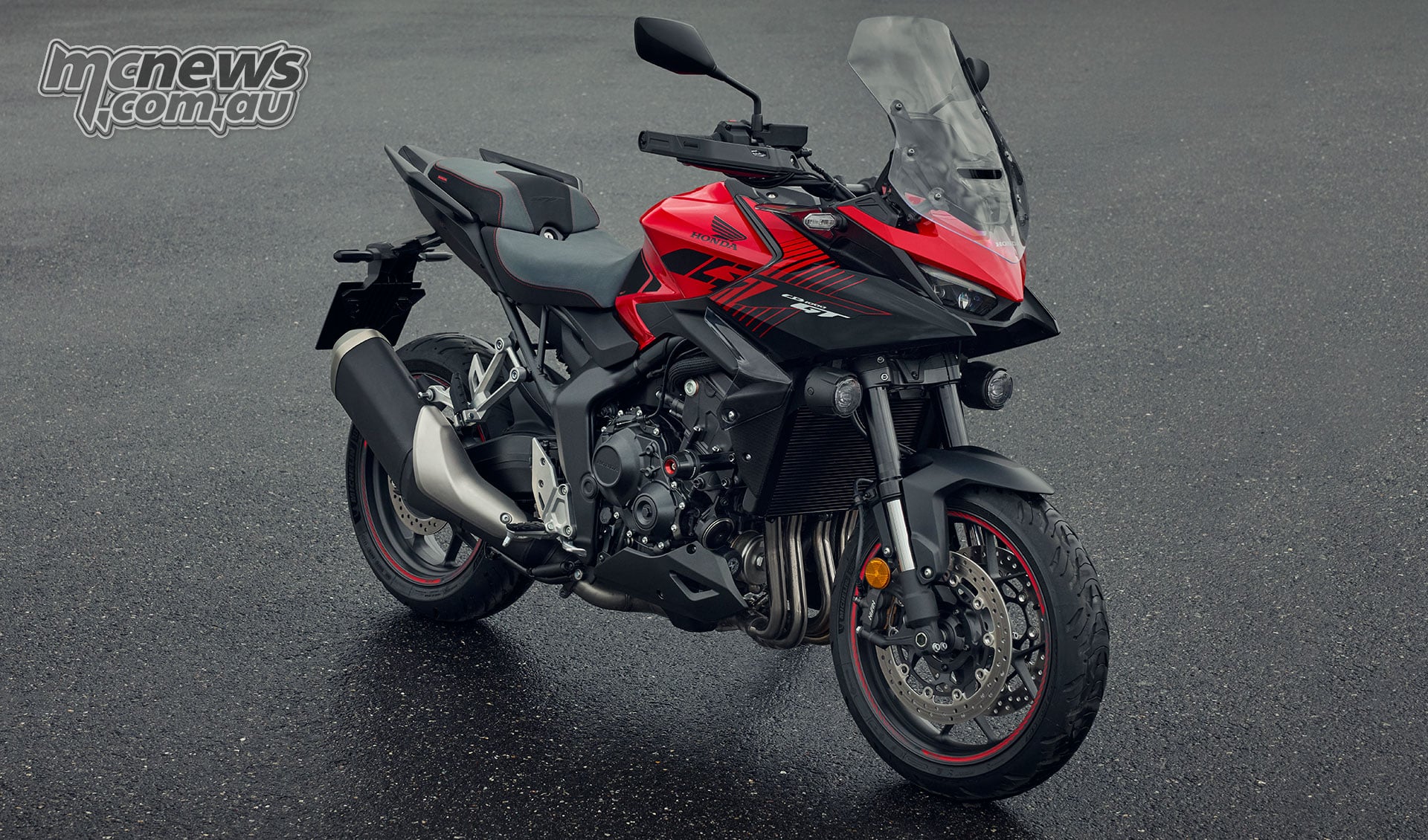
Seat height is 825 mm, 16 mm higher than the standard CB1000 Hornet, while the riding position has been made more upright and the handlebar and footpeg positions altered for longer periods in the saddle.
Honda has also increased seat cushioning over the Hornet by 15 mm for the rider and almost 40 mm for the pillion. Cast-aluminium pillion footpegs and wide passenger grab rails further underline that this is intended to be a genuine two-up motorcycle rather than simply a sports bike with a taller screen.
Fireblade-derived four-cylinder engine
The CB1000GT uses the 1000 cc DOHC inline four-cylinder engine architecture originally developed for the 2017 CBR1000RR Fireblade.
Bore and stroke measure 76 x 55.1 mm, and the compression ratio is 11.7:1. In CB1000GT form, the engine produces 110.1 kW at 11,000 rpm and 102 Nm at 8750 rpm.

Those numbers are accompanied by model-specific fuel-injection and Throttle by Wire calibration. Honda says particular attention was paid to producing a smooth and progressive response when the throttle is first opened, reducing the workload on the rider and making the motorcycle easier to manage over long distances.
The torque curve has also been shaped to provide strong mid-range response while retaining the top-end character expected of a litre-class Honda four.
Second through fifth gear have been selected to provide strong acceleration, while the taller sixth gear is intended to deliver more relaxed engine speeds during highway cruising.
An assist and slipper clutch reduces lever effort and helps control rear-wheel movement during aggressive downshifts. Honda’s European specification also lists a two-way quick-shifter as standard, providing clutchless upshifts and auto-blipped downshifts.
Honda quotes a maximum speed of 200 km/h for the European model.

21-litre tank and 340-kilometre potential
The fuel tank holds 21 litres, four litres more than the CB1000 Hornet.
Claimed WMTC fuel consumption is 6.0 litres per 100 kilometres, which equates to a theoretical range of approximately 350 kilometres. Honda itself suggests riders should be able to travel more than 340 kilometres between fills under suitable conditions.
Real-world range will naturally depend on speed, load, weather and riding style, but the combination should give the CB1000GT meaningfully greater touring reach than most naked litre-class machines.

Five riding modes and IMU control
A six-axis Inertial Measurement Unit sits at the centre of the CB1000GT’s electronic package, providing information on the motorcycle’s roll, pitch and yaw.
Four preset riding modes — Standard, Sport, Rain and Tour — are joined by a configurable User mode.

Each mode combines one of three settings for engine power, engine braking and Honda Selectable Torque Control. The traction-control system uses information from the IMU to adjust intervention according to the motorcycle’s attitude as well as rear-wheel slip.
Standard mode uses the middle settings for engine response, engine braking and traction control. Sport selects the sharpest power delivery with lower engine-braking and traction-control intervention, while Rain softens the throttle response and increases the level of electronic assistance.

Tour mode uses similar engine characteristics to Standard but adjusts the electronic suspension according to road speed. User mode allows the rider to save a preferred combination of power, engine-braking, traction-control and suspension settings.
Wheelie control is also included within the European specification, with the electronic systems adjusted through the switchgear and five-inch TFT display.

Showa-EERA electronic suspension
Showa Electronically Equipped Ride Adjustment suspension will be standard on the Australian CB1000GT.
The system uses information from the engine ECU, six-axis IMU and a fork stroke sensor to continually calculate the required damping force. Honda says the suspension control unit can alter damping within 15 milliseconds.
The 41 mm upside-down fork provides 130 mm of travel, while the Pro-Link rear suspension offers 144 mm. Front spring preload remains manually adjustable, while rear preload can be adjusted electronically through 24 increments and changed while the motorcycle is moving.

Standard, Sport, Rain and Tour suspension calibrations correspond with the principal riding modes, while the User setting allows the rider to choose a preferred combination of damping and rear preload.
Standard is intended as the general-purpose setting, Sport increases support for more aggressive riding, Rain softens suspension response, and Tour provides firmer damping for higher speeds, two-up use and heavily laden touring.
The system is also programmed to reduce excessive front-end dive under hard braking.
Cornering ABS and radial-mount brakes
Braking duties are handled by a pair of radial-mount Nissin four-piston front calipers acting on 310 mm floating discs.
A single-piston Nissin rear caliper grips a 240 mm disc, with sintered rear pads selected to maintain performance when the motorcycle is carrying a passenger and luggage.

Cornering ABS uses information from the six-axis IMU to manage brake pressure when the motorcycle is leaned over.
The cast-aluminium wheels carry conventional sports-touring tyre sizes: 120/70 ZR17 at the front and 180/55 ZR17 at the rear.
229 kg before the panniers
Honda Australia quotes a weight of 229 kg excluding the panniers.
Honda’s current UK specification lists the detachable panniers at a combined 12.5 kg, taking the complete pannier-equipped figure to 241.5 kg.

The motorcycle measures 2135 mm long, 930 mm wide and 1290 mm high, with 135 mm of ground clearance and a 3.2-metre turning radius in European specification.
Honda quotes a power-to-weight ratio of 2.08 kg per kilowatt before the panniers are included.
Standard panniers and serious touring equipment
Touring equipment is a major part of the CB1000GT proposition rather than something left entirely to the accessory catalogue.

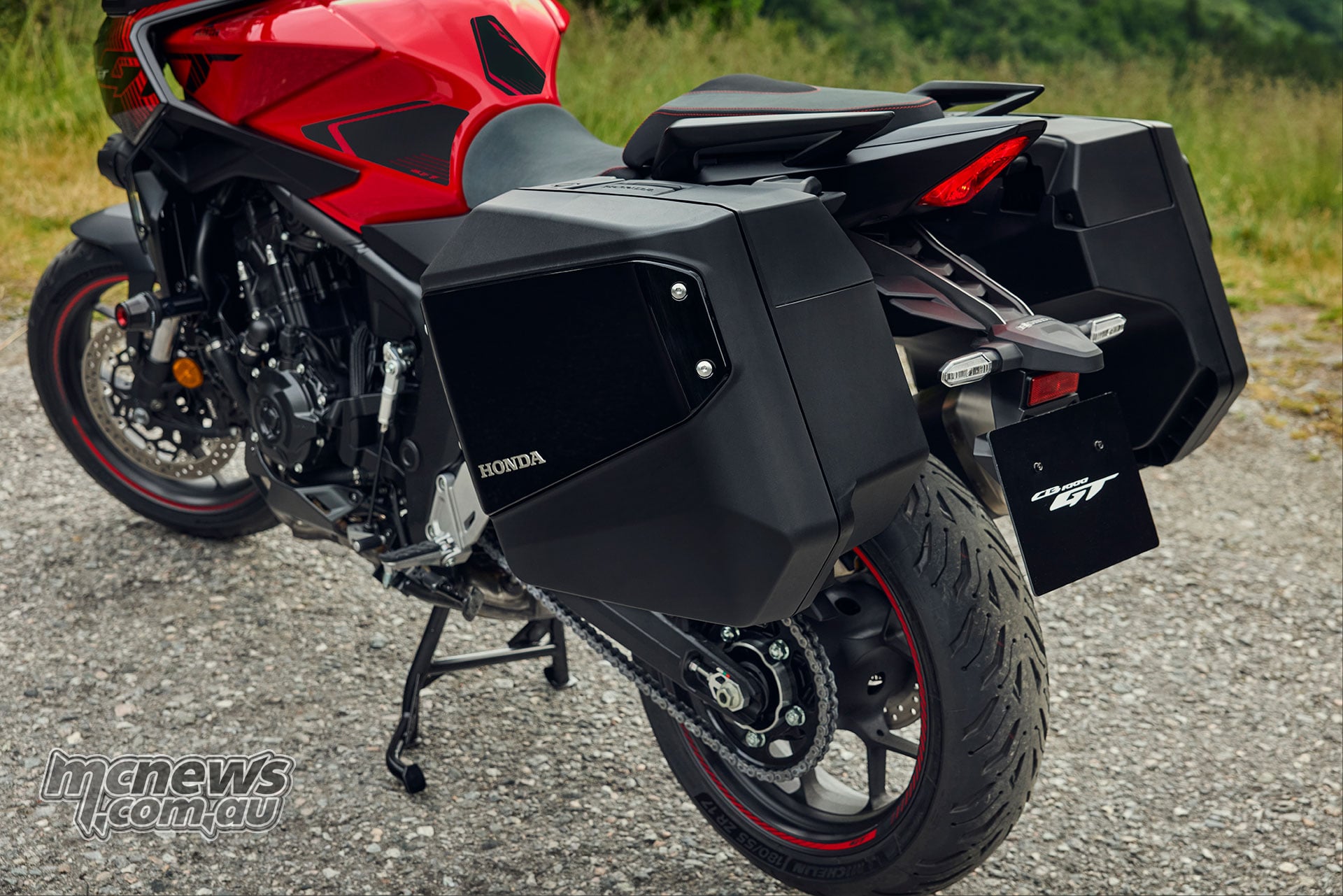
Detachable panniers are standard, with the European-market cases providing 37 litres of capacity on the left and 28 litres on the right. Their unequal dimensions allow clearance for the exhaust system.
Also standard are cruise control, heated grips, hand guards, a centre stand and a windscreen offering five levels of adjustment across an 81 mm range.

The screen can be adjusted with one hand, while the bodywork and front fairing were developed using Computational Fluid Dynamics to balance wind protection against stable handling in different riding conditions.
The European cruise-control system operates between 50 and 160 km/h.
All lighting is LED, including the compact twin projector headlights that form the centrepiece of the CB1000GT’s sharply chiselled front-end styling.

TFT connectivity, Smart Key and USB-C
A five-inch colour TFT display uses optical bonding to reduce reflections and improve visibility in bright sunlight.
The rider can choose between Bar, Circle and Simple display layouts, while Honda RoadSync provides smartphone connectivity through the left switchblock.
Once paired with a compatible smartphone and helmet headset, RoadSync can provide turn-by-turn navigation along with access to calls and music. A USB-C charging socket is positioned alongside the display.
Honda Smart Key allows the main ignition to be operated while the key remains in the rider’s pocket. A conventional folding key housed within the Smart Key unit is used for the fuel cap and seat.
The indicators cancel automatically after a turn or lane change and incorporate Honda’s Emergency Stop Signal. Under sufficiently hard braking, the hazard lights flash to warn following traffic.
Australian colour and accessories
Honda Europe offers the CB1000GT in Grand Prix Red, Pearl Deep Mud Grey and Graphite Black.
Honda Australia has so far confirmed only Grand Prix Red for the local market.

The European accessory catalogue includes a taller screen, comfort rider and pillion seats, upper and lower wind deflectors, fog lights, an engine guard, under-cowl, rear carrier, alarm, tank bag, rear seat bag and 50-litre top box.
European buyers can also choose Comfort, Sports and Urban accessory packs, along with an Akrapovič slip-on exhaust and billet components produced in partnership with Gilles Tooling.
Honda Australia is yet to confirm which individual accessories or packages will be offered locally.

Honda Australia on the CB1000GT
“The 2026 CB1000GT combines the performance and character that riders love from Honda’s 1000 cc sports motorcycles with the comfort, technology and practicality needed for sports touring,” said Chris Schultz, General Manager – Powersports and Products at Honda Australia.
“The CB1000GT strikes the perfect balance between sports bike excitement and genuine touring capability, making it a great fit for Australian riders and roads.”
Expressions of Interest now open
The 2026 Honda CB1000GT is scheduled to reach Australia in late 2026.
Prospective buyers can register an Expression of Interest through an authorised Honda motorcycle dealer or through the Honda Australia CB1000GT Expression of Interest page.
Australian pricing, final local specifications and accessory availability will be announced closer to launch.