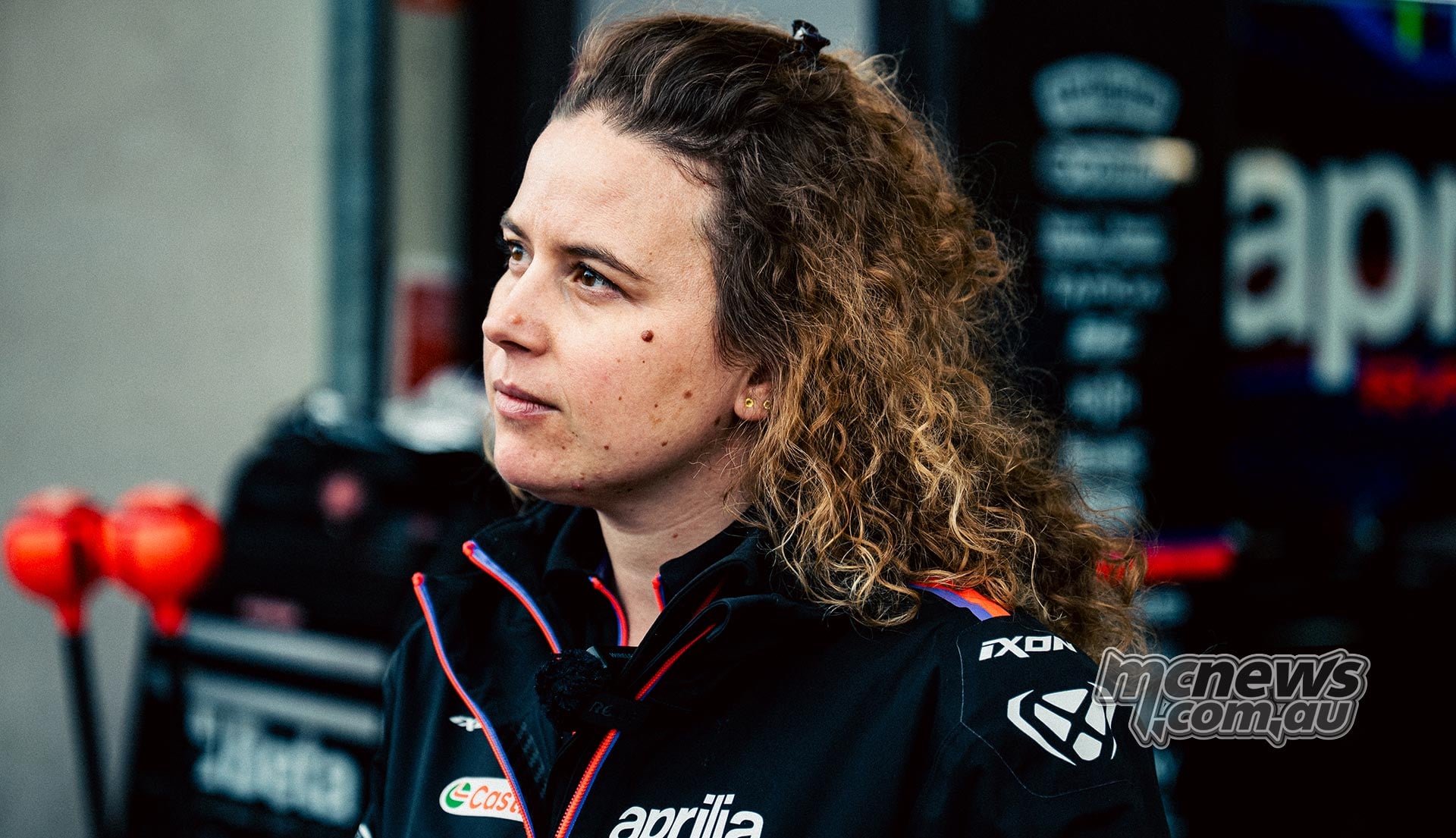


Elena De Cia
Meet Aprilia’s mathematician
Give Elena De Cia four anonymous sets of Aprilia MotoGP data and ask her to assign a rider’s name to each; she reckons she could do it with around 90 per cent confidence.
In the way they combine the rear brake with engine braking and their relationship with the throttle, Jorge Martin, Marco Bezzecchi, Ai Ogura and Raul Fernandez each leave their own signature in the numbers.
For most of us, recognising them involves a helmet, a race number or a particular way of hanging off a motorcycle. De Cia has another way of getting to know them.
She is Aprilia Racing’s Strategy & Data Analysis Lead, a mathematician whose work reaches across the RS-GP’s electronic controls and the methods used to understand its performance. When I caught up with her at Phillip Island, she offered a fascinating look at how the numbers become something a rider can use.
Two passions, one opportunity
De Cia studied mathematics in Padua, near Venice. Applied mathematics particularly interested her: taking numbers and turning them into information about the world around her.
Motorcycles were already another passion. When Aprilia was looking for a mathematician for a master’s degree project, the opportunity brought the two together.
Elena De Cia
“I was a fan of motorbikes. Aprilia was looking for a mathematician for a master’s degree, and I said, ‘I have to try. If not, you can never know.'”
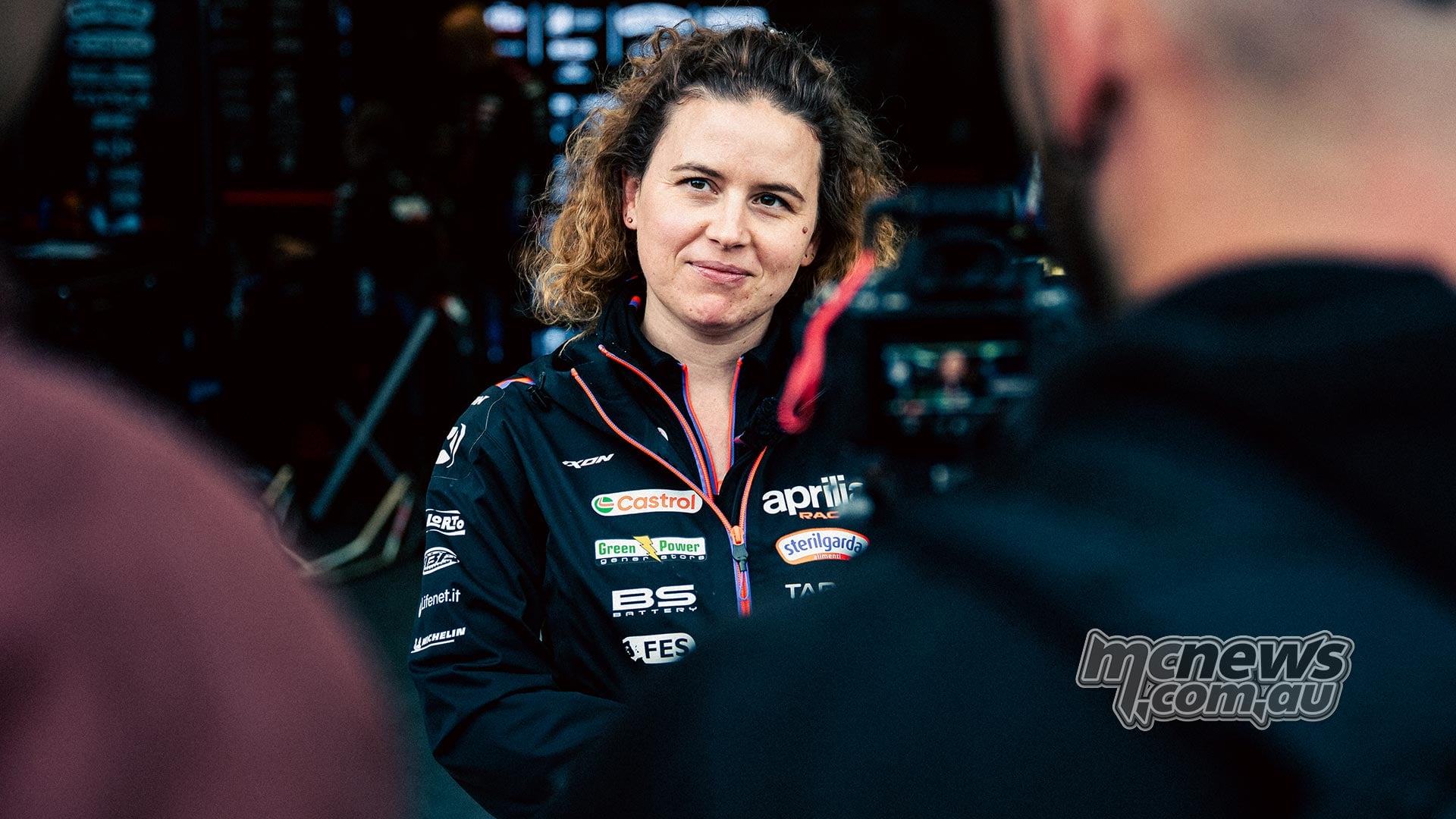
The attraction went well beyond getting a job in a MotoGP paddock. Here, she could test the usefulness of her work on the very next run.
Analyse the numbers, draw a conclusion, help the engineers make a change, then send the motorcycle back out. The next set of data and the rider’s response provide another opportunity to learn. Sometimes the outcome confirms the thinking. Sometimes it sends everyone looking for a detail they missed, or a different way of approaching the problem.
Elena De Cia
“When I could put these two passions together, it was like a dream. You are bringing many numbers, but then you can see directly, the run after, if this information was good and how you can improve.”
In the middle of the information
Ask De Cia to explain where she sits within Aprilia’s technical structure, and the answer quickly spreads across several departments.
Her responsibilities cover electronic control strategies and the methods that allow data to be analysed as quickly as possible during a race weekend. Each rider has a strategy engineer working close to the crew chief, and those engineers are her direct contacts.
Beyond that, she works with the engine, tyre and vehicle engineers. Their areas all affect what the electronics need to achieve.
A crew chief’s choice of motorcycle setup influences the required calibration. Tyre behaviour and consumption have to be considered. The engine engineers need to be involved because the maps govern how the engine delivers its torque. A useful change has to make sense across those relationships.
Elena De Cia
“I try to stay in the middle of all the information, try to collect it and then deliver to the guys how to calibrate as best as possible.”
So, I suggested, she is the filter.
“We can try to say it like this, yes,” she replied.
It is a useful way of understanding the job. Information comes from different sensors, different riders, and different ways of describing what a motorcycle is doing. Her group helps turn it into something the engineers beside each crew chief can act on.
Four riders, four signatures
That process needs to accommodate four distinct riders. De Cia finds their differences particularly interesting because they demonstrate how similar performance can be achieved in different ways.
Braking is one example. A rider might prefer smoother engine braking and do more of the adjustment with the rear brake. Another might want a different balance, using the rear brake to make only a small correction.
There are differences in how they want the front of the motorcycle to behave under acceleration, too. One rider may be comfortable allowing the front wheel to stay up for longer; their throttle use and the response they want from it add further clues.
Those habits become familiar enough that, when I asked whether she could identify the riders from blind data traces, De Cia immediately thought it was possible. Then came a mathematician’s qualification: you can never say 100 per cent. Around 90 per cent, though, she thought they could manage.
She also pointed towards something visible to anyone watching the television coverage: how differently the riders move on the motorcycle. Their body position affects the outcome, even where that movement is not apparent in the data she is examining.
The traces therefore need to be understood alongside the person producing them. A calibration that suits one rider’s use of the rear brake or tolerance for wheelie may need adapting for another.
A map for almost every part of the lap
In this context, the word ‘map’ covers a substantial collection of settings.
De Cia runs through ignition and fuelling, throttle and exhaust-valve control, torque delivery, engine braking, wheelie control, launch settings, rev limiting and gear changes. Some concern the basic operation of the engine and its actuators; others shape how the motorcycle responds to the rider and the track.
A rider’s preference for smoother or more aggressive delivery is part of that work. So is deciding how the controls should behave at different points around the circuit.
Elena De Cia
“We can set up this set of strategies each corner, so corner by corner, and something also gear by gear. We can really define almost each point of the track.”
Phillip Island provides a particularly vivid example. Through the fast, flowing Turn 3, a rider can be managing a substantial slide. One corner later, at the slow Turn 4 hairpin, the demands on the motorcycle are very different.
I asked how far the electronics let the riders off the leash through Turn 3. De Cia’s answer focussed on the distinction between the two corners: their calibrations belong to completely different families.
Traction control and stability control both fall under that umbrella. The settings need to suit what produces performance in each situation.
Watching an RS-GP sweep through Turn 3 and then accelerate away from the hairpin, we see the rider dealing with two very different challenges. The motorcycle’s controls have been calibrated to reflect that change as well.
Making the next run count
When we spoke, Aprilia was working through the preparation that fills Wednesday and Thursday at a Grand Prix.
That means bringing people up to speed on new items and ideas, understanding each rider’s run plan, discussing tests and anticipating the conditions or problems the weekend might present.
Once practice begins, the first rider comments and the first data start testing those plans. One immediate question is whether a useful finding from one rider can help the others.
Sharing that information quickly gives all four an opportunity to improve sooner. With short sessions and a field operating at such a high level, time spent reaching a decision matters.
Alongside the search for performance sits another responsibility: making sure the motorcycle is behaving as expected.
A questionable sensor reading, a concern about an engine or a set-up that is producing an unexpected response can demand intervention. The rider might need to change bikes while the engineers investigate, allowing the session to continue while the problem is examined.
Elena De Cia
“It’s important to have these two views: reliability and performance.”
The flow of information from the rider also needs managing. De Cia explained that microphones allow the staff to hear the rider’s comments in the garage. A mechanic hearing a complaint about ergonomics, for example, can begin dealing with it directly.
Her own communication during a session goes through the strategy engineers, crew chiefs, telemetry or performance engineers. The crew chief remains the rider’s main reference, giving the discussion a clear point of contact.
After the race, the conversation opens out. Each rider gives feedback in front of the wider staff, providing an opportunity for more detailed questions and a review of the weekend.
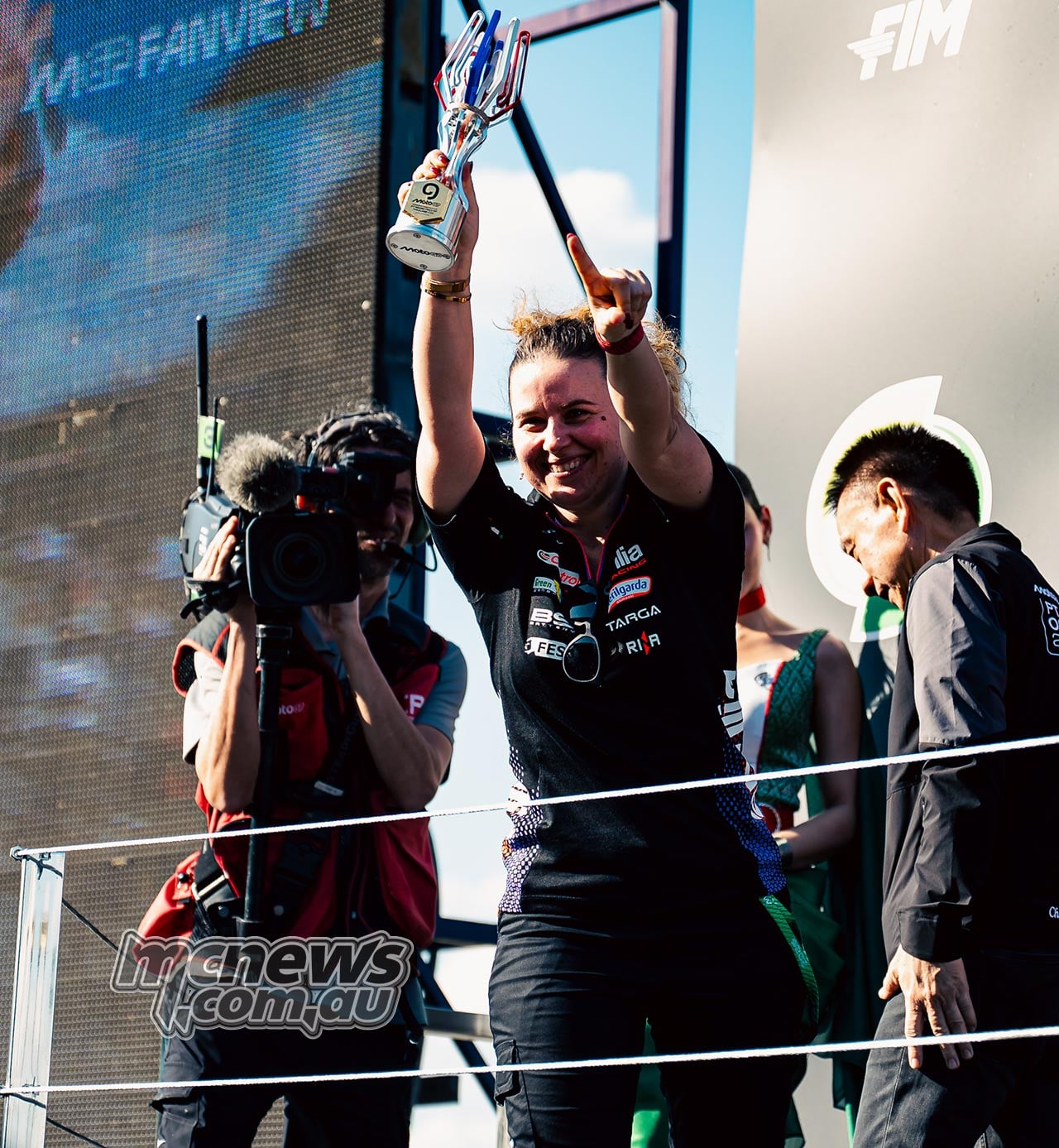
The work continues in Noale
A flyaway round does not mean a smaller travelling group doing De Cia’s work at the circuit. She says the personnel remain the same across the calendar.
Support also comes from Aprilia’s base in Noale, where colleagues can examine the data remotely. European rounds make it easier to work together in similar hours, but the time difference at a distant event can have advantages of its own.
If an issue emerges during the Australian day, or the team identifies something it wants to improve after the opening sessions, the people back in Italy have their working day to investigate it.
As De Cia put it, there are pros and cons to being far away.
Why 2027 could make the job harder
MotoGP’s 2027 regulations will bring 850 cc engines, reduced aerodynamic freedom and a ban on ride-height and holeshot devices. The move to Pirelli adds another major change.
I asked whether fewer devices and less engine performance might make her work easier, or whether removing some of the tools used to control the motorcycle would make it harder.
De Cia expects a demanding transition. The bike and the tyres are changing together, and Aprilia will have to understand quickly how the knowledge in its existing database translates to the new package.
The opening races will require particularly close analysis. Meanwhile, reduced aerodynamics and the removal of devices leave every manufacturer looking for other ways to gain an advantage.
Elena De Cia
“You can never stop the development.”
She makes another telling point: the closer you get to the limit, the harder it can become to identify what matters. Having more data and more sensors does not remove that difficulty. The decisive detail still has to be found among everything else.
Elena’s fingerprint
To finish, I asked De Cia what she would put her name to within the RS-GP programme. What contribution was she most proud of? What could she point towards and say, ‘Elena did that’?
Her answer went straight back to the subject that brought her into racing.
Elena De Cia
“I hope the way to look at the numbers.”
She described a shift in thinking when a run ends. The data has been collected; the next question is how it can help the team make a decision.
The tools and methods she helps develop encourage colleagues to bring information together, use statistical techniques and identify trends across the available data. Seeing those methods adopted gives her particular satisfaction.
Elena De Cia
“As a mathematician, I’m so happy when my colleagues are using statistical methods, or they change the way they look at the data.”
It is a contribution that can spread through a team: a better question, a clearer trend, another engineer seeing something useful before the rider goes back out.
She came to Aprilia because it offered a way to bring mathematics and motorcycles together. Her contribution now reaches into how the people around her think, work and go racing.