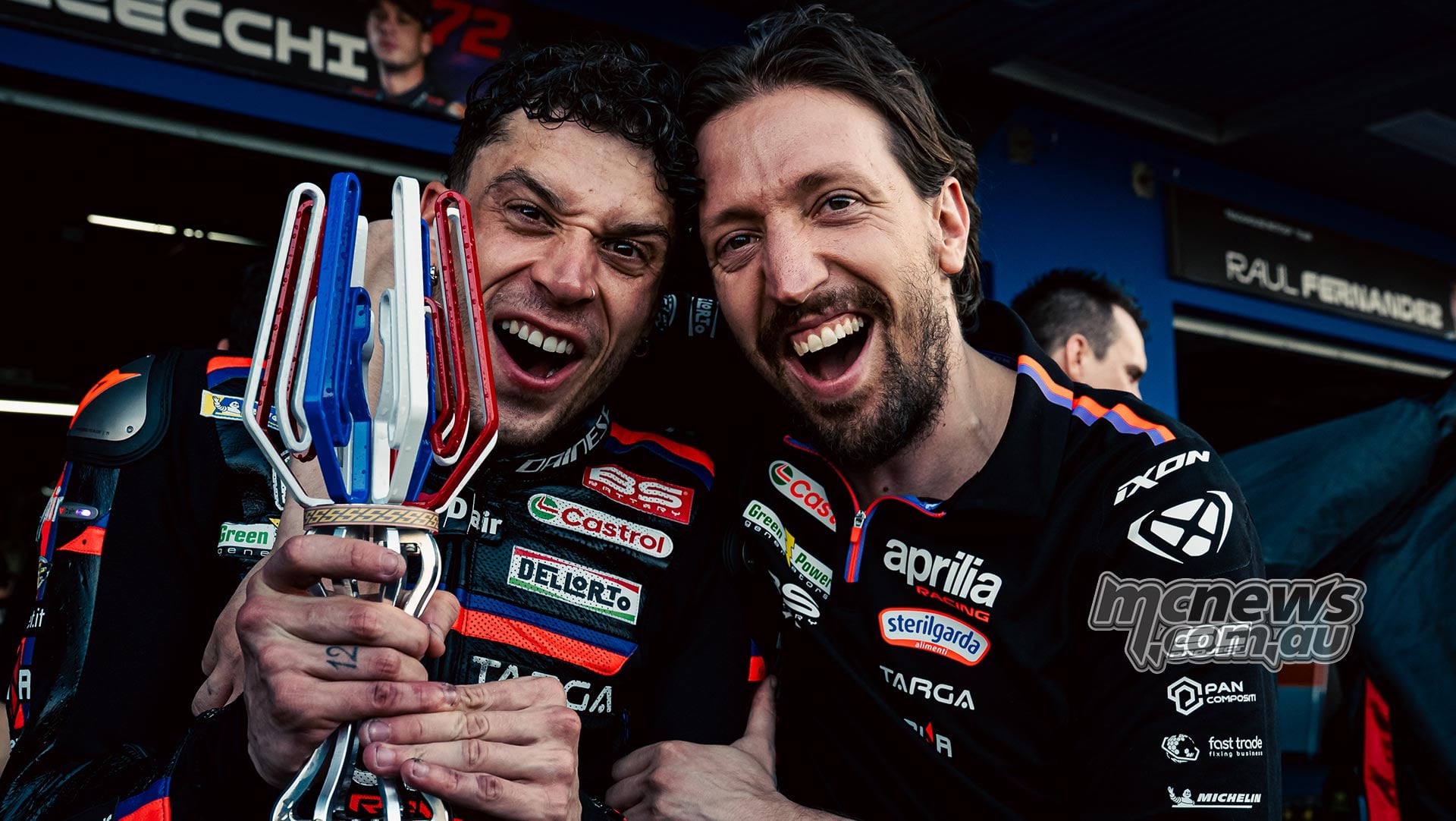


Four riders, four approaches
Inside Aprilia with Pasquale Valente
When a new component arrives from Noale in Aprilia’s MotoGP garage, Pasquale Valente needs to know how it will be fitted, who will test it and what the engineers expect to learn.
He also needs to make sure it works alongside everything already on the motorcycle. A promising development has to survive the practical business of fitting it, checking it and sending a rider down pit lane with it and then ensure it doesn’t detract from any other area of performance..
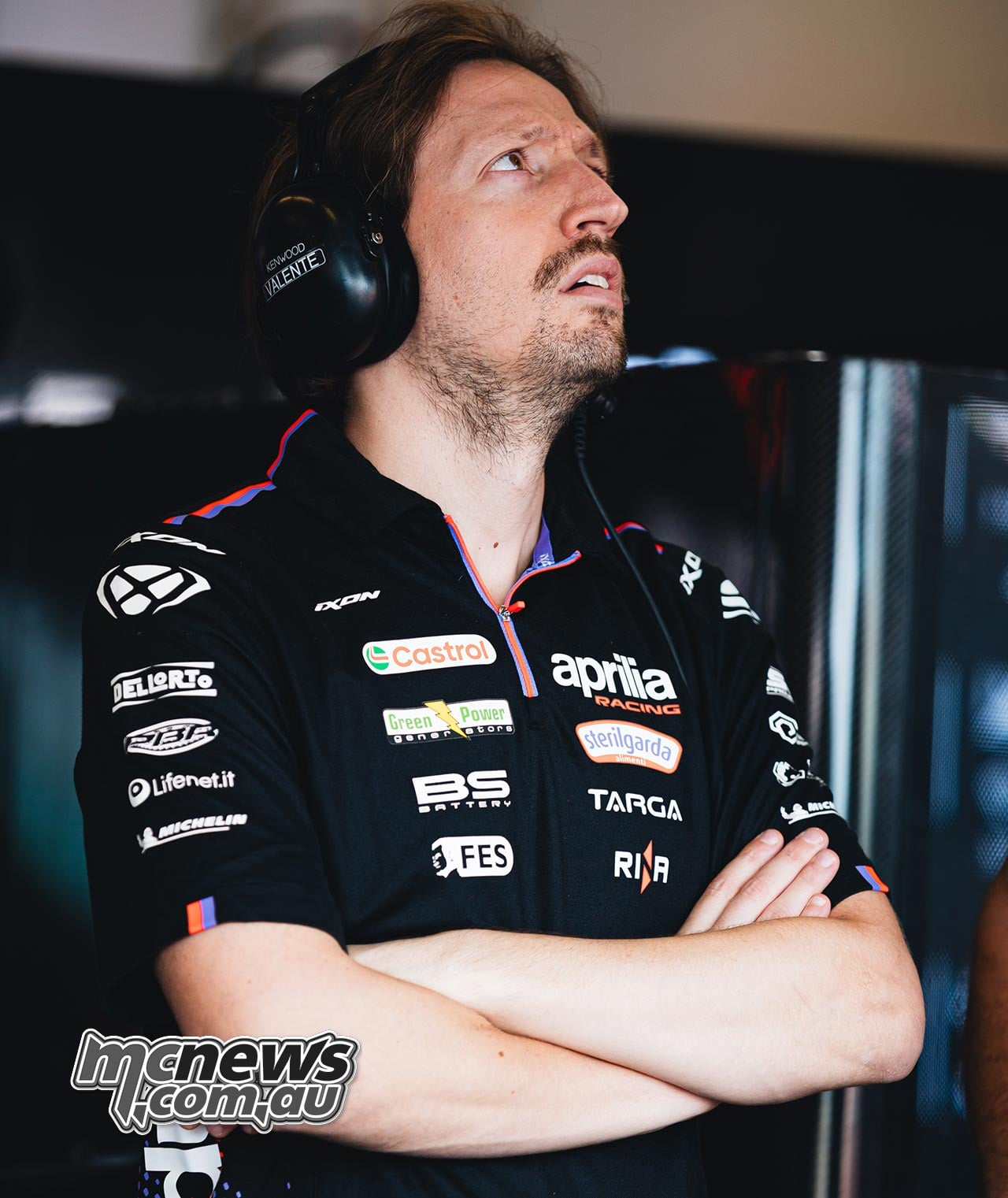
A mechanical engineer within Aprilia Racing’s vehicle department, Valente is responsible for the vehicle side at the circuit. He reports to Marco De Luca and Fabiano Sterlacchini on the motorcycle’s mechanical reliability, while helping information flow between the factory and the people running the bikes.
Speaking with MCNews.com.au at Phillip Island, he identified that communication as one of the most important parts of his job.
Pasquale Valente
“It’s important to give headquarters the right information to develop the bike, or to say that we have some problems to solve.
“Then, when new parts arrive on track, I have to explain and manage these parts for the engineers and mechanics, trying to be sure that these parts work well and there are no failures on the bike.”
Getting the motorcycle ready
Much of that work takes place before the first practice session. On Wednesday and Thursday, Valente works with the mechanics and crew chiefs to establish the weekend’s test programme.
If new components are available, he discusses the plan with Sterlacchini and the crew chiefs. One rider might assess one development while another tries something different. Once those decisions have been made, Valente explains the programme to the mechanics and oversees the installation checks.
Those checks include ensuring no unwanted contact occurs between components that could cause a problem for the rider.
The existing equipment receives attention, too. Even at a race with no new parts, the motorcycles are dismantled and components inspected after the previous Grand Prix. Crash damage can mean particular scrutiny of items such as radiators and frames, with anything unfit for use replaced.
Pasquale Valente
“Our goal is that the bikes are mechanically perfect, to avoid any failures during the weekend.”
Once the sessions begin, sensors and data help Valente assess whether the motorcycle and its components are working correctly. His analysis also extends into performance.
If a new part is reliable and producing a useful improvement, he can advise the crew chiefs that it deserves wider use, including passing it to another rider. That makes his work part of the process of deciding which developments the team will race.
By Sunday, the aim is to have confidence in those choices. The final stage is familiar to anyone who has prepared a racing motorcycle.
“During the races, you cross your fingers and hope that all goes well.”
A rider preference or a motorcycle limitation?
Valente also works with Trackhouse, bringing the experiences of four riders into the development picture. Their different techniques provide useful information, but interpreting it requires care.
A comment might describe a limitation in the motorcycle, or it might reflect how a particular rider wants to use it. Understanding that distinction helps Aprilia decide whether to pursue a solution for that rider or a development that could benefit everyone.
Pasquale Valente
“One important thing is to understand if the rider’s comment is due to his riding style or due to the behaviour of the bike.
“If we can distinguish this, we can develop a solution for the rider, or understand that it’s a bike limitation and develop for everyone.”
Asked what stands out about the four Aprilia riders, Valente began with Marco Bezzecchi’s attention to detail. He values the way the Italian listens to advice and builds his weekend through the information available to him.
Pasquale Valente
“He has great attention to detail and he listens to every piece of advice from us. He builds his weekend trying to get better and better with every video, every piece of telemetry data, every piece of advice from his engineers.”
Jorge Martín places considerable emphasis on the electronics and adapting his technique as the weekend progresses. Valente explained that his braking on Sunday can look different in the data from his approach on Friday, as he works out how to get more from the motorcycle.
Ai Ogura stands out under braking, particularly in trail braking. Valente highlighted how long the Japanese rider can remain on the brakes, suggesting that his technique may also help him conserve the rear tyre.
Raúl Fernández, meanwhile, is particularly effective with the throttle, using it to help turn the motorcycle.
Those differences give the vehicle department several ways of examining the same RS-GP. Rider comments and data are both needed to understand what each is finding.
Predictability in the wind
Phillip Island brings another variable into that work: wind that can alter the forces and turning moments acting on the motorcycle’s aerodynamic surfaces.
A change in wind direction or speed can change the way the bike behaves. For Valente, the interaction between aerodynamics and vehicle dynamics makes consistency particularly important.
Pasquale Valente
“One of the most important things for the rider is that the behaviour of the bike is predictable.”
He wants a motorcycle that retains that predictability across different components, tyres and environmental conditions. Aerodynamic efficiency has to be considered alongside the confidence the rider has in the bike when braking or opening the throttle.
When I suggested that understanding the effects of a windy session might depend primarily on rider feedback, Valente’s answer was immediate: both the rider and the data contribute.
Aprilia has aerodynamic parts it can change to address those conditions, as well as advice it can give its riders. CFD simulation and development for different circuit characteristics also form part of the preparation.
Keeping heat in the brakes
Another Phillip Island concern comes from how little time the motorcycles spend braking.
Valente highlighted the circuit’s limited braking phases as a challenge when the ambient temperature drops or rain arrives. Keeping sufficient heat in the brakes becomes part of ensuring that the rider can trust them.
MotoGP’s carbon brakes need temperature to work effectively, and Aprilia has different disc covers and associated components available to help manage that.
The biggest change for the 850
Valente is also involved in Aprilia’s 850 cc project. Asked what had presented the biggest uncertainty when work began, he pointed to the tyre.
He had no previous experience working with Pirelli, making its characteristics a significant new element to understand. The removal of ride-height devices, by comparison, presented changes the engineers could begin to anticipate through their knowledge of the motorcycle.
Even so, the combined effect of different tyres, reduced aerodynamic freedom, lower weight and the loss of those devices reaches into the fundamental layout of the bike.
Valente identified the centre of gravity, frame stiffness and swingarm stiffness among the areas affected. The behaviour of the rear tyre will be particularly important in understanding how the complete motorcycle works.
He also described a possible consequence that complicates the idea of simply giving an 850 less aerodynamic load.
Pasquale Valente
“With no ride-height device, you will have more wheelie, so maybe you will need a front wing with more vertical downforce.”
That additional front load would then have to be balanced with the demands elsewhere in the lap. He raised it as one of the trade-offs being considered for the new motorcycle.
“It’s a balance between all of these things.”
He believes Aprilia’s early ideas are taking the project in the right direction. For the engineers, the scale of the change also brings plenty to get their teeth into.
“Very, very challenging, and we’re excited.”
Finding time for the next motorcycle
When I raised the importance of the off-season, Valente’s response offered a reminder of how little uninterrupted time the race schedule leaves.
Between returning from the final events, Christmas, assembling the motorcycles and preparing to head to Sepang, he put the available gap at something like 15 days.
The development work has to be moving well before that. Valente pointed to the preparation for the Spielberg test and the work already under way for Valencia, with further solutions to assess at Sepang.
Aprilia is doing all of that while pursuing the current championship. Both the factory and the people at the circuits have had a busy 2026, he acknowledged, with the next project demanding attention alongside the present one.
The people behind the parts
To finish, I asked Valente which personal contribution to the current RS-GP he would put on his résumé.
He eventually identified work on the motorcycle’s overall weight and weight distribution. First, though, he returned to the relationship between the people developing and running it.
Pasquale Valente
“The performance of the bike is a balance between aerodynamics, structural stiffness and tyre behaviour. The performance of the team is the same.”
His own work has to fit with Sterlacchini’s, the crew chiefs, mechanics and the vehicle, electronics and engine departments back at the factory.
Over time, he explained, people learn how their colleagues work. Understanding which areas a particular crew chief focuses on helps Valente judge how he can be most useful, and how his approach might need to change when working with someone else.
Pasquale Valente
“Year by year, we work better, we know each other better.
“The human component is very important.”