

2015 Suzuki GSX-S1000 Review
2015 Suzuki GSX-S1000F Review
Originally tested in 2015.
Prices and model comparisons refer to the Australian launch.
Nakedbike fans have been turning GSX-R1000s into streetfighters for years. More often than not, my reaction has been: why ruin a perfectly good sportsbike?
Off came the fairings, on went a random set of flat bars, and the finished product frequently looked like a crashed GSX-R whose owner couldn’t afford to fix it properly. A few were worthy objects of desire. Most were just crap.
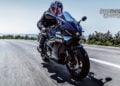
Suzuki has now taken on the job itself, with rather more engineering behind the exercise. The result is the GSX-S1000, joined by its faired GSX-S1000F sibling, and both make a convincing case for putting GSX-R muscle into a more comfortable road-going package.

There is plenty of grunt, sensible ergonomics and enough practicality to make it an everyday proposition. Crucially, Suzuki has kept the fun.
The Australian launch pricing also deserves credit. At $14,990 plus on-road costs for the naked bike, Suzuki has resisted the temptation to attach a silly new-model premium and then slash it once the initial excitement fades. Other manufacturers, please take note. The GSX-S1000F adds $800, taking its asking price to $15,790 plus on-road costs.

A familiar name and a very good engine
My affection for Suzuki fours predates the GSX-R. My first road bike was a GS750, complete with flat-slides, hot cams and what must have been the loudest shorty exhaust in Western Australia. It shrieked across the countryside as only an air-cooled four could.
I also owned a GSX750F. It’s okay; I didn’t have it long…
The GSX-S1000 draws on a rather more celebrated member of the family. Its 999 cc four-cylinder engine has its roots in the 2005-2008 GSX-R1000 generation, beginning with the much-loved K5. For plenty of road riders, that engine remains one of Suzuki’s finest.

The attraction is its flexibility. Suzuki has adapted that longer-stroke engine architecture for a bike that will spend most of its life on the road, with less aggressive camshafts and an emphasis on low- and mid-range performance.

There are lighter pistons, 44 mm throttle bodies using Suzuki’s familiar SDTV dual-butterfly arrangement, and a compact coolant-fed oil cooler that helps with packaging around the engine and exhaust headers.
The GSX-R family connection extends to other components, but describing the GSX-S as a sportsbike with its fairings removed would sell the development work short. Its aluminium twin-spar frame was designed for this application, bringing the engine and running gear together around a more upright riding position.

Plenty of grunt where it matters
Suzuki claims 107 kW, or approximately 143 hp, at 10,000 rpm, with peak torque of 106 Nm arriving at a surprisingly high 9500 rpm.
The figures recorded on Phil Tainton’s dyno were healthy, with the GSX-S machines producing between 147 and 152 hp depending on the gear used for the run. The useful comparison is with other machines tested on that same dyno: a K5 GSX-R1000 recorded 161 hp, while the 2015 GSX-R1000 managed 176 hp.
That puts the GSX-S around 9-14 hp behind the K5 and 24-29 hp behind the contemporary GSX-R1000 in those tests. Some top-end performance has been traded away, but there is still considerably more here than most riders will regularly use.
More relevant is what happens at everyday engine speeds. Around 4000 rpm, where the GSX-S sits at a highway cruise, it feels particularly strong. There is ample drive without having to chase the upper reaches of the rev range, although the engine remains keen to play when you do.
The fuel injection and engine management have moved on considerably since the K5, yet the response still feels unmistakably GSX-R. There is a pleasing connection between your right hand and the rear tyre, without that frustrating sense of a computer considering your request before deciding how much acceleration you deserve.
Some riders might find the initial throttle response abrupt. I didn’t find it objectionable. There is a little driveline lash, which can amplify a ham-fisted transition on and off the gas, but it did little to detract from an otherwise excellent drivetrain.

A gearbox worth using
I have always liked GSX-R gearboxes, and a little time away from them had almost made me forget just how satisfying a good gearchange can be. Up or down, the GSX-S shifts precisely, positively and without fuss.
There is no quickshifter. With a gearbox this sweet, I didn’t particularly miss one. Working through the ratios is part of the pleasure.
Nor is there a slipper clutch on these original models. Again, its absence didn’t spoil the experience. Coordinate your braking and downshifts properly and the Suzuki behaves well. Grab a fistful of Brembo and stamp down through the gearbox without much thought, and you are asking more of the rear tyre.
That might sound like making excuses for missing equipment, but the distinction is how well the underlying motorcycle works. A quickshifter and slipper clutch would be welcome additions; neither felt essential to enjoying this bike.
I am a big supporter of motorcycle technology. I also appreciate the connection you get when the mechanical basics are this well sorted.

A taller sixth gear would be on my wish list. It would calm things a little on the highway and leave more scope to shorten the final gearing for extra punch in the lower ratios.
There is a minor tingle through the bike at around 5000 rpm. It wasn’t enough to annoy me on the launch, but shorter gearing could put that vibration closer to your normal cruising speed. Given the engine will pull from as little as 1500 rpm in top, I doubt I would bother changing the sprockets.
It certainly doesn’t need help lifting its skirt. On standard gearing, that generous mid-range makes the front wheel easy to loft and remarkably easy to keep aloft. Just when you think it is coming down, there is another helping of torque to keep things entertaining.
Shift early, ride the torque, click another gear. It is that sort of engine.

Comfort and everyday practicality
The ergonomics worked well for me on both variants. The rider’s seat is supportive without being too firm or too soft, and there are no awkward edges digging into your legs.
I didn’t try the pillion accommodation, although it doesn’t look especially inviting for anything beyond a short hop.
The bike feels slim between the knees and is easy to climb aboard. In fact, the narrow shape makes it feel more accessible than the already modest 810 mm seat height might suggest. Cornering clearance is also quite reasonable given how low you sit.

The 17-litre tank should provide useful range. Based on our 600 km launch ride, I would expect around 240 km even when ridden hard, with something closer to 300 km plausible in normal use. Those are estimates from the launch, rather than a measured run to empty, but the bikes certainly seemed frugal.
The instrumentation does its job well. I have yet to meet an LCD tachometer I really like, although Suzuki’s effort is better than most. The mirrors provide a decent view and remain usefully clear.

The GSX-S1000F springs a surprise
The biggest surprise came when swapping between the two models. The faired GSX-S1000F turned in and steered noticeably better than the naked bike, with a more agile and sporting feel from the front end.
Suzuki’s explanation centred on a small difference in fork oil level. The F has a little more oil in its fully adjustable 43 mm KYB forks, reducing the air gap. Suzuki told me the change accommodated the additional aerodynamic load from the fairing at speed.
Whatever the full explanation, the difference was clear from the saddle. The F’s fork set-up is something I would investigate if I owned the naked version.

The rear shock offers preload and rebound adjustment and coped well with our reasonably brisk road pace. Track work or regular two-up riding might expose its limitations, but neither was part of this test.
Serious nutters will probably want an Öhlins TTX. Everything deserves an Öhlins TTX. I want one on my office chair.
Adding a little preload at both ends and some compression damping up front sharpened the response, with the predictable trade-off of reduced comfort when the road deteriorated. Even on the standard settings, though, the Suzuki holds a line well and is no wallower.
Suspension is one area where the more expensive opposition can justify some of its premium. A good semi-active system would broaden the bike’s ability to deal with changing surfaces and loads. The conventional KYB equipment nevertheless delivers a useful balance of control, adjustability and comfort at this price.

Brembo brakes, ABS and traction control
The radial Brembo monobloc front calipers provide plenty of stopping power. Initial bite is gentler than on the GSX-R, which suits the softer road-focused fork set-up.
A different pad compound could add some bite if that is your preference, but I felt no pressing need to change anything.
Both Australian models have ABS and traction control as standard. Of the two systems, the traction control impressed me more.
There are three intervention settings, plus the option to switch it off. In the less intrusive settings, it allows the front wheel to skip briefly clear of the road without immediately shutting down the fun. More pronounced differences in wheel speed bring stronger intervention.
It isn’t lean-angle sensitive, but it is a useful addition for commuting and riding in variable conditions. For much of the time it works unobtrusively enough to leave you enjoying the engine.

The Bosch-controlled ABS also works reasonably well. There are more sophisticated systems on some of the dearer alternatives, but the Suzuki’s braking package does a good job at the road pace we maintained.
Suzuki GSX-S1000 verdict
Suzuki has taken one of its best-loved engine designs and built a thoroughly enjoyable road bike around it. The engine is muscular and engaging, the gearbox is a delight, and the chassis combines sporting ability with reassuring stability.
There are compromises. I would like a taller top gear, the rear suspension has scope for improvement, and the original electronics don’t match the most sophisticated systems available. None of that stopped me enjoying the ride.
The GSX-S1000F adds another twist by feeling sharper through the steering, despite carrying the extra bodywork. That makes it worth riding both before deciding which suits you.
Both deliver comfort, practicality, a decent standard exhaust note and plenty of GSX-R character for sensible money. Suzuki has remembered that a motorcycle like this should make you want to take the long way home. These certainly do.

2015 Suzuki GSX-S1000 / GSX-S1000F specifications
| Engine | 999 cc, liquid-cooled, DOHC inline four-cylinder |
| Bore x stroke | 73.4 x 59 mm |
| Compression ratio | 12.2:1 |
| Claimed power | 107 kW (approximately 143 hp) at 10,000 rpm |
| Claimed torque | 106 Nm at 9500 rpm |
| Fuel system | Fuel injection, 44 mm SDTV throttle bodies |
| Transmission | Six-speed, chain final drive |
| Traction control | Three settings, plus off |
| Frame | Aluminium twin-spar |
| Front suspension | 43 mm KYB inverted fork; adjustable preload, compression and rebound |
| Rear suspension | KYB monoshock; adjustable preload and rebound |
| Front brakes | Twin 310 mm discs, radial Brembo four-piston monobloc calipers, ABS |
| Rear brake | 240 mm disc, Nissin single-piston caliper, ABS |
| Front tyre | 120/70 ZR17 |
| Rear tyre | 190/50 ZR17 |
| Length / width | 2115 / 795 mm |
| Height | 1080 mm; F: 1180 mm |
| Wheelbase | 1460 mm |
| Rake / trail | 25 degrees / 100 mm |
| Ground clearance | 140 mm |
| Seat height | 810 mm |
| Wet weight | GSX-S1000: 209 kg GSX-S1000F: 214 kg |
| Fuel capacity | 17 litres |
| Australian launch RRP | GSX-S1000: $14,990 GSX-S1000F: $15,790 Both plus on-road costs |