
Wednesday, November 4, 2026
MCNews
  • NEWSLatest
  • REVIEWS
  • LATEST BIKES
  • RACING
  • FEATURES
  • TOURING
  • PRODUCTS
  • MEDIA
    • GALLERY
  • MORE
    • INDUSTRY NEWS & EMPLOYMENT
    • POPULAR ARTICLES
    • MCNEWS COMMENTS
    • MAIN FORUM
    • CONTACT US
    • ABOUT US
No Result
View All Result
MCNews
  • NEWSLatest
  • REVIEWS
  • LATEST BIKES
  • RACING
  • FEATURES
  • TOURING
  • PRODUCTS
  • MEDIA
    • GALLERY
  • MORE
    • INDUSTRY NEWS & EMPLOYMENT
    • POPULAR ARTICLES
    • MCNEWS COMMENTS
    • MAIN FORUM
    • CONTACT US
    • ABOUT US
No Result
View All Result
No Result
View All Result
MCNews

Suzuki SV-7S updates the SV650 formula, LAMS version confirmed

Suzuki brings the SV650 formula up to date with riding modes, traction control, a quickshifter and a connected TFT. Full-power and LAMS SV-7S models are expected in Australia around mid-2027.

Trev by Trev
November 4, 2026
in LAMS Learner Approved Motorcycles, LAMS News, Latest Bikes, Motorcycle News, Suzuki, Suzuki News

2027 Suzuki SV-7S

Suzuki’s SV650 formula is heading into another generation, with the new SV-7S adding electronic throttle control, riding modes, traction control and an up/down quickshifter to the familiar 645 cc V-twin roadster.

Australian buyers will have a choice of full-power and LAMS versions, with both expected to arrive around mid-2027. Pricing is still to be announced.
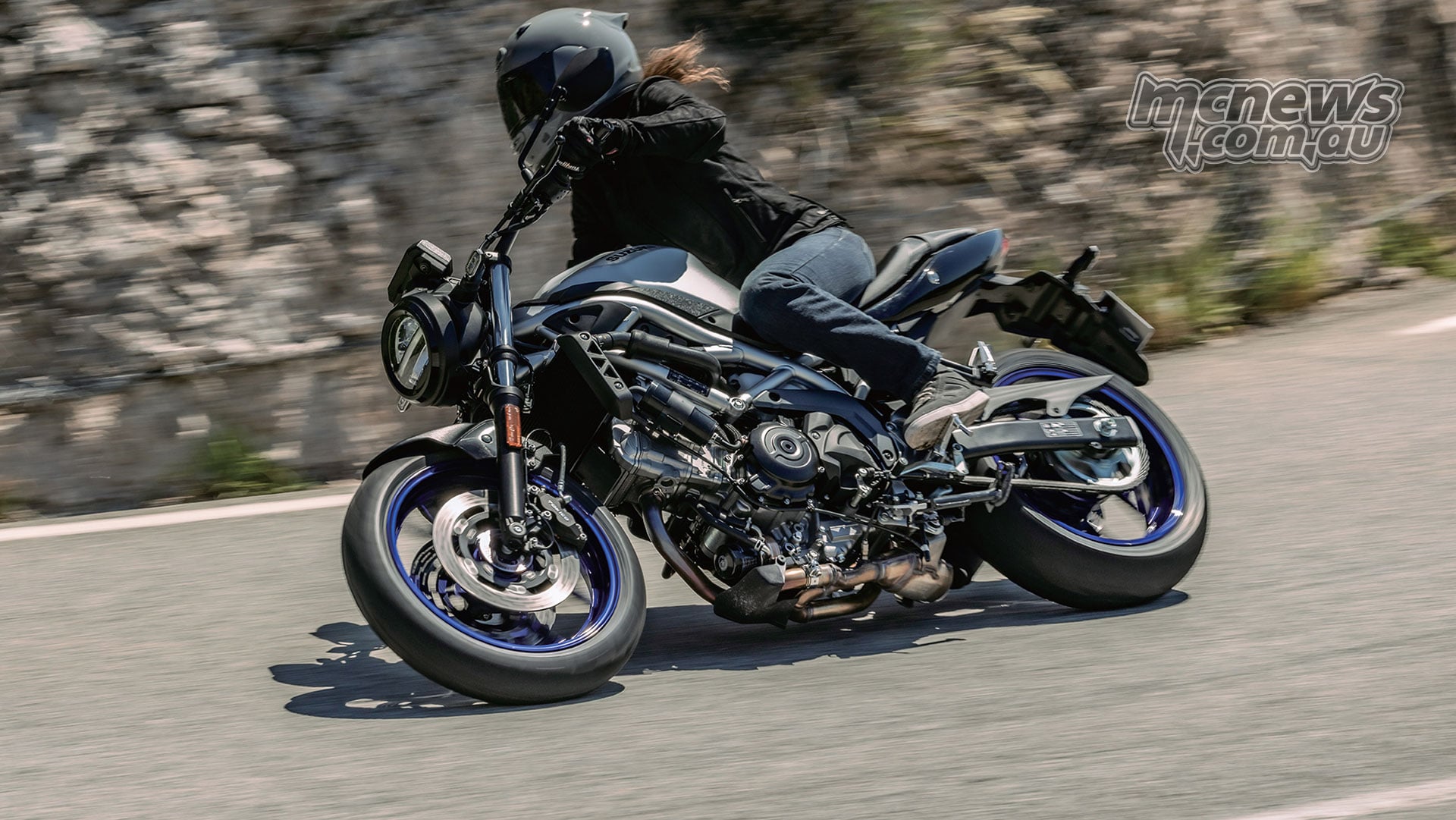
Rider cornering on the silver 2027 Suzuki SV-7S, with its V-twin engine and silver trellis frame exposed.
Suzuki SV-7S: Full-power and LAMS versions are expected in Australia around mid-2027, with pricing still to be announced.

The SV has introduced plenty of riders to motorcycling, carried commuters through years of daily service and provided affordable entertainment on back roads and race circuits. This latest evolution preserves its distinctive V-Twin engine layout, low seat and exposed steel trellis frame while giving it the electronics and instrumentation now expected of a modern middleweight.

The new badge deserves one early clarification: engine capacity remains 645 cc.

The SV V-twin gets another chapter

The liquid-cooled, 90-degree DOHC V-twin uses four valves per cylinder, an 81.0 mm bore and 62.6 mm stroke, with an 11.2:1 compression ratio. Full-power output is quoted at 54 kW, or around 72 hp, at 8500 rpm, with 64 Nm at 6800 rpm. Separate Australian LAMS output figures are not yet available, but we can expect around 48 horsepower.

Right-side studio view of the blue 2027 Suzuki SV-7S, showing its silver frame, V-twin engine and blue wheels.
The new name brings no capacity increase: the SV-7S retains a 645 cc, 90-degree V-twin, with full-power output quoted at 54 kW and 64 Nm.

Suzuki says it has produced more than 500,000 examples of this engine family since its introduction in 1999.

Blue 2027 Suzuki SV-7S ridden past a rock face, showing the left side of its 645 cc V-twin engine.
The 90-degree V-twin remains a clear mechanical distinction from the 776 cc parallel-twin used in Suzuki’s GSX-8S.

Changes for the latest application include updated transmission gears and magneto, along with electronic throttle bodies and revised intake plumbing. Each cylinder is fed through a 39 mm throttle body, while shortened air-cleaner outlet tubes are intended to support power delivery higher in the rev range.

Dual iridium spark plugs per cylinder, coated pistons, low-friction cylinder plating and piston-cooling oil jets remain part of the engine package. The two-into-one exhaust uses an updated catalytic converter, with oxygen sensors before and after the catalyst, to meet Euro 5+ emissions requirements.

Close-up of the Suzuki SV-7S exhaust silencer, satin-finished heat shield and right rider footpeg.
A revised satin-finished silencer cover updates the appearance.
The exhaust incorporates the catalytic converter and sensors for Euro 5+ compliance.

Riding modes, traction control and a quickshifter

Ride-by-wire facilitates the biggest changes in the SV’s equipment. Suzuki Drive Mode Selector offers three settings: Active, Basic and Comfort.

Active gives a sharper throttle response, while Basic is intended to most closely resemble the familiar SV650 delivery. Both retain the quoted 54 kW peak. Comfort softens the response and limits peak output to 45 kW on the full-power model.
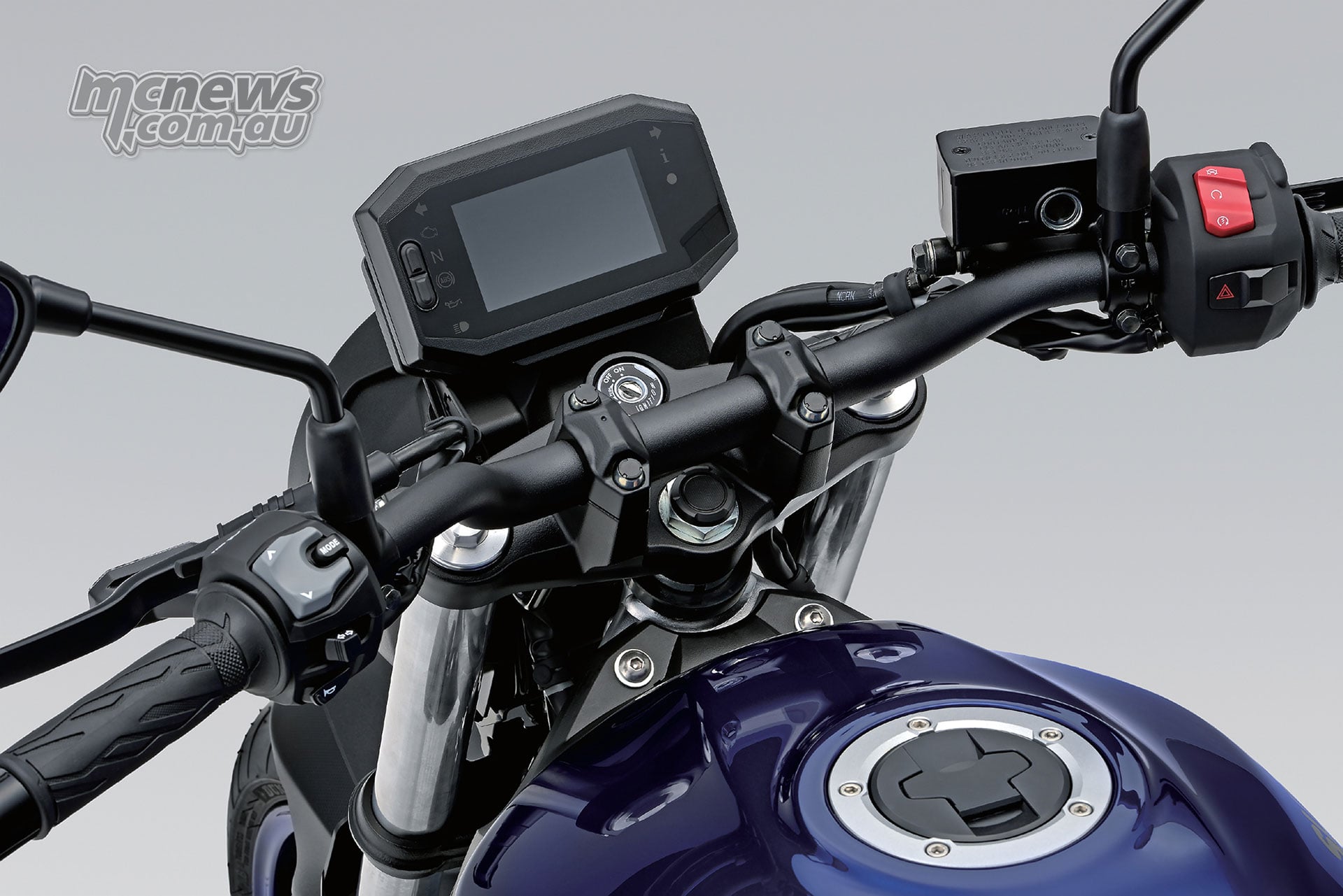
Suzuki SV-7S cockpit showing its tapered handlebar, left mode switch, ignition barrel and compact TFT instrument panel.
The left switchblock controls riding modes, traction control and quickshifter settings.
The new tapered bar is also wider and closer to the rider than the SV650 bar.

Traction control offers three intervention levels and can be switched off.  The system manages rear-wheel slip through both ignition timing and throttle butterfly adjustments.

Blue Suzuki SV-7S leaning through a mountain-road bend, viewed from the front right with its LED headlight illuminated.
Selectable throttle maps and traction-control settings add more ways to tailor the SV formula

The six-speed transmission gains a bi-directional quickshifter, allowing clutch-free changes in both directions. Suzuki specifies operation above 2000 rpm for upshifts and above 1700 rpm for downshifts, with automatic throttle blipping for the latter.

Easy Start and Low RPM Assist continue familiar SV features. A brief press of the starter button initiates starting, while Low RPM Assist helps support engine speed during launches and low-speed manoeuvres. Riding-mode, traction-control and quickshifter settings are adjusted through the left switchblock.

Suzuki SV-7S TFT dashboard in day mode, showing a circular tachometer, fuel gauge, gear indicator and electronic settings.
The 4.2-inch TFT keeps fuel level, gear position and electronic settings together.
This image shows the warning lights and indicators illuminated.

A connected TFT dashboard

A 4.2-inch colour TFT replaces the SV650’s LCD instrumentation. It offers day and night displays, automatic brightness adjustment and smartphone connectivity through Suzuki Ride Connect+ for compatible iOS and Android phones.
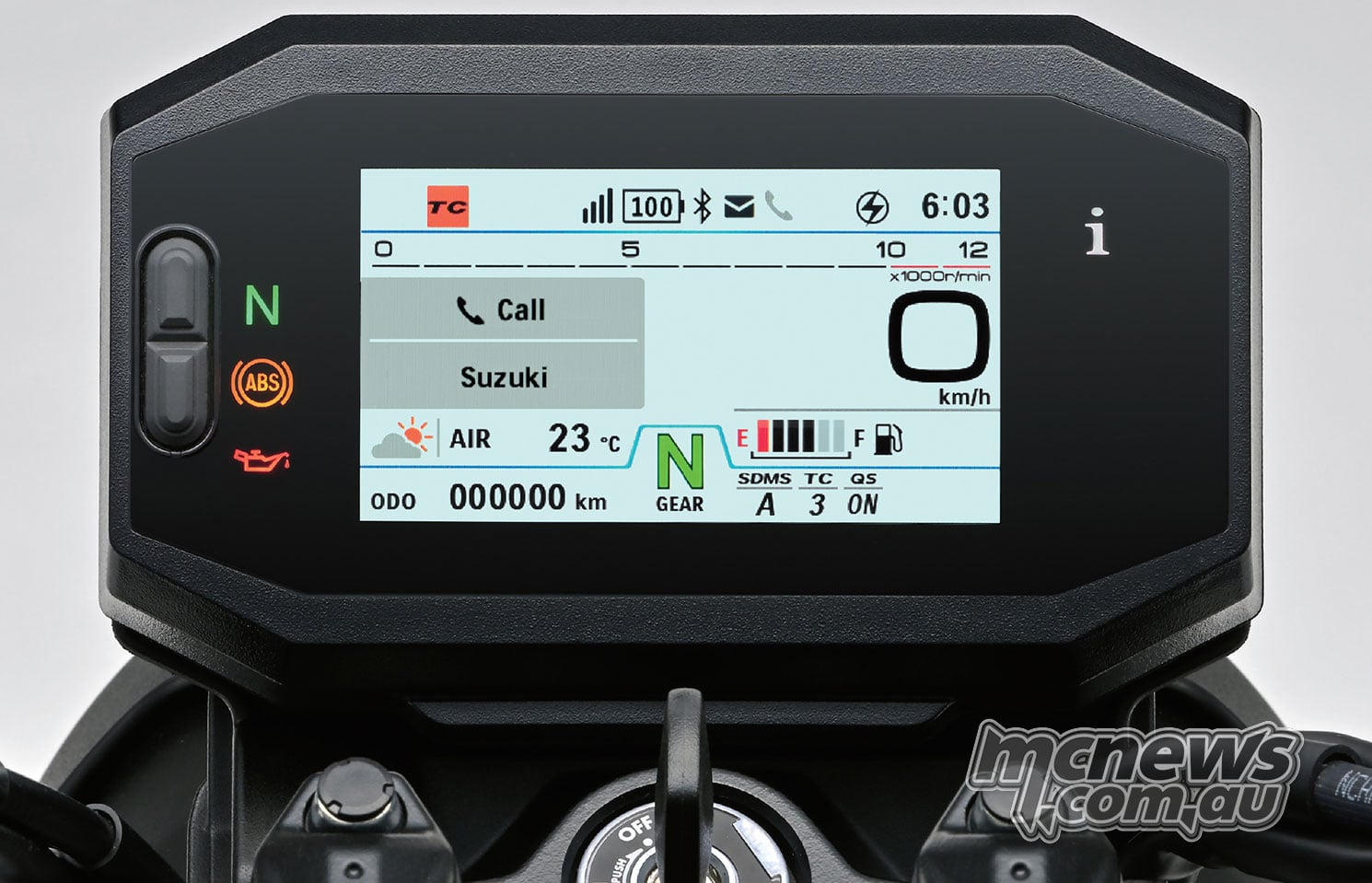
Suzuki SV-7S connected TFT display showing an incoming-call notification, phone status icons and weather information.
Phone pairing adds notifications, navigation prompts and weather information.
The incoming-call display shown here illustrates the connected dashboard layout.

Navigation on the motorcycle display uses turn-by-turn arrows and distance prompts, with arrival and remaining-distance information. The phone handles full map navigation, with voice guidance available through a connected headset. The app also supports traffic and weather information, notifications and a parked-location function.

Functions include a fuel gauge, riding-range information, current and average consumption, gear position, two trip meters, a voltmeter and an oil-change indicator.
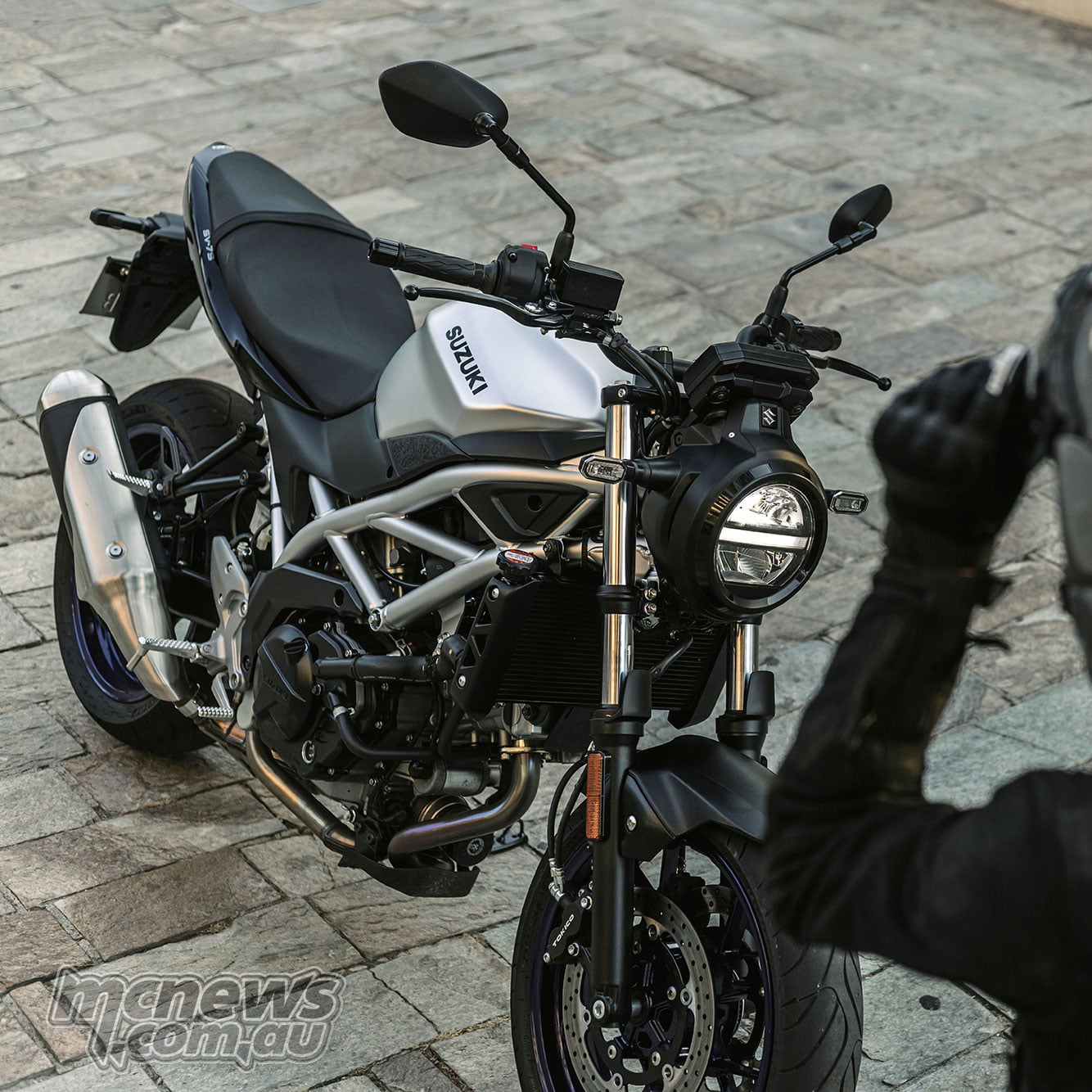
Silver Suzuki SV-7S parked on stone paving beside a rider holding a helmet, viewed from above its front right.
The view from above shows the narrow tank-to-seat junction that accompanies the SV-7S’s 785 mm seat height.

Low seat and familiar SV proportions

Seat height remains 785 mm, with Suzuki retaining the SV650’s seat shape and narrow midsection. Keeping the tank-to-seat junction slim helps make the ground easier to reach.

Close-up of the Suzuki SV-7S stepped rider and pillion seat, with a retaining strap across the rear section.
Suzuki retains the SV650’s seat shape and low 785 mm seat height.

A new 719 mm tapered aluminium handlebar is wider and positioned closer to the rider than the old bar, with revised grip angles intended to provide a more natural hand position. Both the bar and its mounting brackets receive a black finish.

Front three-quarter detail of the silver Suzuki SV-7S, showing its round LED headlight, tapered handlebar and fuel tank.
A round headlight and exposed frame keep the SV family resemblance.
LED lighting and the revised cockpit bring the presentation up to date.

The redesigned fuel tank holds 14 litres and makes room underneath for the additional electronic components. Kerb weight is listed at 200 kg, with a 1445 mm wheelbase, 25-degree rake and 106 mm trail.

The steel trellis frame and steel swingarm remain central to the design, with the engine and frame still prominent parts of its appearance.

Conventional suspension and four-piston front brakes

The suspension package remains straightforward: 41 mm conventional telescopic forks provide 125 mm of front-wheel travel, while the link-type rear suspension offers 129 mm. The rear shock has seven-step spring-preload adjustment.
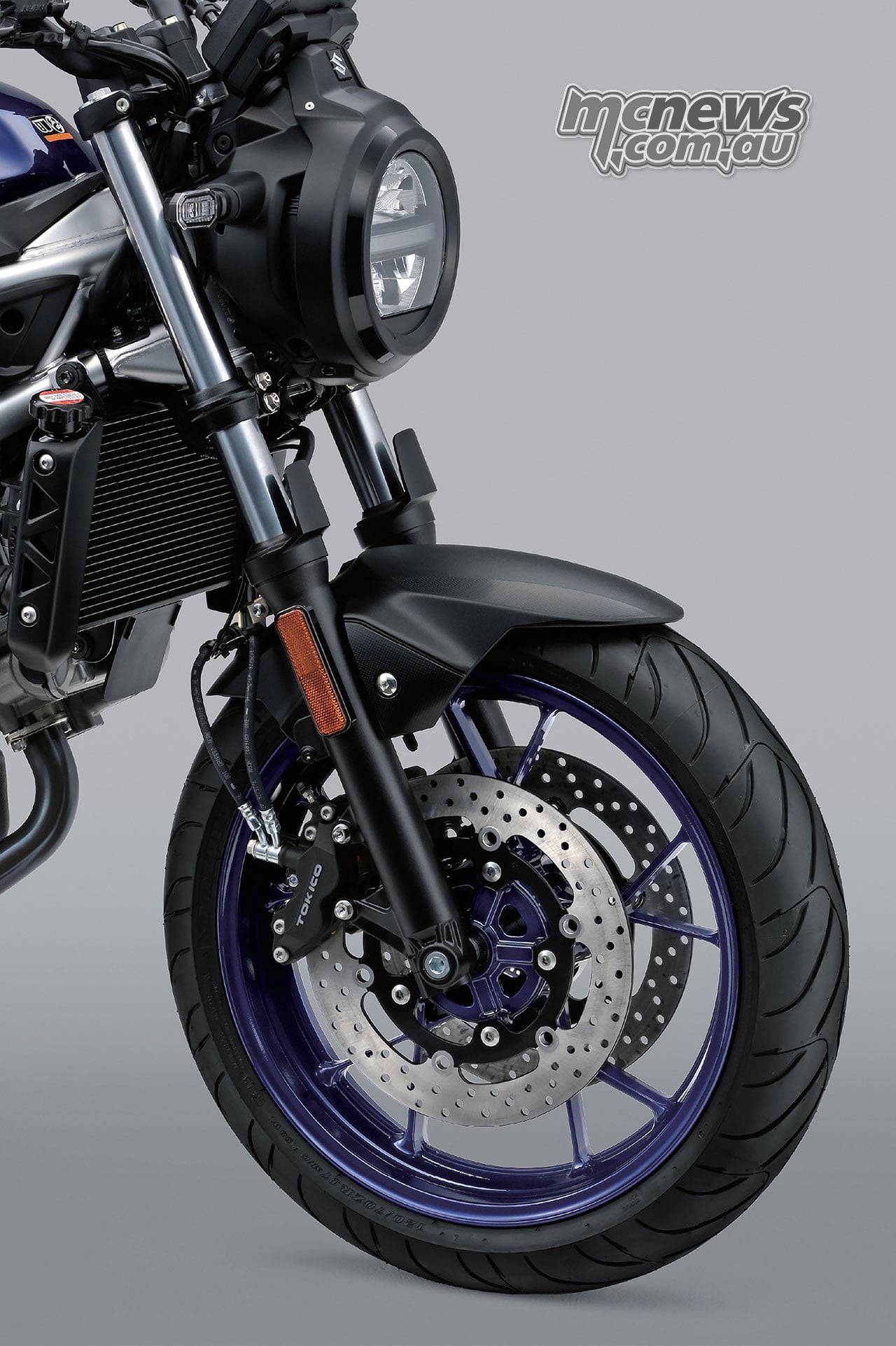
Suzuki SV-7S front-end detail showing conventional telescopic forks, round headlight, front wheel and brake disc.
The front end uses conventional 41 mm telescopic forks with 125 mm of wheel travel.
Suzuki describes the suspension tune as favouring comfort while retaining sporting capability.

Suzuki describes the suspension calibration as favouring comfort while retaining the sporting character associated with the SV650, reflecting the intended mix of daily riding and weekend back-road use. We know from experience that Suzuki suspension set-ups are generally at the sportier firm end of the spectrum in this category of bike, with good damping control.

Close-up of the Suzuki SV-7S rear shock absorber and black coil spring inside the silver steel trellis frame.
The link-type rear suspension provides 129 mm of wheel travel, with seven-step spring-preload adjustment for changes in load.

Twin 290 mm floating front discs are gripped by four-piston calipers, backed by a 240 mm rear disc and ABS. The global specifications list ten-spoke cast aluminium wheels and Dunlop Roadsmart III tyres, in 120/70ZR17 front and 160/60ZR17 rear sizes.

Suzuki SV-7S front wheel showing a Tokico brake caliper, drilled floating disc, ABS sensor ring and fork leg.
Four-piston front calipers grip twin 290 mm floating discs. ABS is standard.
Suzuki SV-7S rear wheel, brake disc, steel swingarm and exhaust silencer viewed from the right side.
A 160/60ZR17 rear tyre and 240 mm rear disc sit alongside the steel swingarm and two-into-one exhaust.

Familiar round headlight

The new LED headlight retains the round outline associated with the naked SV, with a horizontal position light across its centre. LED indicators, rear lighting and number-plate illumination complete the lighting update.

Front view of the blue Suzuki SV-7S with its round LED headlight and compact LED indicators illuminated.
The headlight keeps a recognisable round outline with a horizontal position light across its centre.
The indicators, tail light and number-plate light also use LEDs.

The colourways destined for the Australian market at yet to be announced.

Right-side view of the 2027 Suzuki SV-7S in Glass Sparkle Black, with dark frame and black wheels.
Glass Sparkle Black combines black bodywork and wheels with a dark frame finish.
Black, silver and blue Suzuki SV-7S motorcycles parked together beside a winding mountain road.
Three global colour schemes are pictured.

The silver-and-black treatment combines a silver tank and frame with blue wheels, while the black version takes a more subdued approach with black wheels and a dark frame finish.

Right-side studio view of the silver 2027 Suzuki SV-7S, with a silver trellis frame, black body panels and blue wheels.
Matte Sword Silver/Glass Sparkle Black finish pairs a silver tank and frame with blue wheels.

Full-power and LAMS models expected mid-2027

Full-power and LAMS versions are both expected in Australia around the middle of 2027. Australian pricing and the LAMS model’s specific output figures remain to be announced.

The SV-7S also creates an interesting choice alongside Suzuki’s 776 cc parallel-twin GSX-8S. On published specifications, the SV seat is 25 mm lower and its 200 kg kerb weight is only 2 kg below the GSX-8S. Engine character, riding position, styling and the eventual price difference will all matter when choosing between them.

It also joins the updated V-twin family covered in our earlier look at the Suzuki SV-7GX crossover, giving riders a conventional naked alternative within the range.

The SV’s appeal has always included how much useful motorcycling it delivers for the money. The electronics update strengthens that package considerably; Australian pricing will tell us how convincingly the SV-7S can carry that tradition forward.

2027 Suzuki SV-7S specifications

The figures below are for the full-power model. Australian LAMS engine-output specifications are yet to be announced.

Specification Suzuki SV-7S
Engine 645 cc, liquid-cooled, 90-degree V-twin, DOHC, four valves per cylinder
Bore x stroke 81.0 x 62.6 mm
Compression ratio 11.2:1
Maximum power 54 kW (approximately 72 hp) at 8500 rpm
Maximum torque 64 Nm at 6800 rpm
Transmission Six-speed, bi-directional quickshifter
Frame Tubular steel trellis
Front suspension 41 mm telescopic fork; 125 mm travel
Rear suspension Link-type monoshock; 129 mm travel; seven-step spring-preload adjustment
Front brakes Twin 290 mm floating discs, four-piston calipers, ABS
Rear brake 240 mm disc, ABS
Front tyre 120/70ZR17
Rear tyre 160/60ZR17
Wheelbase 1445 mm
Rake / trail 25 degrees / 106 mm
Seat height 785 mm
Ground clearance 135 mm
Kerb weight 200 kg
Fuel capacity 14 litres
Claimed consumption 4.1 L/100 km (WMTC)
Instruments 4.2-inch colour TFT with Suzuki Ride Connect+
Australian versions Full-power and LAMS
Expected Australian arrival Mid-2027
Australian pricing To be announced

RelatedPosts

Right-rear view of the 2027 BMW M 1000 RS showing its titanium exhaust, carbon wheels, brushed aluminium tank and RR-derived tail.

BMW claims hyper naked power crown with M 1000 RS

November 4, 2026
Royal Enfield Continental GT 750 TT Blue faired and Master Clean unfaired models riding side by side

Continental GT 750 promises Royal Enfield’s highest performance yet

November 4, 2026
Tags: 2027 motorcyclesEICMAEICMA 2026LAMSNaked BikesSuzukiSuzuki SV-7SSuzuki SV650V-Twin
ShareTweetShare
Previous Post

BMW claims hyper naked power crown with M 1000 RS

Trev

Trev

Motojourno - Founder of MCNews.com.au - Australia's leading resource for motorcycle news, reviews and race coverage for over 20 years.

Related Posts

What does the Ducati Panigale V4 SP’s $9575 premium buy?

What does the Ducati Panigale V4 SP’s $9575 premium buy?

November 3, 2026
Ducati Streetfighter V4 SP with brushed aluminium tank, carbon-fibre wing and gold Öhlins fork, viewed from the front right

2027 Ducati Streetfighter V4 SP: What does $13,200 over the S buy?

November 3, 2026
KTM financials update after Alpine Creditors Association meeting

KTM recovery strengthens as operating profit climbs to €11.3 million

November 3, 2026
2027 Ducati Diavel V4 S brings Öhlins EC 3.0 to the muscle bike

2027 Ducati Diavel V4 S brings Öhlins EC 3.0 to the muscle bike

November 3, 2026
Load More
Leave Comment

Subscribe to Latest News

Subscribe to MCNews

* indicates required

Support MCNews On Patreon

💙 Support MCNews on Patreon

Help keep independent motorcycle journalism alive

SUPPORT OUR SUPPORTERS

MCNews

MCNEWS.COM.AU is a specialist on-line resource that provides motorcycle news for motorcyclists. MCNews covers all areas of interest for the motorcycling public including news, reviews and comprehensive racing coverage.

©2026 MCNews

No Result
View All Result
  • NEWS
    • ALL NEWS
    • ALL NEWS CONDENSED
    • POPULAR ARTICLES
    • BMW News
    • Honda News
    • Husqvarna News
    • KTM News
    • Suzuki News
    • Yamaha News
    • Triumph News
    • CFMOTO News
    • Ducati News
    • Moto Guzzi News
    • Royal Enfield News
    • Kawasaki News
    • Aprilia News
    • Harley News
    • Indian News
    • MV Agusta News
    • Benelli News
    • GASGAS News
    • BETA News
    • Norton News
    • Victory News
    • EBR News
    • Rieju News
    • Sherco News
    • Bimota News
    • Zero Motorcycles News
    • EV Electromobility News
    • Scooter News
    • LAMS News
    • ATV / SSV News
  • REVIEWS
    • All Bike Reviews
    • LAMS Reviews
    • KTM Reviews
    • Honda Reviews
    • Yamaha Reviews
    • Triumph Reviews
    • BMW Reviews
    • Suzuki Reviews
    • CFMOTO Reviews
    • Ducati Reviews
    • Kawasaki Reviews
    • Husqvarna Reviews
    • Aprilia Reviews
    • Benelli Reviews
    • BETA Reviews
    • EV Electromobility Reviews
    • EBR Reviews
    • GAS GAS Reviews
    • Harley Reviews
    • Indian Reviews
    • Kymco Reviews
    • Moto Guzzi Reviews
    • MV Agusta Reviews
    • Norton Reviews
    • Royal Enfield Reviews
    • Scooter Reviews
    • Sherco Reviews
    • Victory Reviews
    • Rieju Reviews
    • Bimota Reviews
    • Zero Motorcycles Reviews
  • NEW PRODUCTS
  • LATEST BIKES
    • ALL LATEST BIKES NEWS
    • BMW
    • Honda
    • Husqvarna
    • KTM
    • Suzuki
    • Yamaha
    • Triumph
    • CFMOTO
    • Ducati
    • Moto Guzzi
    • Royal Enfield
    • Kawasaki
    • Aprilia
    • Harley
    • Indian
    • MV Agusta
    • Benelli
    • GAS GAS
    • BETA
    • Norton
    • Victory
    • Bimota
    • EV Electromobility
    • Scooters
    • LAMS Learner Approved Motorcycles
    • Rieju
    • Sherco
    • Zero Motorcycles
  • RACING
    • ALL RACING
    • ROAD
      • MotoGP
      • WorldSBK / SSP / SPB / WCR
      • ASBK
      • BSB
      • Baggers
      • Real Road / TT
      • Historic Road Racing
      • Japan / Asian Road Racing
      • Endurance Road Racing
      • American Road Racing
      • NZ Road Racing
      • Supermoto
      • ATC / Rookies / Junior GP / MiniGP /Moto4
    • DIRT
      • Supercross
      • AMA MX
      • Australian MX
      • MXGP
      • Enduro / Rally
      • Dirt / Flat Track
      • Speedway
  • FEATURES
  • TOURING
  • GALLERY
  • MOTORCYCLE INDUSTRY NEWS & EMPLOYMENT
  • LATEST COMMENTS
  • CONTACT
  • ABOUT US
  • COMMUNITY FORUM

©2026 MCNews