

Old-school boxer chosen for BMW’s toughest team adventure
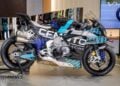
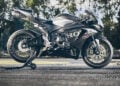
BMW has revealed the fully equipped R 12 G/S Competition Bike that will be used in the 2026 BMW Motorrad International GS Trophy, to be staged across Romania from September 13–19.
BMW had already confirmed the R 12 G/S as the chosen machine when Romania was announced as the host of the tenth International GS Trophy. We now have our first proper look at the specification and Motorsport-inspired livery that the competing teams will take into the Carpathian Mountains.
Romania promises a considerable test, with narrow forest trails, rocky tracks, loose climbs, river crossings and potentially treacherous mud all likely to feature during the week-long event.

A very different GS Trophy machine
The selection of the R 12 G/S represents a notable change in direction for the GS Trophy.
The 2024 edition in Namibia was contested on the then-new R 1300 GS, while the 2022 Albania event used the R 1250 GS. The F 850 GS was selected for New Zealand in 2020, following three successive editions on the R 1200 GS in Mongolia, Thailand and Canada.
Rather than again choosing the latest and most technologically advanced large-capacity GS, BMW has turned to a more traditional air/oil-cooled boxer with styling inspired by the original R 80 G/S.

The road-going R 12 G/S is powered by BMW’s familiar 1170 cc boxer twin, producing 80 kW and 115 Nm, with drive sent through a six-speed gearbox and shaft final drive.
It is a machine that has already made a strong impression on us. In his MCNews review of the BMW R 12 G/S Enduro, Wayne described it as perhaps his favourite off-road BMW, praising its responsive engine, composed suspension and, most importantly, its sense of fun.
The GS Trophy will now provide a rather more severe examination of those qualities.

Enduro Package Pro forms the foundation
The Competition Bike is based around the R 12 G/S fitted with BMW’s Enduro Package Pro. That package brings an 18-inch rear wheel to complement the standard 21-inch front, more serious off-road tyres and handlebar risers to improve the standing riding position.
BMW has also fitted the Comfort Package, which includes Hill Start Control, Gear Shift Assist Pro, heated grips and cruise control.
That may sound rather civilised for a competition motorcycle, but the International GS Trophy is not a conventional sprint race. Riders face long days in the saddle, considerable liaison distances and a combination of riding, navigation and team challenges. Heated grips and cruise control may be every bit as welcome as knobby tyres by the end of a long Romanian stage.
Headlight Pro, including an adaptive cornering light, and Riding Modes Pro are also fitted.
Protection is provided by engine bars and cylinder-head covers, important additions given that the boxer’s cylinders sit directly in harm’s way during low-speed spills and technical special tests.
A Rally cockpit fairing, navigation preparation and an Akrapovič silencer complete the major mechanical and equipment changes. BMW has even repurposed a five-litre tank bag as a compact rear bag.

A GS Trophy replica without the Trophy decals
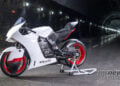
The competition machines are finished in Lightwhite, contrasted by blue graphics across the fuel tank and a bright red seat. The combination deliberately draws on BMW Motorrad’s familiar Motorsport colours while giving the relatively understated R 12 G/S a much harder-edged appearance.

BMW will not sell the GS Trophy Competition Bike as a complete limited-edition model. However, the company says customers can reproduce almost the entire specification by starting with a production R 12 G/S and selecting the relevant packages and accessories.
The competition decals and a handful of minor details will remain exclusive to the GS Trophy machines, but owners should be able to build a convincing road-going replica without needing to liberate one from the Romanian bivouac.

Australia and the GS Trophy
The International GS Trophy began in Tunisia in 2008 and has subsequently travelled through Southern Africa, Patagonia, Canada, Thailand, Mongolia, New Zealand, Albania and Namibia.
Australia’s direct involvement began relatively recently. The 2018 Australian qualifier selected our first national team for the Mongolia event, where competitors covered approximately 2350 kilometres across eight days.
Australian Julia Maguire also qualified for one of the international women’s teams, joining South African Ezelda van Jaarsveld and France’s Sonia Barbot.
Team Australia ultimately finished tenth in Mongolia, while the combined Ausamerica women’s team placed 15th. South Africa won the event and went on to maintain its winning run through the 2020 and 2022 editions.
The following GS Trophy was staged much closer to home, with the 2020 International GS Trophy taking competitors through New Zealand aboard specially prepared F 850 GS models.

Not a race, but certainly a competition
The GS Trophy is not decided simply by who can ride the fastest. Teams score points through off-road special tests, navigation exercises, mechanical challenges and tasks that demand planning, communication and cooperation.
Nine men’s teams and six women’s teams are expected to contest the 2026 edition. Australia was among the countries selected to hold a national qualifying event.

Romania will be only the second European host, following Albania in 2022. Its dense forests, eroded gravel roads, rocky climbs, alpine plateaus and water crossings should offer a very different challenge from the sand, dry riverbeds and open spaces encountered during the 2024 event in Namibia.
The R 12 G/S may present a nostalgic silhouette, but a week of repeated special tests, long stages, river crossings and inevitable drops should quickly establish whether its old-school appearance is backed by proper GS durability.
A convincing Motorsport paint scheme is one thing. Surviving a week in the Carpathians is another.