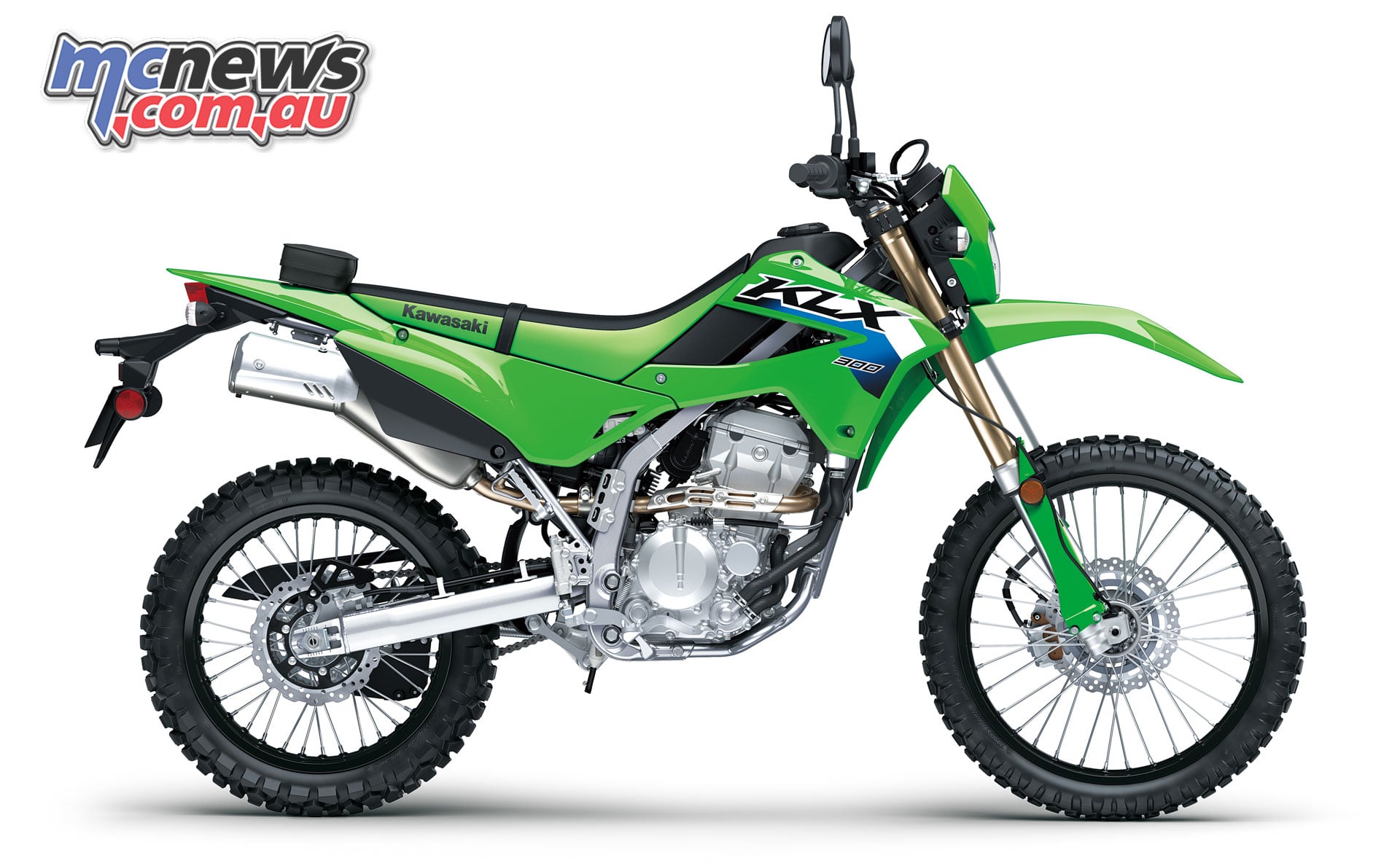




2026 Kawasaki KLX300
Kawasaki’s KLX300 dual-sport is headed for Australia, arriving road-registerable and LAMS-approved with a price tag of $7,849 plus on-road costs. The KLX300 is essentially a road-ready variation of Kawasaki’s off-road-only KLX300R.

Powered by a liquid-cooled 292 cc four-stroke single-cylinder, the KLX300 runs a six-speed gearbox and fuel injection as standard. While Kawasaki nods to its enduro racing heritage, the KLX makes no pretence of being a full-on race machine; instead, it aims to strike a balance between everyday usability and off-road capability.
The engine produces 19 kW (26 hp) at 8,000 rpm and 24 Nm of torque at 7,000 rpm, aided by a flat-top piston, pentroof combustion chamber, and 11.1:1 compression ratio. Cam profiles are borrowed from the KLX300R, while an electrofusion treated cylinder enhances heat transfer and durability.

A gear-driven balance shaft helps to keep vibrations in check, ensuring smooth performance on and off the road. Kawasaki emphasises the KLX300’s rider-friendly power delivery and long-ride comfort, aided by a 34 mm throttle body with sub-throttle for a refined character, strong fuel economy, and cleaner emissions.
Cooling is managed by dual radiators, with fans designed to direct heat away from the rider. Emissions and safety are further supported by a catalyser, secondary air system, and spark arrestor as standard. Even the muffler is engineered with lower slits to vent hot air outward, reducing the heat that reaches the rider.

Kawasaki highlights the box-and-tube high-tensile steel perimeter frame, which combines short wheelbase agility with high rigidity for both sharp handling and solid straight-line stability. An aluminium D-section swingarm complements the package, while the rear subframe is designed to accept an optional luggage carrier.
Suspension travel is generous, with a 43 mm USD fork offering compression adjustment up front and a fully adjustable Uni-Trak rear shock. Riders get 285 mm of travel at the front and 289 mm at the rear, with a respectable 275 mm of ground clearance for tackling rough terrain.
The seat height comes in at 895 mm, which may be intimidating for some, though this is partly offset by the KLX’s relatively light 137 kg kerb weight. Fuel capacity is 7.5 litres.

Braking hardware sees a modest 250 mm rotor with a two-piston caliper up front, and a 240 mm disc with single-piston caliper at the rear. Interestingly, there’s no mention of ABS, raising questions about how Kawasaki has navigated Australia’s requirement for ABS on all road-registerable motorcycles, or whether the feature was simply omitted from the release notes.
The KLX300 rolls on 21-inch front (3.00) and 18-inch rear (4.60) wheels, wrapped in dual-sport rubber to suit both road and trail use.
Instrumentation is by way of a fairly simple-looking digital dash. In keeping with the KLX’s straightforward character, there are no electronic rider aids such as traction control or ride modes, reinforcing its analogue appeal.

A compact LED headlight leads the way, while the handlebar layout delivers a relaxed, upright riding position. Kawasaki also promises improved comfort thanks to a two-tone, thickly padded seat, with footpegs positioned close to the centre-line for a natural stance both on and off-road. Slimmer shrouds further aid rider movement, addressing one of the criticisms of the previous KLX300 generation—though that model never officially reached Australia.
Practical touches include a tidier rear tail with a flap design to deflect water spray, along with an ignition featuring five tumblers for improved theft resistance.
The KLX300’s main competition will most likely be Honda’s similarly priced CRF300L, and more distantly, Suzuki’s recently released, more expensive and higher spec’d DR-Z4S.
Head to the Kawasaki Australia website for more information or localised pricing (link).