

From WR400F revolution to MY27
Yamaha WR450F evolves again
Few motorcycles share a relationship with Australia like Yamaha’s WR450F.
For much of its history, the WR450F has been Australia’s biggest-selling enduro motorcycle. At times, it went considerably further, topping the Australian motorcycle sales charts outright across every category.
But the WR story isn’t measured only by how many Yamaha dealers have wheeled it out of their doors. It also marks a defining shift in modern off-road motorcycling.

Australian riders already had a long relationship with Yamaha four-stroke dirt bikes through the XT and TT families of the 1980s and ’90s. Those machines earned their own special place in Australian motorcycling folklore through their durability, versatility and suitability for covering big distances in a big country.
Then the WR400F arrived and shifted the four-stroke goalposts dramatically towards the racing end of the spectrum.
Closely related to Yamaha’s revolutionary YZ400F motocrosser, the WR400F brought a level of four-stroke enduro performance that was genuinely new at the time.
Almost three decades later, Yamaha is still developing that same basic proposition: take the performance generated through motocross competition, then make it controllable, durable and versatile enough to work in the bush.

For 2027, that means a new frame, revised engine character, a new KYB rear shock, substantially revised suspension settings, a hydraulic clutch, a lighter rear brake assembly, shorter final gearing, and detail changes aimed primarily at improving control rather than simply producing more outright performance.
And, appropriately enough, Australians and New Zealanders have again helped develop it.
From XT and TT to the WR400F revolution
Yamaha describes the original WR400F as the world’s first modern-era four-stroke enduro motorcycle, and its arrival in 1999 undoubtedly heralded a new era. The contrast with what had gone before was considerable. Yamaha’s XT and TT models had already done plenty to establish the company’s four-stroke off-road credentials through the previous two decades, particularly in Australia.
The WR pushed much further. Rather than taking a traditional trail motorcycle and making it sportier, Yamaha effectively started with contemporary racing performance and adapted it for enduro.
When MCNews revisited the WR story during the major 2012 redevelopment, Yamaha explained just how important Australia and New Zealand had become to the project. Australasia was the major market for WR models despite its comparatively small population, and Australian enduro legend Geoff Ballard was directly involved in development work.
The WR400F became the WR426F in 2001 before the first WR450F arrived for 2003, bringing electric start and establishing the name that would become almost synonymous with big-bore four-stroke enduro riding in Australia.
A major step followed with the move to an aluminium frame for 2007.
Then, for 2012, Yamaha effectively started again. Fuel injection replaced the carburettor, and a new aluminium bilateral-beam chassis, heavily influenced by the contemporary YZ250F, transformed the handling package. The original handheld Yamaha Power Tuner also let owners adjust fuel and ignition settings without dragging a laptop into the bush. That basic concept survives today, albeit now controlled from a smartphone.
Australia wasn’t just buying WRs – we were developing them
Australia’s importance to the WR programme has been unusual. Australian and New Zealand riders, racers and technicians have repeatedly been involved in tuning the bikes for conditions encountered here.
That became particularly obvious with the completely overhauled 2016 WR450F. Former Grand Prix motocross racer Josh Coppins was among the Australasian riders involved in its development, while the bike itself moved much closer to Yamaha’s contemporary YZ competition architecture.
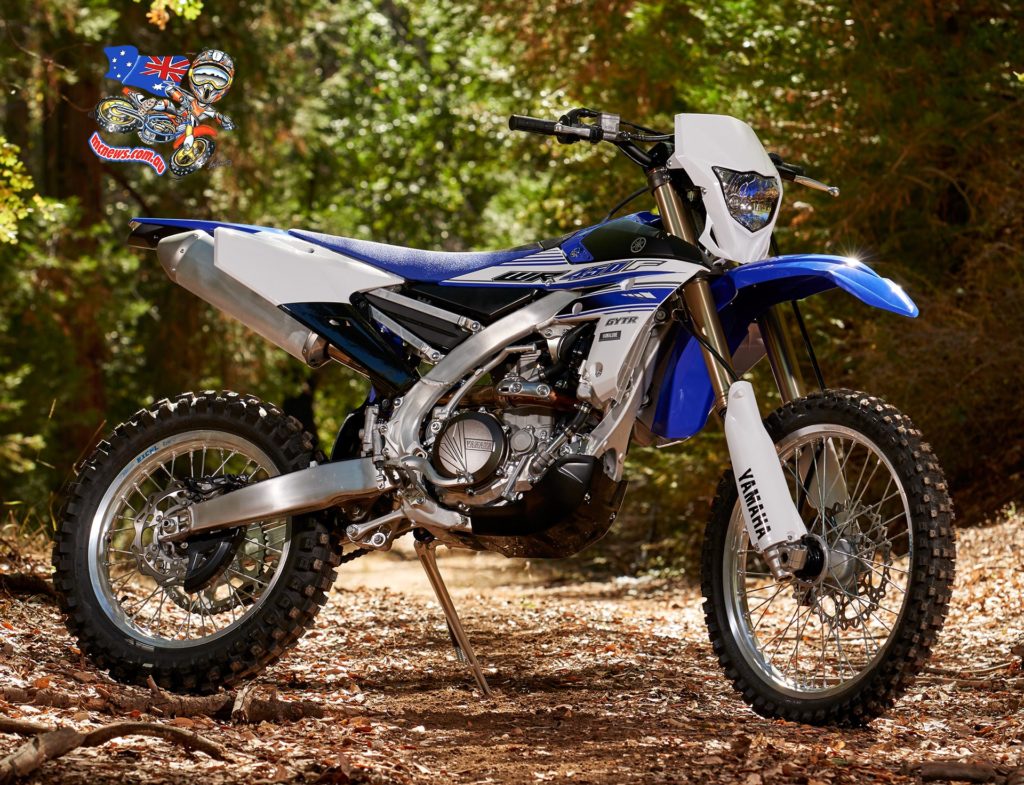
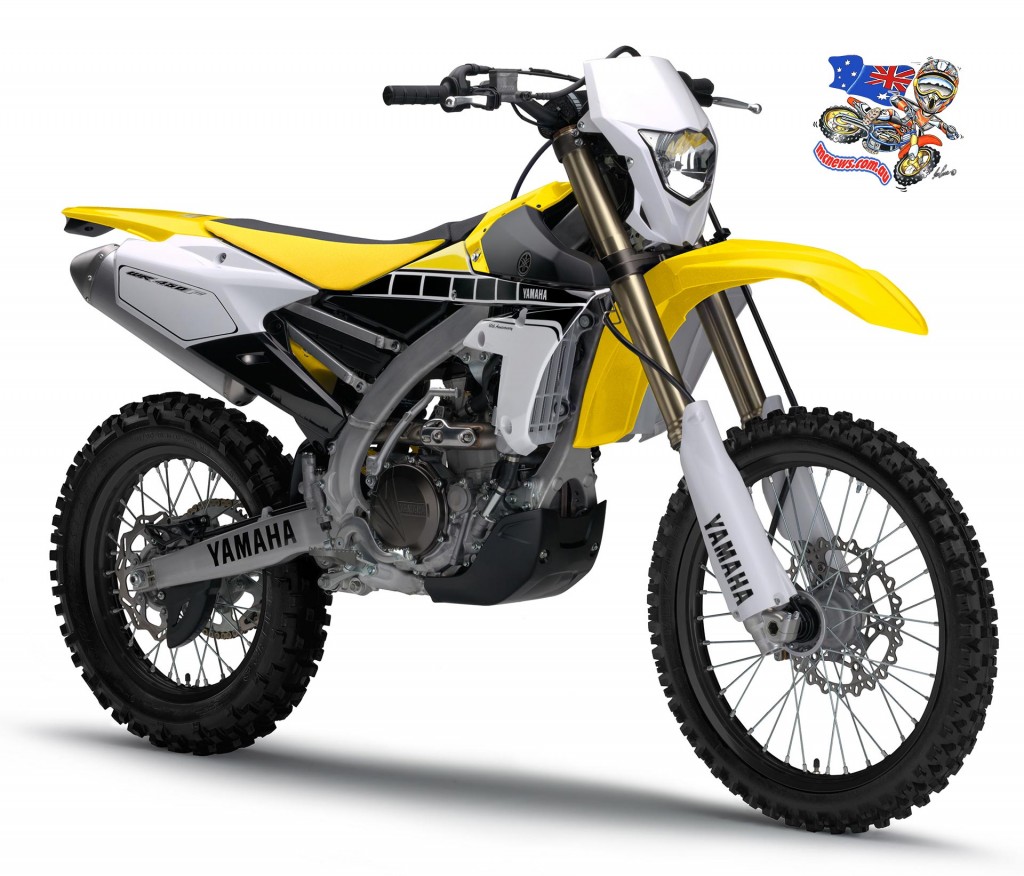
The 2016 machine brought Yamaha’s reverse-cylinder-head, front-intake and rear-exhaust architecture to the WR450F, along with a YZ-derived aluminium chassis, revised fuel injection and another substantial weight reduction. Australia and New Zealand were important enough to Yamaha that it produced an Oceania-only 60th Anniversary version.
At times Australia’s biggest-selling motorcycle – full stop
That local development connection was backed up by extraordinary sales success.
When MCNews detailed the heavily revised 2019 WR450F, we noted that the WR450F had conquered Australia’s enduro sales charts year after year.
In some years it wasn’t merely Australia’s best-selling enduro motorcycle. It was Australia’s biggest-selling motorcycle outright across all categories.
The 2019 generation again drew heavily from Yamaha’s YZ competition programme, while smartphone-based Power Tuner functionality replaced the earlier handheld tuning device.
The connection between Australia and WR was formally celebrated again for 2021 when Yamaha produced a 400-unit WR450F Aussie Edition. At the time, Yamaha Australia explicitly noted that Australia sold more WR450Fs than any other territory in the world.
Another major reset for 2021
The 2021 WR450F represented another substantial reinvention. A new, lighter and more powerful YZ-derived engine raised compression to 13.0:1, while a new Controlled Fill aluminium bilateral-beam frame further refined chassis flex.
The gearbox, cooling system, brakes and suspension were also heavily revised.
Once again Josh Coppins played a significant role in helping Yamaha’s engineers tailor engine and suspension performance for Australasian conditions.
That process of taking increasingly potent YZ technology and tempering it for enduro has become a constant in WR development.
The eighth-generation WR arrived for 2024
The latest fundamental engine and packaging overhaul came with the eighth-generation WR450F introduced for 2024. That bike was two kilograms lighter than its predecessor at a quoted 117 kg wet, and considerably slimmer.
A new YZ450F-derived engine alone saved 1.1 kg, while the Controlled Fill frame was lowered at the head tube and the bodywork became 50 mm narrower through the shrouds.
The MY24 bike also adopted the latest disc-spring clutch architecture, although Yamaha retained cable actuation.
When MCNews tested that generation, its combination of serious mid-to-top-end performance and surprisingly nimble handling stood out.
The new-generation Power Tuner app also demonstrated just how effectively the engine could be softened and tailored for slippery conditions. The MY24 platform provides the foundation for the 2027 machine.
2027 again starts with a championship-winning YZ450F

Yamaha specifically points out that the 2027 WR450F is based around the YZ450F platform that carried Jed Beaton to the 2026 Australian ProMX MX1 Championship. Beaton wrapped up that crown at Conondale after an extraordinary opening six rounds in which he won 11 of the first 12 motos.
But what works on the motocross track isn’t necessarily what works six hours into a hard day in the bush. Thus the emphasis for MY27 is not extracting another headline power figure from the 450. It’s making the performance more controllable.
Same basic engine architecture – different character

The 450 cc reverse-fed DOHC four-stroke retains its 97.0 x 60.8 mm bore and stroke and 13.0:1 compression ratio. Unlike the major MY24 engine overhaul, Yamaha hasn’t pursued a fundamentally new engine architecture for 2027. Instead, it has concentrated on changing how the existing performance reaches the rear tyre.
A redesigned intake port is claimed to improve combustion efficiency and torque while creating a more linear response. Cam timing has been revised for more stable combustion.
Yamaha has also increased AC magneto inertia, adding rotating inertia to help calm low-rpm response and make the engine harder to stall when crawling through technical terrain.
The model-specific ECU continues to target tractability down low before allowing progressively stronger performance through the medium and upper rev range.
Fuel delivery remains via a 44 mm Mikuni throttle body.
One more tooth out back

The rear sprocket grows from 50 to 51 teeth. That shortens the final gearing, which should help at the lower speeds encountered in technical terrain. Yamaha specifically points towards flowing third-gear trails when explaining the change.
The five-speed transmission itself carries over in concept, while the new hydraulic clutch represents one of the most obvious MY27 changes.
The WR450F finally goes hydraulic

Hydraulic clutch actuation replaces the cable arrangement used on the MY24 machine. Yamaha claims the new system provides a lighter lever pull, smoother feathering and a more consistent engagement point, while eliminating the requirement for clutch adjustment during a ride. The clutch inner hub has also been redesigned so lubrication reaches a greater surface area, aimed at improving consistency and durability.
It’s an interesting change, given our MY24 test where Aiden noted that the cable clutch required more effort than the hydraulic systems he had become accustomed to on European enduro machinery. For 2027, Yamaha has eliminated that comparison altogether.
A genuinely new frame – but familiar geometry

Yamaha describes the 2027 aluminium bilateral-beam frame as new. The primary goal is a revised relationship between rigidity and controlled flex, with particular attention paid to the front downtube.
Yamaha claims improved stability and stronger front-end feedback, making the WR easier to tip into a turn, easier to place on the chosen line and more willing to hold that line.
Interestingly, the geometry figures reveal that Yamaha hasn’t chased those gains by dramatically altering the basic dimensions.
Seat height remains 955 mm. Wheelbase remains 1470 mm. Rake remains 27 degrees and trail 121 mm. Ground clearance is still 330 mm. Overall length, width, and height remain 2170 x 825 x 1265 mm.
So while the frame is new, this is overwhelmingly a rigidity and flex development rather than a geometry change.
KYB development targets front-end confidence
The familiar 48 mm KYB Speed Sensitive System coil-spring fork remains, with 300 mm of travel and tool-free compression adjustment. Its internal settings are revised and more progressive for MY27.
Yamaha says that improves initial movement, bump absorption and front tyre contact while giving the rider more confidence to push harder through technical terrain.
Rear travel remains 306 mm, but the KYB shock itself receives significant changes. A new piston increases damping force in the lowest-speed portion of shock movement and expands the useful adjustment range. Yamaha also says the transition between low and high-speed damping has been made smoother.

Importantly, the rear shock now gains its own hand-operated low-speed compression adjuster. The front of the WR has offered tool-free compression adjustment since MY24; now one of the most commonly altered rear settings can also be changed trailside without hunting through the tool kit.
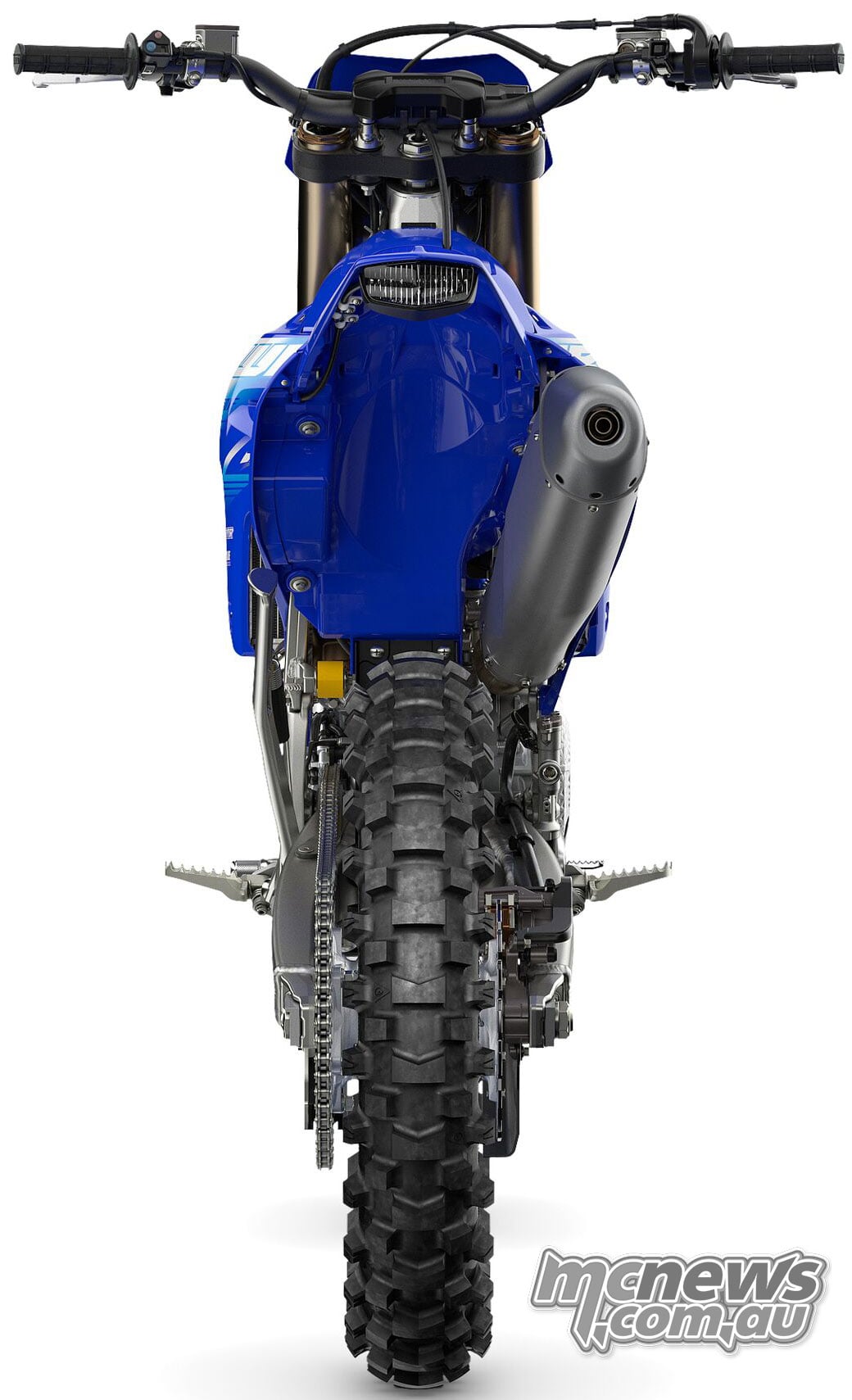
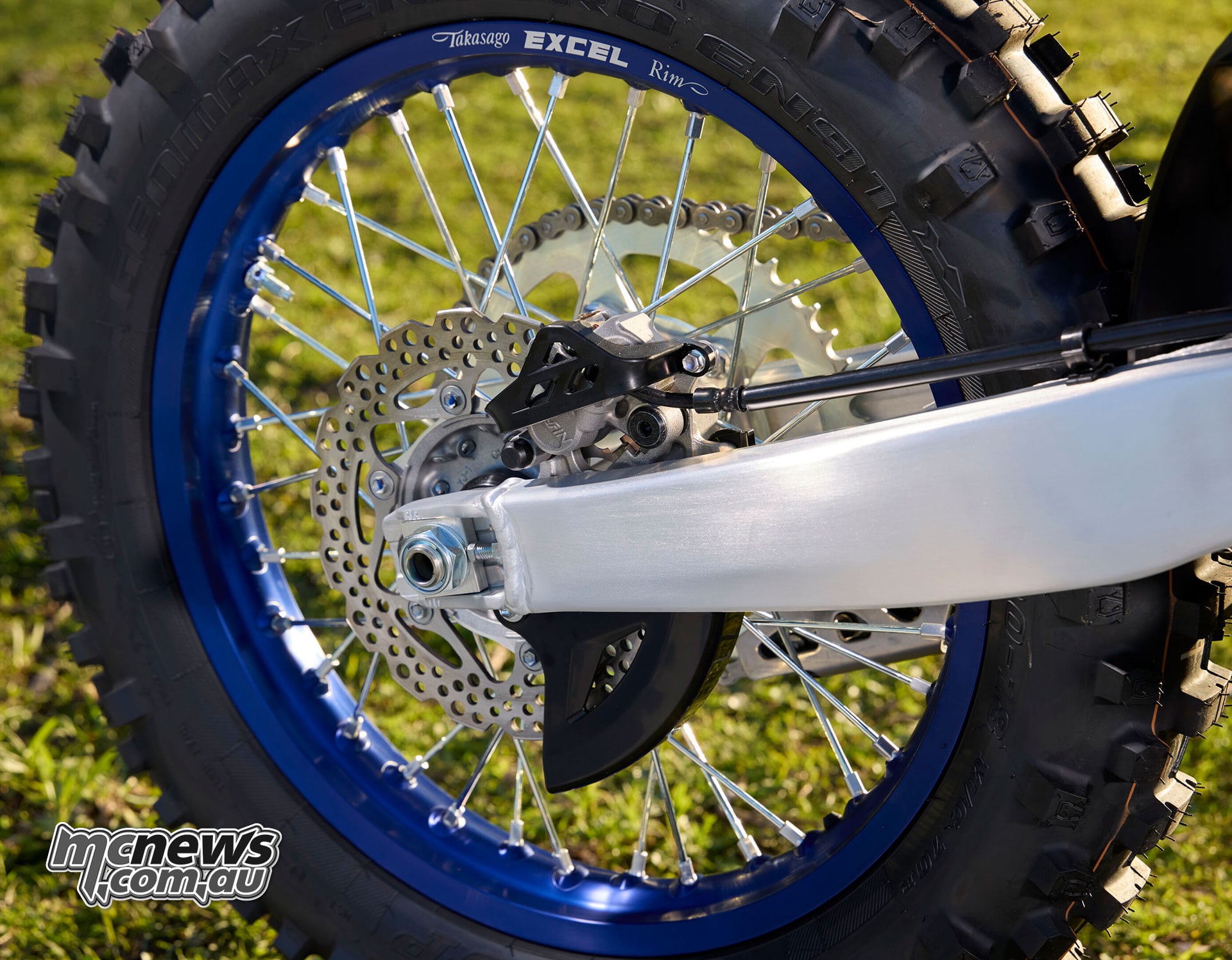
Rear brake shrinks from 240 to 220 mm
The rear brake rotor is now 220 mm in diameter. The MY24 WR450F used a 240 mm rear disc. Yamaha has reduced not only the rotor diameter but also the rear master cylinder and piston dimensions.

Together with revised pad material, Yamaha claims the new package improves rear brake controllability while saving 180 grams. The front retains its 270 mm hydraulic disc and Nissin caliper.
Presumably, the aim was to remove weight from unsprung and rotating components, which is generally more valuable than trimming the same amount from somewhere static near the centre of the motorcycle.

116 kg in competition trim
Yamaha quotes 116 kg wet with full fuel and fluids when configured in off-road competition specification. At 116 kg with its 7.4-litre tank full, the WR remains impressively light for a 450 four-stroke, but retaining all the ADR kit might tip the scales a couple of kg heavier than that claimed figure suggests.

Australian Power Tuner specification
The Yamaha Power Tuner app continues to separate the WR from many conventional enduro offerings. For the Australian MY27 model, Yamaha specifies its Quick Setting slide-bar engine-tuning function, along with adjustable Traction Control and Launch Control.
The recently introduced ECU lock is retained, allowing the starting system to be electronically secured through the app. It also incorporates maintenance records, race logging, and diagnostic functions.
A multi-function handlebar switch combines engine stop and power-map controls.

Full ADR compliance remains a major Australian advantage
Australian-delivered WR450Fs continue to arrive fully ADR compliant for road registration.
Every Australian bike is also supplied with a free closed-course competition kit specifically intended to convert it from ADR trim for off-road competition.
For MY27 the kit comprises a lightweight LED tail-light and licence-plate holder, braided-steel front brake line, full-power/full-movement throttle-stop screw, rear brake snake, off-road brake-light wiring harness, Barkbusters enduro handguards, original front and rear brake-line banjo bolts, tail-light undercover, original engine start and stop switches and the Communication Control Unit map switch.
Australian bikes also run FIM Enduro and DOT-approved Dunlop Geomax EN91 tyres in 90/90-21 front and 140/80-18 rear sizes.
New bodywork and a clever seat cover
The visual changes are less dramatic than the mechanical developments. It features sleeker side covers, a sharper rear guard, and new WR graphics.

The seat receives a new honeycomb-pattern surface. The design lets the rider slide forward relatively freely under braking while providing more grip in the opposite direction to resist being pushed back under acceleration.

GYTR and Akrapovic options
Yamaha Australia has also outlined a sizeable accessory range for the new WR. Available hardware includes GYTR clutch and ignition covers, a chain guide, a high-flow air filter, an airbox, a carbon-fibre skid plate, and aluminium radiator braces. An Akrapovic titanium exhaust is also listed.
Almost 30 years later, the objective has changed
An interesting contrast exists between what Yamaha was trying to achieve when the WR400F arrived and what it is trying to achieve with the WR450F today. At the end of the 1990s, the breakthrough was performance.
Australian riders knew and loved four-stroke trail motorcycles, but the WR introduced a level of raciness that changed expectations of what a four-stroke enduro machine could be. Today outright performance isn’t the difficult part. A current 450 already produces more than enough of it for most mortals. The challenge is making that performance usable for longer, across more varied terrain and with less effort from the rider.
Look through the MY27 changes and almost every one serves that objective. More linear power delivery. Greater stall resistance. Shorter final gearing. A frame with revised flex characteristics. More progressive fork response. Better low-speed shock control. A lighter hydraulic clutch.
Even the seat cover is designed to let the rider move more effectively.
Nearly three decades after the WR400F helped change the four-stroke enduro landscape, Yamaha is still pursuing the same fundamental idea.
Take serious competition performance and make it work better in the bush. For Australian riders in particular, that formula has plenty of history behind it.

2027 Yamaha WR450F Specifications
| Engine | 450 cc liquid-cooled DOHC four-stroke single, four valves |
| Bore x stroke | 97.0 x 60.8 mm |
| Compression ratio | 13.0:1 |
| Fuel delivery | Fuel injection |
| Transmission | Constant-mesh five-speed |
| Clutch | Wet multi-plate, hydraulic actuation |
| Final drive | Chain, 51-tooth rear sprocket |
| Front suspension | 48 mm KYB spring-type Speed Sensitive System fork, fully adjustable, 300 mm travel |
| Rear suspension | KYB single shock, fully adjustable, 306 mm travel |
| Front brake | 270 mm hydraulic disc |
| Rear brake | 220 mm hydraulic disc |
| Front tyre | 90/90-21 Dunlop Geomax EN91 FIM Enduro DOT |
| Rear tyre | 140/80-18 Dunlop Geomax EN91 FIM Enduro DOT |
| Length | 2170 mm |
| Width | 825 mm |
| Height | 1265 mm |
| Seat height | 955 mm |
| Wheelbase | 1470 mm |
| Rake | 27 degrees |
| Trail | 121 mm |
| Ground clearance | 330 mm |
| Fuel capacity | 7.4 litres |
| Wet weight | 116 kg with full fuel and fluids in off-road competition specification |
| Warranty | Three months, parts only |
| Colour | Team Yamaha Blue |
| Australian compliance | Full ADR compliance; closed-course competition kit supplied |
| Australian price | TBA |
| Australian availability | TBA |

2027 Yamaha WR250F
The WR250F continues into 2027 unchanged mechanically from the 2026 model, with updated graphics the only announced change.
Australian pricing and availability for both 2027 WR models will be announced at a later date.
2027 Yamaha WR450F Images