

Inside MotoGP brakes
Some MotoGP riders want a front brake lever that barely moves. Others prefer more travel and less effort at their fingertips. Each wants that response to stay predictable at the next corner.
Heat, vibration and changing loads make that a demanding brief. The rider needs to judge braking force right down to the final subtle complete disengagement through the lever.
During our visit to Brembo, Performance Motorcycle Market Manager Andrea Pellegrini explained how master-cylinder dimensions and caliper internals shape that response. His explanation also puts our look at Brembo’s 2027 MotoGP brake package into context: lighter hardware still has to deliver the feel riders rely on.
Brake feel starts with the hydraulic ratio
Some riders brake with one finger, others with two. Master-cylinder dimensions help determine the balance between the effort they apply and the travel they feel.
The master-cylinder piston converts force from the lever into hydraulic pressure. That pressure acts on the caliper pistons, clamping the pads against the disc.
With the same caliper and lever geometry, a smaller master-cylinder bore produces more pressure for a given finger force. It also moves less fluid per millimetre of piston travel, so it needs more travel to move the same volume.
A larger bore moves more fluid for a given stroke, giving a shorter action but requiring more finger force to generate the same pressure.
Andrea Pellegrini
“It depends how they learn to brake,” he explained.
Years of racing teach a rider to associate lever movement and finger pressure with what the front tyre is doing. Changing that relationship can mean relearning part of their technique, even when the available braking force is unchanged.

MotoGP master-cylinder dimensions are selected around each rider’s preferred effort and travel.
From Doohan’s injury to the left handlebar
Pellegrini told us that around 60 per cent of the MotoGP grid use a thumb-operated rear brake. He expected that proportion to grow as riders arrived from Moto2 already comfortable with the control.
The idea grew out of Mick Doohan’s severe right-leg injury at Assen in 1992. With the Australian still struggling to move his right foot, Brembo developed a left-hand thumb control for him in 1993, as the company recounts in its history of the thumb master cylinder.
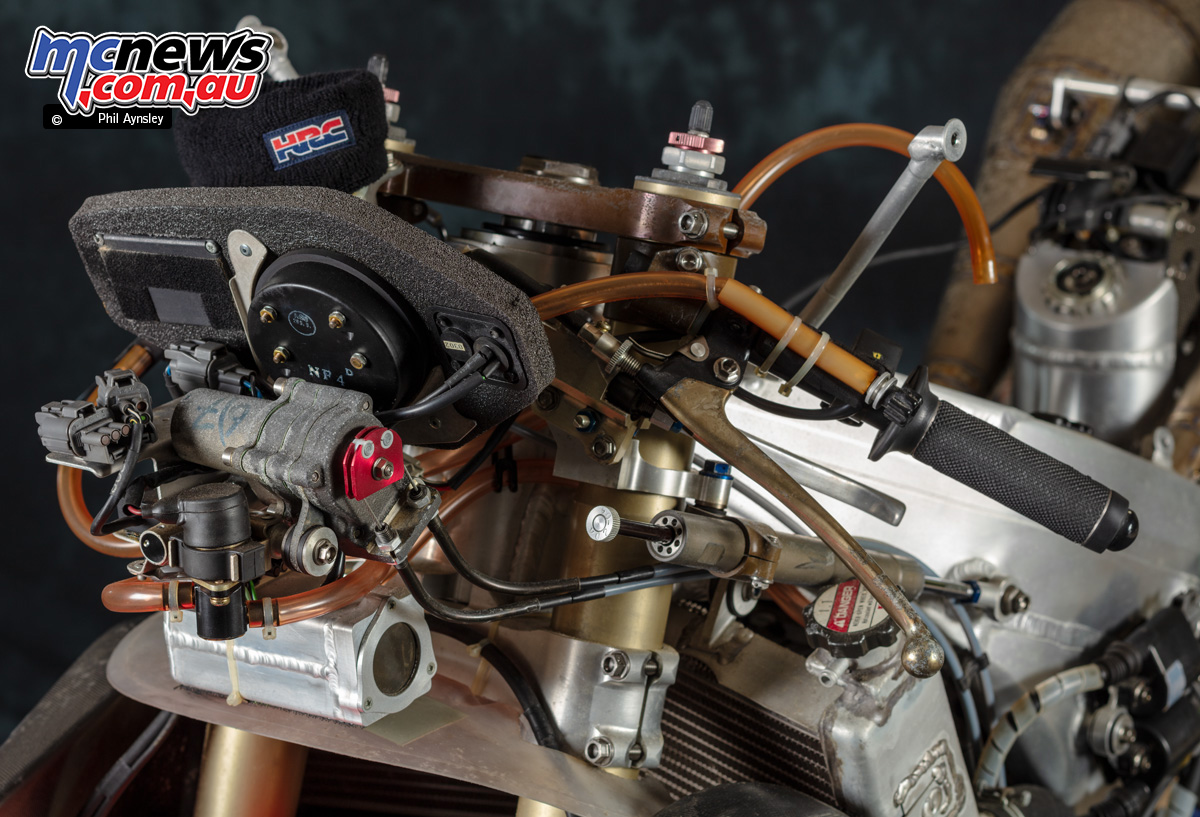
Brembo developed his thumb-operated rear brake after the Australian’s 1992 Assen injury.
Image Phil Aynsley
The benefits extend beyond injured riders. Body position and lean angle can make the foot pedal awkward to reach in a right-hand corner. A left-handlebar control lets the rider apply the rear brake while keeping the right foot in position.
Pellegrini also highlighted the thumb’s sensitivity when making small adjustments on corner exit. Familiarity matters, though: he recalled Valentino Rossi struggling to make the control instinctive when trying it later in his career. At the time of our conversation, he said Marc Marquez had removed his thumb brake and was using only the traditional foot lever.
A thumb brake can coexist with a foot lever. Brembo offers a shared hydraulic circuit, with the controls used as alternatives, or separate circuits acting on different pairs of pistons in a four-piston rear caliper. The latter allows both controls to work together.
The rear brake works beyond corner entry
The rear brake helps riders manage the motorcycle’s attitude through a corner and under acceleration.
Pellegrini described its use on corner exit as a form of manual traction control. Applying the rear brake while the engine drives the wheel reduces the net torque at the tyre, helping the rider manage drive and wheelspin. It can also help control front-wheel lift.
Under heavy braking, the opposite problem arises: load transfers forward, leaving the rear tyre lightly loaded or clear of the track. Its contribution to slowing the bike obviously falls accordingly.
Pellegrini said Brembo had reduced rear-disc diameter and thickness compared with earlier MotoGP designs. Under maximum deceleration, he explained, the rear brake does much of its useful work early in the stop, before the rear wheel becomes substantially unloaded. For some riders, the feel can again become important in the final part of the entry process when approaching full lean.

How a caliper boosts braking force
Pellegrini dates Brembo’s introduction of the booster caliper into MotoGP to around 2017–2018, following its use in Formula 1.
The assistance comes from inclined pad guides inside the caliper. As the rotating disc acts against the pads, their guided movement adds a clamping effect, producing more braking torque for the same hydraulic pressure.
Brembo’s GP4-MotoGP caliper for road motorcycles also uses this oblique pad-slide principle. It gives the rider more braking effect for the same lever effort, or less effort for a given braking demand.

Anti-drag: Letting go cleanly
When the rider releases the lever, the pads need to release the disc. Residual contact creates unwanted braking torque and heat.
Brembo’s anti-drag system uses a spring mechanism to assist pad retraction as hydraulic pressure falls. Clearance needs careful control: enough lets the disc turn freely, while too much would require extra fluid movement to bring the pads back into contact.
Anti-knockback: Avoiding a surprise at the lever
Knockback occurs when movement of the disc relative to the caliper pushes the pads and pistons back farther than intended. The master cylinder must take up that extra clearance at the next application, which the rider feels as additional lever travel before braking force develops.
Choosing a longer lever stroke is one thing. Finding one by surprise at the end of a straight is quite another.
Pellegrini described an anti-knockback valve designed to limit that extra stroke after shaking or vibration. At the time of the interview, he said the feature was used in MotoGP but had not reached Moto2 or Moto3.
Anti-drag helps create the clearance needed to release the disc; anti-knockback limits unwanted extra clearance before the next application.
That development continues in the 2027 GP4 brake package. As Pellegrini explained in our accompanying feature, the anti-shaking valve has moved from the caliper to the master cylinder.
Keeping the heat under control
Pellegrini also described a supercooling piston designed to reduce caliper and brake-fluid temperatures.
Development follows rider feedback: pad drag, extra lever travel after vibration, excessive heat or distracting free play can each prompt another revision.
A surprisingly small group supports that work at the circuit. Pellegrini said two or three Brembo staff covered the MotoGP, Moto2 and Moto3 grids. At European rounds, Moto2 and Moto3 components could be serviced trackside, while MotoGP parts returned to Brembo’s factory for overhaul and detailed checks.

Heat management and careful inspection help maintain consistent response through repeated braking.
Image TH
The rider has enough variables to manage without the brake lever adding its own surprises.