

Why Brembo sees years of development left in hydraulic ABS
You’re already on the brakes when the front tyre hits a patch of wet bitumen. Your fingers haven’t moved. The tyre suddenly has less grip to work with. If it starts to slip, the ABS has to take pressure out of the front brake, then judge how much to put back in when you reach dry road again.
How quickly and smoothly the bike gets through that moment is one area where Brembo sees room for improvement. During our visit, Cosimo Facibeni, who leads technical development for Brembo’s motorcycle division, explained how more precise control of brake pressure could help keep a bike settled as grip changes.
There’s plenty of scope to do that with the hydraulic brakes we already use. An electric motor at the caliper is another possibility. In one enduro example Facibeni gave us, it could put roughly another kilo at the rear wheel. Mario Almondo, Chief Officer of Brembo Performance, said the technology was feasible. He had a harder question.
Mario Almondo
“The point is, does it make sense? Do you really want it?”
What happens when the grip comes back?
Facibeni sees another 10 to 15 years of development ahead for hydraulic ABS. He said even a system he describes as “standard” can be doing a great deal.
Cosimo Facibeni
“There are hundreds of functions inside the ABS.”
Alongside the wheel-speed sensors, modern ABS systems use an inertial measurement unit, or IMU, to account for how the bike is leaning and pitching. Depending on the motorcycle, stability control systems can use that information to manage braking in a corner, control rear-wheel lift or distribute braking force between the two wheels.
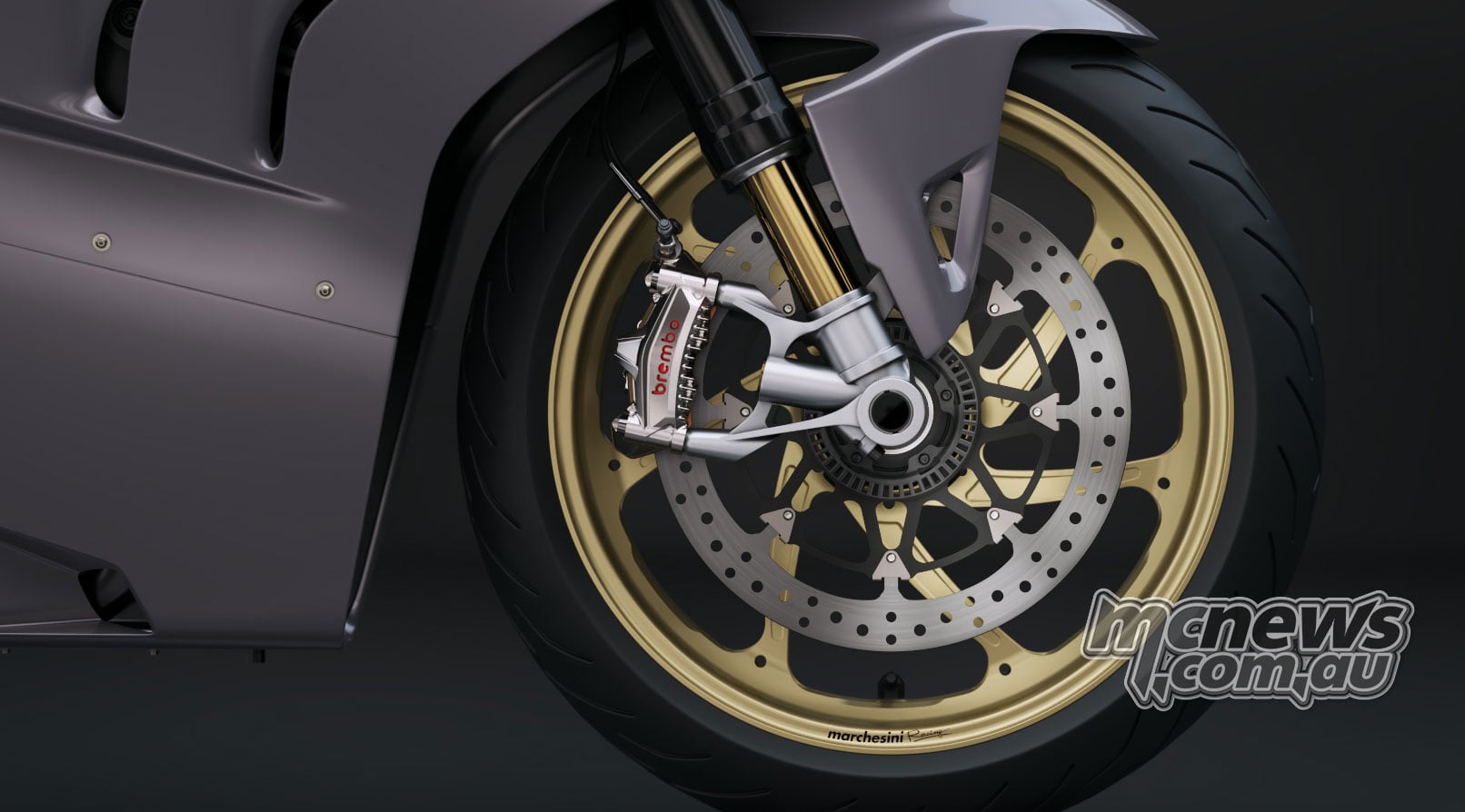
Marchesini M7 R wheel with a Brembo GP4-MotoGP caliper and T-Drive disc.
ABS can lower, hold and rebuild brake pressure. On a wet patch, the immediate job may be to take pressure off to limit slip. Back on the dry, the tyre can handle more braking force. How quickly the system gets back to useful pressure, and how smoothly it gets there, is what really matters to the rider.
Facibeni also pointed to what happens at the back of the bike. If the rear tyre slips too much under brakes, the rear can move sideways. Finer control at both wheels could help limit that movement. How much difference it makes depends on the whole bike, including the tyres, the suspension and how the system is tuned.
What brake-by-wire means at the lever
ABS is what manages wheel slip under braking. Combined braking lets one control apply some braking force at both wheels. Brake-by-wire describes how your braking request gets from the lever or pedal to the brake. A sensor picks up your input, and an electronic controller commands the actuator.
That actuator can still build hydraulic pressure, with brake fluid moving the pistons that press the pads against the disc. An electric caliper uses a motor to do the clamping. Engineers call that fluid-free arrangement a dry brake. This setup is becoming more common across the automotive industry, but packaging and weight concerns are both more difficult and more important for us on two wheels.
How much finer can hydraulic control get?
One way to control pressure more precisely is to use valves that can vary how far they open. The question is how much faster and more precisely the whole braking system can respond.
I asked Almondo about using sophisticated valves like those Moog makes to meter hydraulic flow. He called that route “probably not our priority” and pointed to the current costs of this type of valve. Facibeni said Brembo was weighing several designs against their weight, cost and benefit to the rider. He put the engineering planning horizon at five to six years.
Control quality depends on the information the system receives as well as its hydraulic hardware.
Modern electronic suspension systems emply valves that constantly react and vary to loads and IMU inputs, there is the possibility that future ABS systems will act just as instantaneously and with such fine control, rather than just cycling on-off as most systems do now.
What an extra kilo means at the rear wheel
Brembo has taken brake-by-wire into automotive production. In May 2026, it announced the production debut of Sensify, a platform it designed around fluid-free control at each wheel. Facibeni brought up that work as an example of what’s possible.
Take an enduro bike. In Facibeni’s example, the rear brake assembly might weigh about a kilo with a hydraulic caliper and roughly two kilos with an electric one. That extra weight moves with the wheel as the suspension works. It can make it harder for the tyre to follow a bumpy surface. Then there’s finding room for the actuator and protecting it from heat, water, vibration and the odd knock.

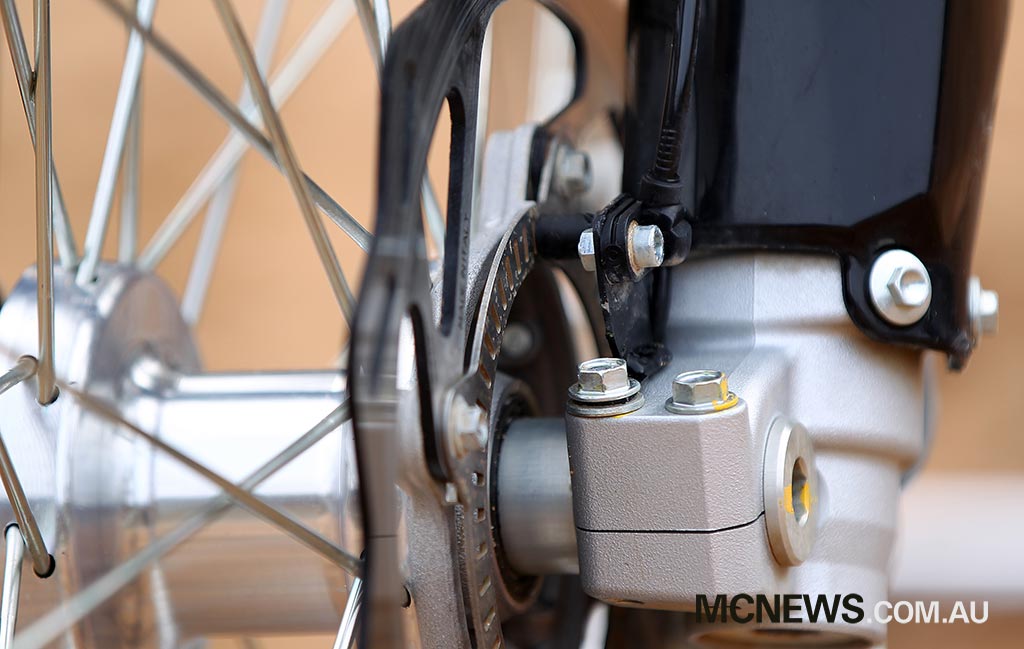
Caliper weight matters because it moves with the wheel and swingarm as the suspension works.
I asked Facibeni whether the rear brake would be the logical place to start, leaving the front with a familiar hydraulic set-up. He questioned whether the rear would be any easier to package and how much a change at one end would achieve on its own. Some of the gains he’s looking for may come from getting the two brakes to work together.
Electric motorcycles add another question. The drive motor can slow the bike and recover energy through regeneration. The calipers still provide friction braking. To blend the two smoothly, the brake controller needs to know how much the motor can contribute and make up the difference when regeneration is limited. That takes cooperation between the brake supplier and the bike manufacturer.
What the rider feels
Facibeni kept coming back to how the bike feels to ride. Once a sensor reads the lever and a separate actuator generates brake pressure, engineers can tune how much braking you get for a given squeeze. They also have to get the feel at the lever right, from the first touch to the point you release it.

There’s a racing angle, too. When I asked Ducati Corse boss Gigi Dall’Igna where he’d open up development in MotoGP, he suggested ABS as an area where racing could help improve safety on road bikes.
When I asked Mario Almondo how Brembo would respond if MotoGP opened the door to ABS, he answered without hesitation. “We are ready.” Brembo believes it has the technology today to make ABS work at MotoGP level. The hurdle for road bikes is delivering that same precision at a price manufacturers can justify.