

2026 Yamaha YZF-R7 Review
In recent years, the R7 has been a veritable sales juggernaut for Yamaha. I’ll admit it has probably flown under my radar in terms of just how popular the bike has been — topping the road bike sales charts in ’24, and that’s all road bikes, before backing that up by topping the supersports category in ’25.

And the reasons are simple. It’s accessible, stylish, sorted, and well-finished. Available in both a LAMS-approved 655 cc model, or the 689 cc full-power HO — High Output — model, it’s easy to see why they’ve been so popular.
The Japanese brand is not resting on its laurels, however. Where you might expect only minor tweaks amidst such strong sales, the latest R7 has received some serious updates. Yamaha has reworked the chassis, suspension, swingarm, wheels, rider position, styling and tech.

The updated CP2 twin-cylinder engine now comes with ride-by-wire throttle, delivering a smoother torque curve and enabling cruise control. It’s a proper overhaul.
I spent two days at the Australian launch recently to get to know the bike better. Day one was spent testing the R7 in real-world conditions on a road loop, with the following day focusing on track performance at Sydney Motorsport Park — Eastern Creek.
And I’m pleased to say that all of the updates are for the better. Spoiler alert — this is a cracker of a bike.

Let’s start with LAMS v HO
Around 80 per cent of R7 sales are of the LAMS variant. That number might have surprised me at first, but it is understandable once I thought about it for a second or two. Certainly, the younger version of me looking for my first road bike would have put the R7 right near the top of my shortlist; that’s for sure. And for good reasons.
As mentioned earlier, the HO has a full-power, full-size 689 cc parallel-twin engine that makes 72 hp at just under 9000 rpm. Peak torque in that spec is 67 Nm and arrives at 6500 rpm.

By comparison, the LAMS variant is a sleeved-down version of the same engine, using the same stroke but a slightly smaller piston diameter, which trims the power output back to a learner-friendly 52 hp at 8000 rpm. That sounds like a big drop, but the figure to pay attention to here is torque, where the output is trimmed only marginally back to 57 Nm. And that peak torque arrives at a much lower 4000 rpm.
The other key changes between the power units are a slight drop in compression ratio, from 11.5:1 to 11.0:1, and the use of an intake restrictor on the LAMS bike. These result in an ever-so-slightly more user-friendly throttle response, regardless of map.

I do need to call out the fuelling specifically, as it’s damn near perfect. Silky smooth in all maps. I couldn’t fault it. And I’m a fussy one when it comes to fuelling.
Real world? Both bikes feel pretty similar down low until around the 4500 rpm mark, at which point the HO engine continues to build power and thus reaches a higher peak. The magic here for the learner engine is the way Yamaha has mapped and fuelled the bike.

In isolation, it doesn’t feel like it’s obviously ‘limited’, as some engines in the category can. The torque curve is nice and flat and totally usable on the road, where a lot of the time is spent between three and five thousand revs in reality.
Not as big a real-world gap as you might expect
Both bikes performed exceptionally on the road, with the grunty bottom end of the LAMS model only marginally behind the HO, showing that, as a daily ride — especially as someone’s first bike — the LAMS model is a no-brainer.
But the bigger surprise came at the track, where I thought the full-power bike would really dominate its LAMS brother. On the SMSP short circuit — Amaroo — it wasn’t nearly as big a gap as I’d imagined.

It should be acknowledged that the short circuit is a relatively tight, twisty loop with no long straights. But riding the LAMS bike alongside HO bikes, there were really only two spots on the track where there was an obvious deficit.
Coming out of turn one, full throttle accelerating up and over the crest towards turn two — the longest proper straight on the circuit — would see the gap grow by five to ten metres. Likewise, coming out of the second hairpin, turn eight, and charging flat-out downhill through the 9-10 combination before braking hard into the left-hand turn 11, the gap would also stretch out by a similar amount.

Nothing that couldn’t be made up in other areas to get past slower riders. In fact, even my still-not-fully-fit carcass was relishing the challenge of gapping riders on full-power bikes when I was on board the LAMS bike. Something something, red rag, something something bull…
For those who haven’t ridden it before, the Amaroo layout is a serious workout, with no real time for rest. The perfect track to be on the R7.

Balanced, planted and predictable
In terms of ride feel at the track, the bike is very well-balanced. While great on the road, the standard Bridgestone S23 tyres aren’t really up to chasing lap times on track as such, and I was definitely finding their limits. Sliding the rear on change of direction, particularly through the repeated change of direction that is the turn 2-6 combination.
What a terrific section of the short track. You brake hard into turn two — actually turn six on the full track — before immediately peeling right onto the short track loop. Heading up and over the hill and down into the first hairpin. Literally five changes of direction with no real rest in between.

What was impressive was how well the chassis and traction control handled things when it started to run out of grip. No big moments, no wobbles, just a nicely controlled slip from the rear for a few metres before it came back in line. We’re talking ‘hey, I can feel it sliding’, as opposed to full-send Melandri, Phillip Island, last-corner drift. Anyone reading this who doesn’t know what that means — search for it on YouTube. You’re welcome.
The front, for what it’s worth, felt pretty much planted. Other than the hairpins, where I’m always nervous on the front, the R7 was super confidence-inspiring to just lay it over into the turn and wind the throttle on.
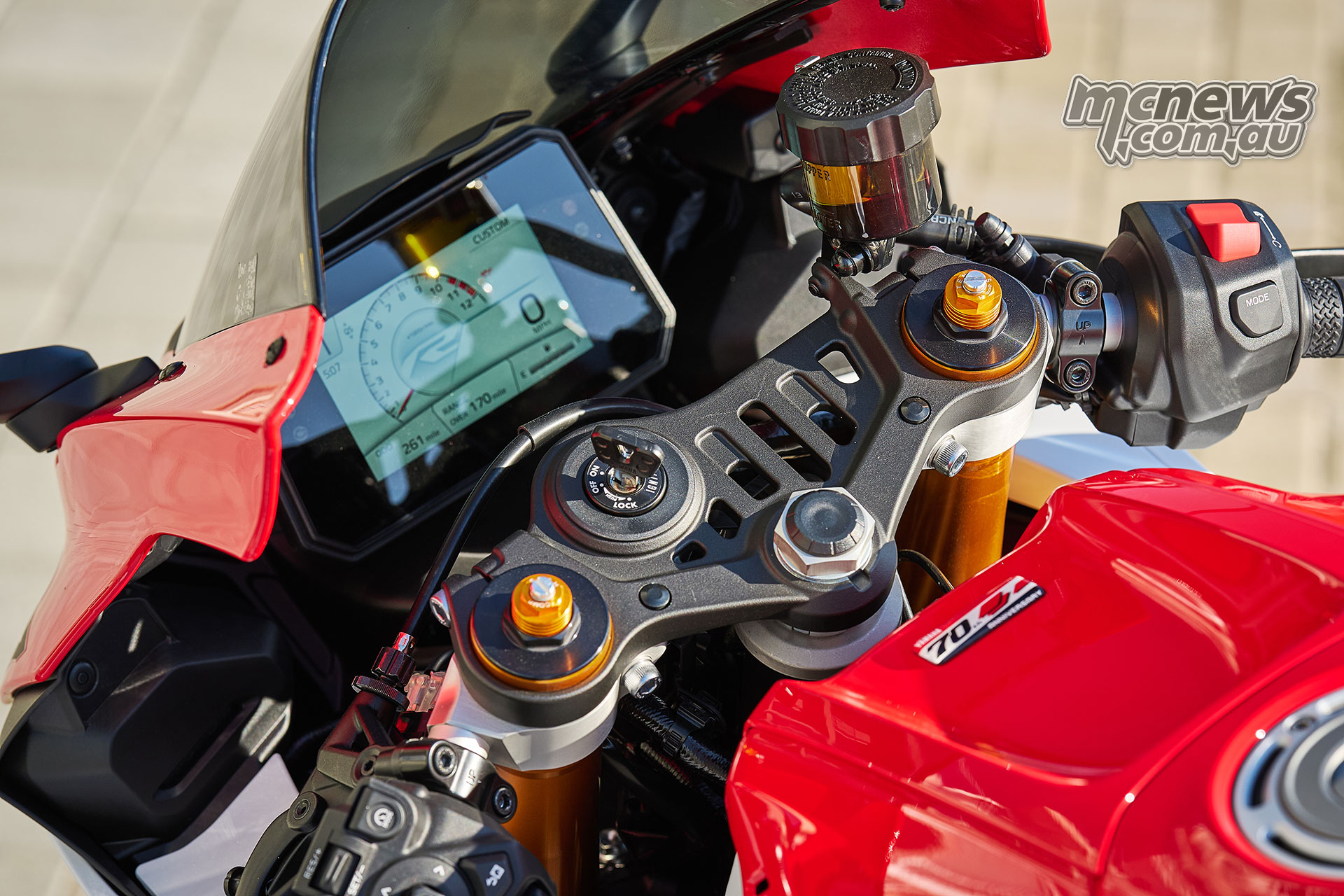
We actually took some weight off the front of one bike by dropping the forks as far as they’d go and making a slight tweak to the fork settings. There was a definite improvement in the way the bike changed direction and a reduction in the slightly heavy feeling in the front end.
Noticeable enough to confirm that minor tweaks would result in a bike that was dialled into the way you wanted it to feel. Both on the track and back in the real world, for most riders, on the road.
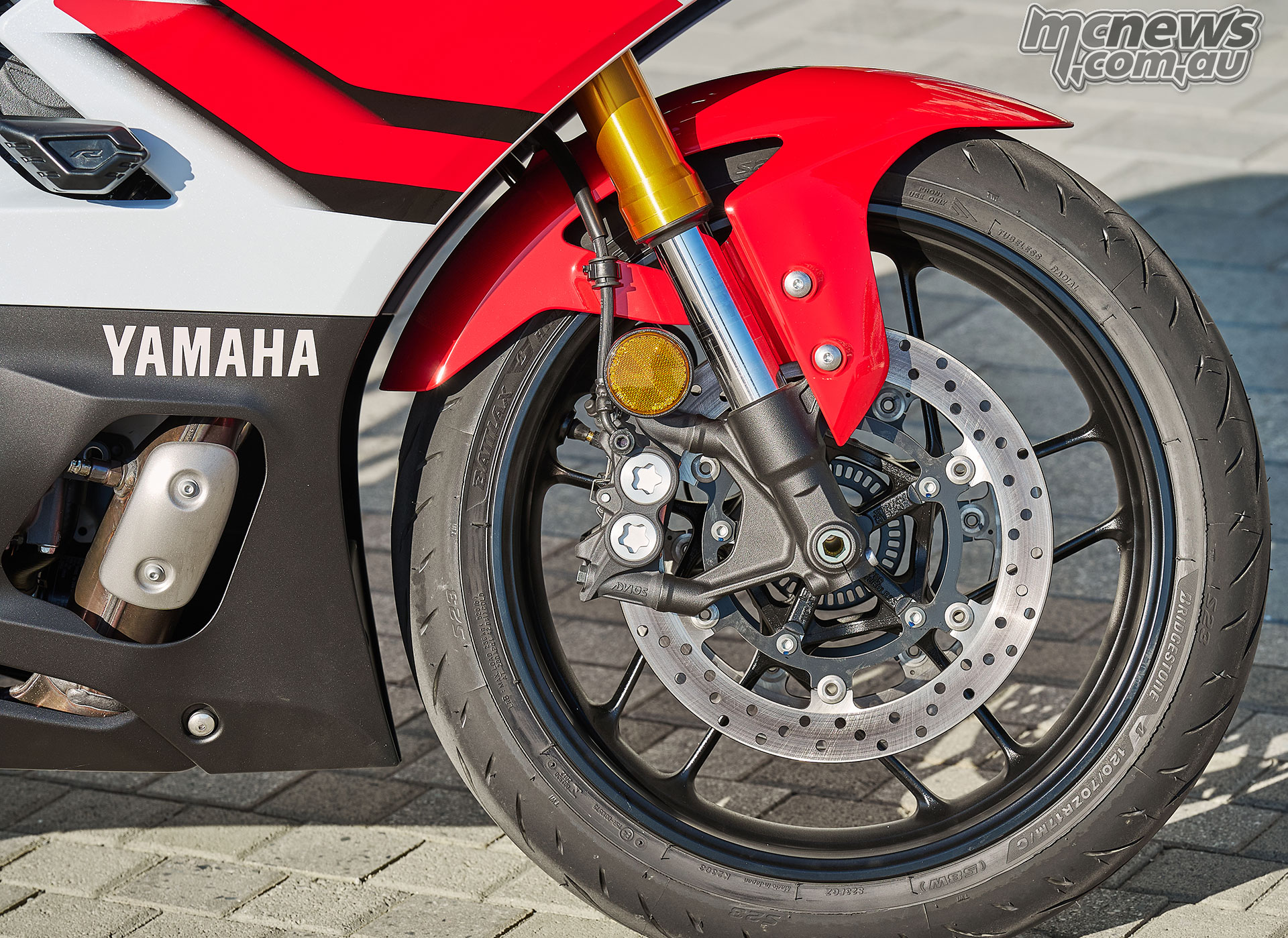
There’s no doubt that if you were a heavier or faster rider than most and wanted to track the bike a lot, you’d benefit from spending some time dialling in the set-up, and you might want to go for stiffer springs, but as an all-round proposition, this is a pretty great starting point.
Easier and more accessible than ever
Good thing then, that the new R7 has an ever-so-slightly more relaxed riding position. With the seat height dropped 5 mm to 830 mm and the bar position also moved slightly higher and closer, there is a shorter reach and less weight on the wrists.
It’s not massively different, but it is noticeable. Especially at the end of the day.

I was still subconsciously leaning the left elbow on the tank every now and again on the road loop, but for a sportsbike, it would certainly be manageable.
Initial impressions on the road were that the bike felt supremely stable and planted. Bordering on a little heavier than I had expected in the steering. I actually went looking for a steering damper to back off…
On the road, that translates to a bike that soaks up bumps nicely, doesn’t shake its head anywhere and is utterly confidence-inspiring over all sorts of everyday road surfaces.

Great feeling and feedback from both ends, with credit going to the updated chassis and swingarm design, as well as the new fully adjustable KYB forks and shock.
It’s also worth mentioning the new SpinForged wheels here, particularly given that they are apparently half a kilo lighter at each wheel. 500 grams might not sound like much to the average person, but any reduction in unsprung weight has a dramatic effect on handling and helps suspension do what it’s designed to do.

For newer riders, unsprung weight refers to the weight of everything that’s not supported by your fork and shock springs. Wheels, tyres, brakes, axles, lower fork legs. The lighter those components are, the quicker they can react to inputs. TLDR? Lighter unsprung mass FTW.
Tech upgrades galore
Speaking of real-world use, other changes that come with the new R7 include a five-inch TFT dash and an upgraded dash layout. The dash unit now includes full smartphone connectivity, including Garmin navigation integration, and three standard rider modes.
But it’s arguably some of the other new tech that interested me more for what it unlocked. The introduction of a ride-by-wire throttle heralds a new R1-esque suite of rider modes and aids.

The two most welcome additions for a lot of riders will be the addition of Yamaha’s third-generation quickshifter for clutchless shifting, as well as the introduction of cruise control for the first time on the R7. Cruise control also comes with a speed-limiter function that lets you set a maximum speed the electronics will automatically limit the bike to.
Personally, I’m not sure I’m sold on speed-limiting systems, since they can’t be overridden as quickly and easily as cruise control. While a quick burst of throttle will override cruise control, it will not affect the speed limiter. In the case of suddenly needing more speed as an escape path to avoid a collision, you don’t get time to think about turning your speed limiter off. So that one wouldn’t get much use from me.

Mode-wise, Street and Sport come as expected, as do two customisable modes and four track modes that you can adjust to suit your specific preferences across a wide variety of aids, including traction control, slide control, lift control, engine braking levels and launch control.
The HO bike also comes with a reduced-power Rain mode, which the LAMS bike goes without.
Track mode has a unique display focussed on gears and revs, while also enabling lap timing and data analysis. The kicker for me in this little bundle of joy was the ability to use a virtual pitboard, where messaging from your pits can be displayed on the dash via integration with the Y-TRAC Rev app.

Helpful examples could be things like, ‘Rain coming in two laps — pit now’, or ‘Rider behind has binned it — relax’. Or even reminders on techniques that are being worked on, such as ‘Eyes up through turn four’. Impressive stuff.
Hey good lookin’
We’ve kind of left the most obvious bit until last this time — the styling updates. I think it’s really come of age this time around and looks authentically like an R-series Yamaha. Not a learner bike that wants to tag along with its cool uncle.
The frontal treatment is far better executed than the outgoing model, with a much cleaner headlight layout. It also comes with mirror-integrated indicators and some winglets thrown in for good measure.

It comes in four colours too. Team Yamaha Blue and Raven black are solid, safe choices. The Breaker Cyan/Raven light blue with yellow wheels is certainly a bolder choice and seems more popular with younger riders, based on the feedback I saw firsthand.
But I kept coming back to the 70th Anniversary Edition red, white and black. Ohh, mama, that’s a good colour scheme. Nitro Nori, eat your heart out.
Yamaha calls it unmistakable R-Series DNA, and I’m not going to disagree. For this is at once the sportiest, most capable learner-friendly R-bike in LAMS form, and the most accessible of the serious sports bikes that Yamaha make.

In some ways, it fits at both ends of the sportsbike journey. The entry-level, first step in your sportsbike journey is obvious. But I also think there’s a play here for experienced riders who’ve done the superbike thing and just want something easier now that’s cheaper and easier to ride, while still sporty and fun.
Rubbing elbows with your mates on these things at a track day or two would be mega fun, regardless of where you’re at in your sportsbike journey.
Where some people might be disappointed
I’ve talked a lot about what the bike is, but I also feel I need to talk about what it isn’t.
To be clear, the R7 is a sportsbike, not a full-fat SuperSport bike. If you want a more focused middleweight with more power, you’re better off looking at the legitimate Supersport R6 or the more powerful, but slightly heavier, R9.
With 72 hp for the HO version, it is definitely down a little on most of its competitors on paper, but that’s not the full story. When I look at the Triumph Daytona 660, Suzuki GSX-8R, Honda CBR650R and Kawasaki Ninja 650, it makes for an interesting comparison.
To keep things a little more mobile-friendly, here’s the competitive set in snapshot form.
| Bike | Key figures and tech |
|---|---|
| Yamaha YZF-R7 HO MY26 | 689 cc CP2 parallel-twin, 270-degree crank Around 72-73 hp / 54 kW at 8750-9000 rpm Around 67-68 Nm at 6500 rpm 189 kg wet Six-axis IMU, YRC modes, traction control, slide control, wheelie control, brake control, engine brake management, launch control, five-inch TFT, cruise control, speed limiter and third-generation quickshifter $16,549 for HO or LAMS, plus $500 for 70th Anniversary livery |
| Triumph Daytona 660 | 660 cc inline-triple 95 PS / 70 kW at 11,250 rpm 69 Nm at 8250 rpm Around 201 kg wet Ride-by-wire, three ride modes, traction control, TFT dash and optional quickshifter $14,790 ride-away, full power or LAMS |
| Suzuki GSX-8R | 776 cc parallel-twin, 270-degree crank 82 hp / 61 kW at 8500 rpm 78 Nm at 6800 rpm Around 205-207 kg wet Ride-by-wire, three ride modes, traction control, bi-directional quickshifter and TFT dash Around $14,990 ride-away |
| Honda CBR650R | 649 cc inline-four 94 hp / around 70 kW at 12,000 rpm Around 63 Nm at 9500 rpm Around 208-210 kg wet Traction control, basic modes/engine-brake options on later updates, LCD/TFT depending on year, no IMU Typically mid-$15K ride-away |
| Kawasaki Ninja 650 | 649 cc parallel-twin 68 hp / around 50.2 kW at 8000 rpm Around 64 Nm at 6700 rpm Around 193-196 kg wet Traction control on latest models, TFT dash, no IMU or advanced multi-mode rider aids Commonly low- to mid-$13K ride-away |
The R7 is only besting the Ninja in power but is very much in the mix for torque, which matters more on the road, unlike the GSX-8R with its capacity advantage.
It’s also the lightest of this group by some margin. Twenty-odd kilos lighter than the GSX-8R and the CBR650R, which is a lot. And it has the most tech by far, including being the only one here with cruise control.

There is no denying that they could extract a little more power from the engine if they really wanted to make it an easy decision for punters. I deliberately didn’t include the Aprilia RS 660 in the table above because it costs about half as much again as the R7 in Australia, but it’s worth noting that the little Aprilia twin makes 100 hp. So there is clearly room in the broader twin-cylinder class for more output if Yamaha ever chose to chase it.
If you really were chasing ‘just a bit more’, it might be worth considering the Akrapovic full system exhaust. It will get you another 6 hp and 3 Nm, while simultaneously shedding 3 kg. It sounds suitably phat too; there was one fitted to a bike on the launch. Expect to pay around two grand for one of those bad boys.

Nearly faultless
It struck me that the R7 felt finished. Refined. High quality. Very hard to find fault with. And certainly the feature list is longer than ever and up there with anything else in the market.
It will be utterly reliable too. That CP2 parallel-twin is a tried-and-tested engine that has proven ultra-reliable across various models in Yamaha’s line-up, including MT-07, R7, Tenere, XSR700, and Tracer 7 in Europe. It’s not particularly highly strung, so it will stand up to pretty much any abuse you’re likely to throw at it.

Add in the fact that Yamaha has one of the largest dealer networks in the country for support, accessories and spare parts, and you have a very compelling product.
Speaking of accessories, and there are plenty available, if it were mine, I’d be ordering a tasty-sounding genuine Akrapovic slip-on to let out some more CP2 aural goodness.

In fact, the only thing I can think of that might make some potential buyers hesitate is the price compared to some of its cheaper competitors. It is definitely towards the upper end of the options in that segment. $16,549 for either the LAMS or HO model, and another $500 for the special 70th Anniversary livery.
But, really, that’s just what good quality and reliability cost these days. Hell, I think I paid only a couple of thousand dollars less than that for my CBR600 back in 2001. That’s 25 years ago! And it didn’t have any electronics or quickshifter or ABS or the ability to tell your mate that you fancied his mum via an on-dash message…
Yamaha R7 hits
- Fantastic evolution of the best-selling platform
- Terrific, characterful parallel-twin engine
- New tech additions, including the quickshifter and cruise control
- Noticeably lighter than most direct competitors
- Styling updates now make it feel like a real R-series Yamaha more than ever
Yamaha R7 misses
- Not the cheapest amongst its direct competitors, but you get a lot for that money
- Could have more power, so consider the Akrapovic full system if you want a little more
- If you’re looking for a genuine Supersport option with more power, look at the R6 or R9
2026 Yamaha YZF-R7 Specifications
|
Yamaha YZF-R7 Specifications (LA)
|
|
|
Engine Type
|
Liquid-cooled, 4-stroke, DOHC inline twin-cylinder, 4-valve
|
|
Displacement
|
689.0 cc (655 cc)
|
|
Bore x Stroke
|
80.0 x 68.6 mm (78.0 x 68.6 mm)
|
|
Power (claimed)
|
54 kW (73 hp) @ 8750 rpm (38.3 kW – 51 hp- @ 8000 rpm)
|
|
Torque (claimed)
|
58 Nm @ 6500 rpm (57.5Nm @ 4000 rpm)
|
|
Compression Ratio
|
11.5 : 1
|
|
Lubrication System
|
Wet sump
|
|
Fuel Management
|
Fuel Injection
|
|
Ignition
|
TCI
|
|
Starter System
|
Electric
|
|
Fuel Tank Capacity
|
14.0 L
|
|
Final Transmission
|
Chain
|
|
Transmission
|
Constant mesh six-speed
|
|
Frame Type
|
High-tensile steel tubular frame
|
|
Suspension Front
|
KYB 41 mm USD fork, fully adjustable, 120 mm travel
|
|
Suspension Rear
|
Swingarm (link suspension), rebound, preload adjustable, 121 mm travel
|
|
Brakes Front
|
Hydraulic dual discs, 298 mm, four-piston calipers – ABS
|
|
Brakes Rear
|
Hydraulic single disc, 245 mm, single-piston caliper – ABS
|
|
Tyres Front
|
120/70ZR17M/C (58W) Tubeless, Bridgestone Battlax S23
|
|
Tyres Rear
|
180/55ZR17M/C (73W) Tubeless, Bridgestone Battlax S23
|
|
Length
|
2070 mm
|
|
Width
|
725 mm
|
|
Height
|
1160 mm
|
|
Seat Height
|
830 mm
|
|
Wheelbase
|
1395 mm
|
|
Ground Clearance
|
135 mm
|
|
Wet Weight (Fuelled)
|
189 kg
|
|
Available
|
July 2026
|
|
Pricing
|
$16,549 for standard colours, $17,049 for SP model
|