
MCNEWS.COM.AU - The ultimate in motorcycle news Could this be a BMW that actually deserves the tag 'Bloody Marvellous Weapon'
April 15
th, 2005 - By, Trevor Hedge

MCNEWS.COM.AU - The ultimate in motorcycle news

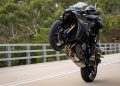
BMW have come out swinging with a new lightweight R 1200 GS HP2 (High Performance 2-cylinder) which weighs in at a claimed, wait for it, 196.5kg wet complete with a full 13 litre tank of fuel. Claimed dry weight is 175kg, holy smoke batman, whoever would have imagined a large capacity shaft driven BMW Boxer weighing in that light.

The R1200 GS has already won International Bike of the Year and is a highly acclaimed machine but with such a massive weight loss combined with conventional style upside-down forks and acres more ground clearance the HP version is surely to be quite a dirt weapon out on the trails.

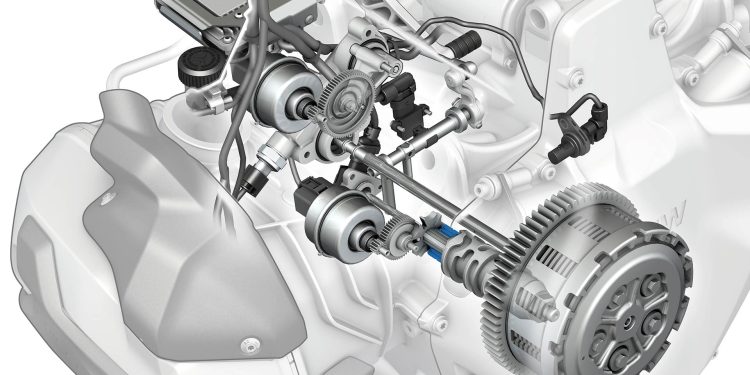
While BMW have gone the mainstream route with upside-down forks at the front in the place of BMW's traditional Telelever front end it has taken another interesting departure from the norm' with a new air/spring damper system at the rear of the machine which BMW claim is a world first application.  In conjunction with German specialist Continental Automotive Systems the new air/spring damper weighs in at only 2.3kg and runs exclusively on air.  It is similar to conventional oil filled dampers as it also features a piston moving in a chamber but the piston in this application does not pressurise hydraulic fluid but on air forced through plate valves into a second chamber. The air contained within the chamber provides the spring effect which has allowed BMW to do away with a conventional steel spring.  Interesting... BMW claim the system had advantages such as the spring rate increases naturally as the load pressure increases and resistance to heat fade combined with simple seat height adjustment and selective damping adjustments.

BMW state the following; "In its structure, the air spring strut comes with three sequential air chambers, connected to one another by ducts. An aluminium cylinder forms the two upper chambers, separated from one another by a piston. Longitudinal movement of the separating piston compresses air within the cylinder, the air thus acting as a kind of spring. At the same time a defined volume of air flows into the other chamber via plate valves - or slot throttles - and, through their throttling effect, dampens sudden wheel travel.

The lower air chamber is formed by a gas-tight rolling gaiter made of rubber tissue, giving the damper freedom of movement and seals the spring strut to the outside, avoiding the need for a piston rod seal, which would merely increase friction within the system. The resistance built up by the rubber gaiter when rolling over a specially shaped cone supplements the progressive effect of the system.

Outside, the spring strut is fully sealed and air-tight. Any leakage which might occur can be compensated by topping up the air through a valve. External variation of internal pressure also permits simple adjustment of seat height by adding or discharging air as required, although spring travel is reduced with the seat set to a lower position, making this setting more appropriate for moderate riding conditions.

Adjusting the system to different load conditions is a very simple operation requiring only a small change in air pressure. A small inspection balance on the rear frame allows the rider to read the normal setting of the motorcycle.

To adjust the system while travelling, the R 1200 GS HP2 comes fitted with a high-pressure pump complete with a pressure gauge – which is also suitable for pumping up the tyres after having reduced tyre pressures when riding in rough terrain.

A unique feature of the air/spring damper system is the option to vary the damping effect as a function of frequency, achieved by adapting the inner flow system with the slot throttles to suit rider preferences.

A major benefit of this unique system is a significant improvement in rear-wheel traction on undulating surfaces. The range of damping effect is factory-configured in the frequency bands of the swinging arm system operating on bumpy surfaces, enabling the wheel to follow uneven surfaces and maintain optimum ground contact.

This means even better traction when accelerating flat-out, as well as extra safety in applying the brakes, for even greater riding pleasure.

Whenever the suspension system threatens to bottom out completely, as is often the case on long and protracted sections of corrugations, on surface “waves” and under high loads, the natural adjustment of the air spring rates, together with frequency-specific damping, mitigates against excessive compression to prevent the motorcycle from using up all available suspension travel.

The basic set-up of the dampers may also be adjusted by a hand wheel opening up a bypass in the damper. This allows adjustment in two stages between a more comfort-oriented roadgoing set-up and a firmer setting for rough terrain.

A minor but nevertheless important point is that static compression of the springs on the R 1200 GS HP2 while at a standstill creates a deceptive impression of the damping effect, since the movements generated at rest are not the same when riding in terms of their speed and frequency.

A further, significant advantage of the system also lies in the complete resistance of the spring strut to dirt and contamination from outside, thanks to the fully enclosed surface. This rules out even the slightest wear on the seals and guide units even in the finest desert sand."

Up front 45mm Upside-down forks grace the front of the machine and provide 270mm of travel which could not have been achieved with the regular Telelever arrangement. The forks are fully adjustable for both rebound and compression damping.

The HP model gains only a little in the power department with BMW claiming five more ponies than the standard models 100hp through some ECU changes. The engine also does away with the balance shaft which reflects the more dirt based design of the HP model. The airbox inlet snorkels are also made more resistant to water. The muffler is 2kg lighter thanks to the deletion of the sleeve pipe and shorter dimensions as the HP2 is not designed for pannier or luggage systems as with panniers fitted a longer muffler would be required to prevent overheating the panniers.  The six speed gearbox boasts reinforcing on the bearings while the ratios and final drive remains unchanged in gearing but a new rubber damper caters for the different arc of the 30mm longer Paralever rear suspension.

ABS is done away with on the HP2 model.

The frame of the HP2 borrows its design cues from the successful R 900 R racing machines used by BMW in the Dakar Rally and other major world rally events. Other specialist dirt biased components include cross-spoke wheels with tubeless 90/90-21 and 140/80-17 Metzeler tyres. Any tubed tyres may also be used and there is a second valve bore hole which can be utilised for the fitment of rim locks.

BMW are saying that these will be hand built machines in low production volumes and hinting that the price will be well over and above the $21,500 sticker price of the regular R1200 GS.

Specifications - The R 1200 GS HP2 and standard R 1200 GS compared

   
R 1200 GS HP 2
R 1200 GS
Power unit  
 
 
Capacity cc
1,170
1,170
Bore/stroke mm
101/73
101/73
Max output kW/bhp
77/105
74/100
at rpm
7,000
7,000
Max torque Nm/lb-ft
115/85
115/85
At rpm
5,500
5,550
Engine configuration  
Boxer (flat-twin)
Boxer Flat twin
No of cylinders  
2
2
Compression ratio/fuel grade  
11.0/premium plus
11.0 premium plus
Valves/gas management  
HC (high camshaft)
HC
Valves per cylinder  
4
4
Intake/outlet dia mm
36/31
36/31
Throttle butterfly diameter mm
47
47
Fuel management  
BMS-K
BMS-K
 
Electrical System  
 
 
Alternator W
600
600
Battery V/Ah
12/12 maintenance-free
12/14 maintenance-free
Headlight W
H4
H7
Starter kW
1.1
1.1
 
Power Transmission/Gearbox  
 
 
Clutch  
Single-plate dry clutch, dia 180 mm/7.1´´
Gearbox  
Dog-type six-speed gearbox
Primary transmission ratio  
1.823
1.823
Gear ratios I
2.277
2.277
  II
1.583
1.583
  III
1.259
1.259
  IV
1.033
1.033
  V
0.903
0.903
  VI
0.805
0.805
Rear-wheel drive  
Driveshaft
Driveshaft
Final drive ratio  
2.82
2.82
 
Running Gear and Suspension  
 
 
Type of frame  
Steel tubular spaceframe, non-load-bearing engine
Tubular spaceframe, engine load-bearing
Wheel guidance, front  
UPSD fork, dia 45mm
BMW Telelever
Wheel guidance, rear  
BMW Paralever
BMW Paralever
Spring travel, front/rear mm
270/250
190/200
Camber mm
Normal set-up 127
 
Wheelbase mm
Normal set-up 1,610
1,519
Handlebar head angle °
Normal set-up 60.5
62.9
Brakes front
Single-disc brake, dia 305 mm
305
  rear
Single-disc brake, dia 265 mm
265
   
No ABS
BMW Integral ABS Partial integral optional
Wheels  
Cross-spoke wheels
Cross spoke wheels/cast alloy
  front
1.85 x 21
2.5 x 19
  rear
2.5 x 17
4.0 x 17
Tyres front
90/90-21 M/C 54Q M+S TL, MCE Karoo 2 (T)
110/80 H 19 TL
  rear
140/80-17 M/C 69Q M+S TL, MCE Karoo (T)
150/70 H 17 TL
 
Dimensions and Weight  
 
 
Length, overall mm
2,350
2,210
Width, overall, with mirrors mm
880
915
Handlebar width, w/o mirrors mm
828
851
Seat height mm
920
840/860
Weight, unladen, with full tank kg
196.5
225
Max permissible kg
380
425
Tank capacity ltr
13
20
 
Performance Data  
 
 
Fuel consumption  
 
 
90 km/h ltr/100 km
4.1
4.3
120 km/h ltr/100 km
5.5
5.5
Acceleration  
 
 
0–100 km/h sec
3.2
3.4
Standing start km sec
22.3
24.7
Top speed km/h
200
208

[../../../../navigation_footer.htm]