
MCNEWS.COM.AU - The ultimate in motorcycle news I must be getting old....
Celebrating twenty years of the CBR1000 with a walk down memory lane
September 21st, 2006  -  By Eirik S
MCNEWS.COM.AU - The ultimate in motorcycle news

I must be getting old...
Honda CBR1000F

The CBR1000 moniker will celebrate its 20th anniversary shortly.

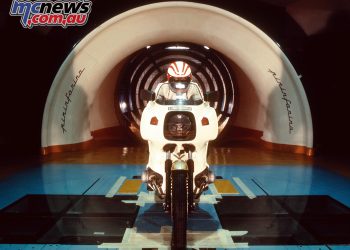
To me, it feels like only yesterday that the Hurricane, as it was named in good ol’ US of A, was presented to the world as the most slippery object know to man next to a drop of water. Huge was the letdown when it proved less slippery than the already old hat Ninja 1000 from Kawasaki, a.k.a. GPz1000RX - something that was repeated some years later when the highly praised Blackbird once more proved less aerodynamic than the Kawasaki it was made to beat. But that’s a different story.

However, the CBR1000 with the ‘F’ suffix proved to be a much better motorcycle than the older Ninja design. It was slick, fast, well engineered and probably the best overall performing motorcycle of its day. Yet it was based upon surprisingly conventional technology, even by mid-80s standards.

The short-stroke engine made smooth power from idle all the way to its 10,500 rpm redline, hitting its 113 rear wheel horsepower peak at ten grand. 89 Nm were available at 8,000 rpm, but more than eighty was present between 5,700 and 10,000 rpm. Up until that point, that was the strongest engine the now defunct Cycle magazine had strapped to a dyno, only beaten by the mighty Vmax. And it beat all comers in the power-to-weight competition as well as posting the highest top speed for a stock motorcycle; 161 mph or 259 kph, beating the Ninja tested alongside it by 5 kph.

Then again, the Kawasaki was hitting its rev limiter at that speed (earlier test units hit an even 160 mph, probably the result of a slightly different rev limiter setting) and were down to 101 rwhp already (from its 105 rwhp peak), whereas the Honda needed every single of its 113 ponies to reach its top speed. In fact, if the rider didn’t time the 5-6 gearshift to perfection, the Honda topped out at an identical 254 kph, refusing to gain the extra revs needed to beat the slippery Ninja. Cycle World magazine received a CBR that was even slower, maxing out at 251 kph, five kph down on their test Ninja. (And to show how much power is required to gain a little speed at those numbers, the restricted CBR tested by MOTORRAD made 88 rwhp and went 237 kph!)

The great power-to-weight ratio didn’t materialise as record setting pace at the drag strip; the ‘Cycle’ Honda pulled off a 10.87 second E.T. @ 199 kph, pretty standard numbers for its class at the time. Cycle World’s test steed was significantly lamer off the line, taking 11.23 seconds to cover the standing quarter-mile with a similar terminal speed.

To tame the power, a steel perimeter style frame was made up to carry the engine as a structural member. In order to keep engine vibrations to a tolerable level, Honda fitted the power producing unit with a balancer shaft. Did it work? Well, partly. Below 5000 rpm, the engine was pronounced to be glassy smooth, but at elevated revs it turned into a serious trembler, numbing rider extremities and tiring him. The explanation given for this partial success was that the balancer ideally should rest directly behind the crank (where the gearbox lives) instead of at the bow where Honda found room for it.

Otherwise, the CBR was described as a dream with supple suspension and a roomy riding position that fit riders of all sizes. Even passengers praised the bike for its excellent accommodations. Heat from the engine bay (which Honda could afford to leave rather industrial looking since it was all covered up) was cleverly led away from the rider, further enhancing comfort. Scoops even led cool air over the shock absorber to help keep damping more consistent.

More clever ideas showed up in the form of perforations in the bodywork to allow easy access to the rear shock preload and idle adjuster. The tank could be propped forward to gain access to the valve cover, and an unlucky owner could even perform gearbox overhauls with the engine still in the frame. Unfortunately, cam chain tensioner woes were far more common than gearbox troubles - and to replace that you had to split the engine open due to its placement inboard of the cam chain.

The full-enclosure bodywork did more than just look good while covering up the unfinished-appearing engine; it also worked admirably, keeping hands and torso mostly free from the oncoming blast. The legs were less well protected, however, and the helmet sat totally unprotected. Mirrors performed well, showing more road than armpit. Built-in hooks in the tank allowed for easy tank-bag fitment while hooks under the pillion made it straightforward to secure luggage.

Stability was considered impeccable even flat out and handling pleasantly light for such a heavy machine (262 kg with fuel). The brakes allowed the bike to stop quickly and under control, although they were slightly overtaxed on a race track. TRAC anti-dive system lacked the adjustments available on earlier versions and didn’t prove overly effective.

While the Germans praised the suspension and preferred it run at its softer settings for comfort and control, the American journalists ran it with quite a bit of preload at the back (while complaining about a lack of rebound damping) while keeping the front as soft as possible in order to get more weight over the front end. The different riding environment may explain that; Germans liked to fly along das Autobahn at over 200 kph, whereas the Americans went searching for back roads.

That was perhaps also the reason why the latter complained bitterly about lack of grip from the rear tyre, claiming it was sliding and spinning everywhere. The CBR was running on bias-ply tyres despite radials already starting to become popular, and at 140 mm the rear rubber was a little narrower than what could be found on several other superbikes from the period.

Overall, the CBR wasn’t meant to go head to head against the likes of Gixxers and Fizzers other than on the sales floor. In fact, its nearest competitor was the VFR750F Interceptor, both bikes showing off as a well-rounded package that offered real-world handling, power and comfort.

To test its stamina, MOTORRAD tortured the bike for 40,000 km and found that it needed replacement of all 16 valves with seals, one valve lifter and 5 clutch springs to make it ready for a new round. Not a single defect appeared during the test period, and only progressively increasing oil consumption indicated all was not well. At the end of the test, compression had dropped from around 11 to 8 bar on average except for one cylinder that was down to only 4 bar. The reason for the drop could be found in badly leaking valves, caused by all that oil passing through the top end and clinging to the hot valve heads.

The chassis held up well with even the suspension showing no signs of getting tired, although its soft setup meant a significant loss of cornering clearance when riding two-up. Tyres lasted around 17,000 km up front and around 10,000 km rear. The only problem experienced was loud noises as the engine warmed up, believed to stem from the cam chain tensioner and/or camshafts. Honda Germany believed they knew the reason and fitted modified camshafts and tensioner (from the latest model) to the bike after 12,000 km - to no avail. The sound returned after only a couple of days and remained constant throughout the test. No wear was found on the replaced or replacement parts. One owner reported being on his 4th tensioner at 22,000 km, but apparently the noise gives little cause for concern regarding reliability if the magazine’s discoveries are universal.

Despite being ridden through a full winter littered with salted roads, the bike polished up to a bright shine and looked almost as fresh as it had at the beginning of the test. One owner reported of cracked plastic parts, but not a single crack could be found on the long term bike. Overall, it seems to have been a very reliable bike that with careful use should be able to still please riders even today.

In detuned form, the engine was later fitted to the CB1000 Big One while an enlarged version was fitted to the X4. The design continues today in the CB1300 frame where it makes less power but substantially more torque than at its inception.

Finally, some may also wonder how the old CBR compares with the current CBR now that the F suffix has been replaced by a double R. To still their curiosity, here are some key numbers:


Measurement

CBR1000F

CBR1000RR

Measured rear wheel hp

  • 113hp @ 10,000rpm
  • 146hp @ 11,000rpm

Measured rear wheel torque

  • 89 Nm @ 8,000rpm
  • 103 Nm @ 8,500rpm

Measured top speed

  • 259kph
  • 287kph

0-60mph (0-97kph)

  • 2.75s
  • 2.70s

Quarter Mile

  • 10.87 @ 199kph
  • 10.14 @ 227kph

Roll on 65-130kph

  • 8.3 seconds
  • 6.3 seconds

RPM @ 60mph (97kph)

  • 3,750rpm
  • 4110rpm

Braking distance from 97kph

  • 36 metres
  • 38.7 metres

Wet weight

  • 262kg
  • 211kg

Wheelbase

  • 1,505mm
  • 1,412mm

Rake / Trail

  • 62 / 117mm
  • 66.25 / 102mm

Wheels

  • 2.5 x 17 / 3.5 x 17
  • 3.50 x 17 / 6.00 x 17

Bore x Stroke

  • 77 x 53.6mm (998cc)
  • 75 x 56.6mm (998cc)

Gearbox

  • Six speed
  • Six speed

Maximum speeds in gears

  • 102/136/171/208/243/270
  • 131/172/211/242/265/288

Front suspension

  • 41mm air assisted forks
  • 43mm inverted forks, fully adjustable

Rear suspension

  • Single shock, preload and rebound adjustable
  • Single shock, fully adjustable

Service intervals small / large

  • 6,000km / 12,000km
  • 6,000km / 12,000km

Fuel consumption

  • 7 litres per 100km
  • 6.5 litres per 100km

NB: Figures are taken from Cycle, Cycle World and MOTORRAD

!!Check out our New Podcasts!!
MCNEWS.COM.AU - The ultimate in motorcycle news
 

Late Braking News  -  ForumBike Tests  -  Features  -  Wallpaper  -  Podcasts - Classifieds
MotoGP - World SBK - Aus SBK - Aus MX - Aus SX - Aus SMBritish SBK - AMA SBK - Enduro

MCNEWS.COM.AU

MCNEWS.COM.AU - The ultimate in motorcycle news